Old Habits

Gary Sick gives his version of recent events in Iran. After the original uranium agreement fell through, he faults the US and its allies:

[T]he United States and its partners could have responded with a counter-offer that would, for example, sequester the Iranian LEU under strict safeguards until the replacement fuel cells were available, thus accomplishing most, if not all, of their original objectives. Instead, they ended all negotiations and introduced a sharply critical resolution by the International Atomic Energy Agency board.

Iran predictably responded by declaring it would reduce its cooperation with the IAEA and, in a fit of blustery indignation, announcing a new plan to build 10 additional enrichment sites – a hollow threat since Iran lacked both the centrifuges and the necessary raw uranium fuel to carry it out.

Iran withdrew into its cocoon of haughty and pained victimization. The United States and its allies made a similar retreat to a posture of righteous indignation, the better to fashion “crippling” sanctions designed to force Iran to change its policies.

He also argues against sanctions because he seems them as ineffective.
“Ain’t No Shame in Bein a Ho”

Christina Davidson profiles a prostitute in Philly:

"I cause pleasure. I provide a service that brings people pleasure. I won't service married men or women, men of the cloth. See even hos got rules of morality," she laughs. "But seriously, I can understand why people who been brought up one way think it's immoral. I don't understand why it's illegal. With our government needing money, I wish I could pay taxes."

On Funding Wars, Ctd

A reader writes:

Just wanted to weigh in on your fascinating discussion of the Greatest Generation.  What has crossed me over and over again about that generation — in talking to relatives, in talking to seniors, or even in watching documentaries (I just watched Burns' outstanding "The War") is the recurrence of this phrase: "We did what we had to do."

I can't imagine a more perfect statement of the concept of duty and fortitude.  No one was eager to go to war or raise taxes or ration.  But it was something that had to be done.  It was as simple as that.  There was a near-universal recognition that we didn't want a war, but we would do what we had to do.  Yes, there was a draft.  But that was mainly for organizational purposes.  There was no shortage of volunteers.  They knew what was needed and, when called, they went, they fought, they came home when their tour was finished.

I see that today when I talk to soldiers.  They are not some crazy left- or right-wing caricature of a warrior.  This is their job, this is their duty, this is their mission.  They will do what has to be done.  The humility of it is is astonishing.

To hear self-aggrandizing politicians, riding around in limos and charter jets, invoke that humble, almost casual commitment to duty is infuriating.  I hear few voices saying that Americans need to do what must be done — pay higher taxes, cut popular programs, make sacrifices, etc.  And on the rare occasion when even a modicum of sacrifice is called for, it's wrapped up in the most purulent self-satisfied prose imaginable.

I will know we have returned from the partisan abyss when I hear a politician say, "This is what we need to do.  It's not going to be fun and it's going to cost a lot of money.  But it must be done."  Obama occasionally veers close to that, which is why I have yet to turn my back on him.

Another writes:

In addition to the MPR story, more man on the street interviews from a project Alan Lomax initiated after Pearl Harbor, courtesy of the Library of Congress's "After the Day of Infamy" collection, can be found here.

The Daily Wrap

Today on the Dish, Andrew delivered a lengthy take on the president's Nobel speech (and responded to a reader response). Peter Wehner praised the speech, as did Reihan. Peter Beinart and Andrew Sprung also gave upbeat assessments. Greenwald simmered over the left-right consensus, which received a reply from Andrew and a reader.

In Uganda coverage, Chuck Grassley ducked his involvement, Rick Warren's persuader spoke out, David Link considered whether the pastor is a bigot, Chris Orr bemoaned his religious rhetoric, and a reader passed along more disturbing details from the African nation. We capped off a week of Iran coverage with some epic poetry, a heartening map, and a Muppets remix.

— C.B.

A Quiet Protest

94245615

AFP:

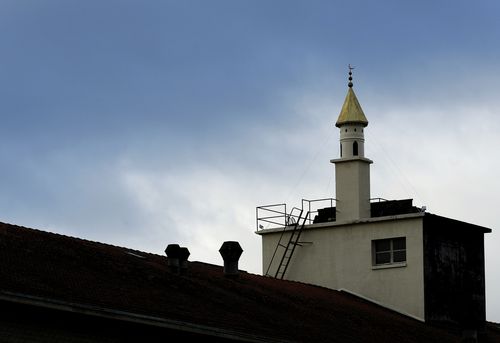
A Swiss businessman appalled by his fellow countrymen's decision to ban minarets has extended a chimney above his company building into a minaret in protest. "It was scandalous that the Swiss voted for the ban. Now we have the support of all the far-right parties across Europe. This is shameful," Guillaume Morand, who owns a chain of shoe stores, told AFP. The businessman, who is not a Muslim, explained that the he had constructed the mock minaret at his building near western Switzerland's city of Lausanne in protest, and at the same time, to "send a message of peace."

(Photo: Fabrice Coffrini/AFP/Getty Images)

The Left Goes To War

Reihan praises Obama's speech:

Had the president dedicated the peace prize to the men and women of the American armed forces, I would have been forced to completely change my assessment of the man and his virtues. What President Obama has done is persuade a not inconsiderable number of liberals who could never have been convinced by the same words coming from the mouth of President Bush or, say, a President Romney. Whether or not that reflects well on them is immaterial — the speech has strengthened the political coalition for the war in Afghanistan, thus giving the Obama administration more breathing room to make its plan work. That's a good thing.

Obama Is Not, And Never Was, Anti-War, Ctd

A reader writes:

It was always apparent that the President viewed Afghanistan as an important war. It is just as apparent that the President sold himself as a pragmatic intellectual. The fact that Karzai stole an election should have changed the calculus. It didn’t. That was one disappointment. The second was Obama’s framing of the War on Terror as one that can be waged through the use of traditional ground troops.

In his speech he stated “Negotiations cannot convince al Qaeda’s leaders to lay down their arms.” Well AQ doesn’t use arms, at least not in the traditional sense, so either he’s trying to make people think that the Taliban and AQ are the same – and we all know they’re not – or he’s giving up the idea that terrorism is best fought with police and intelligence agencies. If that’s where his head is at now then he has seriously lost his way and a lot more American troops will die for no real reason before someone with some sense puts a stop to it all.

Beck’s Gold Problem

No one exposes it better:

The Daily Show With Jon Stewart Mon – Thurs 11p / 10c
Beck – Not So Mellow Gold
www.thedailyshow.com
Daily Show
Full Episodes
Political Humor Health Care Crisis

Beck could be in trouble with Fox over the conflict of interest. Other gold profiteers include O’Reilly, Mark Levin, Michael Savage, Laura Ingraham, Dennis Miller, Fred Thompson, and G. Gordon Liddy. A reader of Ben Smith writes:

What's going to happen when the gold bubble bursts? Who are the masses going to blame? Beck? Obama?

Citing The Gospels

Christopher Orr is disturbed by Rick Warren making the case against the Ugandan bill on religious grounds. Douthat is puzzled:

[Is] it really so depressing that religious appeals are sometimes more effective arguments against discrimination than secular ones? (The civil rights movement might beg to differ.) Would it really have been a more potent statement against bigotry if Warren had told the pastors, “oppose this bill because it violates Kant’s categorical imperative,” or “oppose this bill because it runs contrary to John Stuart Mill’s harm principle”?