The Post-Racial Philanderer

by Chris Bodenner

John McWhorter processes the Tiger Woods scandal and the stereotypes it defied:

I can imagine a black stand-up routine where somebody said “These wives standing by their men admitting they fooled around – if Tiger’s wife was black you know she’d be all over his ass!!! (Ha ha ha …).” Well, it seems hardly unlikely that Tiger’s skinny blond lady came after him with a golf club. Call it a “black” experience – or evidence that people are people and Tiger has been leading nothing but a human life. Isn’t that what we wanted?

Supposedly if he had been sleeping with black women America wouldn’t care – this is a major thread in the blogs, such as here. But is this true? Let’s say the photos of the Tiger bimbos were of shapely brown-skinned babes – can we really say that the tabloids would suddenly lose interest and go home? Wouldn’t this be even better news – i.e. “Looks like Tiger got tired of his skinny white trophy wife and needed some chocolate?” […] The Civil Rights revolution was about allowing people to not only become President, but to fuck up “post-racially.” Let’s – as progressives in the true sense – go with it.

When A Penny Matters

by Patrick Appel

Ryan Sager offers some Christmas shopping tips. Among other inherent biases: 

A recent study in the Journal of Consumer Research found that when pens were priced at $1.99 and $4.00, only 18% of the participants chose the higher-priced pen; but when the pens were priced at $2.00 and $3.99, 44% of the participants selected the higher-priced pen. That one-cent price drop makes the $4 pen seem a lot cheaper.

For whatever reason, we can’t take our eye off that leftmost digit. But we can at least try.

Creepy Ad Watch

by Chris Bodenner

Reebok puts you in the perspective of a pervy cameraman:

Sophia Lear is "appalled," and points to a piece about the ad:

Two highlights: the study proving the benefit of the shoe (it supposedly works your gluteal muscles 28% more than a regular sneaker) was based on a single study of five women. And I love this:

The shoes are designed only for walking, and because of the instability design, wearers are discouraged from running, jumping and engaging in other athletic activities while wearing them.

So, basically, in the pursuit of a tighter butt, women should not run or play sports, but walk around in a specific (pink) sneaker. Nice.

Friendship Is Modern

by Patrick Appel

William Deresiewicz traces the history of the relationship. Like Norm Geras I think Deresiewicz too bearish on friendship and his argument that Facebook is destroying friendship is ridiculous, but this is worth pondering:

Modernity believes in equality, and friendships, unlike traditional relationships, are egalitarian. Modernity believes in individualism. Friendships serve no public purpose and exist independent of all other bonds. Modernity believes in choice. Friendships, unlike blood ties, are elective; indeed, the rise of friendship coincided with the shift away from arranged marriage. Modernity believes in self-expression. Friends, because we choose them, give us back an image of ourselves. Modernity believes in freedom. Even modern marriage entails contractual obligations, but friendship involves no fixed commitments. The modern temper runs toward unrestricted fluidity and flexibility, the endless play of possibility, and so is perfectly suited to the informal, improvisational nature of friendship. We can be friends with whomever we want, however we want, for as long as we want.

The final section of Love Undetectable is a reflection and defense of friendship. It remains one of my favorite pieces of writing by Andrew, or by anyone.

The Limits Of Character

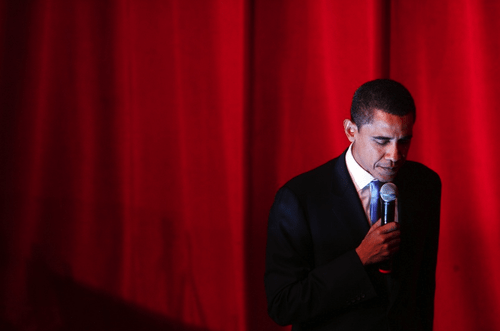
ObamaByHiroko MasuikeGetty

by Patrick Appel

Glenn Greenwald's post earlier this week about the persona of the President and that his fans, and the Dish posts surrounding it, attacked or defended Obama's character without entirely challenging the premise of the debate. Profiles of managed personalities –actors, athletes, politicians – are often of little worth because that Person Of Note is actively crafting a branded identity. They are working against the intent of the profile. No persona is more managed than that of the President.

I don't doubt that Obama is a good person, I'm likewise told by those who have met George W. Bush that he is quite charming, but this focus on the individual, and the mettle of his conscience, misses what is the more important and observable part of a presidency: management style. When debating an executive decision like the escalation in Afghanistan or the transfer of Guantanamo detainees to a US prison, we write that "Obama should do this…" or "Obama shouldn't have done that…" when what we often mean is the executive branch as lead by Obama should or shouldn't have taken a given action. By focusing on the President, we ignore the system surrounding him.

There are symbolic moments where Obama can act unilaterally, but major actions rely on the consultation of experts, the collection of information, and weeks of debate at lower levels of the executive. This system has been constructed by Obama, his advisers, previous occupants of the White House, and Congress. It's not as sexy or as emotionally charged as defending or attacking the character of the President. But thinking of the executive as a bundle of conflicting personalities and incentives funneled through the authority of one man is truer to reality than pretending the President is sitting in a room with a red phone and barking out orders based solely upon the swinging needle of his internal compass.

The Obama executive can be summed up in three words: no sudden moves. Like Greenwald and Andrew, I've been disappointed by parts of the Obama executive's civil liberties record. I regain a smidgen of hope on this issue, and gay rights, and foreign policy, and numerous other topics, not because I trust in the character of the President. I have never met or spoken with the man. Thousands of people have spent endless hours trying to influence my feelings about Obama the person. I discount it all.

What I see from watching the Obama administration is a meticulous consideration of multiple options and a resistance, if not immunity, to the demand that the President act swiftly in all instances. The degree of change in this regard from the last administration cannot be overstated.  And though the Obama management system has not always produced results I agree with, wide-reading and my gut tell me to cut losses in Afghanistan, Obama's method of deliberation at least suggests that he has a larger strategy, what Sullivan has called the long game. I concede that the demonstration of failure may well be the fall back strategy in Afghanistan. I also concede this may be false hope on my and Sullivan's part.

I will be unsurprised if I am disappointed, but I'm more confident that Obama's executive will change course when confronted with failure than I ever was that the Bush executive would do so, which isn't saying much.

(Image:Hiroko Masuike/Getty Images)

The Exobrain Grows More Powerful

by Patrick Appel

Scott Adams is hard to refute:

Technically, you're already a cyborg. If you keep your cell phone with you most of the time, especially if the earpiece is in place, I think we can call that arrangement an exobrain. Don't protest that your cellphone isn't part of your body just because you can leave it in your other pants. If a cyborg can remove its digital eye and leave it on a shelf as a surveillance device, and I think we all agree that it can, then your cellphone qualifies as part of your body. In fact, one of the benefits of being a cyborg is that you can remove and upgrade parts easily. So don't give me that "It's not attached to me" argument. You're already a cyborg. Deal with it.

Minding The Store

by Patrick Appel

As always, it a pleasure to step in while Andrew gets some much needed rest. Guest-blogging is not all that different than my day-to-day activities on the Dish – 24 of the 50 posts currently on the front page were written by me. All the substantive posts are Andrew’s work, but it’s my and Chris’s job to read through the blogosphere and pick out the choicest bits. Andrew edits, approves, and spins what we find, but the illusion of an all-reading blogger is maintained by employing two extra sets of eyes.

I’ll be checking Andrew’s general e-mail account this week (andrew@theatlantic.com). We typically get around 450 e-mails a day, but correspondence drops significantly during Andrew’s absences. If you want to see an e-mail of yours posted to the Dish, you have a much better chance of not being overlooked if you write this week. 

Andrew will return December 21st.

A Vacation

Jonah Lehrer describes the cognitive benefits of travel:

For the first time in human history, we can outrun the sun and segue from one climate to another in a single day. The reason such travels are mentally useful involves a quirk of cognition, in which problems that feel "close" – and the closeness can be physical, temporal, or even emotional – get contemplated in a more concrete manner. As a result, when we think about things that are nearby, our thoughts are constricted, bound by a more limited set of associations. While this habit can be helpful–it allows us to focus on the facts at hand–it also inhibits our imagination.

On that note, I'm handing over the Dish for the next week to the capable hands of Patrick and Chris who will be joined by Conor Friedersdorf, who needs no intro, and Andrew Sprung, whose superb blog can be found here. It's been an amazing year at the Dish and exhausting too. See you December 21.