Friendship Isn’t Modern

by Patrick Appel

A reader writes:

I couldn't disagree more with William Deresiewicz. Yes, modernity is about equality — Tocqueville taught us that much for sure. But this means we do not like to make distinctions, declaring one person or set of morals or way of life to be better or worse than another. The radical particularity of friendship, of loving this person more than that person, pushes against our egalitarian sensibilities. The entire trajectory of modernity has been towards the universal, away from the particular: consider our infatuation with "human rights," which are taken to be universal; our humanitarian concern for those half-way around the world; our skepticism towards nationalism and even patriotism; and our cosmopolitanism. To put this slightly differently, there is an intrinsic connection between equality and universality, or what Tocqueville called "general ideas."

Andrew, in "If Love were All," ends up making precisely the opposite point that Deresiewicz makes — that friendship is the form of love, the relationship, we have lost in modern times.

It is true that friendship is predicated on equality (Aristotle teaches us this), but that is only to say that friendship, especially of the deepest sort, is between equals. This notion of friendship between equals can exist amidst the most radical social and political inequality. Two aristocrats can be friends, and their rough equality of station and power and wealth might make that friendship possible (or free it from certain tensions and problems) — but that is because they are equal, not because "equality" is the principle of justice for the society in which they live. So the fact that modernity is connected to a broader equality, the equality of, say, the Declaration of Independence, really tells us very little about the prospects for friendship. Indeed, to refer again to Tocqueville, the broader equality — equality as a principle of justice — may actually undermine the more particular form of equality, that in which two friends, or a small group of friends, see themselves as somehow set apart from everyone else: equals who are unequal with regard to everyone else. That's one feature of the democratic age, the age of equality: no one is set apart from the rest.

Deresiewicz basically makes this point for me in his discussion of "romantic friendship," which he sees as a recapitulation of a classical ideal. Exactly! To the extent friendship persisted into the modern age, it was understood as a retrieval of an ancient notion. It was not defended on modern grounds.

In summary: Andrew's essay is far more nuanced and interesting and simply accurate than the one you link to. How do these people get published in such prominent places?
The Middle Way

88819290

by Patrick Appel

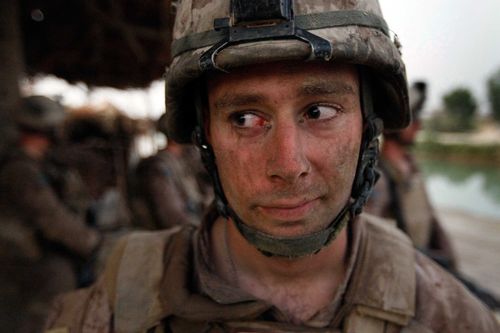
Jonah Leher describes the compromise effect. When presented with three options we are irrationally inclined to pick the middle one. Leher thinks Obama's Afghanistan decision fits this model:

The point is that most of us are natural compromisers, eager to find a middle-way. (There's some suggestive evidence that the tendency to pursue the compromise option is mediated by culture, with East Asians more likely than Westerners to show the compromise effect.) Furthermore, our compromising tendencies can be skewed by the audience: when American subjects were told that they might have to defend their choice in front of a whole classroom, they shifted towards the safety of the middle option. Obama, of course, needed to justify his decision to an entire planet.

(Image: Joe Raedle/Getty Image)

Poseur Alert Nominee

by Patrick Appel

"Her vulva was opposite my face. The small lips protruded slightly from the pale, domed flesh. This sex was watching at me, spying on me, like a Gorgon's head, like a motionless Cyclops whose single eye never blinks. Little by little this silent gaze penetrated me to the marrow. My breath sped up and I stretched out my hand to hide it: I no longer saw it, but it still saw me and stripped me bare (whereas I was already naked). If only I could still get hard, I thought, I could use my prick like a stake hardened in the fire, and blind this Polyphemus who made me Nobody. But my cock remained inert, I seemed turned to stone. I stretched out my arm and buried my middle finger into this boundless eye. The hips moved slightly, but that was all. Far from piercing it, I had on the contrary opened it wide, freeing the gaze of the eye still hiding behind it. Then I had an idea: I took out my finger and, dragging myself forward on my forearms, I pushed my forehead against this vulva, pressing my scar against the hole. Now I was the one looking inside, searching the depths of this body with my radiant third eye, as her own single eye irradiated me and we blinded each other mutually: without moving, I came in an immense splash of white light, as she cried out: 'What are you doing, what are you doing?' and I laughed out loud, sperm still gushing in huge spurts from my penis, jubilant, I bit deep into her vulva to swallow it whole, and my eyes finally opened, cleared, and saw everything." – Jonathan Littell, The Kindly Ones, winner of the 2009 Bad Sex In Writing Award. Other shortlisted passages here.

Chart Of The Day

EvolutionOfReading

by Patrick Appel

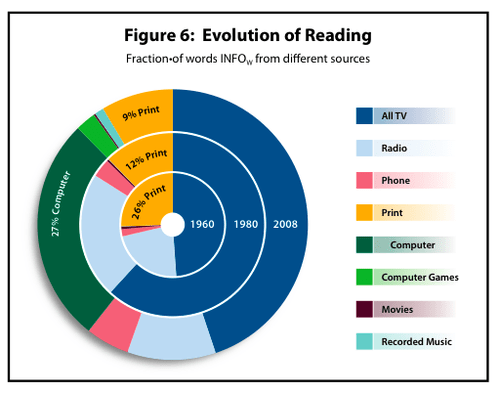
Derek Thompson thinks that the future of reading is mobile:

Mobile ad spending is expected to grow 15 percent next year. I think that prediction could be conservative. As the smart phone war between iPhone, BlackBerry, Palm, Android, etc heats up, the competition will only drive up their capacity and utility and encourage more people to think of their phones as small computers that can make calls, rather than phones pretending as small computers.

Atlas Obscura

by Chris Bodenner

The wonderful site, founded by Joshua Foer, assembles profiles of obscure places from around the world. This entry is for an “Eat in the Dark” restaurant in Paris:

Co-funded by the Paul Guinot Foundation for Blind People, [Dans le Noir?] is staffed entirely by the visually impaired. One is seated by a waiter/guide and given hints on how to avoid spilling such as “putting a finger inside your wineglass” but beyond this the diners are on their own. Diners call their server by literally calling out for them. In the words of one diner, “You have no idea where your fellow diners are sitting, how many are at the table, how big the room is, or indeed if the guy in the next seat has stripped naked and is rubbing asparagus spears into his groin. Ità­s genuinely disconcerting.”

This entry looks at one of the biggest tree houses in world, built by a minister with a divine revelation:

Located just outside of Crosville, Tennessee, the 97 foot tall tree house/church is supported by a still Tree-houseliving 80 foot tall white oak tree with a 12 foot diameter base, and uses six others as  further support. For 14 years he has built the tree house, spending only $12,000 and never running out of material.
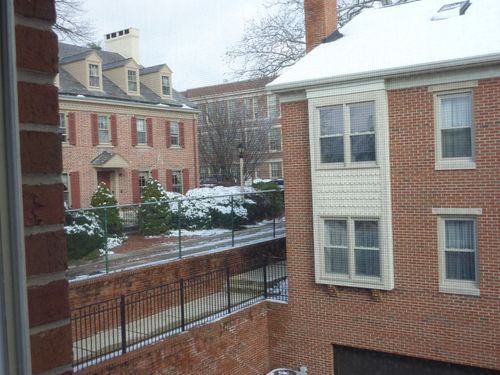
Over that time the treehouse has gained truly monumental proportions, and may have achieved his goal of building the worlds largest treehouse. Currently the Minister’s treehouse is 90 feet tall, said to contain 80 rooms, and currently has five stories complete with a church and a bell tower. The bell tower at the top of the tree house is equipped with oxygen acetylene bottles that, re-purposed as bells, chime daily.

In true southern architectural style every story is fully surrounded by a deck. There are no “Private Property”, “Stay off the Grass” or “No climbing” signs. Burgess say the tree house is Gods house and everyone is welcome.

Hathos Alert

by Chris Bodenner

Buzzfeed compiles 40 absurd photos of celebrities from 2009. The one after the jump – titled "Suri Cruise Calls For Help" – has pathos as well:

Suri

Bonus Scientology hathos: an internal video used to motivate members to start their own "org" in a "crusade" to spread Scientology throughout the land.

More Polarized Than Ever?

by Patrick Appel

John Sides is skeptical:

I am…unsure whether contemporary politics is really characterized by more anger or intolerance for the opposition or what have you. I don’t know what the appropriate comparison would be, but thinking back, it strikes me that these qualities are somewhat endemic. Sure, accusations about Obama’s birthplace seem angry and extreme, but more so than accusations that the Clintons murdered people? Or that Thomas Jefferson was a “howling atheist,” according to some Federalists? My anecdotes don’t qualify as data, obviously. But it is tricky to come up with measures that would show American politics to be more “polarized,” even by this expanded definition. Of course, ideological polarization is evident among elites. But other possible measures of this expanded definition — e.g., the negativity of political campaigns — suggest no conclusive answer. (Compare the findings of John Geer to those of Lee and Emmett Buell.)