The Angry Right

David Frum parses the latest poll on the GOP:

[H]ow much of the anger felt by Republicans is explained by things Obama has actually done – and how much by the generally miserable situation of the country. Republicans have 401Ks too. Only 1% of Republicans name George W. Bush as the person who epitomizes Republican values, and 24% blame him greatly or somewhat for the problems of the country today.

For all the anger felt by Republicans, they are not a very radical group of people. They divide 50-50 on whether they wish to see religion exercise more influence in American life than it does today. Only one-fifth of Republicans think abortion should be illegal in all cases. The party still holds a substantial pro-choice minority: 35% think abortion should be legal in all or most cases. Half of the Republicans and Republican leaners surveyed said they “never” listen to Rush Limbaugh – more than say they never listen to MSNBC.

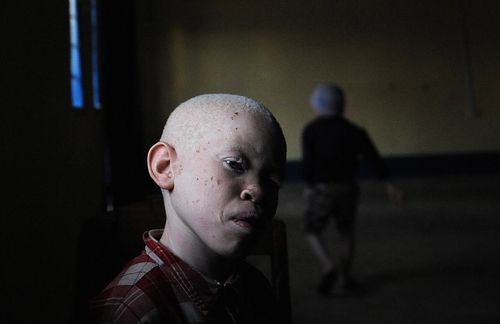
Face Of The Day

AfricaAlbinoGetty2
The AP reports:

The mistaken belief that albino body parts have magical powers has driven thousands of Africa's albinos into hiding, fearful of losing their lives and limbs to unscrupulous dealers who can make up to $75,000 selling a complete dismembered set. […] Since 2007, 44 albinos have been killed in Tanzania and 14 others have been slain in Burundi, sparking widespread fear among albinos in East Africa. At least 10,000 have been displaced or gone into hiding since the killings began, according to a report released this week by the International Federation for the Red Cross and Crescent societies.

(Image by Tony Karumba/AFP/Getty Images)

Taking Palin Seriously

Yglesias opines:

I know some liberals who are excited about the prospect of a joke candidate like Sarah Palin or Dick Cheney getting the GOP nomination in 2012. Not me. The basic fact of the matter is that power tends to alternate between the two political parties. Ultimately, the nation’s interests require both parties to nominate the best people possible. So I hope the Republicans find someone who’s very smart and compelling and does an excellent job of identifying and explaining the flaws in Barack Obama’s approach. Cheney couldn’t possibly win a presidential election…unless somehow he could, in which case the country would be set for a world of pain.

Palin, as Sam Tanenhaus ably demonstrates in his review of "Going Rogue," is not a joke candidate. Neither is Cheney.

They represent a real populist and authoritarian option for a declining power. In the face of a bewilderingly changing world, they stand for white America, the extension of its power across the globe, the elevation of torture as a core American value, the permanent Israeli occupation of the West Bank, and American occupation of client states like Iraq and Afghanistan. They represent a contempt for addressing climate change, and an indifference to debt – both Palin and Cheney have records of appalling fiscal profligacy. They also represent religious fundamentalism as the core Republican political philosophy. Cheney supports a party that would strip his own daughter – and has stripped his own daughter – of basic civil rights. Palin would criminalize all abortion.

The appeal of populist simplicity in complicated, demoralizing times is real and eternal. Obama has not in office been able to muster a scintilla of popular energy the way this rump right has. In fact, his moderate conservative governance has defused the energy of his campaign in ways that remain quite stunning. In this emotional game, the far right has the advantage of "us" vs "them." There are no real solutions to deep problems – no actual spending cuts proposed, nothing but the use of force abroad, nothing in energy policy but more carbon exploration, no immigration policy that isn't obsessed with resisting any sort of amnesty, and on and on.

One imagines that the American people – when they have to decide on a president who will actually have to govern – will turn away from a Palin. But that such a farce remains the most powerful figure on the right should sober anyone with complacency.

We live in a fundamentalist age. And there is only one fundamentalist party. Unless it is beaten repeatedly at the polls, it will at some point govern again.
High-Profile Homecomings

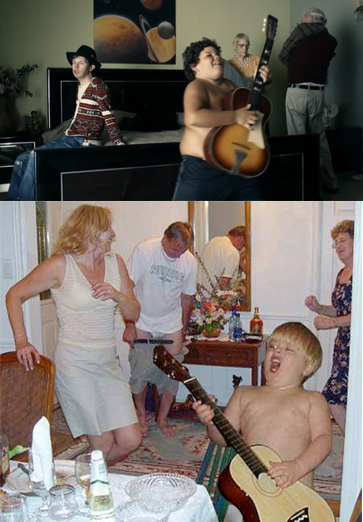
The NYT's Jan Hoffman fleshes out the debate over servicemembers surprising their kids upon returning from overseas deployment:

“Some people think it’s totally fine,” said Lillian Connolly, a mother of four who leads support groups for military families in Brockton, Mass. “But I recommend to families not to surprise children. The child has been without a parent for so long. The child can hold anger. You never know how they’re going to react.” Mrs. Connolly, whose husband is on his third deployment in Iraq for the Army Reserve, added: “And in front of the media? I don’t think it’s fair.”

On the other hand:

The adulation from classmates at these special moments can be reparative, parents say. Peers may finally empathize with the turmoil of a child whose parent is deployed. How bad could a little glory be?

“Nobody paid attention to me, it was all about Hannah,” said Master Sgt. Joseph Myers, of the video in June that vaulted onto national broadcasts showing the reaction of his 10-year-old — freeze-frame expressions ranging from incredulity to ecstatic relief — when he walked into her Randolph Elementary School class at Universal City, Tex. Hannah still Googles her name to read new posts, he said, “and to check what ranking she is on the viewings at YouTube.”

For viewers, these moments have a voyeuristic magnetism. They are mini-dramas, representing the anxiety of the ultimate parent-child separation, with a radiant resolution. Institutions that facilitate them can’t help but benefit from the emotional spillover.

Chief among them: the military. Jon Myatt, a spokesman for the Florida Department of Military Affairs, said those called up — doctors, butchers, accountants like Major Becar — live in communities where people may not understand military families’ ordeal. These reunions and their publicity give a window into their lives. “You don’t get that on the nightly news very much,” Mr. Myatt added.

Continued here.

Trading Moral Power For Political Power

James Carroll lists the many political gambits by the Catholic Church lately – threatening to withhold social services in DC if it allows gays to marry, threatening to scuttle the entire healthcare bill over abortion, etc. – and concludes:

[A]cross the 20th century, [the Church] was a force for progressive social change. That is over. For the first time in its history, the American Catholic hierarchy is solidly right wing. There is not one liberal voice among its members.

That Catholic bishops are genuinely conservative is beyond doubt, but one might also note how their unprecedented alliance with an already powerful political-religious movement nicely solves the bishops’ biggest problem–the bankruptcy of their moral authority and loss of social clout in the wake of the priest-pedophilia scandal. New Protestant allies are happy to let go of old anti-Catholic prejudices, even those confirmed by priestly child abuse, for the sake of advancing their narrow moral agenda. Meanwhile, an equally divided political culture puts bishops in the cat-bird seat when it comes to tipping the scales of close elections or contested legislation, and that unexpectedly pivotal role has rescued them.

They are Rovians: desperate for short-term political highs, all the while undermining their long-term coherence. I suspect that what we will see in the future is a church basing itself in the developing world, and adopting more African views on the subjugation of women, criminalization of homosexuality, and the evils of Western liberal capitalism. Europe will remain the enemy, Islam a useful ally and America's Republican Party Christianists a source of money and power as the Western flock shrinks to the rump that Benedict devoutly wishes for.

If I had been asked to predict the church's future ten years ago, I would have deemed this far too pessimistic a view. But Benedict's papacy has made all the difference. I no longer believe in any revival of a vibrant and truth-seeking Christianity under the Catholic hierarchy in my lifetime. But I can still hope. Because the truth of the Gospels is so much stronger than the politics of the papacy at any given moment in history.

The Politics Of Doubt

Jasmine Beach-Ferrara encourages the marriage equality movement to use doubt to its advantage. Ed Kilgore embraces the strategy:

Beach-Ferrara concludes that ballot measures to stop gay marriage keep winning in no small part because equality advocates don’t talk much to conflicted voters, particularly those for whom religious dogma pulls them away from their own personal sense of fairness–i.e., non-bigots who are lumped in with bigots in most LGBT-rights strategies.

Based on her first-hand interviews with torn voters, Beach-Ferrara contends that marriage equality activists would do well to spend some time convincing such voters to reflect their true convictions by conscientiously passing up the opportunity to make a choice they aren’t prepared to make. In other words, rather than pushing people to come down on one side or the other, activists should have looked at doubt as a political asset.

If those in doubt abstained, would we win?

Dissent Of The Day II

A reader writes:

I've been a fan for a while now, but there is one opinion that is not infrequently espoused on your blog that drives me nuts. This quote is from the the post "The Swiss Ban Minarets":

"But it is a useful reminder that religious liberty and toleration have roots that are not so deep in Europe"

There are many reasons why a statement like this infuriates me. Here are just a few:

First, you can't just say "Europe" and assume you are talking about some cohesive entity. Europe has a history spanning thousands of years, with many different cultures that have developed alongside each other, and cultural differences are vast when it comes to things like religion and religious tolerance. There's so much difference between Southern Europe, Central Europe, Western Europe, Eastern Europe and Northern Europe that making a statement about people's attitudes in the entire thing is nonsensical. It's like saying "North America has a real problem with gay people", and including Canada, the US and Mexico in that statement. It just doesn't make any sense.

Second, the roots of religious liberty and toleration "are not so deep in Europe"? That's just insane!

Take, for instance, a look at the wonderful country that is Poland: they have essentially had religious freedoms since the 15th century (yes, that's BEFORE Columbus discovered America) and complete freedom of religion was guaranteed at the Warsaw Confederation in 1573, and with a few gaps (like, obviously, in the 1940s, but you can't really blame the Poles for that), it has essentially remained ever since.

Third, I live in Stockholm and what you are describing are is far, far from the reality I know. I grew up with Muslims, I went to school with Muslims, I work with Muslims and I have life-long friends that are Muslims. This is the case for most people I know my age. Certainly, Sweden isn't perfect when it comes to integration of recently arrived immigrants and such, but in terms of religious tolerance and religious freedom, I'll put us up with any other country in the world. I defy you to find a single place in America more tolerant of different religions than we are here in Sweden. You wont be able to do it. That's not to say that religious intolerance doesn't exist here (of course it does), but the country as a whole is firmly dedicated to the right principle.

All that said, of course, it's incredibly stupid and discriminatory and offensive of the Swiss to ban minarets. But you know what, just because one dumb-ass country does something stupid, it doesn't mean the whole continent is messed up. Just like Europeans shouldn't extrapolate US views of people of color from things that happen in West Texas, please don't judge "Europe" based on what one country in it does. It's offensive and it obscures the much more nuanced truth.

It’s Always The Incentives

The Economist asks Radley Balko about the biggest problem with the criminal justice system. Part of his reply:

[T]he incentive problems are most apparent with prosecutors. Prosecutors get no credit for cases they decide not to bring, either because of a lack of evidence or because pressing charges wouldn't be in the interest of justice. They're only rewarded for winning convictions. That's what gets them promoted, or re-elected, or gives them the elevated profile to run for higher office. Every incentive points toward winning convictions. And particularly with prosecutors, there's really no penalty at all for going too far to get a guilty verdict. One real disservice the Duke lacrosse case did for the criminal-justice system is it put in the public consciousness the idea that bad actors like Mike Nifong are regularly disciplined for misconduct. In truth, that case was really exceptional.

Mental Health Break

Beck backs up Charlotte Gainsbourg:

The comments section on Antville tries to decipher the video's WTF. Commenter Bunny Greenhouse – who just happens to be the creator of these brilliant YouTube mashups of Girl Talk tracks – lends a hand:

it's almost as if [director Keith Scofield] had this idea of making a cinematic montage of his fave internet/art images for a while, and he just starting saving 'em in a folder on his computer – and now… voila

Bunny's findings after the jump:

Music-video-images

Music-video-images-2

More matches here.

Dissent Of The Day

A reader writes:

I agree with your main point, but the line

In fact, recent events suggest a move backwards as the entropy of the Arab and Muslim world reasserts itself.

suggests a Tom Friedman-style derogation of Arabs and Muslims and a lazy analysis to boot.  Isn't it more a case of the continuing fallout from Britain's creation of an artificial state designed to be perpetually at war with itself? (Yet another reason why many of us who hated Saddam still thought the war was a really bad idea.)  

 
Is the never-ending fight of the Sunnis and the Shiias and the Kurds to rule their own lands with no influence from foreign tribes any different from what's going on in Israel?  Or Ireland?  The entropy of religious and nationalist extremism reasserts itself everywhere.

Yes it does, and I was too glib in that throw-away.

My point is that in most regions of the world, the rare experience of a liberal state that tries to counteract the atavistic impulses of fundamentalism, tribalism and sectarianism is entirely absent. These pathologies are human pathologies, not just Muslim or Arab ones. But with no real tradition of liberalism to counter them, the struggle is quixotic. Look at how sectarian America now is! If the country of Jefferson gave us Palin, the rest of the world seems worthy of cold-eyed realism before we declare freedom on the march. If we haven't learned that these past few years, we have learned nothing,