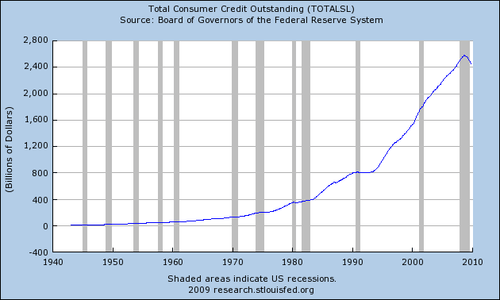
The St. Louis Fed has a good graph that shows the outstanding private credit (consumer debt) since the end of World War II. I believe you are justified in your "two decades" comment although it was actually about two and half decades ago that it really started to explode after starting to ramp up in the 70's. Between about 1984 and 1990 it doubled from $400 billion to $800 billion. Then doubled again in the '90's to $1.6 trillion by 2000. It appeared to be on pace to double again this decade before this recession hit.
Now wait will Gitmo remains open through the middle of next year, finanical re-regulation gets gutted by Geithner, gays keep being fired from the military, unemployment plateaus at 12 percent, and more troops are sent to Afghanistan even as withdrawal from Iraq is postponed because they cannot even agree on an election date or terms despite months and months of negotiations.
Of course, there's a very very long way to go. And if health reform passes, unemployment begins to drop before next November, some movement occurs on Iran, and troops come home from Iraq in larger numbers … anything can happen.
I think it's more aptly put that the new age of publishing has made it possible for small, opinionated news publications to have viable, market-based business models because they can cut the overhead that print requires. These publications have always existed in the print and web worlds, just with subsidies, witness: The Nation, The National Review, and any of the myriad of think tanks like the Cato Institute or the Center for American Progress.
Ultimately, Josh Marshall may be more like the William Buckley of his day but, ironically, with a market based business model rather than a subsidized one.
However, we should probably be careful before going too far with any of this. Marshall is funding his current expansion with investment funds provided by Marc Andreessen. The impressive thing is that Marshall was able to make his expansion pitch based on solid financials. We have yet to see whether the expanded vision he's headed toward is itself profitable.
In October 1937, Dominican President Rafael Leónidas Trujillo Molina ordered the execution of the Haitian population living within the borderlands with Haiti. The violence resulted in the killing of 20,000 to 30,000 Haitian civilians over a span of approximately five days, which would later become known as the Parsley Massacre due to the shibboleth which Trujillo had his soldiers apply to determine whether or not those living on the border were native Dominicans who spoke Spanish fluently. Soldiers would hold up a sprig of parsley, ask "What is this?", and assume that those who could not pronounce the Spanish word perejil (called pèsi in Haitian Creole, persil in French) were Haitian. Within the Dominican Republic itself, the massacre is known as El Corte ("the cutting").
The conventional wisdom is that we're living in the era of the death of the book. This is, of course, ridiculous. We live at a time of unprecedented literacy. People love to read. They read all the time. You are, right now, in the middle of reading this.
But I have to say, after seeing the [above] "book trailer," I'm starting to feel like the death of the publishing industry is long overdue. If, for some reason, you can't watch this, it goes like this:
A novelist establishes that he lives in Park Slope, in Brooklyn, and that he is a douche who French-kisses his dog. He has a grandma and thus decided to write a book about meat, which is not really about meat; it's about family. The video literally starts out, "Oh, hello," like we've all for some reason decided to go to Jonathan Safran Foer's house and startle him in his study. It is a trailer that will make you want to immediately go to the bookstore and punch his book, on principle.
The million-dollar question is, will innovative marketing like Mr. Safran Foer's video help save Big Publishing?
Thanks to the Internet, anyone can write AND publish a book (through mechanisms such as lulu.com or other self-publishing ventures). You only need someone who will give you an ISBN and some CIP data, and your book looks as legitimate as a John Grisham novel to customers at Amazon.com. And with the rise of print-on-demand technology, you don't even have to have inventory.
So the question facing authors starts to be the same as the question facing musicians–do you really need the corporation, or can you do it yourself?
More here. I'm hosting a discussion of Jonathans book, Eating Animals, at the Historic Synagogue at 16th and I Street NW Washington DC this coming Tuesday at 7 pm.
Andrew Halcro's final take-down of Going Rogue can be read in full here. Once again, it reveals the endless omissions of salient fact and concoctions of pure fantasy that mark this disgrace of an un-fact-checked, unedited celebrity-vehicle published solely for money and political insurance. Palin revels in the cowardice of a bully:
There is no personal growth in the entire book, from the beginning where she blames the old boy network (Ruedrich, Allen, Stevens, Murkowski) to the final chapter of blaming the new boy network (Schmidt, Bitney, Wallace et al.) she exhibits no personal growth as a person, a candidate or in her role as an elected official.
In every capacity she is always the aggrieved party, even when she is in charge and has the power to change the circumstances. But more importantly, her tale of woe proves one thing; Sarah Palin is no Barracuda, she's more like a spineless jelly fish…
And of course my favorite part she left out was the truthful nature of our very limited and brief discussions prior to the 2006 campaign.
She left out how we were brought together to meet by Andre McLeod and in fact we only talked twice…twice, about our thoughts regarding the upcoming gubernatorial campaign; once at Cafe Del Mundo in December of 2004 and again in June of 2005 in Palin's living room.
Why did she exaggerate our discussions? Because the third time we met we were both well on the campaign trail and that was the infamous April 19, 2006 meeting at the Hotel Captain Cook when she looked across the table and said: "Andrew, I watch you at these debates with no notes, no papers and yet when asked questions you spout off facts, figures and policies and I'm amazed. But then I look out into the audience and I ask myself, does any of this really matter."
In the end, the self-serving smears of others and fantastic lies about herself will be much more widely understood and known. We have plenty of time.
Kottke highlights the following passage from Matt Zoller Seitz's "Feast":
Cooking, perhaps more than any activity, lets an actor exude absolute physical and intellectual mastery without seeming domineering or smug. Why is that? It's probably because, while cooking is a creative talent that has a certain egotistical component (what good cook isn't proud of his or her skills?), there's something inherently humbling about preparing food for other people. It doesn't matter whether you're a workaday gangster footsoldier giving lessons on how to cook for 20 guys, like Richard Castellano's Clemenza in The Godfather, or a hyper-articulate, super-fussy kitchen philosopher like Tony Shalhoub in Big Night, ("To eat good food is to be close to God…"), when you're cooking, it's ultimately not about you; it's about the people at the table. Their approval and pleasure is the end game.
Read the rest of the essay and watch more sumptuous scenes here.

 The Dish