A Person, Not An Issue? Ctd

A reader writes:

I disagree completely with you and Packer. Yes, as a person-under-thirty I came of age politically under the nightmare of Bush and I campaigned vigorously and voted for Obama. Having graduated in June 2008 I had the luxury of being able to do so while in college; with November just a few months after, and his victory more or less a foregone conclusion at that point (barring a brief scare with Palin-mania), it was easy to be passionate about a host of issues and the man himself. But I’ve only had five cumulative months of employment since, this in spite of a “practical” degree (economics) from a “good” school (East Coast whatever – if my situation is any indication, an Ivy degree doesn’t mean jackshit). Friends of mine with relatively less worldly degrees in many cases have not been able to find a job at all in over a year. And it is not that we’re just sitting on our asses, playing video games because we think we’re above a certain kind of work – this high-handed claptrap is perhaps the most irritating snobbery of so-called “experts”, of a piece with their stellar market analysis over the last decade. No, when we say we can’t get a job, we mean we can’t get any job.

Certainly white-collar jobs, those that we thought we were being prepared for, are so few and far between that they’ve become the stuff of lore, a mythical entity. When someone manages to snag one of those these days it’s treated like a fucking miracle, complete with celebration and deepest envy both. This just for a job! Not two years ago a job was practically a birthright, plentiful and in season; now it’s something to forage and kill for. But we’re having to compete now for jobs that anyone can do – which makes it that much harder to get them as well. Temp agencies mostly turn us away. Shit, even the damned Safeway near me isn’t hiring. I’m perfectly content to bag groceries or wash cars or do construction, but there isn’t a scrap of work to be had.

If all that sounds unbelievable, then you just don’t know what it’s like right now for young, inexperienced people whose first taste of the labor market has been one of closed doors and pounded pavement and steadily increasing panic. At the moment I do have a part-time temp job and I’m grateful for it, but I don’t know how long it’ll last. Every time a superior passes my desk I quake because he or she could be coming to give me the axe – this is how we fortunate employed spend our days, adrenaline-riddled and constantly on tenterhooks. I don’t have health insurance. I’m engulfed in student loans.

Please believe that this is genuinely not whining (nor a solicitation): I’m young, have no mortgage weighing on my head or family to support, and my parents help me out as much as they can. It is, however, to state that if we seem to have lost our enthusiasm for Obama, seem not to care about the wars and the gays and the climate, it’s not because of Obama. We know our employment lot isn’t his fault; we know – and trust me, we’re not nearly as naive as some may think; starry-eyed as we were, most of us were just happy to be happy, thankful that we could indulge in other emotions besides the despair and outrage and contempt that were all that we knew – we know real change is hard; and we know that things are going about as well as could be expected. But when you’re ceaselessly, never-endingly worried about your checking account falling into double digits it’s hard to get exercised about any issue apart from unemployment rising into same.
The Emptiness Of Karl Rove

I remember very vividly a heated argument with Karl Rove over eight years ago in which I worried about spending and deficits. "Deficits don't matter!" Rove kept repeating in that nasal world-weary tone he has. After a bit, I said, "What do you mean, deficits don't matter? Don't you remember the 1990s?" "No, no, no, no, Andrew," he replied. "What I mean is that people don't vote on deficits. That's why they don't matter."

I learned then that nothing beyond short term politics motivates Rove. Nothing. And I also learned: this fathomless cynicism is not just repulsive, it's invariably wrong. People sure did vote on deficits in 1992. And one small reason Obama won in 2008 is because many Independents and Republicans couldn't trust the GOP to stop spending and borrowing us into oblivion in an era of economic growth.

Now, Rove – whose shamelessness is only matched by his incompetence – is writing a deficit hawk column for the WSJ.

The sliver of argument he has left is that the debt we now face is vaster than we imagined only a year ago. The reason? Rove would have you believe it's those spend-and-splurge Democrats. In fact, of course, the massive debt has been building for years and its new height was precipitated by the recession begun under Bush (who was still in office a year ago), by the stimulus necessary to prevent a total abyss, by the bailout money required to rescue the banks, and by the continued de-leveraging after the reckless private borrowing of the Bush-Cheney years.

What Rove requires is what Palin requires: total amnesia of what they just said or did. There is nothing deeper to either of them than the cynical attempt to spin the next five minutes to their own advantage and at the cost of the country in general. One knows better; the other knows nothing. Together, they represent a useful spectrum of the degeneracy on the Republican right.

“Lied Without Lying”

WOJTILADerrickCeyrac:AFP:Getty Images)

A formal investigation of Dublin’s Catholic Archdiocese concludes that there is “no doubt” that child sexual abuse was covered up by Church authorities over four decades. Patsy McGarry has more:

One of the most fascinating discoveries in the Dublin Archdiocese report was that of the concept of “mental reservation” which allows clerics mislead people without believing they are lying. According to the Commission of Investigation report, “mental reservation is a concept developed and much discussed over the centuries, which permits a church man knowingly to convey a misleading impression to another person without being guilty of lying”.

The NYT story today is here. More here from the AP:

[A] report in May sought to document the scale of abuse as well as the reasons why church and state authorities didn't stop it, whereas Thursday's 720-page report focused on why church leaders in the Dublin Archdiocese – home to a quarter of Ireland's 4 million Catholics – did not tell police about a single abuse complaint against a priest until 1995.

By then, the investigators found, successive archbishops and their senior deputies – among them qualified lawyers – already had compiled confidential files on more than 100 parish priests who had sexually abused children since 1940. Those files had remained locked in the Dublin archbishop's private vault.

The investigators also dug up a paper trail documenting the church's long-secret insurance policy, taken out in 1987, to cover potential lawsuits and compensation demands. Dublin church leaders publicly denied the existence of the problem for a decade afterward – but since the mid-1990s have paid out more than euro10 million ($15 million) in settlements and legal bills…"

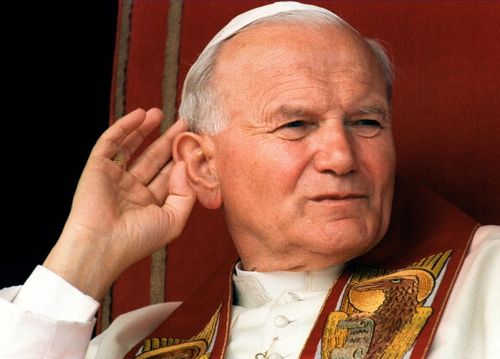
If the Catholic church were a secular institution in Ireland and had been found guilty of child abuse to the massive extent the Church has, it would be forced to close. Its top officials would not be issuing statements of apology and regret, but serving sentences in jail. The name of John Paul II would not be a revered mantra; it would be synonymous with the head of an international organization that had to be dragged kicking and screaming to acknowledge its own long-running, institutional brutalization of generations of defenseless children.

In the name of Jesus.

(Photo: the Pope who presided over an era of denial and cover-up of child-rape, John Paul II, by Derrick Ceyrac/AFP/Getty.)

“The View From Your Window”: First Run Sold Out

COVER-front

The Window book got a little swallowed up by Palinpalooza these past two weeks, but the sales didn't slacken. We sold 2,000 at the low, crowdsourced price of $16.25 within a week, and we've now persuaded Blurb to publish another 1,000 at the same price. After this next thousand are snapped up, the price will return to the normal $29.95. So now's your chance.

They're a great Holiday gift, especially for a Dish reader you know, or anyone else who might be captivated by a world-tour through 200 separate windows in 200 separate Dish-reading abodes across the planet.

You can preview the book here with an interactive guide at Blurb.com, the print-on-demand company that is publishing it. And you can buy it for only $16.25 here. Remember it's a four color, high quality, coffee table book that would usually cost well over $30 from a regular publisher. But we're forfeiting a profit at the Dish, crowd-sourcing the price, and although Blurb will make a small margin, we're still able to bring it to you at close to half price.

The model has been so successful, in fact, that we hope to build on this in the weeks and months to come with a range of cheap user-generated books that are able to air topics – such as late term abortion or the cannabis closet – that tend to be euphemized or turned into ideology, but have managed to unfold on the Dish in realler, clearer form.

But few Dish books have as large a place in our hearts as the Window guide.

It's 200 pages of window views, selected from all the submissions sent in over the past three years, with the front image and the back one picked by you, the readers of the Dish. The book has views on every page – and their contrasts opposite one another add a whole new dimension to the Dish's most popular feature. And there's a foreword recalling the genesis of the whole idea (yes, at the very beginning, I tried to call the whole thing off, but you kept sending views and I kept posting them).

Since this is Thanksgiving, I'd like to thank everyone who sent in a window view – and all of you who still are sending them in (future collections will include many). This book can and will be an annual event and we hope to make it better and cheaper in the future with this new publishing model. I'd also like to thank Patrick and especially Chris Bodenner who made this project possible and did almost all the work, Scott Havens and Justin Smith at the Atlantic who brought it across the finishing line, Leigh Haber who shepherded it throughout and Eileen Gittins who runs Blurb and saw the new model as something worth pioneering. 

Gittins' own view about the new publishing model this book portends can be read here.

Buy them now while the last thousand at $16.25 last.

We Are All Anchormen Now

Julian Sanchez has a smart post on Palin-mania and the blogs aping the MSM:

We like to say new media is allowing us all to be journalists. But it’s probably more accurate to say it lets us all be anchors. Sure, the Internet also allows people with local knowledge or serious expertise to speak directly and be picked up by a wider audience, but it doesn’t fundamentally do a whole lot to increase the population of those people. But it radically expands the population of potential anchors chasing them—or, increasingly, chasing each other. And we don’t even have the benefit of a script written by someone who at least got briefed by someone who knows something. So while on the one hand there’s a well-recognized trend toward media fragmentation into deep niches, there’s countervailing pressure toward convergence on a handful of big shallow water-cooler stories.

Gitmo, Still Open

Phillip Carter, who ran the blog Intel Dump before joining the Obama administration as an official for detainee affairs, resigned last week. Greenwald speculates:

[W]hat is abundantly clear is that many of the Bush/Cheney policies which Carter found most offensive are ones which the new administration has explicitly adopted as its own.  Equally clear is that, following Greg Craig, this is now the second high-profile resignation of a relatively devoted civil libertarian in a short period of time.  Combine that with the still-missing-and-unconfirmed Dawn Johnsen, and all of this leaves those who are indifferent or hostile to civil liberties values — people like John Brennan and Rahm Emanuel — with even fewer counter-weights than before.

James Joyner interjects:

Ironically, given that Phil was a relatively senior appointee in the administration, my position on these issues is closer to the president’s than his.  But this is perhaps the most substantive issue area in which President Obama most sharply differs from Candidate Obama.  From my perspective, this is a classic case of a naive candidate being hit with reality when confronted with the reality of being responsible for America’s national security and I applaud the president for alienating his base rather than doing the wrong thing.  But for a true believer, I could see how the dashing of Hope and lack of Change could be too much to bear.

Meet Your Meat

The turkey wasn't always so dumb:

Generally considered cranially vacant even for a bird—the turkey wasn’t always such a buffoon.  The wild turkey was historically considered a rather shrewd critter, difficult to fool with standard hunting ploys and surprisingly agile. Did you know, for example, that wild turkeys can climb trees?  And if you throw an apple to a group of wild turkeys they’ll play with it like a football, according to Oregon State University poultry scientist Tom Savage.

We’ve all heard that Ben Franklin was so enamored with the wild turkey that he thought it should have been named the national bird instead of the bald eagle. He reasoned that the turkey embodied the resilience and street smarts of the new Americans (unlike the austere, detached eagle that seems more French). Back then, the turkey had class and enjoyed a level of respect rare among fowl.   

But then we started domesticating them, and every bit of the turkey’s appealing attributes were drained out like so much broth.

Harvest Time

Blake Hurst gives thanks:

If the movie “Food, Inc.” can be said to have a theme, it is that corn is too cheap. Cheap corn has led to industrial uses, cheap fast food, and, horror of horrors, corn fed to cows. This year's harvest is bad news for documentary makers, because we're bringing in a tremendous crop. Corn prices are at two-year lows. Author of Fast Food Nation Eric Schlosser's pain is palpable, but a big harvest should be a cause for celebration for everyone else. Farmers make the news when weather causes low yields and high prices, but plentiful and reasonably priced food is such a given that nobody but we farmers celebrates a great crop like this one. The rest of America should celebrate, and be grateful for the abundance that agriculture provides.

There is nothing more fun than a record crop, if you're a farmer. We have a monitor in the combine that approximates yields as we pass through the fields. In the last several years, due to floods, droughts, and a very memorable wind storm (if you recognize your farm on one of those tornado-chaser videos, it's a very bad sign), we've rarely hit 200 bushels per acre on that monitor. This year, I've had days when I barely dropped below 200 bushels per acre. I'm old enough to try to capture this crop, this year, in my memory, given the very real possibility that I'll not farm long enough to see its like again. We farmers are protected from extremely low prices by the government, our crop insurance is subsidized by the taxpayers, biotechnology has made yields and pest control more predictable, we can harvest and plant in a fraction of the time it took my grandfather, but we're still at the mercy of Mother Nature, and she's a tough taskmaster. When we escape her worst, it's a harvest of joy.