
al-Khobar, Saudi Arabia, 4.21 pm
al-Khobar, Saudi Arabia, 4.21 pm
Sonny Bunch follows up on the death penalty debate:
I’m not entirely sure I understand the difference between revenge and justice, especially in a case as personal as this one. What does justice mean for the husband and father whose wife was raped, one of his two daughters was raped, and all three were burned alive by a sadistic pair of monsters? The first definition of justice in Merriman-Websters is thus:
The maintenance or administration of what is just especially by the impartial adjustment of conflicting claims or the assignment of merited rewards or punishments.
I guess that definition hinges on what we decide is a “merited” punishment. But you will never convince me that those two’s actions do not merit death.
Will at Ordinary Gentlemen also goes another round.
Will Saletan joins the abortion debate:
Pro-lifers say the health insurance abortion restriction, known as the Stupak amendment, is just an extension of the Medicaid abortion restriction, known as the Hyde amendment. Pro-choicers say the Stupak amendment is much more invasive. The pro-choicers are right. But pro-lifers didn't create that difference. Democrats did. By mixing public and private health care, they complicated the separation of taxation from abortion. If pro-lifers can't keep their money out of the insurance exchanges, they'll fight to keep the insurance exchanges out of abortion.
Granted, there are less onerous ways to interpret the no-taxes-for-abortion principle. Pelosi tried to sell these alternatives to the pro-life Democrats. They weren't buying.
There's something poignant about the last-minute outrage of the pro-choice groups. The complaints they're leveling—that people had more choices in the private market, that the House bill radically upsets this market, and that it violates Obama's promise not to deprive anyone of their existing coverage—are hardly novel. Republicans have issued such warnings all year. But liberals didn't pay attention until the coverage in jeopardy was abortion.
I'm not saying we shouldn't socialize health insurance. I'm pretty comfortable with the House and Senate bills. But let's give up the two lies we tell ourselves about such legislation. One is that it won't cost us much money. The other is that it won't cost us much choice. When you throw in your lot with other people and agree to play by the same rules, you surrender some of your freedom and risk losing some of your options. Sometimes it's coverage of an MRI or a hip replacement. Sometimes it's coverage of abortion. If that's the price of health care reform, are you willing to pay it?
Friedersdorf makes the same point:
The bigger role the federal government takes in funding health care, the more you’re going to see politicians interfering in matters that would otherwise be left to doctors and patients, and the more controversial these battles are going to become among the public. This seems obvious to me, but I never see progressive writers worrying about it.
This story speaks, rather movingly, for itself. And yes, the “pearly gates” comment is priceless:
Even Fox News is fact-checking her now.
Mark Blumenthal takes a stab at why Americans are more pessimistic about health insurance reform:
The most important thing to remember is that Americans most likely to be shifting their opinions are those least engaged in news about the ongoing Congressional health care debate. And even though most of the Pew Research News Index surveys in recent months show large majorities who say they are "closely" following the debate, they also find that nearly half of adults (44%) do not know that the "public option" deals with health care, while four-out-of-five cannot pick Max Baucus' name from a list of four senators as the chair of the Senate Finance committee working on health care.
He cites more negative ads from reform opponents, process coverage, and Democratic disunity as contributing factors. I'd add the sheer, mind-numbing, nerve-stretching, politician-watching endlessness of it all. If I were not paid to follow these ins and outs, I'd find the whole process alienating.
But this ghastly process is what legislating such an enormously complex bill actually requires. And I do think that one of the most under-estimated aspects of the Obama presidency has been his insistence on letting legislators … legislate.
This is their job. Maybe it's because that's where Obama came from; and maybe it's because he understands that the Clinton approach failed. But it is also a conservative re-balancing of constitutional order.
We no longer live in a republic in which the Decider decides and corrals a rigid ideological party into obedience. We live in a republic in which the to and fro between branches of government is embraced, where complex legislation can evolve over time, with debate, where vital national issues can lead to raucous town hall meetings and ugly Congressional sessions, where goals are examined, deliberated, debated and fought over, where a law's passage is never assured, and where improvement is always possible. In other words, we live in a real, breathing, frustrating, but pulsating democracy.
I must say its demoralizing sausage-making would turn anyone off from a distance, and Americans' skepticism that any of it will make their healthcare better or cheaper or more reliable is a sign of sanity. But for those interested in seeing this republic lurch back to normalcy, it's actually quite encouraging.
And to see a president confident enough to know his role – and not overstep it – well, it's one reason I wanted him to win.
The NYT burrows into the unemployment data and produces an interactive graphic. Free Exchange scratches his chin:
It is worth thinking about the fact that probably 90% or more of the people who make economic policy, write about economic policy, and produce journalism on economic policy fall into demographic groups in which the unemployment rate—during perhaps the worst recession since the Great Depression—is comfortably below 5%
"For the millions of women who voted for Obama on his promise to protect their reproductive rights, this past weekend's whipsaw on abortion funding is just the latest example of a president who frankly could care less about women beyond their votes. […] He had beers with Skip Gates, but ignored it when Rihanna was almost strangled to death," – Amy Siskind.
Edward Glaeser savages the new and unimproved home buyers' tax credit:
If you think that civic engagement is important enough to justify homeownership subsidies, then we certainly shouldn’t be encouraging excess mobility. But the new home buyers’ credit does just that. It subsidizes existing owners to trade up or down, which implicitly encourages people to pull up roots and sever their connections with their existing community.
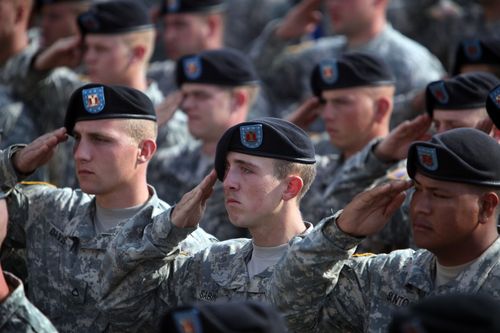
Ambers is right. There was something about this speech that resonated. The specificity of the individuals involved. The moving nature of their individual paths. And a defense of their service that somehow makes the current wars more bearable, their cause more understandable, and their sacrifices less demoralizing. This doesn’t make the case for those wars any easier, but it does reveal the quiet strength of a president who is a very different but, in my judgment, increasingly effective commander-in-chief.
It celebrates military courage and bravado:
Staff Sergeant Amy Krueger was an athlete in high school, joined the Army shortly after 9/11, and had since returned home to speak to students about her experience. When her mother told her she couldn’t take on Osama bin Laden by herself, Amy replied: “Watch me.”
But it also teaches perspective:
In today’s wars, there is not always a simple ceremony that signals our troops’ success – no surrender papers to be signed, or capital to be claimed. But the measure of their impact is no less great – in a world of threats that no know borders, it will be marked in the safety of our cities and towns, and the security and opportunity that is extended abroad. And it will serve as testimony to the character of those who serve, and the example that you set for America and for the world.
Here it is in full. Somehow, the president seems to rise to these occasions, and remind us not just of these servicemembers’ character, but of his as well:
“We come together filled with sorrow for the thirteen Americans that we have lost; with gratitude for the lives that they led; and with a determination to honor them through the work we carry on. This is a time of war. And yet these Americans did not die on a foreign field of battle. They were killed here, on American soil, in the heart of this great American community.
It is this fact that makes the tragedy even more painful and even more incomprehensible. For those families who have lost a loved one, no words can fill the void that has been left. We knew these men and women as soldiers and caregivers. You knew them as mothers and fathers; sons and daughters; sisters and brothers.
But here is what you must also know: your loved ones endure through the life of our nation. Their memory will be honored in the places they lived and by the people they touched. Their life’s work is our security, and the freedom that we too often take for granted. Every evening that the sun sets on a tranquil town; every dawn that a flag is unfurled; every moment that an American enjoys life, liberty and the pursuit of happiness – that is their legacy. Neither this country – nor the values that we were founded upon – could exist without men and women like these thirteen Americans.
And that is why we must pay tribute to their stories.
Chief Warrant Officer Michael Cahill had served in the National Guard and worked as a physician’s assistant for decades. A husband and father of three, he was so committed to his patients that on the day he died, he was back at work just weeks after having a heart attack.
Major Libardo Eduardo Caraveo spoke little English when he came to America as a teenager. But he put himself through college, earned a PhD, and was helping combat units cope with the stress of deployment. He is survived by his wife, sons and step-daughters.
Staff Sergeant Justin DeCrow joined the Army right after high school, married his high school sweetheart, and had served as a light wheeled mechanic and Satellite Communications Operator. He was known as an optimist, a mentor, and a loving husband and father.
After retiring from the Army as a Major, John Gaffaney cared for society’s most vulnerable during two decades as a psychiatric nurse. He spent three years trying to return to active duty in this time of war, and he was preparing to deploy to Iraq as a Captain. He leaves behind a wife and son.
Specialist Frederick Greene was a Tennessean who wanted to join the Army for a long time, and did so in 2008 with the support of his family. As a combat engineer he was a natural leader, and he is survived by his wife and two daughters.
Specialist Jason Hunt was also recently married, with three children to care for. He joined the Army after high school. He did a tour in Iraq, and it was there that he re-enlisted for six more years on his 21st birthday so that he could continue to serve.
Staff Sergeant Amy Krueger was an athlete in high school, joined the Army shortly after 9/11, and had since returned home to speak to students about her experience. When her mother told her she couldn’t take on Osama bin Laden by herself, Amy replied: “Watch me.”
Private First Class Aaron Nemelka was an Eagle Scout who just recently signed up to do one of the most dangerous jobs in the service – diffuse bombs – so that he could help save lives. He was proudly carrying on a tradition of military service that runs deep within his family.
Private First Class Michael Pearson loved his family and loved his music, and his goal was to be a music teacher. He excelled at playing the guitar, and could create songs on the spot and show others how to play. He joined the military a year ago, and was preparing for his first deployment.
Captain Russell Seager worked as a nurse for the VA, helping veterans with Post-Traumatic Stress. He had great respect for the military, and signed up to serve so that he could help soldiers cope with the stress of combat and return to civilian life. He leaves behind a wife and son.
Private Francheska Velez, the daughter of a father from Colombia and a Puerto Rican mother, had recently served in Korea and in Iraq, and was pursuing a career in the Army. When she was killed, she was pregnant with her first child, and was excited about becoming a mother.
Lieutenant Colonel Juanita Warman was the daughter and granddaughter of Army veterans. She was a single mother who put herself through college and graduate school, and served as a nurse practitioner while raising her two daughters. She also left behind a loving husband.
Private First Class Kham Xiong came to America from Thailand as a small child. He was a husband and father who followed his brother into the military because his family had a strong history of service. He was preparing for his first deployment to Afghanistan.
These men and women came from all parts of the country. Some had long careers in the military. Some had signed up to serve in the shadow of 9/11. Some had known intense combat in Iraq and Afghanistan, and some cared for those did. Their lives speak to the strength, the dignity and the decency of those who serve, and that is how they will be remembered.
That same spirit is embodied in the community here at Fort Hood, and in the many wounded who are still recovering. In those terrible minutes during the attack, soldiers made makeshift tourniquets out of their clothes. They braved gunfire to reach the wounded, and ferried them to safety in the backs of cars and a pick-up truck. One young soldier, Amber Bahr, was so intent on helping others that she did not realize for some time that she, herself, had been shot in the back. Two police officers – Mark Todd and Kim Munley – saved countless lives by risking their own. One medic – Francisco de la Serna – treated both Officer Munley and the gunman who shot her.
It may be hard to comprehend the twisted logic that led to this tragedy. But this much we do know – no faith justifies these murderous and craven acts; no just and loving God looks upon them with favor. And for what he has done, we know that the killer will be met with justice – in this world, and the next.
These are trying times for our country. In Afghanistan and Pakistan, the same extremists who killed nearly 3,000 Americans continue to endanger America, our allies, and innocent Afghans and Pakistanis. In Iraq, we are working to bring a war to a successful end, as there are still those who would deny the Iraqi people the future that Americans and Iraqis have sacrificed so much for.
As we face these challenges, the stories of those at Fort Hood reaffirm the core values that we are fighting for, and the strength that we must draw upon. Theirs are tales of American men and women answering an extraordinary call – the call to serve their comrades, their communities, and their country.
In an age of selfishness, they embody responsibility. In an era of division, they call upon us to come together. In a time of cynicism, they remind us of who we are as Americans. We are a nation that endures because of the courage of those who defend it. We saw that valor in those who braved bullets here at Fort Hood, just as surely as we see it in those who signed up knowing that they would serve in harm’s way.
We are a nation of laws whose commitment to justice is so enduring that we would treat a gunman and give him due process, just as surely as we will see that he pays for his crimes. We are a nation that guarantees the freedom to worship as one chooses. And instead of claiming God for our side, we remember Lincoln’s words, and always pray to be on the side of God.
We are a nation that is dedicated to the proposition that all men and women are created equal. We live that truth within our military, and see it in the varied backgrounds of those we lay to rest today. We defend that truth at home and abroad, and we know that Americans will always be found on the side of liberty and equality. That is who we are as a people.
Tomorrow is Veterans Day. It is a chance to pause, and to pay tribute – for students to learn of the struggles that preceded them; for families to honor the service of parents and grandparents; for citizens to reflect upon the sacrifices that have been made in pursuit of a more perfect union. For history is filled with heroes. You may remember the stories of a grandfather who marched across Europe; an uncle who fought in Vietnam; a sister who served in the Gulf.
But as we honor the many generations who have served, I think all of us – every single American – must acknowledge that this generation has more than proved itself the equal of those who have come before. We need not look to the past for greatness, because it is before our very eyes. This generation of soldiers, sailors, airmen, Marines and Coast Guardsmen have volunteered in a time of certain danger. They are part of the finest fighting force that the world has ever known. They have served tour after tour of duty in distant, different and difficult places. They have stood watch in blinding deserts and on snowy mountains. They have extended the opportunity of self-government to peoples that have suffered tyranny and war.
They are man and woman; white, black, and brown; of all faiths and stations – all Americans, serving together to protect our people, while giving others half a world away the chance to lead a better life. In today’s wars, there is not always a simple ceremony that signals our troops’ success – no surrender papers to be signed, or capital to be claimed. But the measure of their impact is no less great – in a world of threats that no know borders, it will be marked in the safety of our cities and towns, and the security and opportunity that is extended abroad. And it will serve as testimony to the character of those who serve, and the example that you set for America and for the world.
Here, at Fort Hood, we pay tribute to thirteen men and women who were not able to escape the horror of war, even in the comfort of home. Later today, at Fort Lewis, one community will gather to remember so many in one Stryker Brigade who have fallen in Afghanistan. Long after they are laid to rest – when the fighting has finished, and our nation has endured; when today’s servicemen and women are veterans, and their children have grown – it will be said of this generation that they believed under the most trying of tests; that they persevered not just when it was easy, but when it was hard; and that they paid the price and bore the burden to secure this nation, and stood up for the values that live in the hearts of all free peoples.
So we say goodbye to those who now belong to eternity. We press ahead in pursuit of the peace that guided their service. May God bless the memory of those we lost. And may God bless the United States of America.
(Photo: U.S. Army soldiers stand together as salute during the playing of taps at the memorial service that U.S. President Barack Obama and first lady Michelle Obama attended for the thirteen victims of the shooting rampage allegedly by U.S. Army Major Nidal Malik Hasan on November 10, 2009 in Fort Hood, Texas. Hasan, an army psychiatrist, is accused of killed 13 people and wounded 30 in a shooting at the military base on November 5, 2009. By Joe Raedle/Getty Images)
 The Dish