The Daily Wrap

Today on the Dish we saw more details emerge on the Hood tragedy and listened to the words of the commander-in-chief. Andrew examined the tragedy at length and in the broader of context of 9/11. Marc Lynch and Greenwald also offered their thoughts, while some ugly rhetoric on the right surfaced here, here, and here.

Napoleon Linardatos and Frum tackled Continetti's puff piece on Palin, and a reader scrutinized her pregnancy story. Andrew confronted Dreher over civil rights tactics and a youtuber took down Maggie Gallagher, hard.

In other commentary, Saletan zeroed in on the combat ban, Kerry Howley profiled Kathleen Parker, Exum gunned for Seymour Hersh, Joe Klein discussed the three Americans accused of espionage in Iran, and Andrew praised, yes, the Clintons.

As our pledge drive for the window book continued, a few readers saw what we see on the future of publishing. A few more readers wound down our discussion on the children of soldiers. And our MHB was pretty sublime.

— C.B.

On “Crap”

A reader writes:

Publishing a novel has been my life-long fixation. I've always been a hack, writing crap while getting paid to be a flak (14 years in PR). So, when I got fired from my last PR job a year ago I put my head down and wrote. The result was "Gone Postal" a political thriller for The Daily Show crowd. After shopping it around, I found a small press that was interested in publishing it.

Unfortunately, the deal fell through. For years I'd told myself if I couldn't get someone else to publish my writing I wouldn't go the vanity press route. After coming so close (and promising the thing to friends) I decided to go ahead and self-publish (I used createspace). What with blogs, twitter, and all the self-publishing vehicles available, it's ridiculously easy to publish crap.

Somewhere in all that crap is the best crap no one's ever read.

The biggest upshot of the self-publishing revolution is the greater likelihood of people finding the crap that means something to them rather than having experts tell them what crap should mean something to them. To survive, the publishing industry needs to figure out how to make money in that environment because there are tens of thousands of individuals working on the same problem and nowadays the gap between Random House and chuckleheads like me has never been narrower.

Face Of The Day

WariaUletIfansastiGetty2

A member of Koran school attends a special prayer school for transgender Muslims or 'waria' on November 9, 2009 in Yogyakarta, Indonesia. The Koran school, called 'Senin-Kamis' meaning Monday-Thursday, the 2 days the school operates, was founded in July 2008 by 48-year old Maryani as a place for waria to pray. Islam strictly segregates men from women when praying, leaving no-where for 'the third sex' waria to pray before now. There are now estimated to be around 300 men who prefer to live as women in Yogyakarta, many of whom work in the sex industry. By Ulet Ifansasti/Getty.

The Limits Of Hoffmanization

A poll came out today showing that Olympia Snowe (R-ME) might be vulnerable to a primary challenge from the right, even though the GOP would probably lose the seat if they forced her off the ticket. Yglesias thinks she will have to switch parties:

This means that when you’re thinking about whether Snowe will support a bill or not, the issue ultimately comes down to not triggers versus non-triggers, or employer mandates versus free rider fees, but whether Snowe wants to remain a Republican or not. Based on this polling, a Snowe who votes for a comprehensive health care overhaul is basically not going to be viable as a GOP primary candidate. Conversely, a Snowe who votes for comprehensive health reform and switches parties would remain a very popular general election candidate with a safe seat.

Chart Of The Day

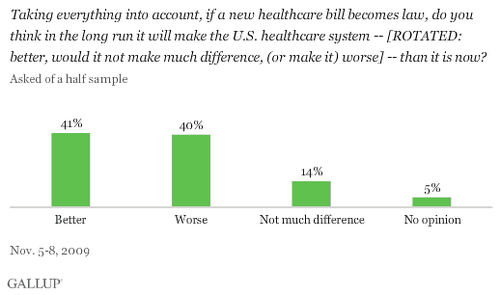
HealthCareOpinion

From Gallup:

The debate over new healthcare legislation now shifts to the Senate, at a time when the majority of Americans are not convinced that a new law would benefit either the national healthcare system or their own personal healthcare situations in the long term. The overall advice from the average American to his or her member of Congress at this point tilts negative, although about a third of Americans initially say they have no opinion on the legislation.

My own response would be: let's see what happens next.

If you see this as a process, then what matters is whether cost-controls can be subsequently generated through new research, comparative studies, bundling and the like. Once you get everyone in a system, you can start tinkering and adjusting. The current plan could lead to a stronger public option in due course, or a more libertarian approach that builds on the new health insurance exchanges. It could lead to serious cuts in Medicare – or a decision to maintain health as such a big and expensive part of American economy. It could lead to a cut in the employer subsidy … or to a single payer over time. We don't know. The question is: does this attempt to include everyone, to remove obvious injustices, and to craft a structure for the future make sense right now?

I think it's a decent start. And I think it was clearly Obama's campaign pledge, and is much more moderate than many seem to believe. I also believe that its failure would cripple Americans' confidence in their Congress to address any profound problem. And that would be a death-blow to constructive government and civil politics for a very long time to come.

Accidental Celebrities

Newsweek compiles a list of ten. Nick Hornby writes the entry for #10:

Levi Johnston flew blindfolded into a perfect—and perfectly contemporary—storm. He found himself at the center of a swirling mess: an inexplicable Republican misstep, the Christian right, an unstoppable presidential campaign, Facebook, the bewildering pervasiveness of modern media. If there are any other Alaskan teenagers who have somehow managed to invoke that sorry lot after an evening (or two) of careless lovemaking, I can’t think of them. A nut ad and a song are the least he deserves for his troubles.

Creating The Clash

Marc Lynch on the Ft. Hood shooting:

The grand strategy of al-Qaeda and its affiliated ideologues is, and has always been, to generate a clash of civilizations between Islam and the West which does not currently exist.  Their great challenge is that the vast majority of Muslims reject their theology, ideology, strategy and tactics.  That's especially true of American Muslims.  They therefore feel the need to change the environment in which Muslims live in order to change their calculations about the appropriateness of extremist identities and ideologies and actions.   

Terrorism is a means towards that end.  The object is to create a violent, polarized environment in which Muslims are forced to embrace a narrow, extreme version of Muslim identity.   They want Muslims to accept a master narrative in which the Islamic umma is existentially threatened by Western aggression, and the only theologically and strategically appropriate individual response is to join the jihad in the path of god (as they have defined it).