Morality As Strategy

Moshe Halbertal, a professor who helped craft the Israeli army’s ethics code, picks apart the Goldstone report and critiques its "overall biased tone." Nevertheless, he calls the siege of Gaza "morally problematic and strategically counterproductive." Money quote:

Radical groups such as Hamas start their struggle with little support from their population, which tends to be more moderate. They increase their base of support cynically, by murdering Israeli civilians and thereby goading Israel into an overreaction (this is not to deny, of course, that Israel can choose not to overreact) in a way that ends up causing suffering to the Palestinian civilians among whom the militants take shelter. The death and the suffering of the civilian Palestinian population, in the short run, is a part of the Hamas strategy, since it increases the sympathy of the population with the movement’s aims. An Israeli overreaction also leads to the shattering of Israel’s moral legitimacy in its own struggle. In a democratic society with a citizen’s army, any erosion of the ethical foundation of its soldiers and its citizens is of immense political and strategic consequence.

I suspect in due course that Gaza will be understood as immoral, and counter-productive. It repelled me in a way that nothing Israel has done repelled me. It was an act of anger and vengeance and cruelty. And it will come back to haunt the Jewish state.

The South Retreats

DiA notices that the leaders of both parties are no longer overwhelmingly southern:

Southerners haven't lost their country, but they have lost power—a power they disproportionately enjoyed for nearly the entire Clinton-Bush II era…"I want my country back," has become a conservative-populist rallying cry. They have not truly lost their country, but have seen a wild swing of power north and towards the coasts. It won't last, either. But it's a painful reality right now for a region that once revelled in separatism, then dominated the country as a whole for an oddly long stretch.

But the South's control of the GOP has never been tighter.

Defending Thatcher With Gorbachev

Claire Belinski says the recent tapes and transcripts tell us nothing very interesting or new about the Iron Lady:

The second thing Thatcher told Gorbachev, according to the transcript, was: “A destabilization of Eastern Europe and breakdown of the Warsaw Pact are also not in our interests.” Why might she have said this? Why would not say instead, “We are fomenting the destruction of the Warsaw Pact in the hope of swiftly burying you?” For the answer, recall that in September 1989, no one imagined that within two months, the Iron Curtain would dissolve without a drop of blood.

Much more easily envisioned was a Soviet crackdown and a brutal bloodletting, which had happened, within living memory, in Czechoslovakia and Hungary, and which the Chinese had just perpetrated months before in Tiananmen Square. Reasonable observers were worried that East German leader Erich Honecker was about to massacre thousands of people on the streets of Leipzig and Dresden—a step for which Honecker was preparing by stockpiling body bags. It was equally reasonable to fear that Gorbachev was on the verge of sending in Soviet troops. The transcript suggests that Thatcher’s goal was to reassure.

A cop facing a panicked criminal with a loaded gun and a room full of hostages is surely better off saying, “We do not plan to kill you, so stay calm” than “We want you dead, so you better shoot your way out of here.” Thatcher’s goal, at such a meeting, would have been to buy time and do what she could to keep the Soviets from panicking. No responsible politician would have told Gorbachev that she was praying for the destruction of the Warsaw Pact, particularly at a private, high-level diplomatic meeting. It would have been an idiotic provocation.

Hiatt’s Neocon Post

A less convincing version of Fox News? Greenwald continues the scrutiny:

The Post today has two former Bush officials, one former Reagan official, two right-wing politicians, a Fox News neocon, the CEO of America's largest oil and gas producer, a defender of the right-wing Honduran military coup leaders, and one liberal columnist.

The Catholic Hierarchy Backs Health Insurance Reform

This is a welcome development, both substantively on the merits (I oppose federal funding for abortion) and politically for the president:

"Passing this amendment allows the House to meet our criteria of preserving the existing protections against abortion funding in the new legislation," the Bishops wrote in a letter to individual members. "Most importantly, it will ensure that no government funds will be used for abortion or health plans which include abortion."

The group goes on to say, "The Conference will remain vigilant and involved through this entire process to assure that these essential provisions are maintained and included in the final legislation. With this important step forward we hope the House can come together and finally move forward essential reform which truly will protect the life, dignity, conscience and health of all. We also hope the Senate will follow the example of the House and include these essential safeguards in their version of health care reform legislation."

It's important to note what the theocons will never mention. Catholic teaching very, very strongly backs universal health insurance as a moral imperative.

“The Last Gasp Of Eloquent Mischief”

  Life-in-hell

John Williams reviews The Simpsons: An Uncensored, Unauthorized History by John Ortved:

Disclaimer: Like many people born in 1974, I’m incapable of writing a purely objective review of anything related to The Simpsons. The 1990s may have been a decade of peace and prosperity in the U.S., but it left much to be desired on the pop-culture front. The 1960s had the British Invasion, the 1970s had the golden age of American film, the 1980s even had its goofy-but-inimitable mix of MTV, early Letterman, and John Hughes movies. By comparison, Soundgarden and Singles seemed like a raw deal. But my generation in its youth had The Simpsons in its youth, and more than just the best thing ever made for TV (Homer’s clan was practically redeeming the existence of the entire medium when The Wire was but a twinkle in David Simon’s eye), the show’s glory days look more and more like the last gasp of eloquent mischief.

A few fascinating bits of Simpsons history after the jump:

[Producer James] Brooks’ reputation allowed the show to operate with an unusually low amount of flak from the suits, and it helped that the biggest suit of all — Rupert Murdoch — was a fan of the show. Wanting to establish his young network’s bona fides, he even moved The Simpsons to run opposite The Cosby Show on Thursday nights. “Cosby must be coming to the end of his run,” Murdoch boldly — and accurately — predicted. “[H]e’s been there forever.” (Simon, peeved at his show being put in such a tough spot, created the vacuous and vaguely Cosbyesque character of Dr. Hibbert to vent a little.)

Ortved is a perceptive enough devotee that he understood the need for Conan O’Brien to have his own chapter; not just because O’Brien is the show’s most famous alumnus, but because he most perfectly represents a certain pivotal strand of its DNA. […] Former staff writer Brent Forrester said, “Conan’s monorail episode was surreal, and the jokes were so good that it became irresistible for all the other writers to write that kind of comedy. And that’s when the tone of the show really took a rapid shift in the direction of the surreal.” Episodes credited to O’Brien managed this surrealism brilliantly, but they also planted the seeds for crasser, zanier shows like Family Guy and South Park to emerge — and for The Simpsons to become weakened, in turn, by the influence of its spawn.

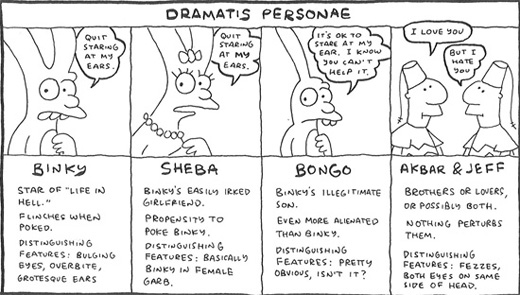
Image from Matt Groening's cartoon strip, "Life In Hell," created in 1977. More background here.

Palin In Wisconsin

Palinemailbanner
The former vice-presidential candidate and leader of the GOP base gave a speech last night in Wisconsin. From the scattered notes of someone who was there, it seems like it was a good speech, and rehearsed some serious applause lines on abortion, and revealed a new sophistication on the subject. I’m not sure how much time Palin has spent reading John Paul II, but she sure knew how to quote him. Here’s a passage as written down by an attendee going rogue:

Those who believed in the sanctity of life were told to sit down and shut up. Well, Wisconsin, you went rogue! Women who are protectors – protectors of the womb – you can’t just get over it and sit down and shut up. You’re changing hearts and changing minds. We’re dealing with the truth. The gift of knowledge lets us see truth with life. John 16:13: “spirit of truth.” Spirit of truth is being poured out on the country today and people are getting it.

But here’s the weird thing: no press was allowed. Here were a few of the restrictions:

• No exit and re-entry allowed • No cell phones • No recording devices • No video or still cameras • No laptops • No photos or recording allowed

There were metal detectors to enforce this extreme lockdown. And all bags were searched for recording devices. The question I have is: why? Here is a national politician addressing a state pro-life group, saying things that are presumably supposed to be part of a public debate and yet the whole thing is shrouded in secrecy. It’s a similar pattern to the campaign. Here is a public figure insisting on rules that no other public figure demands. Why? What is it about sunlight and an open debate that Palin is afraid of?

Beyond Arithmetic

Jonah Lehrer reviews some research showing the cognitive benefits of arts education:

The current obsession with measuring learning certainly has some benefits (accountability is good), but it also comes with some serious drawbacks, since it diminishes all the forms of learning, like arts education, that can't be translated into a score on a multiple choice exam.