Markos pulls the veteran card:
“Bigots,” Ctd
TNC riffs off this post by Brian Chase:
I have loved–and love–many people in my time. Many of them were bigoted against some group, somewhere. This expectation that "good people" won't be bigots is rather amazing. I came up in a world where it was nothing to hear the word "faggot" bandied about. Where those people awful human beings? Nah. Where they bigots? Yep. And I will tell you, without a moments hesitation, that I was one of them.
Sparkman Update
The case of the census worker found hanging from a tree with the word "FED" written on him gets murkier.
Thinking Of The Children, Ctd
A reader writes:
I teach at a large university in a conservative part of the country, and I think a large part of this fear of children learning that – gasp – people can be attracted to the same sex, has to do with the religious right's emphasis on marriage as a primarily sexual institution. They would not agree with that, of course, but look at how they teach sexuality education to their children: "Abstinence til marriage. Nothing else need be said." (Thus sending the message that sex and marriage are yoked at the hip.
The conservative youth group "Young Life" is very active where we live (high schools and college), and I cannot tell you how many young people (18-21) I know who have gotten married because they simply cannot hold out sexually any longer. They get married in order to have sex. They don't get married because they love the person; they may be deeply in love, but that's not why they're getting married at that particular time — they're getting married before they finish college, before they have decent-paying jobs, before they have health insurance, because they are afraid they won't be able to control their sexual urges any longer.
Sex is intrinsically linked to marriage. Sex=marriage=sex.
I also have known quite a number of people in their late 20s and early 30s (students) who are now divorced (or unhappily married), who tell me that that is exactly why they got married 10 or whatever years ago — and they are now stuck with two or three kids, trapped in a marriage they recognize was entered based on an immature idea of what "love" is and pressure from their families and conservative churches to, no matter what, NOT have sex before marriage.
This is not to say that many of those young couples can't make their marriages work, but to point out that the pressure — and the conflation of sex with marriage — is intense.
It is no wonder, then, that for a religious conservative, the thought of their first-grader coming home asking questions about their female teacher's wife, or reading about Heather and her Two Mommies, scares the bejesus out of them. Marriage is all about sex, and sex is already an extremely scary topic (see again their resistance to any kind of true sex education), and Good God …! It's downright terrifying for them.
I'd never really thought of it that way – and it's very helpful. Of course, to my mind, marriage is not really about sex, although it certainly includes that. For me, the core virtue of marriage is friendship.
The View From Your Window

Nairobi, Kenya, 6.13 pm
The Development Cure
DiA is skeptical of John Nagl's prescription for Afghanistan:
Mr Nagl writes that the world's greatest security threats in this century come not from states that are too strong, but from states that are too weak to control their territory. That's true, and it is probably the single fundamental thing that the Bush administration failed to get. He writes that the most important responses to the challenge of such instability are economic and political-diplomatic, not military. And that's right too. But he then wants to build a massive organisational capacity to solve the problems of global underdevelopment and instability through heroic expeditions. At that point, you need to stop and ask yourself whether that $60 billion a year might buy a lot more successful development, and hence a lot more stability, somewhere else in the world, where nobody would shoot at your Nebraska agricultural expert while he tried out a few types of bioengineered seed stock that might work in the local climate.
Aren't here many places in the US that could do with a bit of economic-political development? Like the Deep South or parts of rural America that have been left behind by the global economy? We understand those places a teensy bit better than we do Afghanistan.
We Are All Authors Now (And Publishers Too)
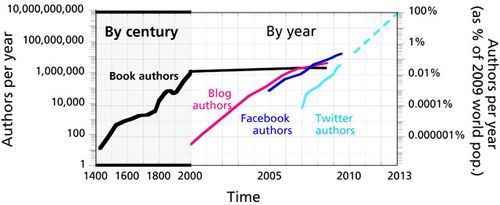
By 2000, there were 1 million book authors per year. One million authors is a lot, but they are only a tiny fraction, 0.01 percent, of the nearly 7 billion people on Earth. Since 1400, book authorship has grown nearly tenfold in each century. Currently, authorship, including books and new media, is growing nearly tenfold each year. That’s 100 times faster. Authors, once a select minority, will soon be a majority.
Today, at 0.1 percent authorship, many people are trading privacy for influence. What will it mean when we hit nearly 1 percent next year and nearly 10 percent the year after as the current growth predicts? Governments, businesses, and organizations must adapt to a population that wields increasing individual power. Protestors used Twitter to discredit the election in Iran. When United Airlines refused to reimburse a musician for damaging his guitar, the offended customer posted a song online—“United Breaks Guitars”—and United’s stock dropped 10 percent.
Norm Geras nit picks the analysis.
The Daily Wrap
Today on the Dish we focused on Fort Hood. We found footage here and here and first-hand accounts here and here. Major reax here. Bruce Bawer addressed the Muslim factor, Andrew warned against targeting Muslims, Greenwald grew frustrated over the media coverage, and Mark Noonan called for torture. We looked back at the other major massacre to hit Killeen, Texas, and there was another shooting today, in Orlando.
Andrew took a look at the unfortunately timed right-wing rally held in DC. One reader worried about the protestors and another pointed the finger at GOP leaders, such as Cantor.
Today's best email recounted a reader's experience growing up with a gay father. We also watched amazing montages of returning vets and movie titles.
— C.B.
God’s Work
I missed this earlier this week. It’s Jon Stewart at his best:
| The Daily Show With Jon Stewart | Mon – Thurs 11p / 10c | |||
| The 11/3 Project | ||||
|
||||
Nuclear Socialism?, Ctd
Yglesias responds to Frum:
Even though carbon pricing ought to make nuclear power profitable on an operating cost basis, it would be prohibitively expensive to raise the capital necessary to construct nuclear plants. I think you could resolve this by having the state step in and do the financing. He thinks, I guess, that some counterfactual private utility could do it if it were far larger than any existing utility. But how would you make these mergers happen? That sounds to me like you need an active state.
 The Dish