"If somebody tells me they want me to pay an appearance fee, it tells me they’re not very serious about running for president,” – Ed Failor, Jr., Iowan GOP insider, on Palin's demand of $100,000 to speak at the The Iowa Family Policy Center banquet next month.
Quote For The Day
"I'm also pleased that the bill includes a public option offered in an exchange. As I've said throughout this process, a public option that competes with private insurers is the best way to ensure choice and competition that are so badly needed in today's market. And the House bill clearly meets two of the fundamental criteria I have set out: it is fully paid for and will reduce the deficit in the long term," – president Obama, today.
First Friedman, Now Buckley
Is the Beltway consensus on Afghanistan shifting?
“No More Matthew Shepards,” Ctd
A reader writes:
While the new hate crimes bill may not be a deterrent in the short term, it will encourage victims to report the crimes–knowing that something might actually be done. (Just wait to see the rise in reported cases). Once more crimes are investigated and prosecuted, it could eventually raise awareness.
There was a time when young, black children were snatched off Southern streets and never heard from again. Lynchings were all too commonplace. But, enforcement of the Civil Rights act and subsequent laws against racially motivated hate crimes have been virtually eliminated what was once a too frequent scenario. It's easy to be cynical, but the law is a first step in the right direction; not to mention it is the first time "transgendered" has been included in federal legislation related to sexual orientation.
Another writes:
While I understand your philosophical objection to hate crime laws, this isn't purely about thought crime. NPR had a story this morning prominently mentioning some of the practical impacts of this legislation like federal resources for expensive forensics and prosecutions as well as improved crime statistics. Bringing hate crimes out of the closet matters too.
Another:
To paraphrase Dan Savage, it is true that hate crimes legislation will not create a force field around gay people and instantly provide them with new levels of protection from anti-gay violence. Hate crime legislation does, however, allow the federal government to provide resources to local governments as they investigate and prosecute hate crimes. In the Shepard case, prosecuting Matthew's two killers cost the county $150,000, forcing the county to furlough five employees (according to the Matthew Shepard Foundation's website). While hates crimes legislation would not have protected Matthew from the rage of his killers — nor would it have added more time to their prison sentences — it could have provided much-needed resources as Laramie struggled to deliver justice. I think this last point should not be dismissed so out of hand.
Another:
Hate crime laws: they're like when your mother buys you a Christmas present you can't stand and you have to say thank you anyway.
All I can say is that the Dish pledges to revisit this issue in a year's time – to assess the evidence that this law was more than mere symbolism. Given the vast amount of gay community resources and money that went into passing this – a decades' long effort – a little productivity check is in order.
Doubling Down
The anti-gay forces in Maine are ramping up the “gay conspiracy to get your kids” angle in the latest wave of ads. The pro-gay forces continue on the high road. I hope this ends well. Both ads after the jump. They are, in a way, almost poignant examples of the politics of fear and the politics of hope:
The View From Your Window

North Bend, Washington, 11 am
The War, Health Insurance, And The Budget
In a rare and welcome sign that the WaPo editorial board is responsive to readers, Fred Hiatt's outfit published the following editorial last Saturday:
A reader recently challenged us to explain what he sees as a contradiction in our editorial positions. We support the goal of universal health care, but argue that President Obama must keep his pledge not to pay for it with borrowed money. We have also backed Gen. Stanley A. McChrystal's request for additional troops and other resources for Afghanistan — but without specifying how the reinforcements should be funded. Why is it okay to finance wars with debt, asks our reader, but not to pay for health care that way?
Good question, no? Here's their short version of the answer:
Wars end, and the spending for them tapers off; entitlement programs must be funded in perpetuity. Wars compel decisions, like the one now at hand; new entitlement programs can be phased in or delayed. And the nation's security must be the president's first priority.
But the war on terror has been defined as unending. And although the Cold War is over, American troops remain all over the globe, in vast numbers in Germany and South Korea, and still – remember! – in Iraq and now more and more in Afghanistan. The truth is: wars are for ever, or at least as for ever as any budgetary process can determine. And secondly, the question of whether a war is vital for national security is an open one in any particular case.
Just because a president says it's necessary – as Bush did with Iraq – doesn't make it so. Assume that, say, that the war in Afghanistan could prevent another 9/11 attack (I'm not sure exactly how, but bear with me). Such an attack killed 3,000 people. As Greenwald points out, plenty of studies find that as many or more people die each year in the US for lack of health insurance. Are deaths from terrorism somehow more of a problem than deaths from lack of healthcare? Especially when the federal government actually has a feasible plan for saving those lives but has no convincing plan for victory in Afghanistan, whatever victory might now mean?
I think the WaPo is right to insist that universal health insurance be budgeted so that taxes are either raised or other spending cut to accommodate it (unlike the last actual entitlement, the Republican Medicare Prescription Act). But it seems to me essential that warfare not continue to be treated as some kind of rare and one-off expenditure. An empire that is running an annual deficit of over $1 trillion cannot make decisions about national security without also assessing the economic and fiscal costs. The time for delegating this to deciders is surely over. And the time to give deference to mere mentions of the words "national security" is surely over as well.
What Makes Palin Different
She’s demanding $100,000 just to give a speech to a Republican group in Iowa:
Tim Albrecht, spokesman for the conservative, Iowa-based American Future Fund, said his group “has a policy not to pay speakers to come to Iowa,” and, like Failor, hinted at what those guests get in return. “We are proud to host conservative leaders from across the country, providing them an audience across the state and nation to share their conservative vision,” Albrecht said. Like the other Iowa political hands, he could not recall a single instance where a potential candidate had been paid to speak.
Palin vs Johnston, Ctd
A reader writes:
How laughable and hypocritical that Sarah Palin would attack Levi Johnston for "selling his body for money." This coming from a former beauty pageant contestant… a well established industry built on 'selling bodies'.
Another writes:
Can you ask around if Levi just opened himself up to a world of legal trouble?
I'm no lawyer, but if he is saying he knows about Palin's illegal actions as governor but he isn't going to say, doesn't that make him an accessory or accomplice to a crime and couldn't he be forced to testify if she were prosecuted? If he doesn't tell the whole truth wouldn't he then possibly face perjury? Ouch. I think he may have opened a can of worms on national TV.
Who knows where this will end up? The only thing I'm sure of is that the MSM has no interest in finding out the actual truth behind Sarah Palin, whatever it is. But the truth nonetheless will eventually come out (just don't expect it from Harper Collins, Katie Couric or Oprah Winfrey).
A Stimulus Upswing Of 9.9 Percent Since Obama Took Office
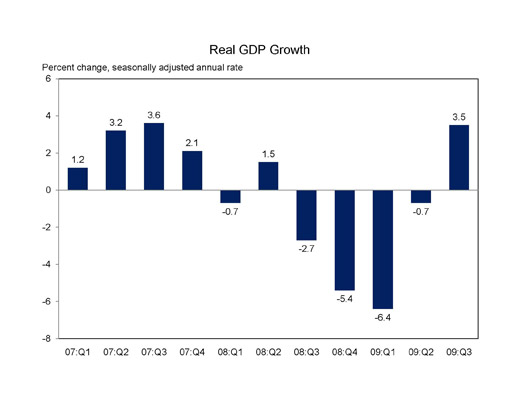
Chart via Yglesias. Free Exchange says not to get too giddy:
[At] long last, the American economy is growing again. Jobs, however, are still tricky to come by. Initial jobless claims declined by 1,000 from the previous week, but remain 10,000 about their level on October 10. Continuing claims fell to their lowest level since March, but this primarily reflects the exhaustion of benefits; workers receiving extended benefits are not counted in the total. So while the end to contraction has stopped the labour market bleeding, recovery has yet to begin the healing. Growth is good, but absent job creation it is difficult to get too excited.
 The Dish