Marriage equality is not dead this year.
Reality Check III
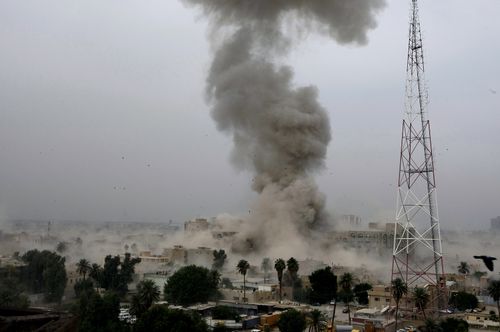
The Beltway's conventional wisdom has long been that the war in Iraq is over. According to the partisan GOP blogs, Bush won the war last year. And yet, for all the many reports of a new calm in Iraq, and on the day that Tom Friedman buys into Maliki's hope that a new non-sectarian future is imminent, two massive car bombs reveal that security still needs a city divided by huge, concrete barriers, and American troops for investigation and clean-up. It's worth recalling that this is still happening even as over 120,000 US troops remain in the country. If this can happen when they are there in such vast numbers, what are the odds that Iraq will remain half-way peaceful and unified when/if the US leaves?
For those who believe the surge solved the Iraq problem, these are inconvenient truths. But the surge failed in its core task: to create an environment in which the three major sects in Iraq could form a national government, a national army, and a stable balance between the three major centrifugal forces in the country and in Baghdad. Maliki's bid for a post-sectarian polity rests fundamentally on his claim to have restored some semblance of security. But how easy it will be for that semblance to be wiped out by violence of the kind demonstrated today.
And how tempting it will be, after the Americans leave, for the largely Shiite Baghdad government to resort to force against largely Sunni insurgents. From there … a short road back to 2006. Maybe the population is exhausted by civil war and will restrain these forces; maybe these blasts are the exceptions that prove the rule of growing normalcy. Or maybe they are warnings that violent forces of sectarianism remain at large, that they are close to impossible to stop, and that the lull is just that: a lull until the invading army leaves and the civil war can resume unimpeded.
This is not over; and any deliberation about moving vast numbers of troops into Afghanistan should grapple with the understanding that many may still be needed in Iraq for a decade or more if that ungrateful volcano is not to explode again and again and again.
(Photo: Smoke billow following a blast close to the Justice Ministry in central Baghdad on October 25, 2009. Twin suicide vehicle bombs blamed on Al-Qaeda blast the justice ministry and a provincial office in Baghdad, killing at least 99 people and sparking turmoil in the embattled Iraqi capital. By Sabah Arar/AFP/Getty Images)
Quote For The Day II
“I’m not much for this war. I’m not sure it’s worth all those lives lost. You can see we are making progress, slowly. But when we leave, the Taliban and Al-Qaeda will surely return," – Sergeant Christian Richardson in Afghanistan.
Reality Check II
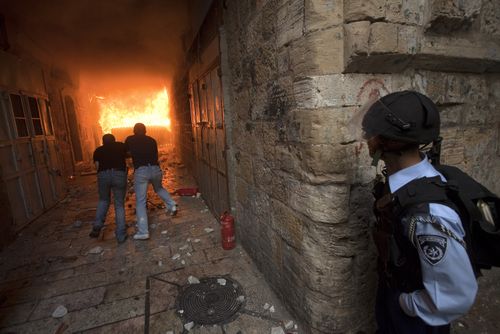
In a reminder that tensions in and around Israel and Palestine are still mounting, extremists on both sides ginned up a nasty confrontation in and around the Al-Aqsa mosque in Jerusalem. Reading most of the reports, it seems as if the melee was provoked primarily by Muslim fanatics reacting against rumors that Israel was intending closer supervision of the site and possibly allowing Jews to worship there. There's no evidence backing the rumors, although some on the settler right clearly would like to up the ante.
It's useful to remember that this impasse is fueled by land but also, increasingly, by fundamentalism. The Israeli government is influenced more than ever by the burgeoning ranks of fundamentalist Jews for whom issues of land and peace are not political endeavors but apocalyptic religious duties. And, of course, to an even greater extent, the Palestinians have shifted from being a nationalist and political entity toward becoming a Muslim and religious force.
These are the forces Obama is battling.
They are the forces we are all battling: as religion coopts politics in places as disparate as the GOP base, the Israeli electorate, and the Muslim masses in the Middle East, the odds of a peaceful, worldly resolution along pragmatic lines lengthen. The trouble is: no grandstanding on civilizational lines can work. The key is to lower the temperature – as Maliki is trying to do in Iraq, as the more secular Green Movement is trying to do in Iran, as what's left of Pakistan's secular military is attempting in Waziristan, as Obama is trying to do on a much milder scale in the culture-religious ars at home.
But symbols like Al-Aqsa or the center of Baghdad remain critical stages for fundamentalist, sectarian drama – the kind that polarizes so deeply that the religious atavistic impulse emerges. It is still here. And still extremely dangerous.
(Photo: An Israeli policeman looks at Palestinian men as they try to extinguish a fire that started after youths set ablaze barricades during clashes with Israeli police in Jerusalem's old city on October 25, 2009. Clashes erupted between Israeli police and Palestinians in and around the Al-Aqsa mosque compound in the latest violence to shake Jerusalem's flashpoint site holy to Muslims and Jews. By Menahem Kahana/AFP/Getty.)
Reality Check I
Obama’s approval ratings among independents:
Presidents Will Never Give Up Power
Julian Sanchez chronicles the Obama administration's latest "Kabuki" on reforming Bush-era executive overreach:
Last week, the Senate Judiciary Committee seemed to abandon hope of bringing any real change to the Patriot Act. A lopsided and depressingly bipartisan majority approved legislation that would reauthorize a series of expanded surveillance powers set to expire at the end of the year. Several senators had proposed that reauthorization be wedded to safeguards designed to protect the privacy of innocent Americans from indiscriminate data dragnets–but behind-the-scenes maneuvering by the Obama administration ensured that even the most modest of these were stripped from the final bill now being sent to the full Senate.
The supposed rationale for rejecting these changes–many of which the very same Judiciary Committee had unanimously favored just four years earlier–was that any new limitations on broad search powers might interfere with an "ongoing investigation." During hearings, one Justice Department official had alluded to an "important, sensitive collection program" involving 215 orders, and Attorney General Eric Holder publicly implied–though he did not state outright–that the new powers had played a crucial role in the capture of alleged bomb plotter Najibullah Zazi. But there is ample reason for doubt.
Continued here.
Quote For The Day
"A bit of dithering might have been in order before we went into Iraq in pursuit of non-existent weapons of mass destruction. For a representative of the Bush administration to accuse someone of taking too much time is missing the point. We have much more to fear in this town from hasty than from slow government action," – George Will, whose sanity on this must be balanced by his positioning on the insanity of Michele Bachmann.
Still, he did describe Bachmann as "an authentic representative of the Republican base." Which us true enough. And enough to make most intelligent conservatives look for another party.
The YouTube Diaries
The Anne Frank Museum has uploaded the only existing footage of the girl – amounting to just 21 seconds. Stefany Anne Golberg reflects:
It’s funny how ghosts always appear at windows. They’re always trying to get in, peering out, or — seen from outside wandering back and forth — floating in and out of the window’s frame. Think Catherine in Wuthering Heights, Peter Quint in Turn of the Screw, the charming maiden in The Deserted House, Poe’s The Haunted Palace…the list is long. Nothing represents longing and loss like a window, especially a haunted one.
It’s no wonder that the word “haunt” has its roots in the word “home.” Ghosts are always trying to find their way home, or find themselves lost in a home where they are unwanted. Even when they are in a home, they never feel “at home.” Ghosts are permanently homeless. They live in the space between inside and outside, between home and not home, like a window. Lurking about a window, the ghost hopes to see and be seen, aching to be free. But ghosts are by definition in limbo, and therefore never free. Anne Frank probably spent many hours at the window of Merwedeplein 37, caught in the limbo between being a 12-year-old girl who must stay at home, and a dreamer, a natural flâneur forced to wander the streets of Amsterdam in her imagination.
Face Of The Day
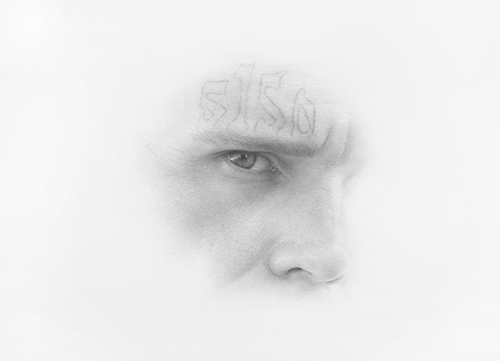
From a collection, "Deadly Friends," by Patrick Lee:
His drawings are painstakingly crafted over months of refinement. Inspired by photographs he takes of men from the streets of America, they convey a unique insight into class and gender ideals. Many subjects are ‘outsiders’ or ‘outlaw’ types; mimicked by pop culture icons and contemporary heroic figures.
More about Lee here.
From The Annals Of Dumb Criminals
Lexington contributes a gem:
[Major Marty Sumner] was describing a period when the police in High Point were trying to figure out which local youths belonged to which street gangs and which gangs were involved in which types of crime. It turned out that one of their most valuable sources of information was the gangs' own Facebook pages. Some gangbangers had posted pictures of themselves posing with guns, showing off their gang insignia and bragging about the money they were making. They also posted messages to each other, making it farcically simple for the police to figure out who was associated with whom.
 The Dish