A niche blog.
Free Sperm
Rachel Lehmann-Haupt blogs about altruistic sperm donors who give away their seed for free:
On www.trentdonor.com, a twentysomething 6-foot-1 blond from Northern California poses to accentuate his square jaw, wide smile, and puppy-dog-brown eyes. He politely promises to respond within three days, although he can take up to a week during heavy donation months. And he’s not talking about a clothing drive. This young stud is giving away his sperm for free, except shipping costs, because, he says, he has “a spirit of volunteering to the community,” and along with the summers he has spent building orphanages and schools with his church in China and Mexico, he believes that “sperm donation is one more way he can help those in his community who may be in need.”
Mental Health Break
Down the Vimeo rabbit hole:
Sound Design for ‘Video Art’ by Gyu Kim from Johannes Oesterle on Vimeo.
Political Correctness, Left And Right
A reader writes:
I've been reading Marilynne Robinson's book of essays, The Death of Adam: Essays on Modern Thought. Her essay entitled “Puritans and Prigs” sets out to defend the Puritans and contrast them to a group she calls prigs, the sort of politically correct thought police that the right used to rail against in the 1990s. I think her argument also has a lot in common with your indictments of fundamentalism and movement conservatism.
The Puritans' belief that we are all sinners, Robinson says, gives "excellent grounds for forgiveness and self-forgiveness, and is kindlier than any expectation that we might be saints, even while it affirms the standards all of us fail to attain." However, she argues that modernity, of which prigs are emblematic, is essentially Stalinist, in that it believes that society
can and should produce good people, that is, people suited to life in whatever imagined optimum society, who then stabilize the society in its goodness so that it produces more good people, and so on. First the bad ideas must be weeded out and socially useful ones put in their place. Then the bad people must be identified, especially those that are carriers of bad ideas. . . [Thus it] creates clear distinctions among people, and not only justifies the disparagement of others but positively requires it. Its adherents are overwhelmingly those who feel secure in their own reasonableness, worth, and goodness, and are filled with a generous zeal to establish their virtues through the whole of society, and with an inspiring hope that this transformation can be accomplished.
The prigs are the ones who, with a sort of superiority, correct the language you use or chastise you for your diet based on some idea of political correctness:
I think because our zealots subscribe to the conversion myth, they can only experience virtuousness as difference. They do not really want to enlist or persuade–they want to maintain difference. I am not the first to note their contempt for the art of suasion. Certainly they are not open to other points of view. If it is true that the shaping impulse behind all this stylized language and all this pietistic behavior is the desire to maintain social distinctions, then the moral high ground that in other generations was held by actual reformers, activists, and organizers trying to provoke the debate and build consensus, is now held by people with no such intentions, no notion of what progress would be, not impulse to test their ideas against public reaction as people do who want to accomplish reform. It is my bitter thought that they may have made a fetish of responsibility, a fetish of concern, of criticism, of indignation.
Indeed, much the same could be said of today’s right. For my part, it seems all such prigs (left and right) stem from the fundamental epistemological arrogance of modernity–that all things can be known. This is as true of Darwinism as it is of biblical fundamentalism. The older I get, the more folly such claims seem to contain. This is not a new insight: one need only look at Ecclesiastes. Efforts such as political correctness and movement conservatism are destructive of civil society and are based on nothing more than a chasing after the wind.
Beautifully and powerfully put.
Illustrating Left And Right
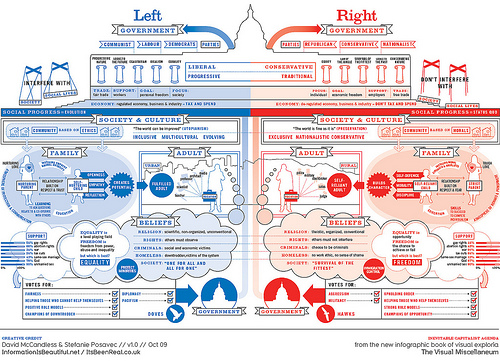
Click here to enlarge. Co-creator David McCandless writes:
Of course, the political spectrum is not quite so polarised. Actually, it’s more of a diamond shape, apparently. But this is how it’s mostly presented via the media – left wing vs. right wing, liberal vs. conservative, Labour vs Tory. And perhaps in our minds too…
Well, certainly in my mind. Researching this showed me that, despite my inevitable journalistic lean to the ‘left’, I am actually a bit more ‘right’ than I suspected. This kind of visual approach to mapping concepts really excites me. I like the way it coaxes me to entertain two apparently contradictory value systems at the same time. Or, in other words, I like the way it f**ks with my head.
Taken like that, it's harmless enough, I guess. But this dumb and lazy-ass "right-left" rubric really does have to stop some time.
(Hat tip: Laughing Squid)
First Andrew Lloyd Webber; Then AIDS
It was tough on Broadway in the early 1990s. Dan Savage interviews Frank Rich and asks why gay equality is so central to Frank's column:
I can't speak for why others don't do it. I am baffled by it. It seems to me such an obvious civil-rights issue. In my case, I got interested in it and my eyes were opened precisely because I covered the theater. In the 1980s, which was the bulk of when I was a Times drama critic, to the early '90s, two things happened in New York theater. One was unfortunately the arrival of Andrew Lloyd Webber and the other was the AIDS epidemic, and it was eye-opening. It was literally happening on my beat; people, artists I admired, were dying, getting sick and dying. In some cases, you'd hear about people's deaths well after the fact, particularly if they weren't famous in the theater, or under mysterious circumstances in those days.
Of course a lot of people don't even remember this history now, but you certainly know it, and it really had the effect of—I guess I wouldn't say radicalizing me, but really opening my eyes to a whole minority of America that had been shabbily treated, that had to often live in secret, and was now being victimized by a ruthless epidemic, while a lot of people stood around and did nothing.
So at first, it really changed my view of things; it really opened my mind to stuff I hadn't, embarrassingly, given much thought to. And then of course, what happened was that theater itself began to take AIDS as a subject, but that's already well along in the story. You'd have to have been dead to be on the beat I was on and not say: "What the hell is going on here?" And so it stayed with me.
Two Tales Of Humankind
Duelity from Ryan Uhrich on Vimeo.
The Generosity Paradox
Robert Wiblin points to a study showing how the most generous people are often the most likely to avoid situations where they will be generous.
Probably the kindest girl in my high school said to me once that she didn’t want a job where she would get rich because there are so many poor people in the world. I said that she should be rich and give the money to the poor people then. Nobody was wowed by this idea. I suspect something similar happens often with people making business and employment decisions. Those who have qualms about a line of business such as trade with poor people tend not to go into that, but opt for something guilt free already, while the less concerned do the jobs where compassion might help.
Hitchens Bait
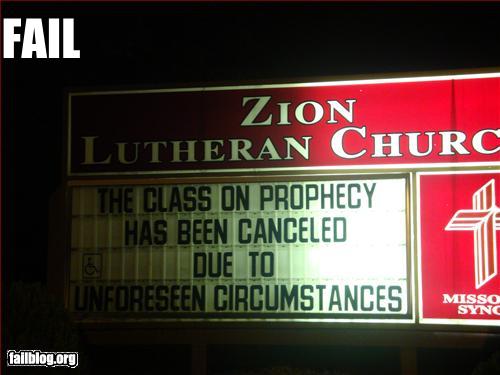
From Failblog.
God Poked Holes In Your Condom
The Anchoress defends the church teaching that "every sperm is sacred." After explaining how "control is often an illusion" because birth control doesn't always work and "God will do what He will, sometimes, whether you’re open to it or not, in hopes that you WILL become open, and more open, to his loving gifts" she hits upon one of the Church's core contradictions:
The church understands and respects nature – sooner or later fertility ends, that does not mean sex ends. One of the common misunderstandings is that “the church says sex must always and only be about procreation, and if it’s not possible, then sex is a sin.” This is nonsense. Sex is the gift and privilege of married couples, both pleasurable and procreative. When fertility has come to an end, when the possibility of new life is no longer there, that means the procreation part has ended, not the pleasure.
I don't dismiss this at all. But if sex can be merely pleasure and not procreation because of the restraints of our nature, what about the gays? The issue is explored at length in Virtually Normal.
 The Dish