“A nifty student animation by Sjors Vervoort – gets even better towards the end…”
Against Cable News
Yglesias takes a stand:
[T]hink about the strange influence that daytime cable news has on American politics. The three networks combined have an aggregate daytime audience of roughly zero. But even though the audience, looked at nationally, amounts to rounding error the networks are hugely popular among the tiny number of people who work in professional politics. Just like traders have CNBC and Bloomberg on in their offices, political operatives are constantly tuned in to what’s happening on cable news. The result is a really bizarre hothouse scenario in which people are basically watching . . . well . . . nothing, but they’re riveted to it. How things “play” on cable news is considered fairly important even though no persuadable voters are watching it. And cable news’ hyper-agitated style starts to infect everyone’s frame of mind, making it extremely difficult for everyone to forget that the networks have huge incentives to massively and systematically overstate the significance of everything that happens.
I've stopped going on for these reasons (and complete lack of time). The web has smarter opinions, far more nuance, and real, accessible, checkable data.
The West’s Afghan Delusions
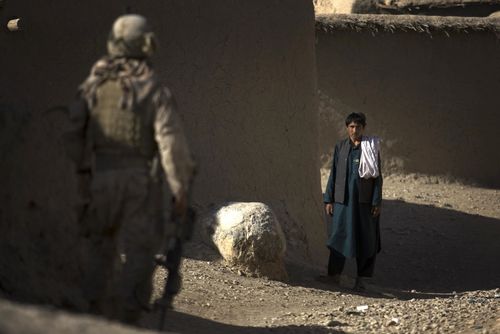
Here's a question asked by Rory Stewart:
Why do we believe that describing what we do not have should constitute a plan on how to get it?
Because something must be done. But what if there isn't much to be done that can actually help? What if less might actually get us more? This almost perfectly sums up how Washington currently approaches the question:
Policymakers perceive Afghanistan through the categories of counter-terrorism, counter-insurgency, state-building and economic development. These categories are so closely linked that you can put them in almost any sequence or combination. You need to defeat the Taliban to build a state and you need to build a state to defeat the Taliban. There cannot be security without development, or development without security. If you have the Taliban you have terrorists, if you don’t have development you have terrorists, and as Obama informed the New Yorker, ‘If you have ungoverned spaces, they become havens for terrorists.’
These connections are global: in Obama’s words, ‘our security and prosperity depend on the security and prosperity of others.’ Or, as a British foreign minister recently rephrased it, ‘our security depends on their development.’ Indeed, at times it seems that all these activities – building a state, defeating the Taliban, defeating al-Qaida and eliminating poverty – are the same activity.
Here's Stewart on the possible unintended consequences of building a stronger Afghan army and police force:
US generals have spoken openly about wanting a combined Afghan army-police-security apparatus of 450,000 soldiers (in a country with a population half the size of Britain’s). Such a force would cost $2 or $3 billion a year to maintain; the annual revenue of the Afghan government is just $600 million. We criticise developing countries for spending 30 per cent of their budget on defence; we are encouraging Afghanistan to spend 500 per cent of its budget.
Some policymakers have been quick to point out that this cost is unsustainable and will leave Afghanistan dependent for ever on the largesse of the international community. Some have even raised the spectre (suggested by the example of Pakistan) that this will lead to a military coup. But the more basic question is about our political principles. We should not encourage the creation of an authoritarian military state. The security that resulted might suit our short-term security interests, but it will not serve the longer interests of Afghans. What kind of anti-terrorist tactics would we expect from the Afghan military? What kind of surveillance, interference and control from the police? We should not assume that the only way to achieve security in a developing country is through the restriction of civil liberties, or that authoritarianism is a necessary phase in state-formation, or a precondition for rapid economic development, or a lesser evil in the fight against modern terrorism.
Read the whole thing, especially snippets from the British debate over the self-same question in the 1860s.
How To Bite A Bully
And other hilarious but helpful tips from the early '90s.
Is Vampire The New Gay?
Stephen Marche muses:
Edward, the romantic hero of the Twilight series, is a sweet, screwed-up high school kid, and at the beginning of his relationship with Bella, she is attracted to him because he is strange, beautiful, and seemingly repulsed by her. This exact scenario happened several times in my high school between straight girls and gay guys who either hadn't figured out they were gay or were still in the closet. Twilight's fantasy is that the gorgeous gay guy can be your boyfriend, and for the slightly awkward teenage girls who consume the books and movies, that's the clincher. Vampire fiction for young women is the equivalent of lesbian porn for men: Both create an atmosphere of sexual abandon that is nonthreatening. That's what everybody wants, isn't it? Sex that's dangerous and safe at the same time, risky but comfortable, gooey and violent but also traditional and loving. In the bedroom, we want to have one foot in the twenty-first century and another in the nineteenth.
Brian Moylan counters Marche. The Dish prefers werewolves.
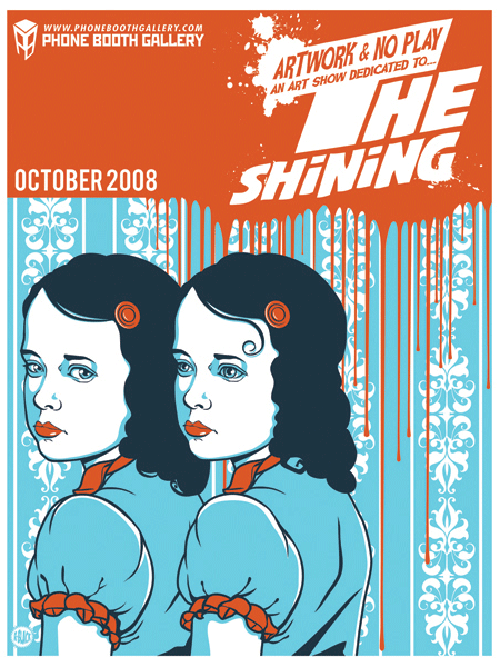
Making Movie Posters Retro

How To Win Marriage Equality
Some tips from Maine. But I'm leery of predicting anything. What works is honesty, not fear. And you can still help:
Out-of-state volunteers can make phone-calls from home, while there are organized phone-banks going on across the country. East Coast volunteers can take a day (or weekend trip) to Maine and find a carpool through an online feature that pairs up people in your area. And you can donate money or airline miles to send volunteers for a week at Travel for Change. Or you can give to the California Young Democrats, who will be helping the last-minute college campus push by getting plane tickets for volunteers who will be on the ground during the last four days.
Best Of “Best Of Wikipedia”
In shopping mall design, the Gruen transfer refers to the moment when a consumer enters a shopping mall, and, surrounded by an intentionally confusing layout, loses track their original intentions. Spatial awareness of their surroundings play a key role, as does the surrounding sound and music. The effect of the transfer is marked by a slower walking pace and glazed eyes.
… or A Company that Makes Everything is a fictional corporation that exists in several cartoons, films and TV series, most significantly in the Looney Tunes universe, where it appeared most prominently in the Road Runner/Wile E. Coyote cartoons, which made Acme famous for outlandish and downright dangerous products that failed catastrophically at the worst possible times.
… is a pronounced emotional desire towards particular inanimate objects. Those individuals with this expressed preference may feel strong feelings of arousal, attraction, love, and commitment to certain items or structures of their fixation. For some, sexual or even close emotional relationships with humans are incomprehensible. The term objectum-sexuality was coined in the 1970s by a woman named Eija-Riitta Eklöf Berliner-Mauer from Liden, Sweden, who was married to the Berlin Wall.
Cool Ad Watch
Peggy Wang captions:
Maybe you’ve seen this already, but it’s a fake trailer for a movie produced by a French premium pay channel (think HBO). This is probably what French people’s love lives are really like.
Still A Tory, Ctd
A reader writes:
Alex Massie wrote:
"It also demonstrates how far American popular conservatism has diverged from its counterparts in Britain and the rest of Europe." That gets it as wrong as it could.
What it actually demonstrates is how divergent American popular conservatism has always been from its counterparts.
THIS is the American popular conservatism that gave rise to Faulkner, Tennessee Williams, and Sinclair Lewis.
THIS is the American conservatism wherein comfortably lies Elmer Gantry.
I don't think you Brits have ever quite understood that. You have instead read the thoughtful writing of conservative intellectuals and assumed this was more or less what American conservatism was. NO!
Yes, the thoughtful ones exist, but they are a minority, and now they have lost control of the tiger they rode.
 The Dish