The World Is Fat

So says a new global study, which finds that 2.1 billion people are now overweight and 671 million clinically obese. The Economist visualizes some of the report’s findings:

20140531_gdc156_2

The gist:

new report published in the medical journal The Lancet found that the highest rates of obesity are in the Middle East and North Africa, but the United States is home to 13 percent of the world’s obese population, a higher proportion than any other country. Lead author Christopher Murray told CBS News that the findings are “pretty grim,” adding that “when we realized that not a single country has had a significant decline in obesity, that tells you how hard a challenge this is.”

To compile the data, researchers combed through surveys, reports and studies from 1980-2013 listing height and weight information for people throughout the world. They found that the percentage of adults with a body-mass index (BMI) of 25 kg/m2 or higher — the threshold for being overweight — rose, for men, from 28.8 in 1980 to 36.9 in 2013, and for women, from 29.8 to 38.

Adrianna McIntyre weighs the report’s implications:

It’s estimated that 3.4 million deaths were caused by overweight and obesity in 2010. The conditions are associated with cardiovascular disease, cancer, arthritis, and kidney disease. Modern medicine can mitigate the symptoms of these diseases — there are drugs that help control blood pressure and cholesterol, for example — but substantial health effects remain, reducing life expectancy and quality of life. …

Science can’t agree on what’s driving the global obesity crisis.

The obvious culprits are higher-calorie diets paired with less active lifestyles — this certainly seems to be the case in the United States — but it’s not clear that those are the only factors driving the global trend. An alternative hypothesis suggests that changes in human microbiomes (the bacteria that line the intestine) could be changing in ways that cause people to gain weight. These bacteria influence the way food is digested; studies have shown that you can make a mouse obese by implanting gut bacteria from an obese mouse. Research into the association between obesity and human microbiomes is still preliminary.

But Keating wonders if the obesity rate isn’t peaking:

It’s not exactly news that the world is getting fatter, and that no country has yet been able to reverse this trend. But, intriguingly, the report also points out that the biggest growth in the prevalence of obesity took place between 1992 and 2002. Since then, it’s been slowing down …

There’s not really data to say for sure yet, but perhaps at a certain level of economic growth, the relationship between affluence and weight gain—caused by more food intake, more prepared food, and less physical activity—starts to change. Or maybe there’s just a saturation point for how overweight a society can get.

And Uri Friedman pulls out one important, troubling detail:

[W]hile some progress has been made in wealthy nations, none of the 188 countries in the Lancet study have recorded significant declines in obesity since 1980. There are “no national success stories,” the authors note. That’s the challenge facing governments around the world. How do you develop a strategy to reverse obesity rates when no country has successfully implemented one yet?

The EPA Goes After Dirty Energy

This could be big:

President Obama will use his executive authority to cut carbon emissions from the nation’s coal-fired power plants by up to 20 percent, according to people familiar with his plans, which will spur the creation of a state cap-and-trade program forcing industry to pay for the carbon pollution it creates.

Plumer previews the plan, which will be released Monday:

The EPA has a fair bit of leeway in designing this rule, and the precise details will matter a lot. A strict rule that cuts power-plant pollution sharply could help the Obama administration achieve its goal of cutting overall US greenhouse-gas emissions 17 percent below 2005 levels by 2020. Officials hope that meeting this goal will help persuade other countries like China to do more to address climate change.

But there are risks, too. A rule that’s too stringent or badly designed could impose high costs on power plants and hike consumers’ electric bills. That, in turn, could trigger a backlash from Congress — which has the power to take away the EPA’s authority. What’s more, the EPA is entering uncertain legal territory with this rule, and there’s always a chance that the courts decide the agency has exceeded its legal mandate and strike down the regulation.

Ben Adler expects Big Coal to put up one hell of a fight:

Whatever the specifics of the EPA’s plan, there is no question that it will create winners and losers among different industries. And since coal is the most carbon-intensive fossil fuel, there is no question that the coal mining industry will be among the latter. That’s why it plans to come out swinging at the new regulations.

The US Chamber of Commerce released a report Wednesday predicting that the new rules could cost the economy $1 billion a year in lost jobs and economic activity. The National Mining Association is running radio spots claiming they will lead to an 80 percent jump in electricity bills. The pro-coal group ACCCE conducted its own study, and concluded that the rules could run up $151 billion in additional energy costs for consumers by 2033.

The trouble with such predictions, counters the Environmental Defense Fund’s Ceronsky, is that the economic impact of the rules will depend entirely on how states chooses to implement the standards,  “They have the flexibility to make this as cost-effective as they can,” she says. British Columbia’s carbon-tax system, for example, has netted more than $5 billion in revenue since 2008, while carbon emissions plunged seven times more than they would have otherwise. And although the NRDC predicts that full implementation of the most rigorous version of the rules could cost up to $14.6 billion nationwide, it predicts savings of up to $53 billion in avoided health and climate impacts, and $121 billion in energy efficiency and renewable energy investments pumped into local economies.

Cohn predicts a Republican freak-out about the return of cap-and-trade:

Of course, this is another case in which the right’s anger will be at odds with policy positions mainstream conservatives once professed to hold. Cap-and-trade is a market-based alternative to a more straightforward carbon tax, which is the solution that many liberals would prefer. It was actually part of John McCain’s 2000 presidential campaign and Mitt Romney, as governor of Massachusetts, played a key role in setting up the market now operating in the Northeast. If states have the flexibility most experts expect, the conservative anger will be doubly ironic, because this is precisely the way that most conservatives think federalism should work—by giving states freedom to solve problems in ways that best suit their resources and preferences.

And Chait gleefully gives Mitt Romney credit for laying the groundwork:

As governor of Massachusetts, Mr. Romney was a key architect of a cap-and-trade program in nine northeastern states, the Regional Greenhouse Gas Initiative. … Officials with the northeastern regional cap-and-trade program that Mr. Romney initially endorsed have played a significant role in shaping the new rule. In frequent trips to Washington over the last several months they have consulted with [EPA administrator Gina] McCarthy [who designed Romney’s cap-and-trade program in Massachusetts] and other top E.P.A. officials.

It’s Cap-and-Mitt!

Reading Rainbow‘s Pot Of Gold

On Wednesday, LeVar Burton launched a Kickstarter campaign to fund a digital version of Reading Rainbow. It surpassed its $1 million goal in less than a day:

The original fundraising target was to raise $1 million by July 2nd, and is sweetened with many incentives (or “perks”) to donate, including meet-and-greet appearances, private dinner with Burton, and even a once-in-a-lifetime chance to wear the actual chrome visor of Geordi La Forge, the blind character that Burton played in Star Trek: the Next Generation. Not only has the goal been surpassed on the first day, but at the time of this article’s publication, the campaign has more than doubled its donations, steadily creeping towards the $2.5-million mark; according to the Kickstarter page, new stretch goals are to be added soon.

But Caitlin Dewey isn’t celebrating:

[W]hen Reading Rainbow began in 1983, the big question was, “how do we get kids interested in reading?” By 2009, that question had become, “how do we teach kids to read, period?” Unfortunately, it’s unclear how the new, digital Reading Rainbow will address that disparity — if it chooses to at all.

The current Reading Rainbow app, which the Kickstarter claims it will expand on, is built on the foundations of the classic show: book read-alongs, “video field trips” — the stuff that worked wonders in the ’80s, and requires lots of bandwidth in the present day. In fact, while the Kickstarter promises to deliver more books to low-income kids, there are already some hints that it’s not totally up to speed with those same kids’ digital realities. It’s well-documented fact, for instance, that low-income households are disproportionately more likely to access the Internet by cellphone. And yet Reading Rainbow wants to put its app on desktop computers first — which requires both computer ownership and high-speed Internet access. …

All this adds up to a criticism that has been levied at high-profile Kickstarter campaigns before: Crowdfunding is theoretically supposed to bolster charities, start-ups, independent artists, small-business owners  and other projects that actually need the financial support of the masses to succeed. It’s not supposed to be co-opted by companies with profit motives and private investors of their own … which, despite Burton’s charisma, is exactly what the Rainbow reboot is.

Kelly Faircloth pushes back:

This line of argument fundamentally misunderstands the point of Reading Rainbow, painting it as, frankly, kind of a luxury. That’s B.S. The program wasn’t about how to read, but rather why. … It’s sad that the American educational system is in such massive crisis that, apparently, we have to pick one approach to literacy, as though this were the climax of Indiana Jones and the Last Crusade. Pick the wrong one and America shrivels into dust and blows away and nobody ever learns to read again.

But it’s also a little naive to act like that million dollars was raised at the expense of other programs. Most of the people who’ve enthusiastically forked over their hard-earned cash probably didn’t wake up with $25 earmarked for the most deserving literacy initiative that came along. At lot of that money probably would’ve gone to Forever21 and Seamless Web. As for the for-profit approach, maybe that’s just a safer prospect in these days of slashed budgets and reformers focused on test results. You don’t begrudge textbook companies for making money, do you?

How To House A Hundred Thousand

David Bornstein looks at how a campaign successfully placed 100,000 homeless Americans into permanent housing:

When I first reported on the 100,000 Homes Campaign in December 2010, it struck me as an audacious vision: the human welfare equivalent of the race to put a man on the moon. Was it achievable? …

[Campaign leaders] developed a kind of blueprint: Mobilize volunteers to get to know homeless people by name and need in the wee morning hours, prioritize certain homeless people based on a “vulnerability index,” bring housing advocates and agency representatives together to streamline the placement processes, and share ideas about how to cut through red tape. It worked. The question was: Could these innovations take root in cities across the country?

Apparently they have; Noelle Swan reports that the Housing First approach has led to a 17 percent decline in homelessness since 2005:

The new data come from the National Alliance to End Homelessness, which sees the recent success as the “giant untold story of the homelessness world,” according to Stephen Berg, vice president of policy and programs. The shift comes as the prevailing wisdom that homeless individuals need to get a handle on other social problems in their lives before they can receive housing gives way to new thinking. In recent years, many states have started to flip that idea and have adopted what’s known as a “housing first” approach.

“Instead of trying to fix all the problems that homeless people have while they are homeless, [housing first] gets them into housing right away, then they end up taking care of a lot of other problems from a stable home,” Mr. Berg says.

And yet another study came out in support of the model just last week, finding that housing the homeless also saves money:

Late last week, the Central Florida Commission on Homelessness released a new study showing that, when accounting for a variety of public expenses, Florida residents pay $31,065 per chronically homeless person every year they live on the streets. … The most recent count found 1,577 chronically homeless individuals living in three central Florida counties — Osceola, Seminole, and Orange, which includes Orlando. As a result, the region is paying nearly $50 million annually to let homeless people languish on the streets.

There is a far cheaper option though: giving homeless people housing and supportive services. The study found that it would cost taxpayers just $10,051 per homeless person to give them a permanent place to live and services like job training and health care. That figure is 68 percent less than the public currently spends by allowing homeless people to remain on the streets. If central Florida took the permanent supportive housing approach, it could save $350 million over the next decade.

Recent Dish on homelessness here, here, and here.

Did Snowden Try To Blow The Whistle?

In his interview with Brian Williams on Wednesday night, Snowden claimed that he had tried to raise concerns within the NSA about the legality of its intelligence programs while he was working there, but to no avail. Yesterday, in an effort to prove him wrong, the Office of the Director of National Intelligence released what it said was Snowden’s only e-mail to the agency’s legal office:

“NSA has now explained that they have found one e-mail inquiry by Edward Snowden to the Office of General Counsel asking for an explanation of some material that was in a training course he had just completed,” the agency wrote. “The e-mail did not raise allegations or concerns about wrongdoing or abuse, but posed a legal question that the Office of General Counsel addressed.” The ODNI went on to say that there were “numerous avenues that Mr. Snowden could have used to raise other concerns or whistleblower allegations.”

However, Snowden tells the WaPo that the release is “incomplete”:

He said it did not include his correspondence with NSA compliance officials and concerns he had raised about “indefensible collection activities.” He repeated claims that he had shown colleagues “direct evidence” of programs that they agreed were unconstitutional.

“If the White House is interested in the whole truth, rather than the NSA’s clearly tailored and incomplete leak today for a political advantage, it will require the NSA to ask my former colleagues, management, and the senior leadership team about whether I, at any time, raised concerns about the NSA’s improper and at times unconstitutional surveillance activities,” Snowden said in response to questions from The Post. “It will not take long to receive an answer.”

Beauchamp calls this “a very risky play by the NSA”:

If they’re lying, and Snowden can prove he reached out in some way other than this email, then it’s almost impossible to trust any other claims they make about their former employee. On the other hand, if they’re telling the truth, the email is very bad for Snowden. It hurts his credibility, and makes it seem like he didn’t try internal channels before arguably damaging American intelligence capabilities by leaking the documents to the public.

But Timothy Lee contends that it doesn’t matter whether Snowden raised concerns through internal channels, because he wouldn’t have been listened to either way:

Remember, the NSA’s position is that it hasn’t done anything wrong. The agency claims that its domestic surveillance programs comply with the law, and that it gets plenty of oversight from both the courts and Congress. The NSA has stuck to this position despite a year of pressure from Congress and the public. Why would it have been any more receptive to the concerns of a lowly contractor?

Maybe Snowden should have brought his concerns to sympathetic members of Congress? That wouldn’t have done any good either, because key members of Congress already knew about the program. And some of them were outraged about it! Sen. Ron Wyden, for example, was already telling anyone who would listen in 2012 that voters would be “stunned” if they knew how the government was interpreting the Patriot Act. But Wyden couldn’t disclose the details without jeopardizing his seat on the Senate Intelligence Committee, so his comments didn’t get much attention.

The Williams interview touched on a few other subjects. Max Fisher calls bullshit, for instance, on Snowden’s claim that he has no relationship with the Russian government:

It would be pretty difficult for Snowden to avoid having a relationship with the Russian government when its security services are physically surrounding him and “circumscribing his activities” at all times. Most famously, in April, Snowden appeared on Russian state TV alongside Putin, of whom he asked a softball question about whether or not the Russian government spies on its citizens (there is abundant evidence that it does, Putin said they do not). Snowden asked his question via video, so the two were not physically adjacent, but surely to have engineered his public question on Russian state media, of the Russian president, there would have been some sort of negotiation with the Russian government, some sort of relationship.

And Benjamin Wittes doesn’t buy Snowden’s claim that his actions were harmless:

Show me the evidence, he protests, that anyone was really hurt by anything he did—and Williams does not call him on the point. But it’s a mug’s game to acquit oneself of doing harm by simply defining all of the harms one does as goods. If one calls democratic debate and sunshine the blowing of sensitive intelligence programs in which one’s country has invested enormous resources and on which it relies for all sorts of intelligence collection, the exposure is of course harmless. If one regards as a salutary exercise the exposure of one’s country’s offensive intelligence operations and capabilities to the intelligence services of adversary nations, then of course that exposure does no harm. And if one regards the many billions of dollars American industry has lost as merely a fair tax on its sins for having cooperated with NSA, then sure, no harm there either.

Snowden is too smart to actually believe that he did no harm to the U.S. What he means, rather, is that he regards harms to U.S. intelligence interests as good things much of the time and that he reserves for himself the right to define which harms are goods and which harms are real harms.

Not A Measly Number

Screen Shot 2014-05-30 at 9.46.21 AM

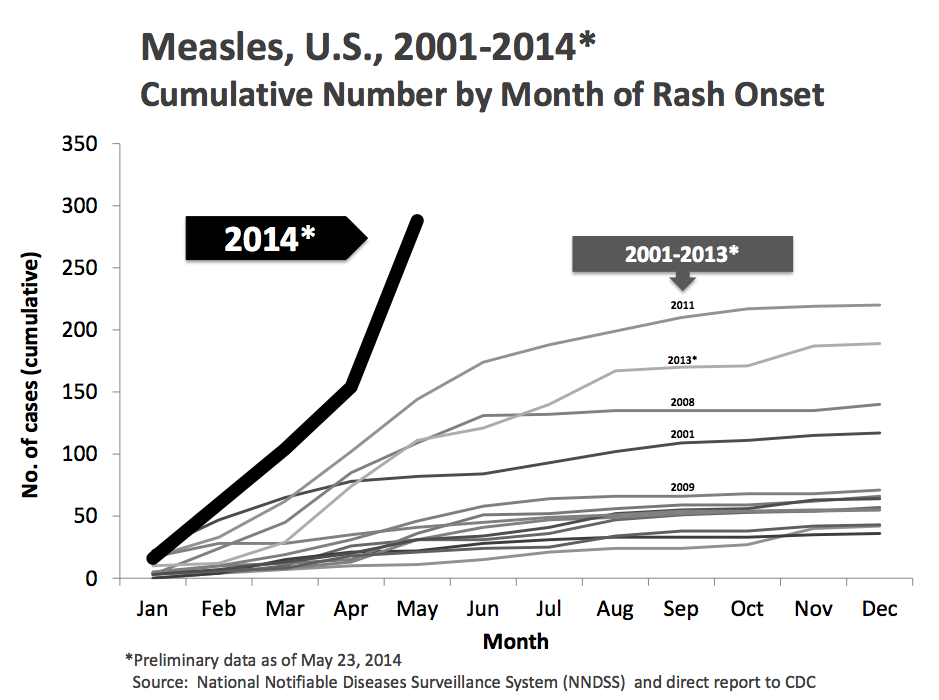
288 cases of measles have been reported to the CDC so far this year, “the largest number of measles cases in the United States reported in the first five months of a year since 1994.” You can probably guess who’s to blame:

“The current increase in measles cases is being driven by unvaccinated people, primarily U.S. residents, who got measles in other countries, brought the virus back to the United States and spread to others in communities where many people are not vaccinated,” said Dr. Anne Schuchat, assistant surgeon general and director of CDC’s National Center for Immunizations and Respiratory Diseases. “Many of the clusters in the U.S. began following travel to the Philippines where a large outbreak has been occurring since October 2013.”

Schuchat also notes in the press release that American doctors are having a hard time diagnosing these outbreaks because they “have never seen or treated a patient with measles” before. Jeffrey Kluger interjects:

Of course, you can bet any first year medical student could have spotted the disease a few decades ago—

and the same was true with mumps and whooping cough and polio and smallpox and rubella and all of the other diseases that we don’t have to see anymore because we have, in this country at least, vaccinated them all but out of existence. What was true in the U.S. then is still true in the developing world, where those diseases and more still run riot.

The people in those countries would not play cute with disease. The people in those countries would not have the time for rumors and lies and celebrity dilettantes who take up the anti-vax cause because they’ve grown bored with the anti-carb or anti-gluten or pro-cleanse fads. Being this close to eliminating a disease is not the same as truly being done with it. That’s something all those new measles patients learned this year. And that’s something we’ll all have to keep learning until we wise up.

And indeed, as Jacob Kastrenakes reminds us, the anti-vaxxers stand to do a lot more damage in the developing world, where measles is still widespread:

Though measles is reaching a relative peak in the US, it’s still far lower in the United States than elsewhere across the globe. There’s estimated to be around 20 million annual measles cases worldwide and about 122,000 deaths stemming from it. Still, the rise in the United States is sharp. The CDC reported that measles cases had spiked in 2013 too, and 2013 saw only 175 confirmed cases in total by early December. In that report too, the CDC said a failure to vaccinate was the issue, with 98 percent of cases being in unvaccinated patients.

Elsewhere in the world, widely disproven concerns that vaccines are linked to autism are said to have been the cause of measles outbreaks. At least one isolated instance of this led to a small outbreak in Texas last year, though the CDC doesn’t break down the exact reasons why measles patients turned down vaccination.

David Gorski fears that history is repeating itself:

Specifically, I have to wonder whether British history is going to be repeated in the US. Remember how in 2008 measles was declared endemic again in the UK, after having been declared eliminated a mere 14 years before, thanks largely to the MMR-autism scare precipitated by Andrew Wakefield’s fraudulent work? … It took fourteen years for the UK to go from having eliminated endemic measles, thanks to the MMR vaccine, to having measles return as an endemic disease. Here we are now, around fifteen years after measles was declared eliminated in the US, and we now have the highest number of measles cases in 20 years.

Reefer Sanity Watch

Late yesterday, the House passed a measure that would prevent the feds from interfering with state medical marijuana laws. German Lopez remarks that this is “the first time in history that any chamber of Congress has acted to protect medical marijuana businesses and users”:

The vote, while historic and a bit surprising even to advocates, is part of the federal government’s ongoing shift toward more liberal marijuana policies. Just a few weeks ago, the feds increased how much marijuana can be grown for medical research. President Barack Obama and his administration have also taken steps to mitigate prosecutions against marijuana businesses that operate legally under state laws.

Sullum is encouraged by the bill’s bipartisan support:

Similar meaures have failed in the House six times since 2003. This year the amendment attracted record support from Republicans, 49 of whom voted yes, compared to 28 last time around. “This measure passed because it received more support from Republicans than ever before,” says Dan Riffle of the Marijuana Policy Project. “It is refreshing to see conservatives in Congress sticking to their conservative principles when it comes to marijuana policy. Republicans increasingly recognize that marijuana prohibition is a failed Big Government program that infringes on states’ rights.” Before the vote, Grover Norquist, president of Americans for Tax Reform, and Ethan Nadelmann, executive director of the Drug Policy Alliance, argued in Politico that it “ought to be an easy ‘yes’ vote for members of the 10th Amendment Task Force on Capitol Hill and other believers in limited government and federalism.”

Thoughts On Kagan

US-POLITICS-MILITARY-OBAMA-WEST POINT

The Atlantic and The New Republic have both been on a roll lately, proving that long-form writing remains a vital part of our now-digital conversation. But I have to say I was underwhelmed by Bob Kagan’s endless piece, “Super-Powers Don’t Get To Retire.” The very title is simply wrong. Super-powers have retired again and again in world history – and it’s usually compulsory retirement. The retirement of both the British super-power in the twentieth and the previous Spanish super-power in the seventeenth came about because of imperial over-reach, in which the fiscal and economic costs of empire bankrupted the imperial motherland. And one of the striking lacunae in Kagan’s worldview is any sense that the US has limits, any awareness of the massive debt under which this country still labors, preventing all sorts of vital investments in education, infrastructure, and the like. The perpetual pattern of super-powers finding themselves hollowed out domestically, while for ever moving forward abroad, is one you would think Kagan would at least nod to. But like the neocons in the Bush administration for whom “deficits didn’t matter,” Kagan simply waves away the crippling cost of maintaining a military power greater than the ten next countries.

You can see this in the gob-smacking way in which some Beltway warriors casually want to the US to stay longer in Afghanistan, already the longest war in the history of the United States, costing the US, by some estimates, $10 million an hour. An argument for the eternal maintenance of American global hegemony that has no real accounting for that cost – in an age when most Americans are themselves struggling to retain their standard of living – is the definition of unserious.

Then, in Kagan’s view, there is the notion that there really isn’t much difference in the US confronting globally expansionist totalitarian empires and dealing with the usual tin-pot autocrats who have littered history for ever. The distinction between authoritarianism and totalitarianism – once made famous by Jeane Kirkpatrick – doesn’t seem to feature in Kagan’s worldview. But the only reason why the United States, after centuries as a Western hemisphere regional power, became the world’s policeman was totalitarianism – of the Nazi and then the Communist variety. Both the Axis powers and the Soviets harbored a universalizing ideology that demanded conquest, mass murder, and a huge modern military machine that reached Hawaii, all of which necessitated an American response. It is simply ludicrous to put Putin’s weak strutting around in his near-abroad in the same category of threat as the decades-long conquest of all of Eastern Europe by a totalitarian state. The uniqueness of the totalitarian threat was once a pillar of neoconservative ideology. Now that it might counsel a policy of prudent retrenchment, it’s suddenly absent from their rhetorical arsenal.

Then there is Kagan’s simply shameful refusal to note the catastrophes of over-reach that we just experienced in the Bush-Cheney era. You can read the essay and find not a scintilla of reckoning with that nightmare that Kagan himself did so much to promote. So we get an essay that deliberately and disingenuously says far more about America in the twentieth century than about America in the 21st. This after close to a hundred thousand dead in a broken, failed state called Iraq, thousands of fatalities of young Americans, and staggering costs. There is also no understanding at all that the United States can no longer argue that it may be a pain in the neck at times – but at least it’s better than the Soviets/Nazis. Growing up in another country, I can assure you this was a rampart of the case Americanophiles (including me) made in Europe for the US alliance for years. It was our logical ace. But that “lesser of two evils” defense of global hegemony has now disappeared, torturebehrouzmehriafpgetty.jpgrendering US hegemony far less legitimate than it only recently was.

Kagan also refuses to acknowledge another key aspect of the Bush administration legacy – and his own. The United States no longer has a leg to stand on when it comes to basic, universal moral norms that undergirded the entire internationalist system the US set up. The US is the only democratic power, apart from Israel, to violate the Geneva Conventions at will. This country perpetuated a regime of brutal torture and has never reckoned with it. This country still detains innocent prisoners of war indefinitely without trial and still subjects them to the torture of foul force-feeding. This country seized and brutally tortured one of its own citizens, without any trial, and with no due process, in the case of Jose Padilla. Its former vice-president and a large chunk of a major party aggressively want to bring back torture as a formal instrument of American democracy. If you think the world sees America as it once did – either as the lesser of two evils or as a paragon of democratic norms – you are deluding yourselves. Kagan did his part in helping destroy that core legitimization of global hegemony. He cannot now pretend it hasn’t happened, even as TNR has shamefully ducked the question of torture for the past decade.

Then there is the simple conservative wisdom that meddling in countries you do not understand is usually a recipe for disaster. Take the one intervention many liberal internationalists liked and argued for – Libya. The solipsistic idea that all that was at stake was preventing a possible massacre in one city has led to a failed state where Islamist terror is now widespread. Today David Brooks waxes lyrical about Kagan, just as he might have before the Iraq War – while completely ignoring the core conservative insight that these foreign and alien cultures and societies are simply beyond our ability to control or direct with any real practical wisdom. No admirer of Oakeshott can possibly believe that the US’ attempt to coax and mold other countries into our political model would lead to anything but tears. What staggers me is that, after Iraq, this point still hasn’t been absorbed by the neocons. There has been no chastening. There is no humility. And there is precious little conservatism.

David also used a really revealing phrase.

He writes of American foreign policy in the 20th Century that “presidents assertively tended the international garden so that small problems didn’t turn into big ones, even when core national interests were not at stake.” America tends the international garden. The world is ours to trim and tweak, plant and grow, mow and cut. The idea that we are actually tending other people’s gardens does not seem to occur to Brooks. The imperial over-hang is that great.

Mercifully, the American people disagree quite strongly and have so far acted as a restraint on the Beltway’s desire for more war, more meddling, and more intervention. Mercifully too, we have had a prudent, conservative president whose vision is both far more in tune with the realities of this interdependent world – far more advanced, wealthy and self-confident than the destroyed vistas of 1945 – and with the American people, whose rock-solid support is still essential for any intervention in the world to have the slightest chance of success. But these are weak constraints against the forces in Washington that still hanker for the hegemon’s swagger. I fear that the wisdom of Obama may not prevail in a future Clinton White House; and I fear that non-interventionists in the GOP will be neutered by the military-industrial complex and the Cheneyites who still drink the Kool-Aid of post-Cold War hubris.

You want American power to regain legitimacy? A prudent retrenchment would help. You want America to retain the option of global military power? Put the US on a path to fiscal balance and economic growth again. You are afraid of autocrats? Why? They will be with us always and they almost always fail. What succeeds is the democratic economic model – which is much more imperiled today by the centrifugal forces of technology and inequality than in a century. What we need to do now is focus on restoring the core economic and democratic health at home before clinging to a role whose legitimacy is in tatters. Restoring our luster as a global model would do far more to encourage democracy around the world than top-down meddling in other people’s business. That is what Obama has done or tried to do. And if you want a sustainable form of prudent, US intervention in global conflicts, it should be your top priority.

(Photos: President Obama at West Point; Seen through splintered bullet-proof glass, US soldiers from 2-12 Infantry Battalion examine their damaged Humvee after an Improvised Explosive Device (IED) detonated on the vehicle, following a patrol in the predominantly Sunni al-Dora neighborhood of southern Baghdad 19 March 2007; posters on the streets of Iran, after the Abu Ghraib revelations. All by Getty Images.)

Dish Intern Wanted: Last Call For Applications

The deadline is tonight at midnight (EST), so don’t delay if you’re interested in applying. The e-mail address for your resumé and a (max 500-word) cover letter is apply@andrewsullivan.com. Full details below:

Dish Publishing LLC is seeking an all-purpose intern to handle both administrative tasks and contribute to the editorial process. The admin side of the job will include: dealing with press inquiries and permissions, helping with support emails, managing the staff calendar, taking notes during meetings, making travel arrangements, and generally assisting the executive editors and me with sundry tasks. Strong organizational skills and attention to detail are musts. You need to be self-starting and pro-active in getting shit done.howler beagle

The editorial side of the job will consist of ransacking the web for smart and entertaining nuggets, maintaining our social media presence, working on larger research projects, and helping the team guest-blog when yours truly takes a vacation. We prefer individuals who can challenge me and my assumptions, find stuff online we might have missed, and shape the Dish with his or her own personal passions. Reporting experience is also a big plus as we try to deepen our coverage. Someone with a background in web entrepreneurialism could catch our eye too.

The full-time internship pays $10 an hour, includes health insurance, and lasts for six months. The position is based in New York City. Since the Dish doesn’t have an office, most of the work will be done from home, but the staff meets regularly for lunch and coffee meetings and social gatherings.  I want to emphasize that this is an intense job for the intensely motivated, and one that can get a little isolating at times. But it’s a pretty unbeatable chance to learn what independent online journalism can be as an integral part of a close-knit team. We’ve decided to pare down to one intern to keep our lean budget under control, which means the one individual really does have to be special. You have to already know what we do here and care deeply about the Dish. And a sense of humor is a real asset.

The start date is July 7, but we are flexible.

The Economy Shrank Last Quarter

GDP Change

Bummer:

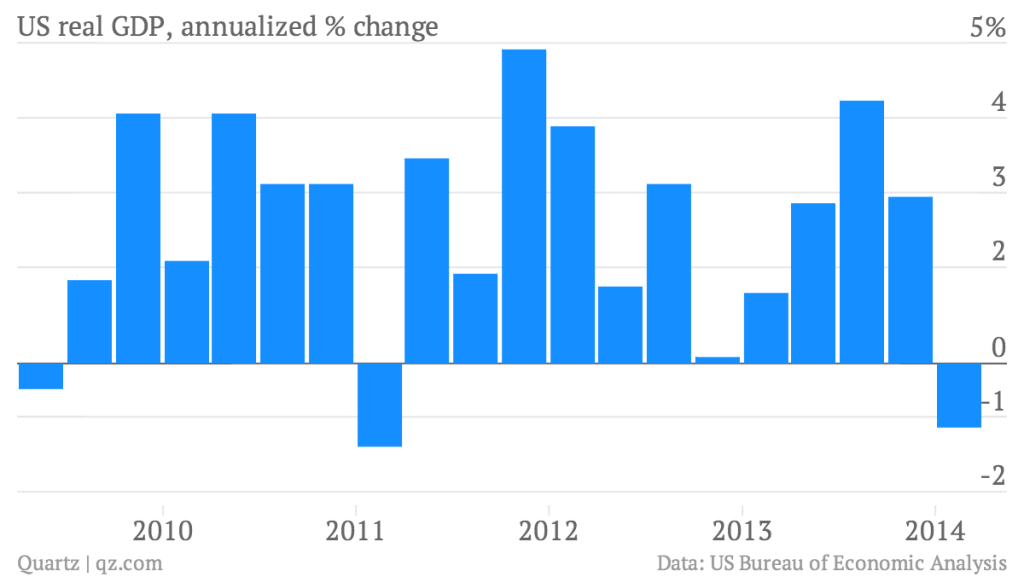
First quarter GDP slowed at an annual rate of -1.0% — worse than the initial estimate of 0.1% growth. It’s the first time since early 2011 that the economy has shrunk, mostly due to business inventories, construction and exports last quarter. Consumer spending actually rose by 3.1%, bolstered by strong health-care spending.

Ylan Q. Mui adds:

Businesses depleted their inventories and cut back on investment in the first three months of the year, while harsh winter weather curtailed construction. … The decline highlights the fragility of the nation’s recovery but is not likely to derail it altogether. Several forecasts for the current quarter show the economy growing at a healthy 3 percent annual rate or faster.

Matt Philips, who provides the above chart, finds that the markets are unfazed:

And that’s as it should be. For one thing, this is old news. Everyone already knew, from a string of previous data, that a brutal stretch of bad weather had hit consumption and other bits of the economy. And the fact that people stayed home to keep warm for the first three months means there’s a bunch of pent-up demand that should bolster the economy going forward. We’re already seeing that play out in the US job market, which has posted employment growth of over 200,000 a month for the last three months. (In April the economy created a particularly peppy 288,000 jobs.)

Ben Casselman puts the report in context:

This kind of contraction isn’t unheard of, but it is unusual. This is just the 10th time since World War II that GDP growth has been negative outside of a recession. Three of those negative quarters immediately preceded recessions. (The National Bureau of Economic Research defines a recession as “a significant decline in economic activity spread across the economy, lasting more than a few months.” A common rule of thumb is that a recession involves two consecutive quarters of economic contraction, although that isn’t part of NBER’s official definition and not all officially recognized recessions have met that test.)

McArdle sees this as “a sign of an economy that is still very weak”:

It has been six years since the financial crisis. Federal government spending is still around 21 percent of GDP, up from 19 percent in 2007, and the Federal Reserve still has a very expansive monetary policy. Under those circumstances, a quarter of negative growth is pretty unsettling.

The most recent jobs numbers are more encouraging — but not all that stellar this far away from the crash. Six years in, employment is barely back to where it was, which means that it hasn’t even kept pace with population growth.

Reihan joins the conversation:

The federal government is not directly responsible for the overall growth rate of the American economy, regardless of what politicians claim. It does, however, play a large role in creating the conditions for business enterprises to invest and grow. And it’s not doing its job well.

Daniel Gross examines the big picture:

We live in an age of long business cycles. The last two economic expansions lasted 73 months and 120 months, respectively. Within those long stretches of growth, there were quarters when the economy grew rapidly and quarters in which it shrank or flat-lined. A bar chart showing quarterly GDP growth resembles the teeth of a saw, not a picket fence. The key is to focus on the long-term. And the long-term trend of growth—unsatisfying, sub-par, sub-optimal, and insufficient growth—is still intact. Next week, the expansion will enter its 59th month since the end of the Great Recession.