Striving While Black

Recent African-American college grads have a harder time finding work than their white counterparts:

In 2013, the most recent period for which unemployment data are available by both race and educational attainment, 12.4 percent of black college graduates between the ages of 22 and 27 were unemployed. For all college graduates in the same age range, the unemployment rate stood at just 5.6 percent. The figures point to an ugly truth: Black college graduates are more than twice as likely to be unemployed. …

[Economist John] Schmitt pointed to a series of studies that have in recent years found that when trained sets of black and white testers with identical resumes are sent on interviews, white men with recent criminal histories are far more likely to receive calls back than black men with no criminal record at all. In fact, the center’s study found that even black students who majored in high-demand fields such as engineering fare only slightly better than those who spent their college years earning liberal arts degrees.

The Kids Are Alright Already!

teen_birth_rate

Sarah Kliff voxsplains:

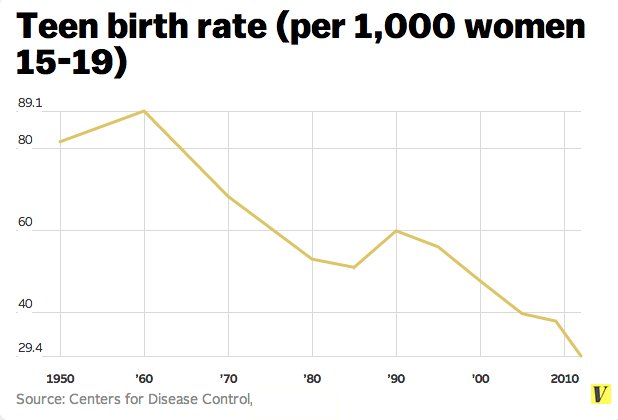
The Centers for Disease Control released a monster report last week on the state of Americans’ health. The 511-page report makes one thing abundantly clear: teens are behaving better right now than pretty much any other time since the federal government began collecting data. The teen birth rate has plummeted in recent decades. Separate data shows this has coincided with dramatic drops in the teen abortion rates. The decline in teen births has also happened at a time when teenagers have gotten better at using contraceptives.

Russell Saunders cheers:

What this says to me is that, despite their reputations as hell raising hedonists with an immortality complex, teenagers are capable of absorbing information about keeping themselves safe and healthy. It speaks to the importance of comprehensive sex education programs, which provide teenagers with the facts they need to take care of themselves.

But he has a bone to pick with Vox:

In presenting those data, they summed it up with the headline “Today’s teenagers are the best-behaved generation on record.” However, the report contains no information about how frequently today’s adolescents call their grandmothers or turn in their homework on time. They haven’t collectively sat through a poetry reading and clapped politely at the end—they’ve demonstrated healthier choices than their parents’ and grandparents’ generations. Presumably health information about those latter age groups wouldn’t be framed in such a condescending manner.

Meanwhile, Drum speculates about the role lead exposure may have played:

What’s happening today isn’t an aberration. Teenagers from the mid-60s through the mid-90s were the aberration. We managed to convince ourselves during that era that something had gone permanently wrong, but it wasn’t so. The ultra-violent gangs and reckless behavior that became so widespread simply wasn’t normal, any more than expecting teenagers to sit around in kumbaya circles would be normal. Nor had anything gone fundamentally wrong with our culture. It was the result of defective brain development caused by early exposure to lead.

I’ll never be able to prove this. No one ever will. The data is simply not rich enough, and it never will be. Nevertheless, what evidence we do have sure points in this direction.

Much more Dish on Drum’s pet issue here.

Ukraine’s Refugee Crisis

Maxim Eristavi shines a light on it:

The death toll in eastern Ukraine, where the vast majority of the fighting has taken place, has climbed to well over 200, making this the most violent crisis Ukraine has seen since World War II. The number of internal refugees also continues to rise rapidly. The United Nations High Commissioner for Refugees (UNHCR) says the crisis has displaced an estimated 10,000 civilians; most are from Crimea, and almost one-third are children. Ukrainian activists in Donetsk say that the amount of internal refugees from their region might also be in the thousands, but it’s harder to measure because unlike Crimeans, internal refugees don’t have to cross a border.

The internally displaced Ukrainians can’t count on the state to help them, either:

The Ukrainian parliament has taken some steps to ensure that refugees have access to basic social services and shelter. For instance, a new law regarding the rights of displaced persons helped thousands of refugees from Crimeathe vast majority of whom are Crimean Tatarssettle in other parts of Ukraine. But those who have fled eastern Ukraine can’t turn to the government for help. If the Rada were to vote on a bill helping displaced persons from within Ukraine’s borders, it might be taken as a sign that Kiev has lost control over eastern Ukraine once and for all. So refugees from the east must count on friends or strangers for help.

Ways The World Is Getting Better

Income Developing World

Here’s one:

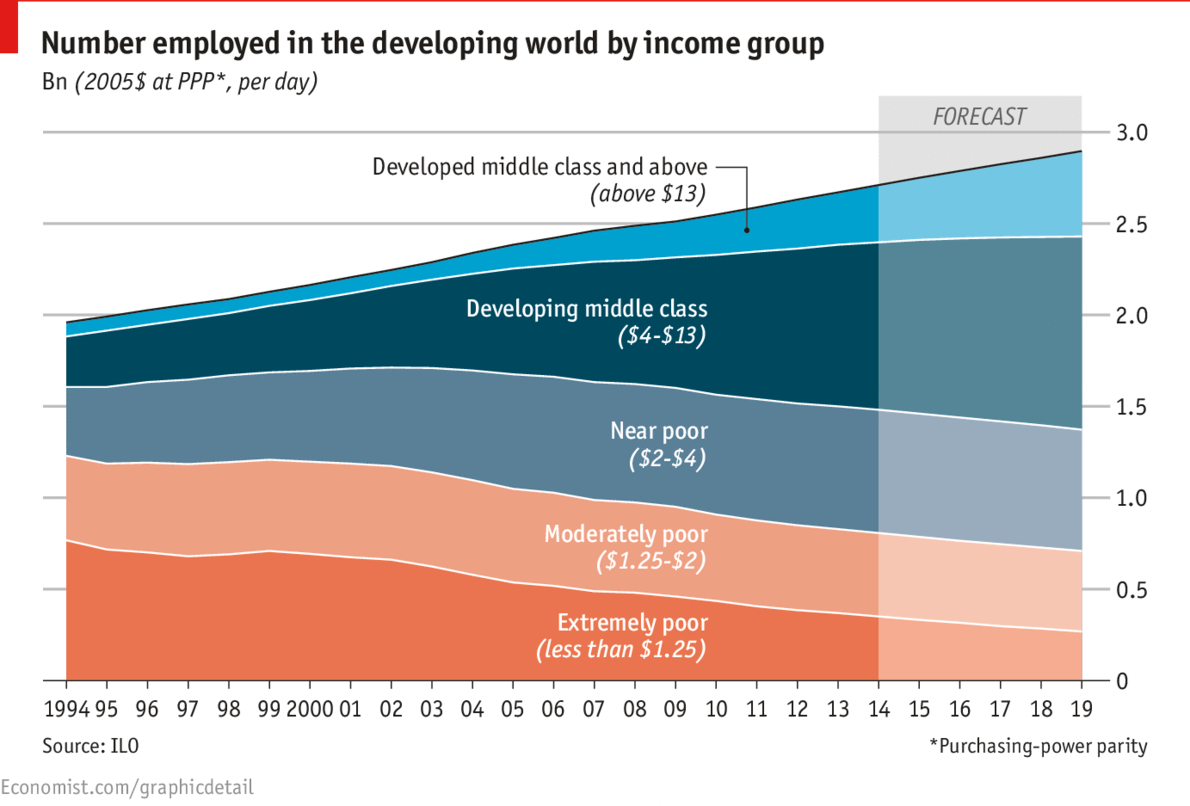
 “For the first time in history, over the next several years, most new jobs in the developing world are likely to be of sufficient quality to allow workers and their families to live above the equivalent of the poverty line in the United States,” states the [International Labour Organisation].

Relatedly, reviewing Bjørn Lomborg’s How Much Have Global Problems Cost The World?: A Scorecard from 1900 to 2050, Yevgeniy Feyman concludes, “There has never been a better time to be alive”:

The doubling of human life expectancy is one of the most remarkable achievements of the past century. Consider, Lomborg writes, that “the twentieth century saw life expectancy rise by about 3 months for every calendar year.” The average child in 1900 could expect to live to just 32 years old; now that same child should make it to 70. This increase came during a century when worldwide economic output, driven by the spread of capitalism and freedom, grew by more than 4,000 percent. These gains occurred in developed and developing countries alike; among men and women; and even in a sense among children, as child mortality plummeted.

Why are we living so much longer? Massive improvements in public health certainly played an important role. The World Health Organization’s global vaccination efforts essentially eradicated smallpox. But this would have been impossible without the innovative methods of vaccine preservation developed in the private sector by British scientist Leslie Collier. Oral rehydration therapies and antibiotics have also been instrumental in reducing child mortality. Simply put, technological progress is the key to these gains – and market economies have liberated, and rewarded, technological innovation.

TMI For Teacher

Adjunct professor Sarah Marshall is struck by her students’ eagerness to share the intimate details of their lives:

In their writings, in our class time, and in their meetings with me, students tell me about their pasts, their aspirations, their medical and mental health emergencies; about family tragedies and abuses they have survived; about their sexualities, their identities, their relationships, and their fears. I do not ask them to tell me any of this, but they offer it freely, as if they have simply been waiting for someone to tell. …

This happens because I am in a position of authority, but I am also deeply non-threatening for being a young, blonde woman who smiles a lot. I can’t strike fear into anyone’s heart, and certainly this has a great deal to do with my age and gender, but it also means that I benefit from a very specific kind of privilege. White male privilege means the gift of easy authority and confidence, among other dubious rewards. White female privilege means being viewed as harmless, innocuous, and safe to confide in.

Hathos Alert

A reader calls it “the Platonic Ideal of a Hathos Alert”:

It’s a music video by a trio of celebrity-inspired plastic surgery addicts (one of which has recently gained some Internet notoriety for turning himself into a sort of grotesque Hieronymus Bosch version of Justin Bieber) crowing about how exceptional they are. This will be one of the artifacts future generations will use to diagnose our civilizational collapse.

China’s And America’s Common Enemy

In the fight against global warming, Jonathan Cohn sees room for cooperation:

In recent years, the Chinese have imposed fuel mileage and appliance efficiency standards, similar in many respects to those in the U.S. Just this week, officials in Beijing announced that the government would be taking another 5 million aging cars off the nation’s road. China has also set up pilot versions of tradable pollution permits—in other words, “cap-and-trade” schemes—for various industries. Officials say they hope to make these nationwide soon. And one reason the Chinese government was so eager to sign that massive new deal with Russia, allowing the import of natural gas, was because it’s desperate to find alternatives to coal. “For a long time, opponents [of new regulations] said we’ll get hoodwinked, because China won’t do anything,” says David Doniger, director of the Climate and Clean Air Program at the Natural Resources Defense Council. “That’s just not true.”

China’s behavior may seem surprising. It shouldn’t. China has a major air pollution problem, causing all kinds of very immediate and very tangible health and economic problems. Efforts to reduce the sources of these noxious particles dovetail naturally with efforts to reduce carbon emissions.

Gwynn Guilford points out that China is already sacrificing economic growth to combat pollution:

[R]ecent analysis of economic data by Wei Yao, an economist at Société Générale, found that “Chinese policymakers are getting serious about air pollution.” So serious, in fact, that those efforts are already hurting GDP performance—something the government has so far shown to be its biggest priority. Yao says GDP will slow 0.35 percentage points cumulatively from 2014 to 2017 because of air pollution mitigation efforts, and she expects the economy to take the biggest blow this year.

Kate Galbraith rattles off reasons why eliminating pollution is such a priority for China:

Beyond individuals’ physical and mental health, the pollution fiasco matters because China wants to transition its cities to modern, service-oriented economies filled with software entrepreneurs, health experts, and international financiers. “Under the old plan, where China’s get-rich plan was based on dirty manufacturing,” environmental concerns didn’t matter, says Matthew Kahn, a professor at UCLA’s Institute of the Environment and Sustainability.

Now, China wants to send manufacturing inland and lure Davos and Silicon Valley types to its big coastal cities. But such people have choices, says Kahn, and Beijing’s allures of cuisine and culture, universities and government, will matter far less if people are afraid for themselves and their children. Even Shanghai, thought to be cleaner than Beijing, suffered its own Airpocalypse in December, a few months after the government grandly established a Shanghai Free Trade Zone to woo the foreign financial sector.
The Golden Age Of Maps, Ctd

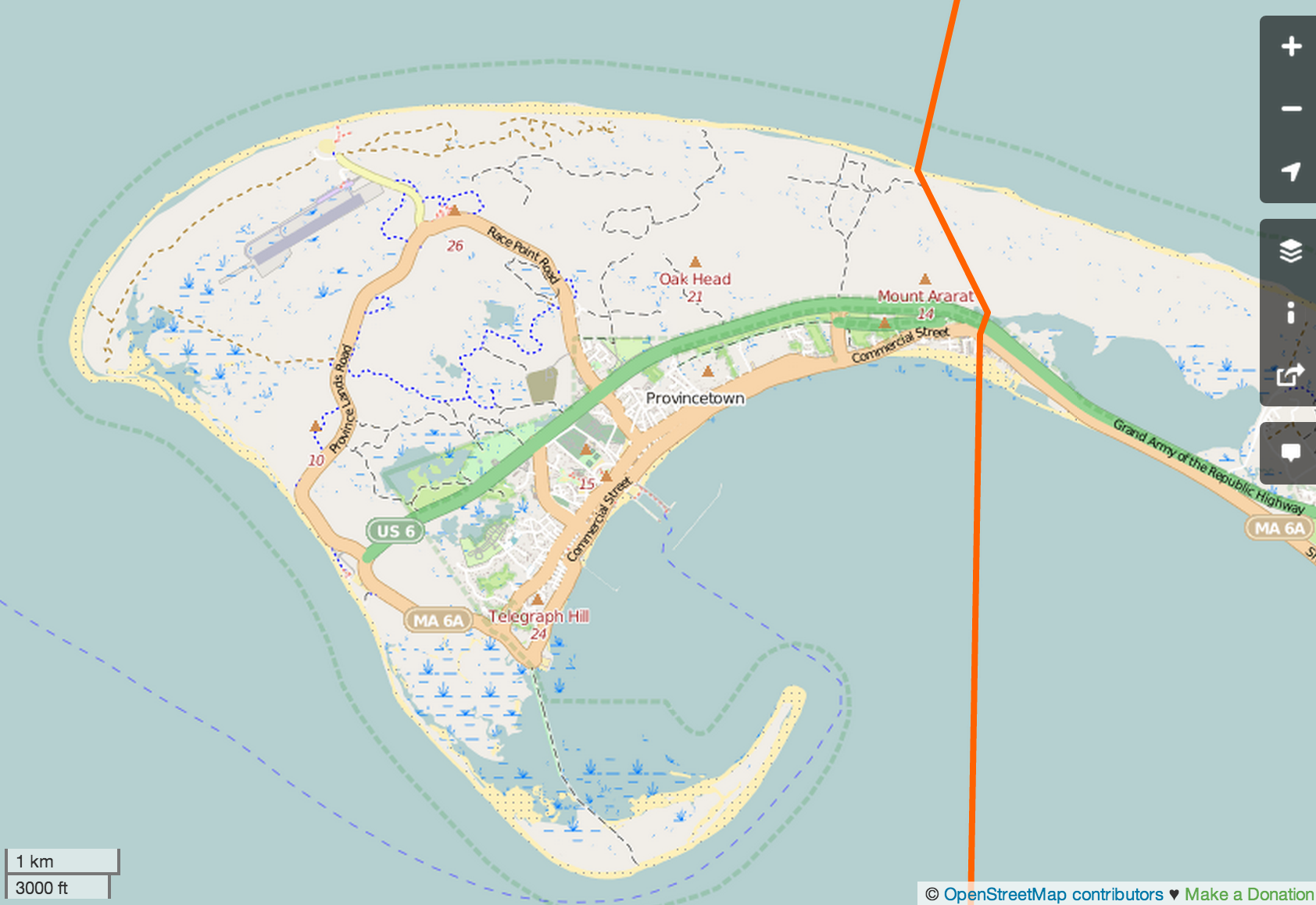
Screen Shot 2014-05-28 at 2.44.06 PM

A reader snickers:

World War II was the golden age of maps? Really? This kind of nostalgic hooey is really too much sometimes. If we’re not living at the beginning of the golden age of maps, then I’ll eat my whole collection of old topos, which have been rendered essentially useless by the Internet. Not only does every person with a smartphone or tablet walk around with an exquisitely and finely detailed atlas in his or her pocket in the form of Google Maps, but it’s searchable, too. And with Google Maps comes Google Maps Engine, which can be used by businesses and schools (who can get free licenses for the product) to create interactive, to-scale maps that are driven by the same platform Google uses. And we’re not just constrained to corporately-owned and tightly-licensed maps, either. With projects like Open Street Map, we have a user-created, openly-licensed atlas that can be freely used, corrected, and tweaked by anyone who wants to contribute to it – a sort of Wikipedia of maps.

And those aforementioned paper topographic maps? They’re basically just good for decoration, now that the USGS has put up free scanned copies of all their old maps for download and has issued a new series of maps based on aerial and satellite imagery with layers that can be enabled and disabled to pick out useful information or hide useless information, all using standard PDF viewing software.

But WWII-era maps printed up in a five colors on bulky paper and with very limited amounts of detail were nice, too, I’m sure.

Can’t argue with that. Previous Dish on the current era of cartography here.

(Screenshot from Open Street Map)

Mariam The Martyr, Ctd

Paul Bonicelli wants Obama to take up the cause of Mariam Yahia Ibrahim, the Sudanese woman sentenced to death for apostasy because she refused to renounce the Christianity of her upbringing and embrace the Islam of her absentee father:

During the last several decades we have witnessed the rise of regimes of armed groups that claim a foundation in Islam to establish an order characterized by cruelty. They hijack one of the world’s major religions to practice a form of governance that uses brutality to enforce control and intimidation, particularly of women. A regime that is willing to torture and execute a woman recently delivered of her child simply because she holds religious views different from the regime’s dictates is truly barbaric.

And it is a direct challenge to all who have advanced civilization and serve as its guardians, whether they do their work unilaterally or via multilateral forums such as the United Nations. Bashir’s government in Sudan is the latest example; its current persecution of Ibrahim and her American husband and unborn child is a calculated and direct threat to the role the United States has been playing in the world. We should make no mistake about why Khartoum has chosen this time and circumstance to shock the world. The regime is bitter at the United States’ role in the loss of what is now South Sudan. The persecution of Ibrahim is a lashing out at the world that the United States has helped to produce. It is a challenge the United States and the West cannot afford to tolerate.

Ibrahim gave birth to a baby girl in a prison clinic on Tuesday and will be allowed to nurse the child for two years before her sentence is carried out. Her 20-month-old son is also in prison with her. Jonathan Fisher considers how the US government might go about securing their release:

The truth is that western governments have few cards to play in Sudan. This has been even more so since the election of fellow ICC indictee Uhuru Kenyatta to the presidency in Kenya and the outbreak of civil war in South Sudan in 2013, two events which have strengthened al-Bashir’s hand regionally and internationally. Threats and condemnations from the West will sadly do little to change Ibrahim’s fate. But western officials have other diplomatic tools at their disposal, notably flattery and face-time. Even the tyrants of North Korea have been known to offer clemency to prisoners when personally lobbied by former US presidents. Indeed, in 2007, al-Bashir himself pardoned a British schoolteacher imprisoned for blasphemy (naming her class’s teddy bear “Muhammad”) after a visit from British legislators. Instead of lobbying John Kerry to grant Meriam Ibrahim asylum, the two US senators from New Hampshire – home state of Ibrahim’s husband – might be better off catching the next flight to Khartoum.

The Best Of The Dish Today

Today, the vice-president who almost single-handedly broke the US military, bankrupted the country, trashed America’s moral standing and failed to secure a single WMD called president Obama the “weakest in my lifetime.” There are times when you really wonder if the man has any self-awareness at all.

So today, we analyzed the foreign policy of the man who inherited this broken country and has steered it with grit and grace ever since. Unlike the Cheney of 2000 – 2009, Obama is a classic conservative realist, and his aversion to shooting first looks like it is paying dividends in Ukraine. I went another round on the Kinsley-Sullivan spat; this video of a heroic tripod dog made me tear up; and we discovered – surprise! – that Silicon Valley is mainly staffed by white and Asian dudes. Also: way cute baby bears. And debunking cute cars.

Last night’s Best of the Dish featured a screenshot from the closing of the HBO documentary which repeated the untruth that the Perry decision has had a huge impact on marriage equality suits around the country (the dumb-ass argument Jo Becker tried to peddle). I’ve been told by HBO that that has been removed from the final version. Maybe HBO has gotten wise to Chad Griffin’s manipulation of gay history.

The most popular posts of the day were both about my whining about New York City’s rank incompetence, ugliness and unliveability. Go figure.

Many of today’s posts were updated with your emails – read them all here.  And you can always leave your unfiltered comments at our Facebook page and @sullydish.

17 more readers became subscribers today. You can join them here. One writes:

Your reader wrote: “I can’t wait ’til you get to Provincetown and chill the fuck out for a while”. I laughed out loud. Because I don’t think that even Provincetown will necessarily meet your exacting standards of living, if memory serves. I think Jim Newell at Wonkette said it best back on July 27, 2009:

HEROIC PUNDIT RETURNS, COVERED IN POOP: You people loved Andrew Sullivan so much when he came this close to seizing the throne of Iran, last month, but then he went on vacation, leaving his blog to numerous bloodthirsty tyrants named Conor. But now he is back, and stone cold covered in shit: “This has been a bust of a summer this year on the Cape: almost no sun, an economic depression that is killing businesses and crippling real estate, and vicious hate crimes from some locals. Oh, and the sewer broke over July 4, with poo coming up out of the drains and showers and toilets. Good times.” Ah, summer with the Sullivans.

See you in the morning.