A reader writes:
Look: no one is for nation building. In the past, realists recognized the national interest at stake in our supporting deeply flawed governments against communist revolutions. The belief was that Communist revolutions were bad for us and bad for the people who suffered in their wake. The hope was that by resisting them and applying pressure, these societies might evolve overtime into something better.
This meant supporting some pretty nasty guys who tortured and killed people. Not a great choice but it’s the very essence of realism which expresses Henry K’s mordant witticism “it has the advantage of being true”. In other words, it was good for us (so we thought) and also good for them. You are correct that conservatives usually opposed these initiatives but supported wars once engaged – sort of the other way round with the liberals.
Clinton brought the notion back into service after the cold war ended in Somalia when he escalated the mission from relief to nation building. There was no national interest explained at the time – only the humanitarian one that unless we stopped Adid, the famine would start again after we left. You make the call.
9/11 linked for the first time the idea of nation building directly to national interest. People like Tom Friedman and you analyzed the threat and came to the conclusion that so long as the Arab/Persian/Muslim world remained mired in various forms of undemocratic governance that were good enough for cold war realist purposes, it would fuel the Islamic radicalism that now threatened us at home and that if we had a hope of defending against it in the long term it would be by providing counter examples – societies that did not waste and torture their human capital, you reasoned, would be less likely to make more Mohammed Attas.
So instead of stability we decided on the Nietzschean exhortation ‘further into disorder’. This idea may be wrong but the alternative is the REAL conservative view expressed by people like John Derbyshire, namely, leave them alone and if they hurt us bomb them to smithereens, invade if you must, kill them all and then go home like we did in WW2. Do you have the fortitude for that? And even if you do, the WW2 model doesn’t work with Pakistan or Iran or NK which, unlike Mexico (yet), have nuclear weapons.
The only refuge left for you is the Biden one – convince yourself that our interests are being served by stand-off surgical strikes and small applications of troops. That will allow you to support the president, argue resources should be applied at home and feel good about yourself. Until the next attack that is…
My regular reader and emailer makes some very solid points here about the last decade or so, and it’s really helpful to remember how many of us have drifted over the years, reassessed and re-reassessed. I don’t think we should flee these shifts – because they reflected good faith judgments at the time rendered inoperable by time and experience. But we should keep examining them, to make sure we haven’t changed our minds for reasons other than the hard evidence and sober scrutiny. Righteous emotion blinded some of us for a while to the limits of American power; but in these mercifully less fraught moments (and they may not last), we may have a chance at cooler reasoning.
 For the record, I opposed intervention in Somalia. I opposed it in Darfur. And my view of the “further into disorder” argument has been chastened deeply by time. The Iraq war demands we learn its lessons. We do not have enough data yet, but I remain skeptical that Iraq is in any way stable yet, given the entropic forces within; but the US has done its best after doing its worst. And that is some opportunity for departure and leeway for delay. Obama has wisely kept his options open here.
My issue with Afghanistan is: what is the relationship between means and ends here? I fear another One Percent Doctrine syndrome in which what is actually a minor threat in the grand scheme of things becomes an obsession purely because that’s where the threat came from in the first place. Yes, it came from there. But remember what “it” was: 19 guys with box-cutters together with our advanced, free society. What we have to be unafraid to ask is:
How will continuing to occupy Afghanistan help foil another such nineteen? Even if we still believe that democratization is the best antidote to Islamism in the long run, we have to decide if this is the place worth using to make that point. Obama might, in other words, be making a reverse image of the Bush mistake: taking his focus off Iraq (which might still conceivably work) while pouring resources into Afghanistan (which could take decades of patience, money and lives).
My reader assumes a cynical pro-Obama spin from yours truly. That’s just the way he is. I’m genuinely trying to figure out the best way forward here, and right now, muddling through in Afghanistan before major withdrawal seems the sanest option on the table. The total corruption of the Karzai government and the fact that Americans have been fighting there for almost as long as the Vietnam War already: these tip the scales.
Maybe there are operational details that I do not know of that will shift minds in the White House toward the maximal McChrystal ramp-up. But it is also perfectly legitimate to ask if the country can or will tolerate another decade of young Americans dying over there for an abstract idea no longer clearly or obviously related to national defense. This is not just a matter of the Democratic base. I have no doubt at all that the GOP base will turn on the Afghan war with more passion if it continues to go south under Obama. In fact, I see the potential of a Ron Paul argument beginning to return the GOP to its Taftian roots if the quagmire deepens. Only a Democratic Rove would use this war to split the GOP still further – and now we have a president strong enough to withstand such foul cynicism.
My last refuge in this situation is actually to do what we realistically can, but to recognize the limits of what we simply cannot do. There is no ultimate solution for Islamist terrorism until it blows itself out. A quarter of the world is Muslim and, although we should help, this is their struggle, not ours’. We do not have the power to do much more – which is anathema to the neocons, but true nonetheless. But to give the neocons their due, to have initiated one fledgling and still extremely fragile democracy in the heart of the Arab world is surely enough to satisfy the attempt to leverage democracy in the very long run against Islamism. In the meantime, we need to be totally, ruthlessly rational in discerning where the actual threat is, and not walking into any more traps.
The awful truth is: We have to live with the constant threat of Islamist terror or perish trying to exterminate it everywhere. This is a practical decision and I do not claim to speak with the kind of knowledge that military experts do or that the Obama cabinet is now wrestling with. But this is a political call as much as a military one. I fear a mismatch between means and ends, I fear complacency on Iraq, and I fear the dashing of impossible expectations yet again.
Under those circumstances, how do you look into the eyes of the mother of a lost soldier and tell her it was worth a try?
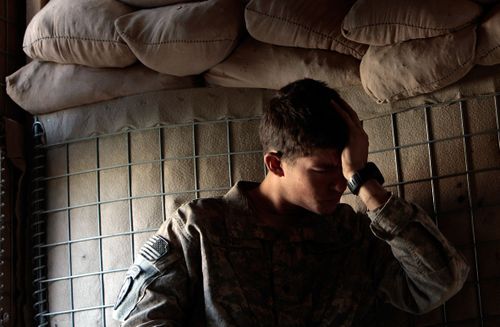
(Photo: Spc. Matthew King of Lompoc, California, who has been without a shower since July 4 of this year, rubs his face in a below ground bunker October 6, 2009 in Forward Operating Base Zerok in Paktika province, Afghanistan. Conditions are harsh for the soldiers of the 3-509 US Army’s 25th Infantry Division and their Afghan Army counterparts at the Zerok field base near the border with Pakistan. The troops stationed at the base frequently patrol the adjacent mountains on foot and endure frequent attacks by militants, as well as living without showers or laundry for months. By Chris Hondros/Getty.)

 The Dish