From The Annals Of Chutzpah

The NYT:

Saudi Arabia is trying to enlist other oil-producing countries to support a provocative idea: if wealthy countries reduce their oil consumption to combat global warming, they should pay compensation to oil producers.

This is, of course, somewhat encouraging. It means the Saudis have a tiny feeling the West might finally get its act together and wean itself off their oil, and all the imperial weight it carries. I sure hope they're right.

(Hat tip: Massie)

Ahmadi’s Game

The Iranian parliament plans to cut energy and food subsidies over the next five years. NIAC smells something fishy:

While attempts to reduce subsidies were made in the past, the government was met with an infuriated Iranian citizenry that took to rioting and protesting. […] This event can be seen as maneuvering in advance of proposed refined petroleum sanctions that could be levied in the event that Iran does not cooperate in the multilateral talks with the p5+1. If the sanctions were to pass and be put into place, it would give the regime the perfect “scapegoat” to catalyze its subsidy removal by blaming Western powers, thereby quelling any serious protest to the action.

3 Minutes; 42 Seconds


The Daily Show With Jon Stewart Mon – Thurs 11p / 10c
Queer and Loathing in D.C.
www.thedailyshow.com
Daily Show
Full Episodes
Political Humor Ron Paul Interview

Jon Stewart busts Fox News bad on their non-coverage of a march of around 75,000. This is not just an ideological problem for them; it’s a news problem. What happened last weekend in DC was a great story – large and colorful protests, a big fight between the grassroots of the gay movement and its DNC bosses, a presidential speech. Where was Fox? Some will say it’s pure ideology. They just ignore stories that do not fit their GOP base audience. The speeches at the march were so emphatic on the core message of equality and the marchers so obviously regular Americans of all stripes, shapes and colors, perhaps Fox simply did not know how to fit the images into the notion that the gay rights movement is some bunch of evil freaks trying to destroy the family. But there’s another possibility.

They didn’t even know it was going on. When you have no openly gay people on air, when the gay people on staff are unable or unwilling to challenge an editorial line, you slowly seal yourself off from America. If it’s true that the MSM were awfully slow and reluctant to cover the Tea Partiers, FNC was woefully blind to this story. If they didn’t like Jon Stewart’s winning lob over the net last night, they shouldn’t set him up so easily.

Fallows, Kaplan And Afghanistan

Gulliver1

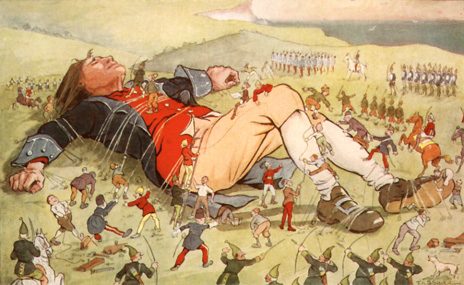
Here's Bob's case for urgent decisive action and Jim's response:

If he or others can really establish that a decision right this minute about Afghanistan is indispensable — that this is a moment comparable to the Cuban Missile Crisis etc — then, OK. (For a contrary argument, see this.) Otherwise, everything I've learned about politics indicates that impatience is almost always destructive, that especially when it comes to military commitments it's crucial to think and think again, and that a president should be less afraid of being "inconsistent" than of making a big mistake.

The fact that two of the smartest, sincerest people around can disagree on this is testament to the difficulty of the decision. Maybe it's post-Bush syndrome, but I'm much more skeptical of dramatic presidential decidership than I used to be. In an equation as complex as this one, prudence dictates caution and a weighing of all the possible factors. Since they all keep changing, this can paralyze. But I don't think Obama will let this drift for ever. And there's an element to Bob's argument that I just don't buy:

Obama must capture the toughness and competence that Bush displayed as a war leader at the end of his term. Otherwise, in the coming months, the Democrats may be seen as having lost a war.

I don't think the debate here should be about the politics of the thing or the appearance of wobbliness or the perception of toughness. It's high time the US conducted its foreign policy according to its own sober analysis of its self-interest rather than the need to be "tough" or to "save face" or to back up allies who will end up more alienated if we dig ourselves more deeply in to the Afghan ditch. Of course, the US is wobbly.

After eight years in Afghanistan, the American people are being told by the Pentagon that the only way forward is a massive increase in manpower and resources. Even if you think the Iraq surge was a success, the expense and risk and long-term wisdom of the same strategy in the vastness of Afghanistan is highly dubious – especially after a fraudulent election. (I am still on the fence about the Iraq surge because we simply don't yet know if it has actually succeeded in doing what it was supposed to do: facilitating a unified, functioning democratic Iraq which won't revert to sectarianism and dictatorship in the absence of vast numbers of US troops. In so far as it helped the US save face while we walked and then ran for the exits, it worked. But that's not toughness and competence. It was just the least worst option worth trying before we gave up entirely.)

Far, far better to mull this over and decide to get out of a hopeless situation than to carry on a doomed mission that will, in fact, kill Obama's presidency (and a lot of young Americans) and advance US security by an indefinable amount. The more I mull this over, the more I think we should get out as swiftly as can be done responsibly. If we take a p.r. hit, if al Qaeda claims victory, so be it. America should define victory on America's terms, not be yanked around by a bunch of braggart Jihadists. It was a necessary war in the first place; eight years later, it's not so clear. Unless it's very, very clear, the Powell doctrine should return.

There's a reason for the Vietnam Syndrome: Vietnam. Only this time, the US is flat broke and the war is even more unpopular at home and intractable on the ground.
Too Early To Call?

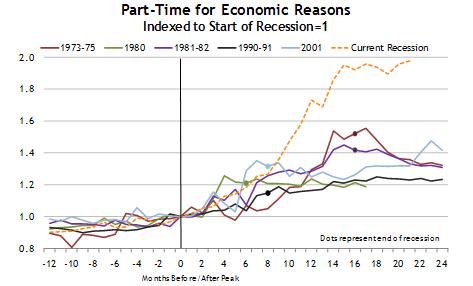
[N]early eight months after its passage, a large majority of the stimulus has yet to start impacting the economy—as was the plan. And as was also the plan, the most visible parts of the stimulus are only taking effect now and will remain active through 2010. As you drive around town, it's difficult to visualize tax rebates or aid to states—the fast-acting components of the stimulus. But as I drive around my town today, I can see workers laboring at a $4 million, stimulus-backed road project that is just getting started and will run through the spring of 2011…the debate over whether the stimulus worked will ultimately be settled in 2012—as voters go to the polls and economists crunch the 2011 data. Until then, we should avoid jumping to rash conclusions.

Letter From Kabul

Over the weekend, George Packer got an e-mail from Rufus Phillips, a foriegn policy expert who has written at length about Vietnam and recently spent some time in Afghanistan. The text of the e-mail:

I’m afraid the President, who seems like a supremely rational being, is trying to find the most rational policy option on Afghanistan, without thinking about whether it is feasible given political conditions on the ground, as well as who is going to implement it and how. What seems the most rational option here could be likely unworkable over there.

This is part of what happened to President Johnson during Vietnam. He relied exclusively on policy ‘experts’ who understood military and geopolitical strategy in the light of World War II and Korea, but who had no direct experience combating a ‘people’s war,’ while underestimating the North Vietnamese and misunderstanding the importance of the South Vietnamese, who were treated as bystanders. His advisers constructed strategies whose feasibility never got tested by those who knew Vietnam first hand. Pure reliance on the chain-of-command was disastrous in Vietnam because much of the most relevant information, the nuances which counted, could not be fully described in writing and were strained out as information flowed to the top. At a minimum, [General Stanley] McChrystal and [Ambassador Karl] Eikenberry, who have that first-hand knowledge, should be sitting in these strategy sessions.

I don’t see evidence of any real political thinking about how to deal with Karzai and the local political scene, no matter what option is selected. As we swing between counterproductive table pounding and passive non-interference, we must muster the will to interfere quietly but firmly when we are on solid moral ground—standing up for the Afghan people and for principles of honest governance.

My Afghan friends tell me as soon as he is confirmed, Karzai is going to launch a big initiative on talks with the Taliban, which are not likely to go anywhere if he leads them. Are we thinking that if we cede territory to the Taliban because they promise not to let Al Qaeda back, we will be able to hold an imaginary line, including Kabul, with the Afghan and international forces we will have? What will that tell the Afghan people, except to signal ultimate abandonment? And how will that affect their support for the Taliban to avoid being killed or severely punished?

I just have an uneasy feeling that this is too similar to the policy discussions Johnson went through, except those were mainly out of public view and these are not. The whole notion that we can speed up the training of the Afghan armed forces and this will do the job is unrealistic—another numbers game. I guess not being in the meetings puncturing balloons is what is really frustrating me. That and the fact that nobody seems to factor in our moral obligation to the Afghan people. We abandoned them twice. Will this be the third time? What does that say about us? It seems more convenient to equate Karzai with the Afghan people. Maybe it will all come out for the best—but the process, and what I see from the outside being discussed so far, doesn’t pass my gut check.

The outcome of the Afghan struggle is ultimately going to be determined not by our unilateral actions or geopolitical moves, but by whom the Afghan people wind up supporting, even reluctantly. Vietnam—Lesson One.