Animal Testing For Animals’ Sake

Is it ethical to conduct experiments on captive chimpanzees to help others survive in the wild? Ed Yong’s take:

In February 2011, a team of scientists led by Peter Walsh at the University of Cambridge injected six captive chimpanzees with an experimental vaccine against the deadly Ebola virus. At first glance, the study looked like a lot of other medical research, in which drugs that are meant for humans are first tested on other animals. But this was different. These scientists were working with chimps to help chimps. The twin threats of poaching and habitat loss are driving the African apes – chimps, bonobos, and gorillas – towards extinction. Diseases are also a problem. Our ape relatives are vulnerable to infections like anthrax, malaria, and respiratory viruses that spill over from human tourists and researchers.

As Yong notes, such studies may soon be a thing of the past:

The era of biomedical research on chimpanzees is drawing to a close. The United States and Gabon are the only countries that still allow this kind of research, and the US may soon leave this short list. In 2011, the Institute of Medicine issued a report saying that “most current use of chimpanzees in biomedical research is unnecessary” – a conclusion that the National Institutes of Health took seriously. In 2013, it announced that all but 50 of its chimps would be retired to sanctuaries. Meanwhile, the US Fish and Wildlife Service has tabled a proposal to list captive chimps under the Endangered Species Act – a move that would ban medical procedures beyond those that “enhance the propagation or survival of the affected species.”

Walsh’s study might still fit the bill but it wouldn’t matter, since labs with the right facilities to house and work with chimps would shut down. That’s a problem, since national park managers in Africa insist that scientists prove the safety of vaccines in captive apes before using them on wild ones (and monkey data won’t suffice). To Walsh, you need captive chimps to test vaccines that would save wild ones from diseases. He’s not just talking about Ebola, either. Vaccines could also protect chimps from HRSV – a human virus that they catch from humans, often with fatal results.

Wake Up And Sketch The Coffee

Paul Gallagher captions the latest video from Boston-based artist Jake Fried:

[He] creates these incredible, trippy, hand-drawn animations, or as he calls them “moving paintings,” by repeatedly layering on top of an original drawing with white-out, gouache, ink and coffee. Each animation shows the drawing process from original sketch lines to finished picture.

The Dish previously featured Fried’s work here. See more of his animations here.

The Inelegant Universe

Phillip Ball questions the notion that “the kind of beauty sought by science has anything to do with the major currents of artistic culture”:

No one has ever shown a correlation between beauty and ‘truth’. But it is worse than that, for sometimes ‘beauty’ in the sense that many scientists prefer – an elegant simplicity, to put it in crude terms – can act as a fake trump card that deflects inquiry. In one little corner of science that I can claim to know reasonably well, an explanation from 1959 for why water-repelling particles attract when immersed in water (that it’s an effect of entropy, there being more disordered water molecules when the particles stick together) was so neat and satisfying that it continues to be peddled today, even though the experimental data show that it is untenable and that the real explanation probably lies in a lot of devilish detail. …

An insistence that the ‘beautiful’ must be true all too easily elides into an empty circularity:

what is true must therefore be beautiful. I see this in the conviction of many chemists that the periodic table, with all its backtracking sequences of electron shells, its positional ambiguities for elements such as hydrogen and unsightly bulges that the flat page can’t constrain, is a thing of loveliness. There, surely, speaks the voice of duty, not genuine feeling. The search for an ideal, perfect Platonic form of the table amid spirals, hypercubes and pyramids has an air of desperation. … I would be rather thrilled if the artist, rather than accepting this unified pursuit of beauty (as Ian McEwan did), were to say instead: ‘No, we’re not even on the same page. This beauty of yours means nothing to me.’

If, on the other hand, we want beauty in science to make contact with aesthetics in art, I believe we should seek it precisely in the human aspect: in ingenious experimental design, elegance of theoretical logic, gentle clarity of exposition, imaginative leaps of reasoning. These things are not vital for a theory that works, an experiment that succeeds, an explanation that enchants and enlightens. But they are rather lovely. Beauty, unlike truth or nature, is something we make ourselves.

The Best Of The Dish Today

photo (3)

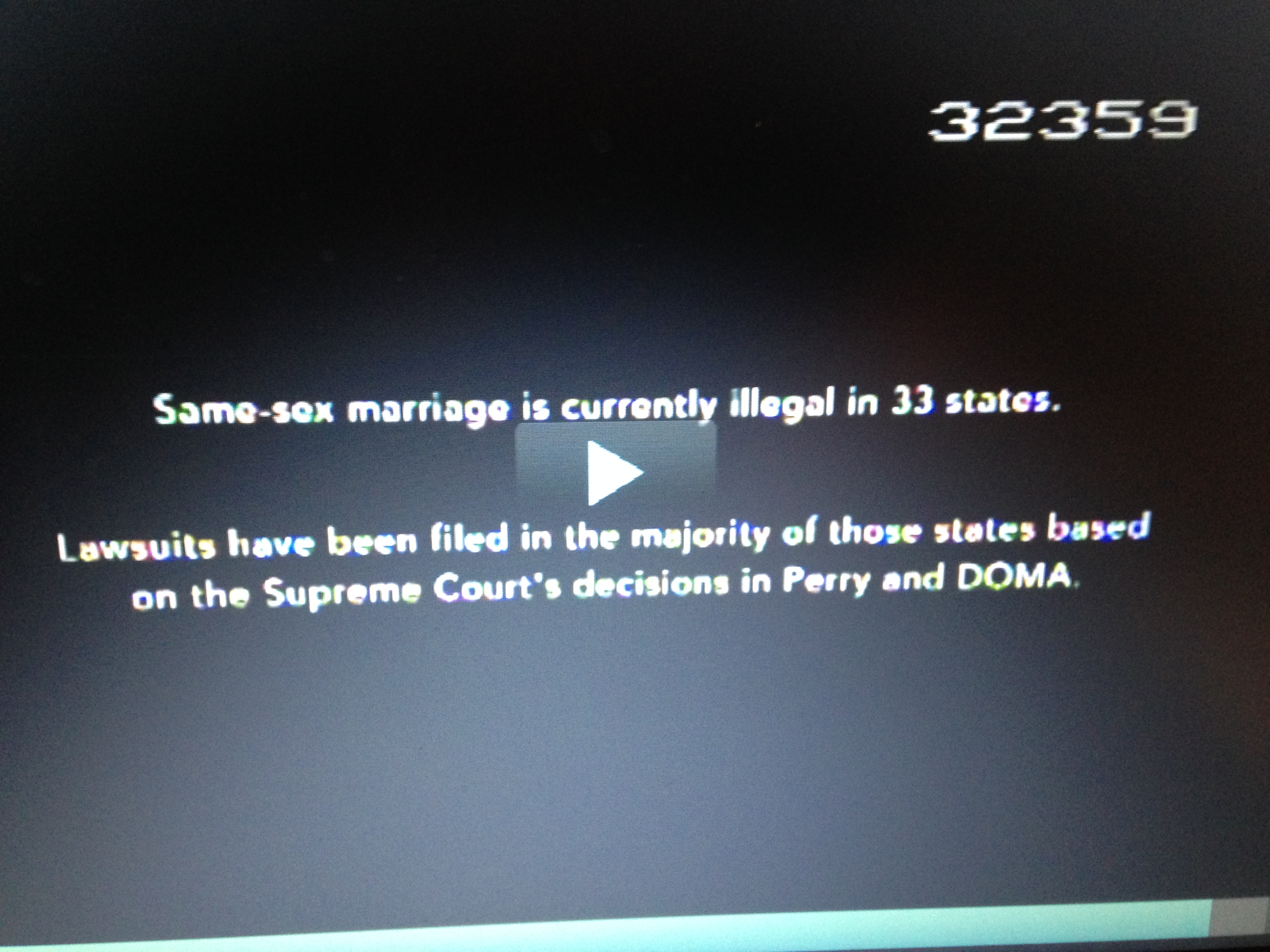
If you hoped the HBO Chad Griffin documentary might not be as egregiously wrong and slanted as Jo Becker’s breathless hagiography, it looks like you’ll be disappointed. See the above screen shot of the final moments, just emailed to me. As a factual matter, so far as I know, no lawsuits have been filed in those states based on the Perry decision, while 24 have been filed based on the Windsor/DOMA decision. So both Becker and HBO made a bet on the wrong case – but keep pretending they didn’t. HBO won’t send me a screener – although they did get their PR flak to call me up to see if I was going to be mean about it. I’ll wait and see the thing before passing judgment, but that screenshot made my stomach lurch. And I had to splutter when I saw this correction from the Huffington Post in a review of the trailer:

CORRECTION: A previous version of this post incorrectly stated that the Supreme Court ruled Proposition 8 unconstitutional. The Supreme Court itself ruled that the private parties that appealed the case to the justices did not have standing to do so after the state of California had bowed out.

Somehow, I think Chad Griffin will find a way to get the world to forget that.

By the way, the “Do I Sound Gay?” kickstarter project has two more days to go and hasn’t reached its target, if you want to help out. Read about it here in our thread on the topic.

The most popular post of the day was my New York Shitty Update. Readers are going to let me have it soon enough, but I hope it’s somewhat clear I have my tongue in my cheek a bit on this. I’m not denying New York’s stunning cultural, business, media and financial depth. I’m just pointing out the vast gap between the city’s self-image and what most sane people would think of living here. My piece on Europe’s red-blue divide was runner-up again.

Many of today’s posts were updated with your emails – read them all here.  You can always leave your unfiltered comments at our Facebook page and @sullydish. And today we posted for the first time in a while a poll to “Ask Andrew Anything” – submit your questions and vote on them here. 20 27 more readers became subscribers today. You can join them here for a little as $1.99 month. It’s how we keep this show on the road.

See you in the morning.

Face Of The Day

President Obama Delivers Commencement Address At West Point

Following a West Point tradition, Alan Jones, age 7, gathers caps after graduating cadets threw them in the air at the conclusion of the graduation ceremony at the U.S. Military Academy at West Point on May 28, 2014. U.S. President Barack Obama gave the commencement address at the graduation ceremony. In a highly anticipated speech on foreign policy, the president provided details on his plans for winding down America’s military commitment in Afghanistan and on future military threats to the United States. By Spencer Platt/Getty Images.

Where The Wild Things Could Go

Emma Marris urges national parks to create “nature play areas,” where kids can “go off trail, climb trees, collect specimens, and generally leave as much trace as they want”:

Richard Louv, author of Last Child in the Woods, agrees that parks should make room for kids to play. “If kids don’t have some kind of connection to nature that is hands-on and independent, then they are probably not going to develop the love of nature and vote for parks and the preservation of endangered species,” he says. “Unless you know something you are unlikely to love it.”

There’s some research to back up this intuition. One 2010 study in the journal Children, Youth and Environments found that among people who ended up dedicated to nature and conservation, most had a childhood filled with unstructured play in nature, some of which “was not environmentally sensitive by adult standards; rather, it included manipulation of the environment through war games, fort building, role playing of stories in popular children’s adventure books and movies, and the like.”

Drones That Get Down

Ben Valentine spotlights the work of Eleven Play, a Japanese dance group that incorporates drones into their performances:

Surrounded by an all-white stage, sprinkled with black computer monitors facing the audience, the three dancers and their accompanying drones put on a mesmerizing and eerie display. The result is stunning. … Much like Alexander McQueen’s haunting use of robotics in performance, Eleven Play’s dance is not without a sinister side. At the beginning, the dancers appear in control, or at least in mutual dialogue with the drones. We see the dancers pushing and pulling the drones, as if conducting them. The drones are what one would want in a good dance partner, they follow the music and they’re responsive to your body, they just happen to be flying robots.

Yet at the performance’s 1:56 minute mark, there is a shift, and the drones become menacing and the dancers visibly fearful. Simultaneously, with the projection appears to become the drones’ conductor — a commentary on the problems of control in a largely algorithmic machine. The drones start dancing to their own beat, and the human dancers become superfluous. This is not a hyperbolic point either; the US has already relied on algorithmically determined drone strikes based solely on phone metadata.

Amber Frost is also impressed:

At first the dancers interact cautiously and experimentally with the drones, then the machines become more active and more threatening. With no control over the increasingly volatile technology, the women flee the stage in fear. In the end, the only ones left dancing are the drones themselves. It’s beautiful and dramatic and there’s a trippy light display and flying robots—what more could you want?

Bob Dylan, Curator

We already introduced Dish readers to David Kinney’s new book, The Dylanologists. Chris Francescani highlights the incredible sleuthing of one superfan, a New Mexico DJ named Scott Warmuth, who has shown that Dylan’s 2004 memoir, Chronicles: Volume One, is “full of fabrication, allusion, and widespread appropriation of material from a vast and surprising spectrum of sources” – and so are many of his songs:

Dylan’s Chronicles, one of five finalists for the prestigious National Book Critics Circle Award for biography or autobiography, appears to sample everything from Ovid and Virgil to Twain, Hemingway, H.G. Wells, a March 31, 1961 issue of Time magazine, and scores of other far-flung source material—even self-help books.

Since 2003, when a Minnesota schoolteacher came across lines from Dylan’s 2001 album Love and Theft in an obscure biography of a Japanese mobster, the legendary songwriter has faced accusations of plagiarism. His subsequent album Modern Times also borrowed liberally from the work of Henry Timrod, a Civil War-era poet from Charleston, South Carolina.

But Kinney, following Warmuth, doesn’t view this as a straightforward act of plagiarism. Ian Crouch explains:

Warmuth’s reading of Dylan’s memoir has revealed that Dylan’s “appropriations were not random. They were deliberate. When Scott delved into them, he found cleverness, wordplay, jokes, and subtexts.” The thefts that Dylan made were part of the story—he had, as Kinney writes, “hidden another book between the lines.”

Kinney remarks on an especially intriguing section of “Chronicles,” in which Dylan seems to be explaining the method behind his guitar playing. Dylan writes, mysteriously, “You gain power with the least amount of effort, trust the listeners to make their own connections, and it’s very seldom that they don’t.” If this sounds inscrutable as musical technique, that’s because it is lifted from a self-help book about gaining influence over others called “The 48 Laws of Power,” by Robert Greene. This, then, is a cunning bit of dark humor: Dylan purports to explain the magic behind his music, but he’s really just revealing how susceptible devoted fans are to this kind of florid nonsense.

This unpacking of Dylan’s memoir, and the increased scrutiny given to his recent albums, is a reminder that Dylan’s work has always been spurred on by his own fannish, idiosyncratic obsessions. Michael Gray, who has written extensively about Dylan’s songwriting, tells Kinney, “You want him to be this lone genius who came from another planet. He never pretended to be. He’s created something out of something else.” Dylan’s earliest songs borrowed chords and lyrics from traditional folk songs; he has lifted lines and licks from the blues; he has repurposed and reassembled the Bible, press clippings, English poetry, the American songbook, and a half century of cultural comings and goings to create a kind of ongoing, evolving musical collage. Dylan is an archivist and a librarian in addition to being an artist.

For more, check out Popova’s selection from a 1991 interview with Dylan about songwriting here.

Time To Punish Maduro?

José R. Cárdenas wants sanctions against Venezuelan officials involved in human rights abuses:

By its own admission, the [Obama] administration believes that if it acts unilaterally in Venezuela, it would “bilateralize” the conflict; that is, it would give the Venezuelan government a new drum to bang in its ongoing cacophony of anti-American rhetoric, thus diverting attention away from the protestors’ grievances. That, however, is giving credence to a problem that doesn’t exist. The view that sanctioning human rights observers will somehow make Venezuelans think any less of skyrocketing inflation, rampant street crime, and shortages of everything from electricity to basic consumer goods is as divorced from reality as is the Venezuelan government’s belief it can beat its people into continued submission.  …

As the saying goes, when you exhaust all your other options, you may as well do the right thing. The crisis in Venezuela has churned for four months now because the government hasn’t had to face any costs for its truculent behavior. The Obama administration has an opportunity to change that equation through the principled application of sanctions against behavior no one who wants what is best for the Americas should accept.

The State Department appears to have backed down from its opposition to a bill that would do just that:

“I’m not saying that the State Department loves it,” Rep. Ileana Ros-Lehtinen, the Miami congresswoman who introduced the bill, said on Tuesday. “But this time they’re not actively against it. …

Ros-Lehtinen’s bill, which would freeze assets and ban entry to the U.S. for people found guilty of human rights abuses against Venezuelan protesters, passed the House Foreign Affairs Committee earlier this month despite a campaign by the State Department to pause the bill and its counterpart in the Senate. Ros-Lehtinen hopes to pass it by a voice vote on Wednesday.

Roberta Jacobson, the State Department’s assistant secretary of state for western hemisphere affairs, had argued that the Venezuelan opposition had said they were against the bill — something Venezuela’s opposition coalition, known as MUD, later denied. The opposition has engaged in talks with the government aimed at resolving months of political unrest that have resulted in the deaths of more than 40 people.

David Noriega compares South Florida’s pro-sanctions Venezuelan-American community to the Cubans of Miami, who have spend decades lobbying for tougher anti-Castro policies:

There were about 250,000 Venezuelans living in the United States in 2012, according to census data, of which almost 65,000 are American citizens. But what defines the population is not its size but its political cohesion: The vast majority of Venezuelan immigrants have arrived in one way or another as a consequence of the rise to power of Hugo Chávez, whose regime was marked by aggressive wealth redistribution, expropriations of private enterprise, and other measures that negatively impacted the wealthier sectors of Venezuelan society.

“Compared to, say, Mexicans or Dominicans or other Latino populations, these are almost exclusively people from the middle class and upper middle class,” said David Smilde, a senior fellow and Venezuela expert at the Washington Office on Latin America and a professor at the University of Georgia. “This is a diaspora of people who are very anti-Chávez and now anti-Maduro, whose interests have been touched upon, who fear the rise of a dictatorship, or who have been victims of some kind of political persecution.”

Update from a reader:

I think that American sanctions against Venezuela would be a horrible, terrible, very bad, not good idea, and a godsend gift to President Maduro. Let me explain.

I am originally from Latin America. Even though it is hard to believe for people outside of it, much of the Latin American Left still believes that Cuba is the worker’s paradise. Whenever some rational person points out the poverty that Cubans live in today, the immediate answer is “American Sanctions!” The sanctions have became a magical trick that the Latin American Left can use to explain anything that it is wrong with Cuba.

The exact same thing will happen in Venezuela. Forget the fact that the economic difficulties have been going on for quite some time: the second that the United States imposes sanctions, the Left will immediately start blaming the sanctions for the Venezuelan economic hardships. In fact, it will feed the old Latin America mystique, that some brave leaders like Fidel and Chavez (and, by extension, Maduro) had risen to fight for the poor people in Latin America against the American imperialists. That way, sanctions would actually give credence to Maduro: he can turn to the protesters and say “You are either with Venezuela (and me) or with the American imperialists”.

What is currently happening in Venezuela is gut wrenching. Our natural impulses are to do something about it. But, please, the best thing America can do for Venezuela is to stay as far away as it can.

Art In The Age Of Mechanical Reproduction

Kalliopi Monoyios is an illustrator who bristles at questions about how much of her work is digital. She ponders perceptions of machine-aided art:

[I]f a machine could draw on its own, would it be able to produce images that move us in the same way that images made by a thinking, feeling human do? It would seem that a fair number of people hold the view that art produced by a machine could never hold a candle to “hand-drawn” images, despite their being enamored with animated films and hyper-realistic video games. In the same way that love still feels real and powerful and fraught with meaning even with the knowledge that it is, at its core, just a chain of chemical reactions, a drawing rendered by a machine can stir something deeply human even if you are aware of its mechanical origin.

She goes on to point to illustrations produced by Iron Genie (seen above), a harmonograph constructed by the artist Anita Chowdry:

Why was Chowdry, who clearly has the skills to create delicate and elaborate drawings with her own two hands, compelled to make an instrument to draw for her?

While it’s amusing to think she might have burned out on creating herintricate and exacting rosettes, the reality is quite different. In her own words,

The immediate appeal of the Harmonograph to me is that you can witness the unfolding of natural dynamic geometries that have always existed independently of our aesthetic sensibilities. We cannot draw them ourselves without the aid of mechanical devices. They have existed long before we discovered them, before we even began to understand the physics that drives them, before we had the language to define them in mathematical terms.

They are a part of the dynamics of the universe – they have existed long before us, and perhaps that is why we find it so hypnotic to watch the drawings unfold before our eyes as the swinging pendulums drive the movements of the pen and paper… in our own slick, virtual, digital age in which we feel less and less in control, a venerable analogue machine with simple workings that we can see, understand, and touch, offers a reassuring physicality.