Loose List Sinks Spook

Over the weekend, the White House accidentally let slip the name of the CIA’s top official in Afghanistan in a list e-mailed to news organizations:

The White House recognized the mistake and quickly issued a revised list that did not include the individual, who had been identified on the initial release as the “Chief of Station” in Kabul, a designation used by the CIA for its highest-ranking spy in a country.

The disclosure marked a rare instance in which a CIA officer working overseas had his cover — the secrecy meant to protect his actual identity — pierced by his own government. The only other recent case came under significantly different circumstances, when former CIA operative Valerie Plame was exposed as officials of the George W. Bush administration sought to discredit her husband, a former ambassador and fierce critic of the decision to invade Iraq.

Jonathan Tobin expresses outrage, decrying what he sees as a partisan double standard:

Let’s remember that what occurred this past week was far worse than anything that happened to Plame. Plame was, after all, serving in an office in Virginia and, while classified, was no secret. By contrast, the CIA station chief whose name was released is in peril every day in Kabul. He is serving on the front lines of a shooting war and the release of his name in this indiscriminate manner may well have compromised his effectiveness if not his safety.

The White House has, in fact, ordered an investigation. And Ambinder counters that, while the Plame leak compromised a number of vital intelligence operations, this one has less dangerous implications:

Station chiefs of major CIA stations are generally known, at least by name, often by sight, to rival intelligence agencies almost from the get-go. Certainly, the station chief, in working with a number of different agencies in Afghanistan, would have to accept that his degree of freedom to control his cover is probably tiny at this point. When the CIA appoints chiefs of stations, the agency generally understands and accepts the risk that the identity, and perhaps the person’s cover history, might be exposed. Occasionally, this can lead to compromised operations, although generally, enough time has elapsed between these officers having actively run agents and operations (as opposed to having managed them) that the risk is — again, to the use the word — acceptable. The more dangerous consequence is not so much that rival spooks figure out the name of the CIA’s man or woman in a certain country. It’s that the country or targeted entity can use this information to pin a target on the person’s back, which is exactly what elements of the Pakistani government did during a dispute about drones and intelligence-sharing a few years back.

Meanwhile, Jack Goldsmith finds it odd that the press has so far been scrupulous about not printing the station chief’s name, but is happy to publish classified information about intelligence and surveillance methods:

I believe the answer is that journalists still tell themselves that they will not publish a secret that, as Bart Gellman put it in a 2003 lecture (not on-line), “puts lives at concrete and immediate risk.”  And publishing the name of a covert operative may appear to put a life at concrete and immediate risk more obviously than publication of a method of infiltrating a communications system.  It is interesting that Gellman – who represents mainstream elite journalistic opinion on this matter – included in his 2003 list of too-risky disclosures not just the “names of clandestine agents,” but also “technical details that would enable defeat of U.S. weapons or defenses.”  I think it is fair to say that eleven years later, and post-Snowden, technical details concerning communications intelligence operations related to U.S. weapons or defenses are no longer considered remotely unpublishable.  I expect that journalists today would argue that such disclosures do not put lives at concrete and immediate risk. …

Let us concede for purposes of argument that Snowden-like revelations do not cause concrete and immediate risk to lives.  The real question is: Why privilege “concrete and immediate risk” to lives over diffuse and indirect risk to lives?  The harms to lives from disclosing communications secrets are harder to see because they are usually diffuse and probabilistic rather than concrete and immediate.  But they are no less real.
Scapegoating Sugar?

David Despain criticizes the new Katie Couric-narrated documentary about youth obesity, Fed Up, for its single-minded focus on added sugar, while largely ignoring other factors, such as exercise:

While added sugars are a significant part of the problem because they are widely used to make food appetizing, they are far from the whole problem, says Dr. David Katz, director of Yale University’s Prevention Research Center and listed as a member of the scientific advisory board for Fed Up. “In terms of overall health outcomes, the evidence overwhelmingly indicates the conjoined importance of what we do with our forks and what we do with our feet,” he says.

If Dr. Katz is straightforward in his criticism, he is joined by many other nutrition experts and organizations who have taken a harder line against the film. Angela Lemond, a registered dietitian nutritionist and AND spokesperson, says that the film’s minimizing of the benefits of exercise is “truly unfortunate” and “irresponsible,” noting that sugar is a quickly absorbed source of carbohydrate that is crucial for exercise performance. Moreover, the film’s focus on sugar as a major factor in contributing to obesity is a “biased view” not shared by the majority of objective scientists, says James O. Hill, a professor of pediatrics and medicine at the University of Colorado, Denver and an ASN spokesperson. “Research is clear now that adding sugar to a diet and taking away the same number of calories does not cause weight gain or any other of the outcomes attributed to sugar in this film,” Hill says.

Michael O’Sullivan finds that the film could have done more to address a deeper issue at work, noting that federally mandated nutrition labels don’t include the “daily value” percentage for sugar:

[T]he real problem isn’t sugar, but sugar education. If consumers only knew that the stuff is not just addictive, but poisonous — one of the film’s experts calls it a “chronic, dose-dependent” liver toxin — they might make better choices at the checkout counter. Unfortunately, “Fed Up” doesn’t seem to recognize the problem of food deserts, which can hamstring even the best-intentioned efforts to teach people how to eat right. (For an exposé of the food desert phenomenon, in which many communities simply don’t have options other than buying processed foods, I strongly recommend the 2012 documentary “A Place at the Table.”)

Celebrities appearing in “Fed Up” include former president Bill Clinton and former FDA commissioner David A. Kessler, both of whom bemoan the lack of government foresight on obesity and diabetes. (Opponents of so-called nanny state efforts to regulate, say, soft drink size are given short shrift.) But it’s author-activist Michael Pollan who delivers the film’s most succinct message when he says that the single best way to improve one’s diet is simply to cook what you eat. And no, that doesn’t mean microwaving a Hot Pocket.

Paula Forbes faults the documentary for ignoring economic inequality’s role in making Pollan’s suggestion difficult to put into practice:

In fact, it is on this point that the film stumbles into blitheness. Michael Pollan at one point states home cooking can be cheaper than fast food as well as being healthy. This he holds, uncontested in the film, as proof that all we need to do is cook ourselves. But he misses the point.

It’s not just about money, it’s about time. The US Congress just defeated a bill that would raise the minimum wage to $10.10. This means the federally mandated minimum wage remains $7.25. (And guess who lobbied against the increase?) Who is going to crisp that kale, who will visit the neighborhood farmers market — which Pollan suggests is a panacea — that will magically appear in the food deserts of New York and Newark and in the poor precincts of Baltimore not to mention Tuscaloosa and Kokomo, if you’re working 70 hours a week to make ends meet?

News To Befuddle Larry Kramer

From Vancouver:

The dedicated HIV/AIDS ward at St. Paul’s Hospital has closed due to a lack of patients.

“It was not that long ago that HIV/AIDS was a death sentence and those who came to this ward at St. Paul’s were here to die,” said Dr. Julio Montaner, director for the BC Centre for Excellence in HIV/AIDS. “Today, ward 10C will provide treatment, support and care for those living with HIV-related issues. We have worked hard to make this day happen and I commend everyone who has supported our efforts.”

Guys Fake It Too, Ctd

Readers keep the emails, er, coming:

In the film 3, there’s a funny scene of a guy spitting into a condom when his girlfriend goes to the bathroom.

Another:

I’m a gay man and I’ve faked it with one new partner a couple month ago.  We had been corresponding online and after proper testing and planning we decided to meet in Vegas.   He wanted to have condom-less sex and I was excited to have my first try at it.  But the hot online affair failed to ignite the proper passion for some reason.  Sex was mechanical and uninspiring, and his pleas for me to ejaculate inside him soon became a turn off.  At one point it seemed we were both waiting for the other to climax and get it over with.

So, I faked it.

I acted out the proper movements and vocalizations and ended it, collapsing to his side in the typical male exhausted post coital disengagement.   I don’t recall if he came or not, and till today I don’t know if he bought it.  I hoped the copious amount of cheap lube we used masked my missing contribution. What’s worse, this repeated two more times over that odd Vegas weekend.

I never got to have my first full bareback experience. And frankly, I can’t tell if the root cause was my anxiety over unprotected sex, or if I should chalk it up to simple sexual mismatch.    I thought he was a handsome and very nice guy, and we had fun in all our other Vegas activities.  The chemistry was somehow lacking between us.

A female reader shifts the gender focus:

First of all, kudos for running a blog that makes me comment on things I had no idea I would be commenting on. Even anonymously. And if you ever have that discussion about opening up a comment section again, please count this email as a solid NO because I wouldn’t be writing in about things like abortion and orgasms in an open comment section because … well, I’m a woman who grew up on the Internet and I’ve sadly learned to think twice about clicking on the Post button.

Moving on to the 50-year-old lady who doesn’t orgasm: That could be me writing in, twenty years in the future.

I like sex. With men. I have orgasms. I simply don’t experience them all at the same time. I started having orgasms early, by accident, when I was around 11 years old or so and a very active imagination soon helped me … broaden my horizons, shall we say? I have absolutely no problems having orgasms by myself but I’ve faked it with everyone I’ve ever slept with. There’s just too much going on in my head when there’s another person involved for some reason. Maybe it’s a control thing? I don’t know. I just can’t find the “release” button, so to speak, when I’m sharing the bed with someone else.

None of the other women I know seem to have this problem. However, considering how I don’t mention it myself, maybe we’re all a bunch of liars just maintaining the status quo.

The reason why I don’t say anything is because I’m hoping to change it. I still think the problem might be psychological rather than physical and I would like to experience a “traditional orgasm” someday. Although now that I think about it, after reading my fellow reader’s email, I don’t really know why I’m so invested in fitting in. I don’t think the sex I’ve had is unfulfilling. It was great sex. I got off thinking about it later on, haha!

Another tosses something out there:

You really want to get people talking? Start a thread about people who come too fast instead of not at all.

Another can attest:

I’ve faked orgasm many a time, but most of the responses you’ve posted so far involve guys who have trouble achieving orgasm. Maybe it’s my uncircumcised status (Sully Bait), but I have the exact opposite malady with the exact same remedy.  When I fake, it’s because a) I’ve cum embarrassingly early and I need to save face, b) she’s seems ready to orgasm within the next minute or two but I can’t wait that long, or, much more rarely, c) I’ve been drinking and I have a similar problem to your other respondents.

In the case of a) and b), it involves not only the fake orgasm, but the fake non-orgasm.  The latter is a good deal trickier.

I’ve always wondered whether other guys do this.  Maybe it’s because I’m not browsing the right forums, but I’ve never seen an online discussion on the subject before.

Creepy Ad Watch

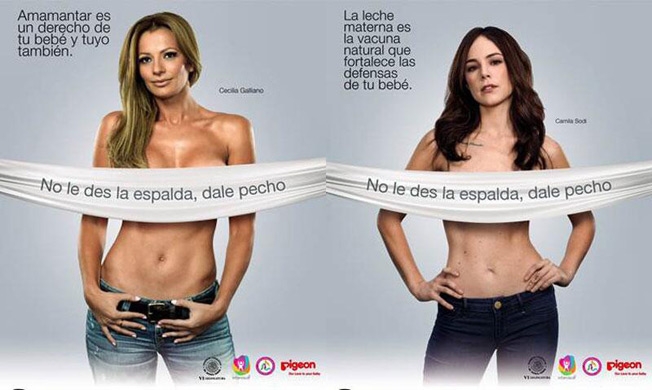
mexico-city-breastfeeding-hed-2014

Rebecca Cullers frowns:

Activists and health advocates are rightly upset over this poorly executed campaign to get Mexico City mothers to breastfeed. It shows topless celebrities with a carefully placed banner running right over their breasts that says, “No les des la espalda, dale pecho,” which translates to, “Don’t turn your back on them, give them your breast.”

The first problem is how overtly sexualized the women are. The act of breastfeeding is not a sexual act. It vacillates between being painful, annoying, exhausting, inconvenient and heartrendingly sublime. The sexualization of breastfeeding is a large part of the reason so many people shame mothers for breastfeeding in public, and a factor in low breastfeeding rates. (This campaign by two students nicely illustrates this part of the problem.)

Update from a reader:

I think something may be getting lost in translation.

The problem the Mexican advocates have with this campaign is that it seems to blame mothers, suggesting that not breastfeeding is “turning your back” on your child.  Mexico has very low rates for exclusive breastfeeding, but that is because most women breastfeed and supplement with formula (about 94% of babies in Mexico are breastfed, compared to 77% in the US).  Part of that is because many Mexican women see formula as offering something extra to the baby (it is scientifically formulated!), so in that sense having celebrities advocating nursing might make sense. (One of the most effective pro-breastfeeding campaigns in the ’80s featured then telenovela queen Veronica Castro.)

However, the thing that started the controversy with this campaign was that the creator stated that this campaign is targeting women who do not breastfeed because they want to maintain their figure. That is such an ignorant and ridiculous take on the true barriers for breastfeeding mother in Mexico I don’t even know where to start taking it apart. But the complaints are not about the pictures sexualizing breastfeeding. As a foreigner, it seems to me that seeing these ads as sexualizing breastfeeding says more about American hang-ups with bare breasts than about anything else. I’ve never heard of a woman being asked to breastfeed in a restaurant’s restroom in Mexico, for example.

The Evolution Of Marriage

A piece predicting the state of marriage in the foreseeable future sent a shiver up Rod Dreher’s leg yesterday. The gist of the piece?

[T]he future of marriage … may turn out to be a lot like the Christian Right’s nightmare: a sex-positive, body-affirming compact between two adults that allows for a wide range of intimate and emotional experience. Maybe no one will be the “husband” (as in, animal husbandry) and no one the chattel.  Maybe instead of jealousy, non-monogamous couples will cultivate “compersion” to take pleasure in their partners’ sexual delight.

Well, you learn a new word every day. Rod runs with this notion and focuses on the fate of children:

If marriage as an institution is culturally redefined entirely to suit the desires of adults, and that is considered a virtue — as Jay Michaelson hopes for — then the children raised in a society like that lose out.

Rod rightly doesn’t blame marriage equality for this, but rather sees marriage equality as a product of this shift. And, look, in so far as marriage is about raising kids, then the potency and importance of monogamy is a point well-taken. But I tend to think the worries are overblown. I very much doubt that parents of toddlers will be engaging in compersion any time soon – not least because they’re always so fricking tired. Maybe gay dads might be tempted to have a few discreet and consensual dalliances, but my own sense is that the act of parenting tends to make them more like straight couples than other gay ones. In fact, I’d argue that the differences between gay and straight marriages are minor compared with the differences between marriages with kids and marriages without them. A new study just shed a little light on that:

Research has shown that a new mother’s brain activity changes after having a baby. Turns out, gay men’s pattern of brain activity also adapts to parenthood, and resembles that of both new moms and new dads, in findings published Monday.

As for childless couples, my own view is that we should chill out on their sexual lives. Most straight ones will be largely monogamous, most lesbian ones super-monogamous, and gay male couples will negotiate their own paths – but the point is that each will find their own equilibrium. On that possibility, Rod intones:

You can have freedom, or you can have stability, but you can’t have both.

I think that’s way too crude a formulation. The question is not a totalist either/or for anyone. It’s a question of balance between the two. Married mothers balance children and economic freedom all the time – and many find a compromise that works, which is why divorce rates have declined. It may also be that for gay male couples, total monogamy may lead to less stability, not more. Men are men, after all, and any honest assessment of marital history would record plenty of extra-marital sex by the husbands. With two men in a marriage, rigid monogamy over a lifetime might therefore actually destabilize the union. With two women, monogamy may be easier, and child-rearing more obvious a priority. The point in all these relationships is not, it seems to me, to support a single rule of “stability” over “freedom”, but to find a sustainable balance between the two in the modern world, and to take the best care of children as possible. How they do that is best left for the couples to decide, in private, because every couple is different. But the best compromises lead to the best marriages.

Perhaps that’s why bringing ideology into the question marriage can be so fruitless. We’re all humans, living in a much different world than humans have been used to for the vast majority of our time on the planet. And in those circumstances, best to let the couples adapt, as best they can, as the institution evolves, as it must and as it always has, to meet the needs of adults and children.

I have confidence in that human evolution, which is why I am not a theocon. I am a conservative.

It Pays To Go To College

College Value

Leonhardt contends that college is still a smart investment:

The pay gap between college graduates and everyone else reached a record high last year, according to the new data, which is based on an analysis of Labor Department statistics by the Economic Policy Institute in Washington. Americans with four-year college degrees made 98 percent more an hour on average in 2013 than people without a degree. That’s up from 89 percent five years earlier, 85 percent a decade earlier and 64 percent in the early 1980s. …

The much-discussed cost of college doesn’t change this fact. According to a paper by Mr. Autor published Thursday in the journal Science, the true cost of a college degree is about negative $500,000. That’s right: Over the long run, college is cheaper than free. Not going to college will cost you about half a million dollars.

Yglesias isn’t so sure:

Suppose I got someone to make a chart showing the incomes of prime-age BMW drivers versus average Americans.

It would reveal a large BMW earnings premium. I could even produce a chart showing that the children of BMW drivers grow up to earn more than the average American. But that wouldn’t be evidence that BMWs cause high wages, and that the BMW Earnings Premiums extends across multiple generations. It would be evidence that high-income people buy expensive cars and that there’s intergenerational transmission of socioeconomic status.

To understand whether college is “worth it” — or, more precisely, which colleges are worth it to which students — we would need some much more fine-grained data.

Leonhardt fends off this type of attack:

[T]he detailed research on the value of college comes to the same conclusion as the straightforward data comparing the pay of graduates and nongraduates. For the vast majority of people, college pays off. Correlation and causation, in this case, run in the same direction.

I’d argue that you do not need complicated academic research to demonstrate this point, either. Just look at market behavior. Virtually everyone with the resources to send children to college does so — including those who say they’re skeptical of its worth. And large numbers of low-income parents say that one of their highest goals in life is to send their children to college. In this case, the collective behavior of millions of people says as much about the value of education as any regression analysis.

Ben Casselman adds a caveat:

Most of the benefits of college come from graduating, not enrolling. Indeed, as Leonhardt pointed out, the wage premium for people with some college but no degree has been stagnant, even as debt levels have been rising. That means that people who start college but drop out may be worse off than people who never enrolled in the first place. Any attempt to answer the “Is college worth it?” question, therefore, has to grapple with not only the value of a degree, but the likelihood of obtaining one.

For many students, the odds aren’t good. Less than 60 percent of full-time students who are enrolled in college for the first time graduate within six years.

Are Egyptians Snubbing Sisi?

Egypt’s presidential election was supposed to end yesterday, but it was extended through tonight after voters failed to show up in the vast numbers the putative victor Abdel Fattah el-Sisi needs to claim a broad mandate. Turnout, however, still remains low:

On Wednesday, state and privately owned media loyal to Sisi put the turnout at between 37 and 46 percent of the electorate of 54 million. In a speech last week, Sisi had called for 40 million votes, or 80 percent of the electorate. The electoral commission said that over Monday and Tuesday, the scheduled two days of polling, just 37 percent of eligible voters cast ballots – a number well below the nearly 52 percent who voted in the 2012 election that brought Islamist leader Mohamed Morsi to power.

The lower turnout than Sisi had sought will sound a warning that he had failed to rally the level of popular support he hoped for after toppling Morsi, Egypt’s first freely elected president, following street protests last year. Reuters news agency reported on Wednesday that polling stations in the capital city of Cairo and Egypt’s second city of Alexandria showed that the turnout was lower than anticipated with only a trickle of voters casting their ballots.

This lackluster showing comes despite a full-court press to draw voters to the polls:

Over the past two days, the Egyptian government has pulled out all the tricks at its disposal to boost turnout. After the first day of voting, it declared Tuesday to be a national holiday, freeing state employees to head to the ballot box. Egypt’s Transport Ministry made the trains free to make it easy for voters to travel to polling stations, and some of Cairo’s largest malls shut down early so patrons and employees could go vote. Prime Minister Ibrahim Mahlab, meanwhile, threatened to fine registered voters who abstained from casting a vote.

The reason for voter apathy, however, may be inherent in the campaign itself. Sisi’s victory has appeared inevitable for months — he had already been meeting with foreign delegations even before the formality of the election. Moreover, the career military man ran a campaign that was almost completely absent of policy details, giving even voters inclined to support him little idea of how he would govern the country.

Jesse Rosenfield takes the pulse in the capital, finding that those who are turning out are mostly voting for Sisi:

Pro-Sisi residents in the cramped, narrow streets are welcoming as long as only their perspective is being heard. “Sisi is from the Egyptian army and the army is the best to form the government,” says 61 year old Said Shahada, who ekes out a living selling Pepsi products and is hoping for economic reforms that benefit the poor.

However, the atmosphere grows distinctly hostile when I cross the road to speak with 31-year-old construction worker, Farahat Tamer, who is boycotting the vote. Originally from Upper Egypt, he moved to the neighborhood for work six years ago and contends that few people from his home town will cast a ballot. “The regime of [ex- President Hosni] Mubarak has been taken out [but] my biggest fear is something worse is coming,” he says as Sisi supporters in the area become increasingly aggressive.

Creative Destruction Is So Cute

This video of Google’s driverless car prototype is pinging around the blogosphere:

[youtube http://youtu.be/CqSDWoAhvLU]

Megan Garber describes the car as “a cross between a Volkswagen Beetle and a Disneyland ride”:

Google’s prototypes aren’t meant to convey ideals so much as they’re meant to convey … familiarity. Friendliness. The reassurance that comes, implicitly, with being part of “the great multitude.”

They are, like the Model T before them, strategically banal. … We consumers of technology, as unapologetic adopters of status quo bias, tend to like the changes foisted on us to be incremental. And when new devices—new approaches—violate the status quo, we tend to dismiss them in a way that recalls the 19th-century anxieties. We call them “creepy.”

As Google’s then-CEO, Eric Schmidt, put it to The Atlantic‘s James Bennet in 2010: “Google policy is to get right up to the creepy line and not cross it.”

Adam Raymond observes that, more “than the convenience or the impressive technology, Google is talking about how safe its invisible chauffeur is”:

The car has backup steering and braking mechanisms should the primary systems fail. The front is made of a soft material so pedestrians safely bounce off and the windshield is plastic. There’s a giant stop button onboard, speeds top out at 25 miles per hour, and every time one of these hits the road, two Google employees are monitoring it and ready to take control at any moment. These things still have tons of tests ahead of them to ensure they can navigate the ever-changing environment of city streets, but CEO Sergey Brin says it’ll only be a few years until robot cars have swarmed the roads.

Victoria Turk also comments on Google’s safety focus:

This car isn’t built for cool points; it’s designed to push the idea that self-driving cars are totally safe and not scary at all. Google says it itself in a blog post detailing the car prototype. “It was inspiring to start with a blank sheet of paper and ask, ‘What should be different about this kind of vehicle?’ We started with the most important thing: safety,” they wrote.

According to the Associated Press, Google co-founder Sergey Brin compared riding the bubble car to using a chairlift when he announced it at a California tech conference on Tuesday evening.  Point being, it’s not exactly a Ferrari, and it’s not meant to be.