Getting Away With Murder

There’s a place where it’s possible, apparently:

Let’s imagine Daniel and Henry are vacationing in Yellowstone National Park, and set up camp in the 50 square miles of the park that are in Idaho (unlike most of the park, which is in Wyoming). They get into a fight and Daniel winds up killing Henry.

But rather than bury the body and try to cover up the crime, Daniel freely admits to it and surrenders himself to the authorities.

At his trial, he invokes his right, under the Sixth Amendment, to a jury composed of people from the state where the murder was committed (Idaho) and from the federal district where it was committed. But here’s the thing — the District of Wyoming has purview over all of Yellowstone, even the parts in Montana or Idaho. So Daniel has the right to a jury composed entirely of people living in both Idaho and the District of Wyoming — that is, people living in the Idaho part of Yellowstone. No one lives in the Idaho part of Yellowstone. A jury cannot be formed, and Daniel walks free.

That scenario is fiction, but all the legal maneuvers Daniel employs are completely legitimate, and someone in a similar situation could quite possibly get off scot free. That got a lot of attention when it was first pointed out by Michigan State law professor Brian Kalt in his 2005 Georgetown Law Journal article, “The Perfect Crime.” After all, it implied that there was a 50 square mile “Zone of Death” of the United States where you can commit crimes with impunity, like in The Purge or something. The scenario even got featured in a best-selling mystery novel, Free Fire by CJ Box, who consulted Kalt when writing the book.

Update from a reader:

I served as a chaplain in a trauma hospital in Alabama, and I observed that criminal investigators from rural counties rarely bothered to investigate apparent suicides as possible murders. One case in particular stood out, where a man was brought in who had initially survived a gunshot wound to the head. The story being told by his common-law wife was that the gunshot wound was self-inflicted, but she seemed to be in a big hurry to have his life support removed. Others in the family were concerned that the wife was somehow responsible. When it was all said and done, the county law enforcement spent about 20 minutes investigating the incident and ruled it a suicide. The county didn’t do an autopsy because of funding issues and the man was cremated expeditiously.

I learned at that moment that if you wanted to get away with murder, stage a suicide in a rural county in Alabama.

Off-Roading With Google Street View

dish_canyonview

While praising Google for bringing Street View to the Grand Canyon – “the company has captured the canyon with tremendous accuracy” – Jeremy Miller describes the limitations of virtual tourism:

[Street View Grand Canyon] feels conspicuously inadequate in critical ways.

On the virtual river you can fast-forward downstream, avoiding the soaking rapids and searing sun, putting in and taking out as you please. But part of the Grand Canyon experience is surrendering to the flow of the river and committing to the journey. Anyone who has traveled in canyon country knows how much the terrain can change in a matter of seconds during an afternoon rainstorm, or in the hours between noon and dusk, as sunlight glistens and fades upon the canyon walls. To these subtle but vital gradations, Google’s roving digital eye remains conspicuously blind.

I’d heard these shortcomings voiced by proud river runners and backpackers, often delivered with mild condescension (“I guess I can cancel my rafting permit for this summer”) or outright indignation (“Is nothing sacred?”). Jonathan Thompson, an editor at High Country News, invoked the cantankerous author Edward Abbey, who in the 1970s wrote, “The utopian technologists foresee a future for us in which distance is annihilated and anyone can transport himself anywhere, instantly. . . . To be everywhere at once is to be nowhere forever, if you ask me. That’s God’s job, not ours.” [Project leader for Google’s Grand Canyon mapping effort Karin] Tuxen-Bettman made a similar concession, pointing out that the map and its imagery were no substitute for the canyon itself. “It reflects what’s there at one moment of time,” she said, “but it does not replace it.”

Explain Yourself

It might make you more open-minded:

Recruiting a sample of Americans via the internet, [researchers] polled participants on a set of contentious US policy issues, such as imposing sanctions on Iran, healthcare and approaches to carbon emissions. One group was asked to give their opinion and then provide reasons for why they held that view. This group got the opportunity to put their side of the issue, in the same way anyone in an argument or debate has a chance to argue their case.

Those in the second group did something subtly different. Rather that provide reasons, they were asked to explain how the policy they were advocating would work. They were asked to trace, step by step, from start to finish, the causal path from the policy to the effects it was supposed to have.

The results were clear. People who provided reasons remained as convinced of their positions as they had been before the experiment. Those who were asked to provide explanations softened their views, and reported a correspondingly larger drop in how they rated their understanding of the issues.

Face Of The Day

by Andrew Sullivan

EU Election Count In Southampton

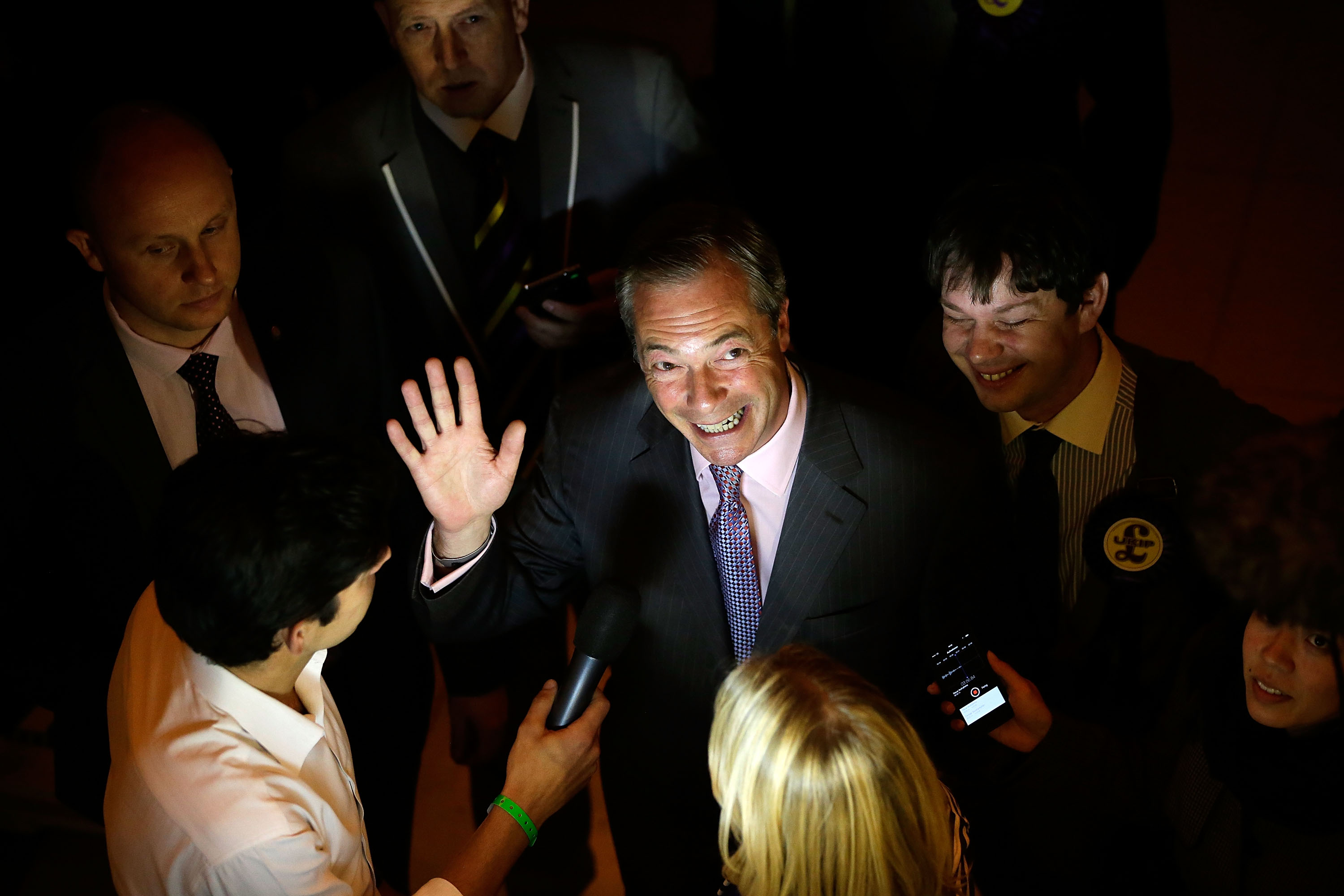
UK Independence Party (UKIP) leader Nigel Farage is interviewed by media as he arrives at the Guildhall for the results of the South East election count on May 25, 2014 in Southampton, England. UKIP, which advocates withdrawal from the European Union, was the top vote-getter in Britain’s European elections, beating both the Tories and Labour. By Matthew Lloyd/Getty Images.

Why Take Vacations?

by Jonah Shepp

Pointing to the abundance of research showing that “people who take vacations aren’t any happier, or are only barely so, than those who [don’t],” Jennifer Senior asks the obvious question:

Several reasons: First of all, our happiness often increases before vacations too, and that’s no small thing—never underestimate the hedonic power of anticipation. The positive memories from vacation also seem to occupy disproportionately large tracts of real estate in our minds, even if we weren’t enjoying our holidays at every moment in real time—and who are we, if not the sum of our most cherished memories?

But perhaps more to the point, our bodies appear to crave a respite from real life. While on vacation, we sleep more (about three quarters of an hour extra per night) and better; there’s also good evidence that they reduce our risk of cardiovascular disease and generally improve our long-term health. As de Bloom and her co-authors say in their 2013 paper, “Asking why we should keep going on vacations is therefore comparable to asking why we should go to sleep considering the fact that we get tired again.” Our bodies need them, simple as that.

More Than Pulling Strings

by Matthew Sitman

8620870455_d7bf611145_b

Eric Bass, a puppeteer, explains why the assumptions behind phrases like “puppet government” or “played him like a puppet” misunderstand what the art is all about:

As puppeteers, it is, surprisingly, not our job to impose our intent on the puppet. It is our job to discover what the puppet can do and what it seems to want to do. It has propensities. We want to find out what they are, and support them. We are, in this sense, less like tyrants, and more like nurses to these objects. How can we help them? They are built for a purpose. They seem to have destinies. We want to help them arrive at those destinies.

A simple example: What are the properties of a ball? It rolls, and sometimes it bounces. To put a ball onstage and have it never bounce or roll is a denial of what that ball is. Even if the ball does nothing, it can be said to be waiting to roll or bounce. A figurative puppet’s properties may not be quite so obvious, but they are there, and so is its character.

Analyzing the character will not get us very far. We have to discover who our performing partner is. This is true of its actions, its gestures, and its voice. Our cleverness in thinking of great things for the puppet to do or say will not help the puppet live. They will only draw attention to ourselves. If we try to impose them on the puppet, the piece we are performing will not be about the puppet at all. It will be about us, the manipulator. Or it will be about the conflict between us and our puppet.

The practice of our art, then, requires that we be the exact opposite of a controller. In fact, it requires that we step back and allow our puppets to perform their roles, their actions, their moments of life on the stage. It requires from us a generosity. If we try to dominate them, we will take from them the life we are trying to give them.

(Hat tip: Prufrock. Photo by Wolfgang Lonien)

Sex And The Single Soldier

by Katie Zavadski

In What Soldiers Do: Sex and the American GI in World War II France, Mary Louise Roberts recounts the unsavory activities of the good boys of the Greatest Generation. Jennifer Schuessler reviews the book (NYT):

The book cites military propaganda and press accounts depicting France as “a tremendous brothel inhabited by 40 million hedonists,” as Life magazine put it. (Sample sentences from a French phrase guide in the newspaper Stars and Stripes: “You are very pretty” and “Are your parents at home?”)

On the ground, however, the grateful kisses captured by photojournalists gave way to something less picturesque. In the National Archives in College Park, Md., Ms. Roberts found evidence — including one blurry, curling snapshot — supporting long-circulating colorful anecdotes about the Blue and Gray Corral, a brothel set up near the village of St. Renan in September 1944 by Maj. Gen. Charles H. Gerhardt, commander of the infantry division that landed at Omaha Beach, partly to counter a wave of rape accusations against G.I.’s. (It was shut down after a mere five hours.)

In France, Ms. Roberts also found a desperate letter from the mayor of Le Havre in August 1945 urging American commanders to set up brothels outside the city, to halt the “scenes contrary to decency” that overran the streets, day and night. They refused, partly, Ms. Roberts argues, out of concern that condoning prostitution would look bad to “American mothers and sweethearts,” as one soldier put it. Keeping G.I. sex hidden from the home front, she writes, ensured that it would be on full public view in France: a “two-sided attitude,” she said, that is reflected in the current military sexual abuse crisis.

Fiona Reid also reviews the book:

GIs arrived on French soil with preconceived sexual fantasies and an ingrained belief in the decadence of French women. This prejudice was reinforced in the early days of liberation as women suspected of sexual liaisons with Nazi soldiers were paraded, shaven-headed, through the streets while other (equally available) young French women eagerly greeted their American liberators with public kisses. Clearly there was romance but there was also abuse. Sex may have been given freely in the initial heady days of liberation, but it quickly became a commodity and US soldiers were soon associated with prostitution and soaring rates of sexually transmitted disease. Those who argue that prostitution does not necessarily degrade should pay close attention to the language of Panther Tracks, a GI newspaper, on this topic: “An especially vivacious and well-rounded harlot might demand a price of 600 francs. However the price scales downwards for fair merchandise and mediocre stock. Some fairly delicious cold cuts can be had for 150 and 200 francs.” By conceptualising French women as “cold cuts”, GIs grew used to accepting subservience from all women and from the entire highly “feminised” French nation.

In a review last month, Robert Zaretsky considered the racial implications:

A veritable army of infected women, overwhelming France’s shattered medical facilities, was one tragic legacy of this cultural collision. An even more tragic and disturbing legacy, though, was that of rape by American soldiers. The crime was almost always, due to the institutionalized racism of the American Army and racial prejudices of French civilians, associated with blacks: of the 152 soldiers tried for rape in France, 139 were black. Segregated and relegated to service duties like food and laundry services, black soldiers had more contact with French civilians. This presence of black soldiers in the rear lines fused with racial stereotypes, widespread among both Americans and French, that blacks were “hypersexualized.” When one adds stark linguistic and cultural divides to these stereotypes, as well as the traumatic experience of war and liberation, blacks were frequently accused of crimes they never committed.

Inevitably, a segregated army that numbered thousands of officers from the American South rarely questioned these accusations. Roberts’s meticulous review of the rape trials reveals a fatal pattern of racial prejudice with accusers and the military courts. Along with chocolate and cigarettes, Jim Crow turned out to be another welcome American import.

David Ellwood finds parts lacking:

It is a devastating tale, written with rare fluency and style and meant to pull down for ever the sacred images of the ‘good war’ and America’s armies as being full of unsullied heroes, risking their lives to bring liberation, relief, hope and democracy. Unfortunately it also presents a blinkered view, restricted in effect to what happened in two regions in northern France in parts of 1944 and 1945. … Depravity was not the whole story. In most places Americans were also seen as carriers of a model of modernity. The medium of their technology alone carried a message: the soft power of hard metal.

It is David Reynolds who explained best just why the GI’s behaved so often in their uncontrolled way, a question Roberts never gets to the root of, even as she insists that the US army was unique in its attitudes to sex. Freedom to spend, eat, drink, smoke and to buy women anywhere, anytime was not the casual thoughtlessness of a power new to total war. Instead it was the key technique chosen by the general staff and Congress to hold together armed forces which were not fighting to defend home and hearth; a huge, raw mass of young individuals in uniform from a land with scarce military traditions and a strong commitment to citizen democracy. The American under arms was an extraordinarily privileged being compared to those all around wherever he (or she) went to war. Probably it is still so, but over time the Pentagon has found other ways to motivate its personnel beyond the promise of unlimited money, food and sex. The unhappy Normans (and plenty of others) paid the price for the start of this learning process.

When Your Next Step Could Be Your Last

by Matthew Sitman

Byliner has unlocked Brian Mockenhaupt’s The Living and the Dead: War, Friendship, and the Battles That Never End for Memorial Day, which follows three soldiers in Afghanistan – Tom, Ian, and Jimmy – and the way battle shapes their lives. Here’s a glimpse of the gripping story Mockenhaupt tells:

With the mine detector, his rifle, ammunition, grenades, body armor and helmet, two radios, the bomb jammer, water, and medical supplies, Ian carried close to 90 pounds, more than any other Marine in the patrol.

He could handle the load: at five foot seven, he had weighed 150 pounds when he entered the Marines in 2007, but he had since bulked up to 205. He figured carrying extra weight would increase the patrol’s overall effectiveness—a weaker and overloaded Marine falling behind put everyone at risk. Besides, that way other Marines couldn’t complain about their lighter loads, or not being able jump across canals with the awkward weight.

Ian turned south, onto a tree-lined road that split two muddy fields. In a month the fields would be thick with waist-high poppy plants.

Tick tock.

Fifty yards up, the road crossed a canal just in front of a large, high-walled compound to the left.

“Muller,” Tom said, “slow it up a bit.” The patrol had stretched out after the Afghan soldiers, farther back, stopped to question a farmer. Tom and Matt picked up their pace and closed the distance with Ian, who worked the mine detector back and forth.

Tick tock.

Holly sniffed the air, five feet behind Ian, as he stepped onto the dirt bridge that spanned the canal.

Tick tock.

Tick.

Matt still can’t figure out how Holly wasn’t killed.

For the rest of the holiday weekend, you can read the rest here. Purchase The Living and the Dead as a Kindle Single here.