The Final Commercial Frontier?

by Tracy R. Walsh

Rachel Riederer is skeptical of space-mining ventures:

These new companies talk about space in a way that sounds unfamiliar to the civilian ear accustomed to the reverent tone of planetarium field trips; rather than the vastness of space, the companies emphasize its accessibility. Moon Express calls the moon “the eighth continent.” Planetary Resources wants to “bring the solar system into humanity’s sphere of influence.” Experiencing awe is fun. It’s even more fun to imagine a world of outer-space abundance in which we don’t have to worry about fossil fuels and everyone can afford a platinum case for their iPhone. And there is great potential for resource extraction in space, though these ventures will carry great upfront costs and plenty of uncertainty about whether they will actually come to fruition. Many deadlines and timeline estimates are fast approaching or have passed already.

What’s misleading about these projects isn’t that they’re subject to budget problems and delays, but that they come couched in overblown rhetoric about their potential to radically alter human life, to do away with the notion of scarcity and deliver us to a future of plenty and peace. It’s a pattern that has become familiar in Silicon Valley: develop a plan for a business that will do something cool and make a lot of money, but describe it instead as something that will change the world.

Previous Dish on extraplanetary resource exploitation here, here, here, and here.

When It’s Not PTSD

by Jessie Roberts

Lynne Jones questions the spread of the diagnosis, which entered the DSM-III in 1980. She recalls that, while working as a psychatrist in Sarejevo during the Bosnian War, “what immediately struck all of us living under siege at that time was the irrelevance of describing anything as ‘post-traumatic’”:

One researcher found that almost 94 per cent of displaced Bosnian children living in collective centres met the criteria for PTSD. But he wondered if some of those symptoms might be adaptive in the midst of continuing conflict. The children had been repeatedly shelled during the two-month research period. The hyper-vigilance that made a child startle at a sudden sound might actually keep them alert enough to take cover.

Jones went on to run a mental health clinic in Gorazde, Bosnia in 1996. She remembers that “most of the problems people brought to the clinic simply did not fit [the PTSD] pattern of symptoms”:

The most common problem among the ex-soldiers was chest pain. Bojan arrived at the clinic short of breath and trembling with anxiety. A short chubby man, slightly balding, he sat down and talked without stopping. The problem had begun during the war. After the funeral of a close friend, who had died in fighting, Bojan had collapsed with chest pain. Everyone thought he was having a heart attack. He had been sent to Sarajevo and put in intensive care with chest monitors and blood tests. After a few days, they told him it was his ‘nerves’ and sent him back to his unit in Gorazde. He was angry at doctors who had mishandled his problem and terrified of dying of a heart attack like his father. But he did not have nightmares or tend to relive painful memories from the war. He enjoyed his six-year-old child, his wife, his work; and whatever he had, it was not PTSD.

Some of my colleagues at home argued that the PTSD construct should be adjusted to include all post-conflict reactions, in both adults and children. But the point of a diagnosis is to distinguish problems that require different approaches. What is gained by extending the frame to include different symptom patterns, when all they have in common is exposure to the same supposed triggering event? A patient who has a persistent cough and is diagnosed with pulmonary tuberculosis requires a quite different treatment from a chronic smoker with a cough. If no distinction is made, one may end up giving the psychological equivalent of cough mixture: the ubiquitous, undefined ‘counselling’.

Why The FBI Is Struggling To Hire Hackers, Ctd

by Chris Bodenner

It’s not just the pot problem:

[Brian Honan, who set up Ireland’s first Computer Emergency Response Team (CERT),] said the real problem around luring talented hackers into law enforcement largely comes down to one thing. And that’s money. “The problem faced by law enforcement agencies, including the FBI, is the salaries that are on offer. Many talented hackers can demand high salaries in the private sector or indeed even more from criminal gangs,” he said.

A sub-£100k ($170k) per annum salary isn’t worth bothering with for many, given a hacker can make that kind of money in one go by selling a zero-day exploit (code that targets unpatched, unknown vulnerabilities in software). It’s down to them whether they want to hand their zero-day to a legitimate exploit broker, who tend to have big contracts with governments and law enforcement anyway, or to a criminal organisation, which could use it for nefarious purposes like stealing money from internet users.

He Certainly Did More Than Paint

by Matthew Sitman

In a long review of three recent books about John Quincy Adams and his wife, Louisa Catherine, Susan Dunn considers the accomplishments of his post-presidential career, which saw Adams return to public life as a member of the House of Representative and take up the abolitionist cause:

Though launched anew upon what he called “the faithless wave of politics,” Adams had a John_Quincy_Adams_1843guiding star, a clear path forward: the battle against American slavery. In 1831 and again in 1832, he dined with an impressive young Frenchman who queried him about the culture of democracy in America. “Do you look on slavery as a great plague for the United States?” asked Alexis de Tocqueville. “Yes, certainly,” Adams replied. “That is the root of almost all the troubles of the present and fears for the future.”

Ending slavery became Adams’s great mission. But because he understood that slavery was the one issue that could tear apart the union, he decided that, instead of taking it on frontally, he would attack it on the flanks. He aggressively defended the right of abolitionists to petition Congress and denounced the “gag resolution” that mandated the tabling of all petitions and propositions relating in any way to slavery, and he opposed Texas’s admission to the union as a slave territory. Invoking the immortal values of the Declaration of Independence, taunting his foes, barely surviving a censure resolution, he became known to sympathizers, as Robert Remini noted in his excellent short biography of Adams, as “Old Man Eloquent” and to southerners as “the Madman from Massachusetts.”

In 1847, Abraham Lincoln, a freshman congressman from Illinois, took his seat alongside Adams in the House of Representatives. John Quincy, whose mother had taken him more than seventy years before to watch the Battle of Bunker Hill from atop Penn’s Hill in Quincy, was a living link between the revolutionary generation that created a republic tragically flawed by its compromise with slavery and Abraham Lincoln, who would end slavery and rescue the republic from its own undoing.

Focusing on Fred Kaplan’s biography, John Quincy Adams: American Visionary, Carol Berkin emphasizes that “John Quincy did not find his independent voice until he was in his 70s,” when his anti-slavery activism reached its peak:

As Kaplan lays out the events that heightened Adams’ commitment to abolition, the narrative’s tempo increases and the story unfolds more powerfully. It culminates with the Amistad trials, which revolved around 53 Africans seized by Portuguese slave traders. Sold to Spanish planters, they were loaded onto the Amistad to be sent to Caribbean plantations. They rebelled, killed the captain and attempted to sail to Africa, but the ship was seized by an American brig off the U.S. coast. The Africans were imprisoned in New Haven, Connecticut. As the planters, the Spanish government and the brig captain argued over who owned this human property, abolitionists insisted the Amistad passengers were free individuals, kidnapped illegally.

When the case came to the Supreme Court, it was Adams who argued — and won — the defendants’ case. This, at last, was Adams’ moment — not a tribute to his father’s memory but a declaration of his own commitment to human equality and justice.

(Image: John Quincy Adams in 1843, via Wikimedia Commons)

A Poem For Monday

by Alice Quinn

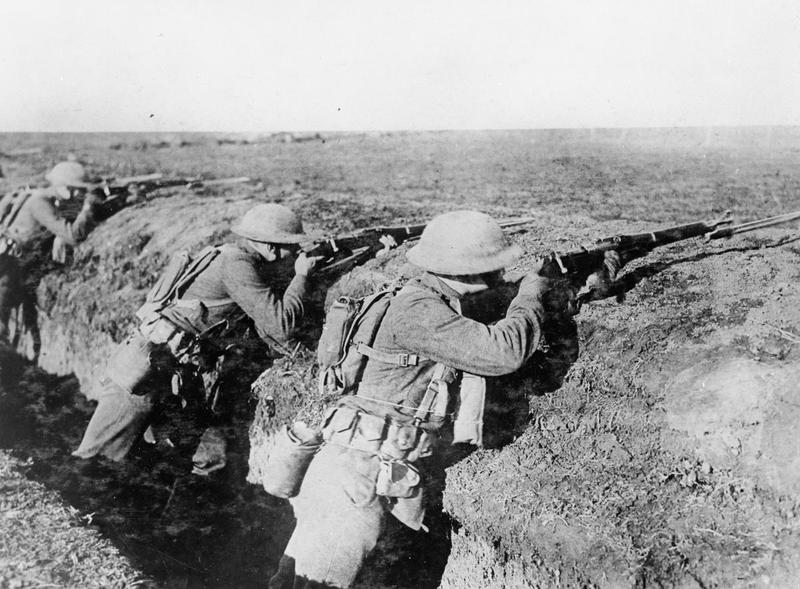
The_US_Army_on_the_Western_Front_1914-1918_Q70181

“The Man He Killed” by Thomas Hardy:

“Had he and I but met
By some old ancient inn,
We should have sat us down to wet
Right many a nipperkin!

“But ranged as infantry,
And staring face to face,
I shot at him as he at me,
And killed him in his place.

“I shot him dead because—
Because he was my foe,
Just so: my foe of course he was;
That’s clear enough; although

“He thought he’d ’list, perhaps,
Off-hand like—just as I—
Was out of work—had sold his traps—
No other reason why.

“Yes; quaint and curious war is!
You shoot a fellow down
You’d treat if met where any bar is,
Or help to half-a-crown.”

(From War Poems, selected and edited by John Hollander © by John Hollander 1999. Used by permission of Everyman Library. Photo of American marines ready to fire at the enemy in the trenches, Breuvannes-en-Bassigny, France, 1918, via Wikimedia Commons)

Government Is Not The Problem

by Matthew Sitman

Arguing that “American conservatives are in danger of appearing as though they had no positive idea of government at all,” Roger Scruton makes the case for the necessity and goodness of government:

The truth is that government, of one kind or another, is manifest in all our attempts to live in peace with our fellows. We have rights that shield us from those who are appointed to rule us—many of them ancient common-law rights, like that defined by habeas corpus. But those rights are real personal possessions only because government is there to enforce them—and if necessary to enforce them against itself. Government is not what so many conservatives believe it to be, and what people on the left always believe it to be when it is in hands other than their own—namely a system of power and domination. Government is a search for order, and for power only insofar as power is required by order. It is present in the family, in the village, in the free associations of neighbors, and in the “little platoons” extolled by Burke and Tocqueville. It is there in the first movement of affection and good will, from which the bonds of society grow. For it is simply the other side of freedom, and the thing that makes freedom possible.

Rousseau told us that we are “born free,” arguing that we have only to remove the chains imposed by the social order in order to enjoy our full natural potential. Although American conservatives have been skeptical of that idea, and indeed stood against its destructive influence during the time of the ’60s radicals, they nevertheless also have a sneaking tendency to adhere to it. They are heirs to the pioneer culture. They idolize the solitary entrepreneur, who takes the burden of his projects on his own shoulders and makes space for the rest of us as we timidly advance in his wake. This figure, blown up to mythic proportions in the novels of Ayn Rand, has, in less fraught varieties, a rightful place in the American story. But the story misleads people into imagining that the free individual exists in the state of nature, and that we become free by removing the shackles of government. That is the opposite of the truth.

Fightin’ Words

by Jessie Roberts

Andrew Bacevich argues that Tom Clancy “was among the first to intuit that the antimilitary mood spawned by Vietnam represented an opportunity”:

What Clancy did was seize the role of Reagan’s literary doppelgänger—what the Gipper might have become had he chosen writing instead of politics after ending his acting career. Clancy’s own career took off when President Reagan plugged Red October as “my kind of yarn.” As well he might: Clancy shared Reagan’s worldview. His stories translated that worldview into something that seemed “real” and might actually become real if you believed hard enough. Reagan was famous for transforming the imagined into the actual; despite never having left Hollywood during World War II, he knew, for example, that he had personally witnessed the liberation of Nazi death camps. Similarly, Clancy, who never served in the military, imagined a world of selfless patriots performing feats of derring-do to overcome evil—a world that large numbers of Americans were certain had once existed. More to the point, it was a world they desperately wanted to restore. Clancy, like Reagan, made that restoration seem eminently possible.

Soon after Clancy’s death, the Washington Post published an appreciation entitled “How Tom Clancy Made the Military Cool Again,” written by a couple of self-described Gen-Xer policy wonks. “Clancy’s legacy lives on in the generations he introduced to the military,” they gushed, crediting Clancy with having “created a literary bridge across the civil-military divide.” His “stories helped the rest of society understand and imagine” the world of spooks and soldiers. Perhaps not surprisingly, those who served or aspired to serve found those stories to be especially gratifying. Clancy depicted American soldiers and would-be soldiers precisely as they wished to see themselves.

The Invention Of The Brazilian Aardvark

by Tracy R. Walsh

_MG_4409

Eric Randall shares the story of a high-schooler whose joking edit to Wikipedia became an established truth:

In July of 2008, Dylan Breves, then a 17-year-old student from New York City, made a mundane edit to a Wikipedia entry on the coati. The coati, a member of the raccoon family, is “also known as … a Brazilian aardvark,” Breves wrote. He did not cite a source for this nickname, and with good reason: he had invented it. …

About a year later, Breves searched online for the phrase “Brazilian aardvark.” Not only was his edit still on Wikipedia, but his search brought up hundreds of other Web sites about coatis. References to the so-called “Brazilian aardvark” have since appeared in the Independent, the Daily Mail, and even in a book published by the University of Chicago. Breves’s role in all this seems clear: a Google search for “Brazilian aardvark” will return no mentions before Breves made the edit, in July, 2008. The claim that the coati is known as a Brazilian aardvark still remains on its Wikipedia entry, only now it cites a 2010 article in the Telegraph as evidence.

This kind of feedback loop – wherein an error that appears on Wikipedia then trickles to sources that Wikipedia considers authoritative, which are in turn used as evidence for the original falsehood—is a documented phenomenon. There’s even a Wikipedia article describing it.

(Photo of a baby South American coati by Alex Proimos)