What Climate Change Will Mean For Us

White House Climate Maps

Brad Plumer features maps from the National Climate Assessment, which was released this week:

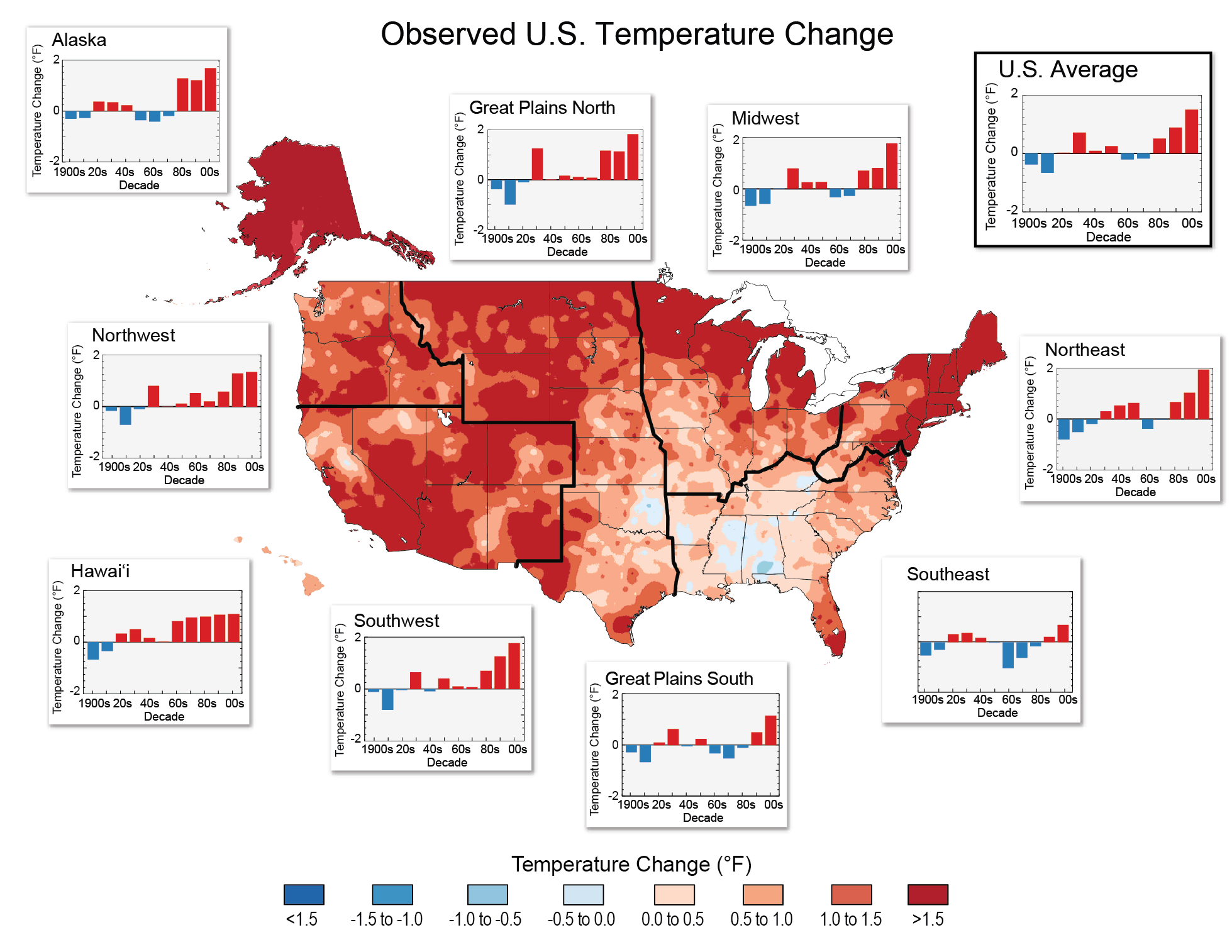
This map is the simplest way to see global warming in action. Since the 19th century, average US temperatures have risen by 1.3°F to 1.9°F. (Note, though, there have been some fluctuations here and there: in the 1960s and 1970s, temperatures dipped, partly due to the cooling effect of sulfate pollution that was eventually cleaned up.)

Recent decades have been even hotter: since 1991, every region in the United States has been warming, with the biggest temperature increases occurring in the winter and spring.

Peter Coy observes how the report “tries to shake people awake by making climate change up close, personal, and present, rather than abstract and in the future”:

The risk of this up-close-and-personal approach is that it could make some fence-sitters on climate change feel manipulated. The atmosphere is a complex system, and scientists don’t know enough about it to trace every regional variation in climate straight back to global warming.

The benefit is that there’s a strong scientific consensus that on the whole, climate change is causing an increase in extreme weather. The authors of the National Climate Assessment are betting that people will be more impressed by shoreline scouring in the Great Lakes than by the latest prediction regarding average sea temperatures in the western Pacific a century from now.

Chris Mooney looks at specifics:

According to the assessment, the Western drought of recent years “represents the driest conditions in 800 years.” Some of the worst consequences were in Texas and Oklahoma in 2011 and 2012, where the total cost to agriculture amounted to $10 billion. The rate of loss of water in these states was “double the long-term average,” reports the assessment. And of course, future trends augur more of the same, or worse, with the Southwest to be particularly hard hit. As seen in the image at right, projected “snow water equivalent,” or water held in snowpack, will decline dramatically across this area over the course of the century.

And then there is Alaska:

Nowhere is global warming more stark than in our only Arctic state. Temperatures there have increased much more than the national average: 3 degrees Fahrenheit since 1949, or “double the rest of the country.” The state has the United States’ biggest and most dramatic glaciers—and it is losing them rapidly. Meanwhile, storms batter coasts that used to be insulated by now-vanished sea ice.

Ben Adler provides more highlights:

“Heat kills people, and it sends thousands of people to emergency rooms because climate change fuels longer and more severe heat waves,” says Kim Knowlton, a scientist with NRDC’s health and environment program and an author of the Human Health chapter of the NCA. “There will be 10 more days over 100 degrees for the entire country on average from 2021 to 2050,” notes Liz Perera, a federal climate policy analyst at the Sierra Club. “The interesting thing there is that regionally there’s actually quite a distribution difference. It will be worst in the Southwest, Southeast, and Great Plains.” Those, of course, are already the places with the harshest summers. The U.S. has recently seen its worst heat waves in history, and increasing casualties as a result. A study published in the journal Epidemiology found, for example, that in July 2006, “California experienced a heat wave of unprecedented magnitude and geographic extent … Coroners attributed 140 deaths to hyperthermia, and it has been estimated from vital statistics data that in excess of 600 heat-related deaths may have occurred over a 17-day period.” The study also found that climate change is causing worse humidity to accompany heat waves, making them more unpleasant and dangerous.

Who Should Pay For Culture?

Astra Taylor, author of The People’s Platform: Taking Back Power and Culture in the Digital Age, explains why she sees the rise of sponsored content as part of a larger economic problem:

[W]hen people aren’t being funded to create work by publishers or labels or whatever, then advertisers end up filling in that gap. Advertisers are happy to see the stuff they’ve branded out there for free, they don’t care about scarcity, they want any message they’re invested in to be shared and to be abundant and to be passed along. One thing that struck me about going to … tech conferences was all the enthusiasm for free culture, and remixing, and social media, but people’s greatest ambition was to be sponsored by Chipotle or something equivalent to that. It was this weird mix of collaborative, utopian claims and this total acquiescence to commercial imperatives. I think that overall, ultimately the impact of advertisers calling the shots is a more cloying, complacent culture.

Evegeny Morozov finds that one of the most important messages in Taylor’s book is that “web-enabled innovations like crowdfunding make for wonderful add-ons to, but very poor substitutes for, existing cultural institutions”:

[W]hat does it mean to democratize culture? To some, it means getting rid of gatekeepers such as the National Endowment for the Arts and replacing them with some kind of direct democracy, in which citizens can simply cast their votes for or against particular films or books. But this is definitely not how Taylor sees it. “Democratizing culture,” she writes, “means choosing, as a society, to invest in work that is not obviously popular or marketable or easy to understand. It means supporting diverse populations to devote themselves to critical, creative work and then elevating their efforts so they can compete on a platform that is anything but equal.”

But Tom Chivers argues that both Taylor and Morozov are a bit too black-and-white in their thinking:

Taylor’s book, it strikes me, is not so much directed against the internet – even though that is the “people’s platform” of her ironic title – but against the free-market purists who are in charge of so much of it. The cheerleaders she quotes regularly suggest that what the public is interested in is exactly the same as what is in the public interest: so long-lens shots of bathing celebrities, or lists of funny pictures of cats, are just as worthy as the best 14,000-word New Yorker investigative feature. The invisible hand of the free market will always create the best of all possible worlds, they say.

Meanwhile, Ann Friedman is eager for solutions:

Yes, some of the best technical minds of our generation are being used to create ad software. But there are also plenty of people who want to use their engineering skills to fix the very social problems Taylor describes. How can we support this type of entrepreneur? After all, I can’t choose a more artist-friendly alternative to Spotify if it doesn’t exist.

I wish [Taylor] had devoted two or three chapters to such possible solutions rather than merely referenced them in her conclusion. The problems she explains in convincing detail are of the looming, complex variety that have vexed activists for generations. If the Internet really does pose new slants on these old problems, as she argues, it must also present new opportunities for remedying them.

Previous Dish on The People’s Platform here.

Do I Sound Gay? Ctd

Dave Cullen, author of the best-selling Columbine and the forthcoming Soldiers First, adds to yet another Dish thread, this time discussing his experience as a closeted gay man in the Army Infantry:

A reader shares a similar story:

I’m deeply fascinated by this topic and look forward to any of your readers sharing their stories on their experiences. Like you, I haven’t worried much about whether or not I had a gay voice, but since viewing the documentary promo, one particular memory has been on my mind ever since.

In the sixth grade, a new boy transferred to our school, and his voice instantly identified him as Gay with a capital G. Even though I was deeply closeted at the time, I took a risk and befriended him, most likely because he didn’t exhibit the traits which made me apprehensive to be around straight boys. Like me, he wasn’t into sports, enjoyed reading and other “girly” pursuits, and had no emerging interest in the female anatomy like all the other boys did.

The major difference between us, then, was that his vocal mannerisms gave him away immediately and mine did not. I was always able to “pass” among all the straight boys, whereas my new friend was constantly bullied and mistreated for being different, even though we were virtually the same in all other aspects. That’s how much the public perception of sexual orientation is tied into the way you speak.

There was one particular incident which burns my heart to remember:

my poor friend was enduring the usual taunts about his femininity by a group of aggressive classmates and, as usual, I did nothing to help him or stop it, lest I too become branded as a faggot. During this specific incident, I distinctly remember watching the bullying and telling myself, “Whatever you do, don’t ever talk with that kind of voice. Even when you’re an adult and able to be openly gay, always keep your voice masculine to avoid being harassed.”

That’s how easily the closet strips you of your humanity. I was witnessing a friend’s humiliation at the hands of others, but rather than come to his rescue, I used the opportunity to remind myself of the need to adopt the vocal cadence of all the straight boys.

I wish I could find that boy today (he only lasted at our school for a year, and I’ve long since forgotten his name), just so I could know that he made it though the rest of his school years with grace and bravery. I’d like to apologize to him for my failure to speak up and defend him when he needed me most. Perhaps that’s why the topic of “gay voice” interests me so much; 40 years after the fact, I’m still coming to terms with the choices I made and didn’t make on that day, and those choices were based entirely around how we speak.

Thanks for letting me tell my story.

Book Club: Can Modernity Survive Without Christianity?

A reader adds a final twist to the debate:

You started the Dish book club by asking if Christianity can survive modernity, and the discussion that ensued proves, I think, what a challenging – and open – question that remains. Ever since that first post of yours, however, I haven’t been able to shake a different question: can modernity survive without Christianity?

I’m no reactionary, and I have little patience for those who reject, wholesale, the scientific and technological advances of modern life. But glancing at the world around us can be incredibly dispiriting, from our destruction of nature to the rapaciousness of global capitalism to wars and rumors of wars. And that’s to say nothing of the lurking sense many of us have that finding meaning in contemporary life only is becoming more difficult, that there’s a soullessness at the heart of our modern way of life, a rotten center beneath the glittering surface of all our would-be achievements.

In a strange way, what I’ve just described makes me hopeful for the future of Christianity, because I can’t think of circumstances in which the message of Jesus and the core tenets of Christianity are more needed. They teach us that all our achievements have a dark side, that good and evil grow together in history, that our fallibility and fallenness touch everything we do, serving to warn us against unalloyed ambition and striving, and a facile optimism. It surely is no accident that two of the 20th century’s greatest Christian thinkers, Michael Oakeshott and Reinhold Niebuhr, thought the ancient tale of the Tower of Babel especially resonated with our times.

Even more, to borrow Oakeshott’s phrase, Christianity is the religion of non-achievement. Jesus taught us to consider the lilies of the field and take no thought for tomorrow. Could there be a more radical message for our age, an age that grows ever more frantic, ever more competitive, and in which wealth and power are ever more eagerly sought after?

Many of us are doubtful, I think, that we can continue on the path we are treading, that our unceasing more, more, more can be sustainable, or provide happiness. Jesus offers us a way of life that inverts these values, that shows us their futility. This non-instrumental approach to living is more timely than ever.

But most of all – and I know I risk sentimentality here – when reduced to its most basic idea, Christianity holds, and Jesus showed us, that God is love. Love and forgiveness and mercy are deeper than suffering and hate, they are what we are made for, our truest calling. Love is “the greatest of these,” and what Jesus told us to do when he summarized the entirety of the moral law. Man’s failure to love, of course, is a perennial sin. Yet the call to love takes on added resonance when the reach of our power and the consequences of our decisions impact ever more people. At no time in history has the question, “Who is my neighbor?” mattered more, or demanded a more expansive answer. We need to be reminded that the duties of love have no limits, that every human life is precious and fragile, and that “the least of these” particularly demand our attention and care.

Thinking about these matters, I come back again and again to this passage from Romano Guardini, a Jesuit priest, which Walker Percy chose as the epigraph to his novel The Last Gentleman:

We know that the modern world is coming to an end…At the same time, the unbeliever will emerge from the fogs of secularism. He will cease to reap benefit from the values and forces developed by the very Revelation he denies…Loneliness in faith will be terrible. Love will disappear from the face of the public world, but the more precious will be that love which flows from one lonely person to another…The world to come will be filled with animosity and danger, but it will be a world open and clean.

I’ve always thought that modern, Western moral and political thought was more dependent on Christianity than most realize. For a long time we’ve lived in a halfway house, where we want the “values” derived from Christianity – the dignity of the individual, equality, and compassion – without faith itself. As Nietzsche derisively put it, we’ve rejected the Church but not its poison. Maybe what we’re hurtling toward is a moment when having it both ways no longer is tenable. Maybe, as Guardini claims, our dangerous world, in which love is so strikingly absent, will force us to again turn our gaze toward the wandering preacher from Nazareth, whose words we finally will have ears to hear, as if for the first time.

About That 97%

Paul Roderick Gregory catches Russia’s Human Rights Council disputing the official results of the Crimean referendum, which claimed a 97 percent vote in favor of annexation and 83 percent turnout:

[A]ccording to a major Ukrainian news site, TSN.ua, the website of the President of Russia’s Council on Civil Society and Human Rights (shortened to President’s Human Rights Council) posted a report that was quickly taken down as if it were toxic radioactive waste. According to this purported report about the March referendum to annex Crimea, the turnout of Crimean voters was only 30 percent. And of these, only half voted for the referendum–meaning only 15 percent of Crimean citizens voted for annexation.

The TSN report does not link to a copy of the cited report. However, there is a report of the Human Rights Council, entitled “Problems of Crimean Residents,” still up on the president-sovet.ru website, which discusses the Council’s estimates of the results of the March 16 referendum. Quoting from that report: “In Crimea, according to various indicators, 50-60% voted for unification with Russia with a voter turnout (yavka) of 30-50%.” This leads to a range of between 15 percent (50% x 30%) and 30 percent (60% x 50%) voting for annexation. The turnout in the Crimean district of Sevastopol, according to the Council, was higher: 50-80%.

Ilya Somin corroborates Gregory and adds:

The Council report also discusses a number of troubling developments in Crimea since the Russian occupation began. For example, it states that the new authorities in Crimea have decided to “liquidate” the pro-Ukrainian Kiev Patriarchate Orthodox church in the region, details the persecution of Crimean Tatar groups opposed to Russia rule, and notes that Crimean journalists fear the “numerous restrictions” on freedom of speech and press imposed by Russian law.

It should be noted that the Council has long been one of the few Russian government agencies willing to criticize the government on human rights issues, but more recently many of the more liberal members of Council have resigned or been forced out.

And Sometimes There Is A Smoking Gun Email

If you were in any way troubled by the idea that a journalist would write a book based on exclusive sources, who are portrayed as uniquely responsible for a breakthrough in civil rights, and then those very lauded sources would throw book-parties and events to promote the book, you’re not alone.

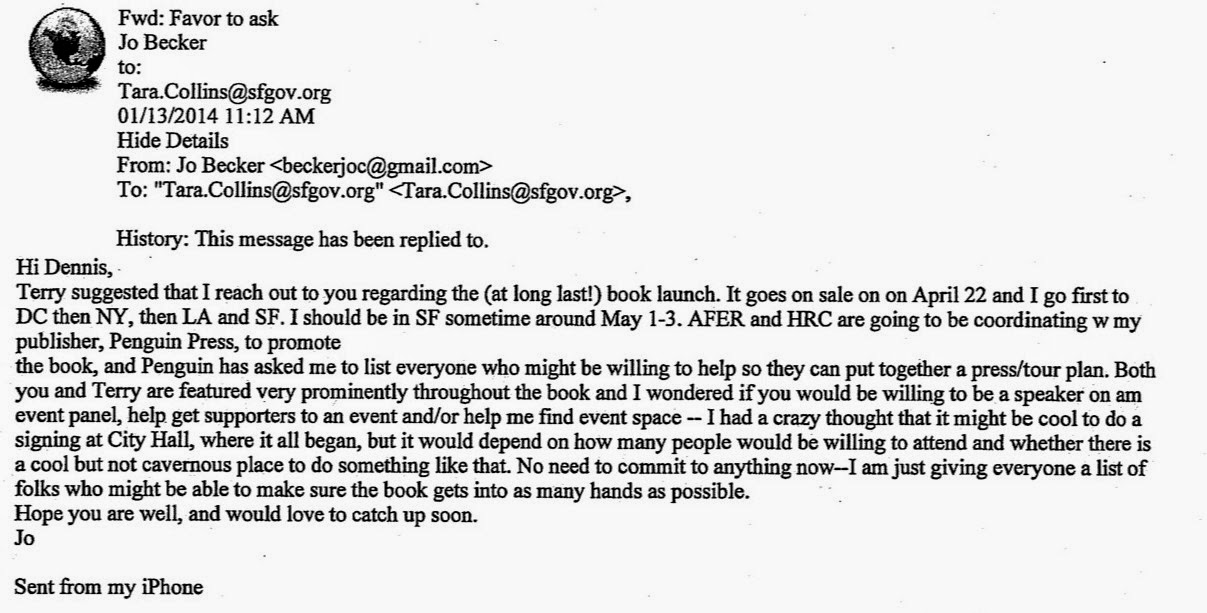
I was a little gob-smacked that Jo Becker’s book tour promotion was aided and abetted by those sources – with book parties by Ken Mehlman and Ted Olson. But we are finding out that this was only the tip of the iceberg. An inkling of this comes with the latest, ethically disturbing news that Becker’s lionized sources in San Francisco’s city government have also been promoting the book. Dennis Herrera, SF City Attorney and his aide, Terry Stewart, heroes of the book, were involved in its promotion. How do we know? Well Herrera was hosting a book event for Becker at San Francisco City Hall last week. But we also have other proof. As city officials, Stewart’s and Herrera’s emails on public business are vulnerable to public disclosure. So intrepid activist/pest/gadfly Michael Petrelis did the leg-work to get all the emails that pertained to Becker’s book. They make for interesting reading:

becker to stewart

A journalist is offering to give her sources an event to celebrate themselves while also promoting the book. Is that what the New York Times would regard as ethical conduct? Then a second email sent by Becker the next day tells us something equally remarkable:

becker to herrera

Note the following: “HRC and AFER are going to be coordinating w/my publisher, Penguin Press, to promote the book, and Penguin has asked me to list everyone who might be willing to help so that can put together a press/tour plan.” Becker wanted to sell books at the City hall event, but this raised ethical issues about using City Hall for a private commercial enterprise. How were those resolved? At Becker’s original suggestion, Herrera was inclined to place a bulk order under his “campaign/office-holder account.”

So to recap. A key and celebrated source in the book is placing bulk orders and holding a reception at City Hall for the tour, at Becker’s request. At the same time, HRC and AFER are integrally involved in the entire book tour. Both groups are part of Chad Griffin’s Hollywood-DC p.r. empire. So the main source and central hero for Becker’s book was integral to its publicity and promotion. While publicly writing that he disowned being called the Rosa Parks of the movement, Griffin has been actively and aggressively promoting the very book that says that in its first paragraph! And he was using HRC’s and AFER’s money – money donated to advance gay equality, not Griffin’s personal profile – to promote his own hagiography.

If you want more evidence that this book was access journalism at its unethical worst, here it is. Quite why the NYT Public Editor has not weighed in on this is beyond me. It’s a disgrace.

How Many Lives Will Obamacare Save?

Sarah Kliff analyzes the Romneycare study the came out a couple days ago:

The new Harvard study estimates that for every 830 people the Massachusetts insurance expansion covered, one additional life was saved. This was a 2.9 percent decrease in the mortality rate compared to similar counties that did not have insurance expansions. … It’s hard to know whether the health care law will lead to similar gains elsewhere. Massachusetts has more doctors per capita than any other state, which could mean it was easier for people to see a doctor once they gained insurance coverage. But there’s also the possibility of even bigger gains outside of Massachusetts, where states are starting from a lower insured rate than the Bay State did in 2006. If the coverage expansion effects more people outside of Massachusetts, that could mean even more deaths prevented elsewhere.

Michael F. Cannon feels that the cost is too high:

Even if [Romney care has saved lives,] this Annals study also suggests that success has come at a very high cost. The authors estimate that “for approximately every 830 adults who gained insurance [under RomneyCare], there was 1 fewer death per year.” If we assume the per-person cost of covering those 830 adults is roughly the per-person premium for employer-sponsored coverage in Massachusetts in 2010 (about $5,000), then a back-of-the-envelope calculation suggests that RomneyCare spent $4 million or more per life saved. The actual figure may be much higher if we include other costs incurred by that law. The World Health Organization considers a medical intervention to be “not cost-effective” if it costs more than three times a nation’s per-capita GDP per year of life saved. This in turn suggests that RomneyCare would have to give every person it saves an average of nearly 30 additional years of life to meet the World Health Organization’s criteria for cost-effectiveness. Given that the mortality gains were concentrated in the 35-64 group, that seems like a stretch.

As an economist might put it, this means there are likely to be policies out there that could save a lot more lives than RomneyCare does per dollar spent.

Bill Gardner counters:

Cannon believes that there are policies that would deliver more benefit than Romney- or ObamaCare. If you are a critic of the ACA and this is what you believe, Cannon’s argument obligates you to do that better thing with the money. This poses an acute test for leaders in the 24 states that refused the ACA’s expansion of Medicaid. How many of those states refused to expand Medicaid, but then did nothing else for the health of their uninsured? If politicians in those states just refused the money and let the poor die, they do not have standing to make Cannon’s criticism about paths not taken.

Second, is it just to worry about the cost of health insurance only when we are considering insuring the poor? 55% of the US population had employer-based health insurance in 2011. Because this benefit isn’t taxed, this meant that 55% received a large subsidy for their insurance, including many affluent people. (And I’m sure Michael Cannon hates this, probably more than I do!) If you oppose the expansion of Medicaid, you should also favor the taxation of employee health benefits. Otherwise, you are arguing that we can afford to subsidize the health insurance of the rich, but that it costs too much to do it for the poor.

Sprung sees no viable alternatives to Obamacare on the horizon:

Those who don’t like the ACA can fairly argue that there are better models for extending affordable health insurance to all. … It’s noteworthy, though, that there are almost no Republican elected officials who have proved willing to commit to actual legislation that would purport to “replace” the ACA with an alternative that could make a credible claim to extend health insurance to as many uninsured Americans as the ACA does. Senators Coburn, Burr and Hatch rolled out the outline of such a plan — which looked a lot more like an opening bid to reform the ACA to conservative specs than actual replacement — and their colleagues studiously ignored it.

Suderman worries that Romneycare and Obamacare are unsustainable:

[I]t’s worth remembering that for the past several years, the price tag in Massachusetts has looked unaffordably expensive. In a 2011 review of the state’s health reform published in Health Affairs, a team of researchers looked at the results of the program over the same time frame measured by the new study. What they found was more coverage, more utilization of care—and costs that could not be supported over time. Not in Massachusetts. Not anywhere. “The pre-2010 status quo is not a sustainable option for Massachusetts or the nation,” the report said. Around the same time, state health officials were also describing the program’s costs as unsustainable, warning that, if left unchecked, they will crowd out everything else the government needs to do. Some reforms have been put in place by then, but even still, cost-containment is a challenge—in part because more coverage has led to greater use of care.

McArdle’s bottom line:

I haven’t changed my beliefs radically: I still basically think that health insurance improves mortality rates, but that that improvement is unlikely to be huge if you can get results like Oregon. However, after [Monday’s] report, I’ve revised the probability of “huge benefits” upward, and you should do the same. And beware of those who are only willing to revise their beliefs in one direction.

Conservatives And Immigration

Pointing_finger_48sheet

It’s not just a problem with the GOP. It’s an increasingly knotty problem for the British Tories, now trying to manage the rise and rise of the anti-immigrant United Kingdom Independence Party (a rough version of the US Tea Party). Alex Massie notes:

As I pointed out yesterday, the Tory share of the BME [Black and Minority Ethnic] vote in 2010 was exactly the same as their share of the vote in Scotland: 16%. True, this was an improvement on 2005 when only 11% of BME voters endorsed Conservative candidates but that’s a matter of only modest solace for Tory modernisers … Immigration is what you might term a Gateway Issue. You need to get past it before you can speak about other issues of more immediate concern to voters’ actual lives. You need to earn the right to be listened to. You need license to be heard. You need standing.

The discomfort of British Conservatives with immigration is not as easily conflated with racism as in the US. UKIP’s focus is as much on European immigrants (4,000 a week – exercizing their right to work and live where they choose in the EU) as on South Asian or Middle Eastern immigrants. And it speaks to something that I think is sometimes crudely over-looked in this debate. Conservatives in general are article-2618288-1D80455300000578-566_634x435more attached to the status quo than liberals, more suspicious of radical change, especially when it seems to be an ideological imposition by empowered elites. And so to live in a small town which has been ethnically and culturally very English for centuries and then to see in a matter of years a sudden and palpable Polish immigrant population that instantly changes the entire cultural dynamic will inevitably lead to bewilderment, anger, loss. It’s also true that Britain, in comparison with the US, is a tiny island, with limited resources and land. Remember also that European immigrants will almost immediately be eligible for treatment in the National Health Service and many other state benefits, and you can see why this is an issue.

And so conservatives are in a bind. They would like, in some ways, to reverse history – to never have had the 1986 amnesty in the US, or to have never agreed to enter the EU. But both those changes are effectively irreversible without incurring further massive subsequent changes which would disturb the status quo even more profoundly. And conservatives have a hard time making their legitimate case for cultural stability without seeming like bigots. It’s the same thorny problem with marriage equality: a discomfort with change but an inability to offer a viable, workable alternative, which leads to an understandable assumption that all opposition to gay marriage is mere rancid KKK-style hate.

And this is an eternal conservative problem.

Conservatism at its best is an imaginative attempt to balance stability and change in a manner which makes a society more coherent, more itself. When change happens swiftly, that balance is all the more necessary but also more difficult. At some point, mass immigration or a multi-cultural society or a gay-integrated world becomes the status quo to which conservatives will become attached. But in the meantime, they are pinioned emotionally between past and future and have not found leaders in either the US or the UK that have risen to the occasion of bridging the two. Fear and anger have thereby increasingly defined the new conservative center. And it’s currently a lose-lose proposition.

In part because I’m an immigrant and gay and live in a historically black city which is increasingly integrated, my own conservatism is of the much more moderate kind. Perhaps because I am not so threatened by racial and cultural change, I saw Obama as a quintessentially small-c conservative, a living blend of black and white, a realist abroad, a pragmatist at home, an integrator rather than a polarizer. I was an outlier, we now know. But at some point, that more moderate conservatism – one that actively celebrates a multi-cultural society as a traditional American value – will win. The question is simply how tortuous the path to that future will be. Which is why we are searching the landscape for a future Republican leader who gets this (and keep bumping into versions of Ted Cruz) and searching for a British Conservative who can do the same (and sussing out Boris).

(Illustrations: two posters for UKIP in the European elections on May 22.)