Military Suicides Come Home

Thor Benson notes that suicide is now more common in the National Guard and Reserve than in the active duty Army:

National Guard and Reserve members do have access to mental health treatment, but they don’t have the same kind of environment that encourages them to use it. National Guardsmen and Reserve members are often not protected with the same level of attention that active troops might get. After they’re out, “They don’t get the long-term benefits of VA support that active duty folks get,” [Veterans 360 founder Rick] Collins says.

The kinds of problems these Guardsmen and Reservists face can be dire. “Their previous employers are supposed to hire them back, but often times they don’t,” he says. Collins explains that Reservists and Guardsmen returning to civilian life are often left jobless, broke, and suffering from PTSD.

Book Club: Relating To Resurrection

A reader writes:

Something in How Jesus Became God that resonated personally was the discussion in Chapter Five regarding After-Death Communications as an explanation for the visions of the resurrected Christ that some disciples received.  Our son was born with a severe heart defect and had to undergo open-heart surgery at age two.  We were told there was a 90% chance of his survival.  Two days after the surgery, he suffered heart failure in the ICU.  We went through several weeks of alternating between hope and despair as to what could be done for him, bookclub-beagle-trincluding receiving a heart transplant, but eventually we had to decide to remove all life support. He died in our arms, slowly, hour by hour, as we watched his vital signs decline to nothingness.

Neither my wife nor I had ever experienced anything so emotionally tortuous.  We both fell into depressions, and in my case I began to experience dreams that I was being visited by my son.  What was exceedingly real about these dreams was the physical sense of holding him in my arms, his cheek next to mine, listening to him babble.  A tremendous sense of contentment flooded over me, knowing that he was alive.  I would wake up at peace, and it would take five or more minutes for me to understand I was back in a different world of pain and sorrow.  These dreams persisted for a few months and then stopped entirely.

I’m not a believer in an afterlife, but I am a believer that experiences such as these could convince anyone that someone close to them who had died tragically and unexpectedly, was alive in a real sense – not here on earth, but in heaven (if they believed heaven exists).  This could have happened to any number of Christ’s followers, and it was a very short step for them to then exalt Jesus as being at the right hand of the Father, since his disciples had spent three extremely intense years speculating that this unique and remarkable man could very well be the promised Son of Man, or even the Son of God.

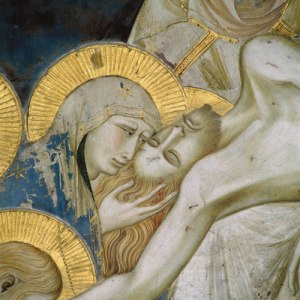
My own effort to explain how I view the Resurrection of Jesus is in my last post in the Book Club here. But I also have personal experiences that are similar to my readers, and I wrote about them at length in my book about Pietro_lorenzetti,_compianto_(dettaglio)_basilica_inferiore_di_assisi_(1310-1329)surviving the plague of AIDS, Love Undetectable. I was diagnosed with HIV six weeks after one of my closest friends at the time had been diagnosed with AIDS. He had kept it a secret, until one afternoon he asked to meet me at the fountain in Dupont Circle, where he told me his diagnosis as I told him mine. The coincidence had us both smiling. We were already both Catholics and both writers and both gay in a terrifying era very different from today. But from that moment on, we bonded even more deeply, and over the next two years, I and his other close friends took care of him as he slowly slipped away from us. I saw him turn into a walking skeleton; I saw him pound the floor in pain; I saw him wracked by intense and unremitting fevers; I saw his breath literally taken away from him; I saw as cancer lesions speckled his body and advanced relentlessly toward his lungs; I saw the unspeakable shock and pain of his family; I listened to his voice, racked with fear and pain, over the phone at night; and I was entrusted with the details of his funeral. Watching my dear friend die at 31 of an agonizing disease will never leave me. And I will always, somewhere deep down, feel in some ways guilty for having lived, while he died.
But after his death, I felt his presence strongly at times. He appeared to me in symbols – like the sea-gulls that flew over the bay where we had released his ashes, or one gull that kept recurring in my life on the Cape and elsewhere as an almost sacred sign of his presence. He appeared to me in my dreams – and in one unforgettable one, I didn’t at first recognize him.

He was Patrick and yet no longer Patrick. His tormented shell of a body, racked by slow starvation and countless lesions, was now resplendent. His face was clear, his body more luminous than in life, all flaws removed. And he was happy. Weeks would then pass and I would suddenly be arrested by a sense of his presence – on the sidewalk, reading a book, sleeping on the beach. I cannot fully explain this, although a modern mind can always analyze it from the perspective of grief, survivor guilt, wish-fulfillment, and the like. And over time, Patrick’s presence diminished. But I experienced it as very, very real for as long as it lasted.

So, yes, I can indeed see the disciples having similar experiences – and they have been attested to in countless other lives as well, in studies and surveys over the years, as Ehrman notes. I infer from mine that Patrick is alive and well, and that one day, we will be together again. Perhaps at that fountain in Dupont Circle. And we will be laughing. And happy. And free from death and the fear of death. That is my faith. And I believe it was the faith of the disciples as well. It is what I mean by resurrection.

(Read the whole Book Club thread on How Jesus Became God here. Please email any responses to bookclub@andrewsullivan.com rather than the main account, and try to keep them under 500 words. Painting: Pietro Lorenzetti from the basilica in Assisi.)

John Kerry Tells The Truth … And Therefore Has To Apologize, Ctd

A reader notes that the chorus of indignation at John Kerry’s use of the term “apartheid state” to refer to Greater Israel’s destiny never actually engages the substance of his statement. So Ted Cruz, calling for Kerry’s resignation:

The fact that Secretary Kerry sees nothing wrong with making such a statement on the eve of Holocaust Remembrance Day demonstrates a shocking lack of sensitivity to the incendiary and damaging nature of his rhetoric.

Whatever else this is, it is not an argument that Israel is not an apartheid state or on its way to becoming so. On the left, we have this from Barbara Boxer:

Israel is the only democracy in the Middle East and any linkage between Israel and apartheid is nonsensical and ridiculous.

But what about those under Israeli control who have no right to vote at all? It doesn’t occur to Boxer that the apartheid-like regime on the West Bank is actually a function of Israeli democracy, since a majority of Israelis support it. But, of course, AIPAC created the template all these lemmings follow and its statement is the purest of them all:

Any suggestion that Israel is, or is at risk of becoming, an apartheid state is offensive and inappropriate.

But is it true? That’s the question AIPAC never wants debated. So it polices the American discourse to prevent it. Since the observation is of the bleeding obvious, this can be hard. Jeffrey Goldberg, my old sparring partner on matters of Israel, wrote this a decade ago:

A de-facto apartheid already exists in the West Bank. Inside the borders of Israel proper, Arabs and Jews are judged by the same set of laws in the same courtrooms; across the Green Line, Jews live under Israeli civil law as well, but their Arab neighbors — people who live, in some cases, just yards away — fall under a different, and substantially undemocratic, set of laws, administered by the Israeli Army. The system is neither as elaborate nor as pervasive as South African apartheid, and it is, officially, temporary. It is nevertheless a form of apartheid, because two different ethnic groups living in the same territory are judged by two separate sets of laws.

Here’s Ehud Barak, former prime minister of Israel, making the exact same argument:

“The simple truth is, if there is one state” including Israel, the West Bank and Gaza, “it will have to be either binational or undemocratic. … if this bloc of millions of Palestinians cannot vote, that will be an apartheid state.”

Here’s Tzipi Livni:

The time has come for the same youth to ask, to what kind of state do they want to leave the gas reserves? To a Jewish democratic Israel? Or to a binational Arab state? Or to an apartheid state? It is impossible to deal with economic issues and to ignore the important diplomatic issues related to two states for two peoples.

Here’s another former prime minister, Ehud Ohlmert:

If the day comes when the two-state solution collapses, and we face a South African-style struggle for equal voting rights (also for the Palestinians in the territories), then, as soon as that happens, the State of Israel is finished.

Of course, Kerry could be criticized for speaking an undiplomatic truth in a meeting he considered off the record. But the peace talks are at a dead end anyway, and it’s perfectly appropriate for a US secretary of state to explain why such a failure is a dreadful portent for the future of Israel. It’s a truth that the Israelis need to hear from Americans just as much as they need to hear it from their own leaders.

The real question is: why do some want this fact deemed off-limits in America when it sure isn’t in Israel? And the answer is obvious: AIPAC has no interest in a two-state solution and wants no impediment to the permanent establishment of Greater Israel, even if that means keeping half or more than half of the country in undemocratic bantustans for ever. That’s another truth no one is allowed to say out loud. But man does it sit there right in front of our noses.

When Mental Illness Is A Gift

Priscilla Long, wondering why schizophrenia persists across generations, points to a link between the illness and creativity:

Imagination, suggests Princeton molecular biologist Lee M. Silver, is related to the brain’s “noise” (random firings of neurons, or nerve cells), thus generating more associations. Brain scans of people with schizophrenia and their unafflicted family members show mega-amounts of random noise. Brain scans of control subjects (no schizophrenia in the family) do not.

A recent major study confirmed a high association between people in creative professions and their first-degree relatives (parents, offspring, and siblings) who have psychopathologies such as schizophrenia. Could there be inherited brain structures that produce thought patterns such as “broad associative thinking” in which contradictory images and ideas knock about together, structures that serve an artist’s work but that in some brains go too far and become the twisted thoughts of mental illness? Does selection for a more robust imagination – so very useful to us humans – keep imagination’s more dysfunctional forms from dying out?

Similar observations are made about bipolar disorder, which have played a role in the current TV trope of mental-illness-as-superpower. A reader, responding to our post on the new series Black Box, worries about romanticizing mental illness:

Having bipolar disorder, especially untreated bipolar disorder, is not a wondrous gift.

Sure, some people afflicted with it do well for themselves. Some can harness the energy and do great things with it. Most people ruin their lives with lousy careers, broken relationships, and a lot of detritus from the manic episodes, interspersed with bouts of crippling depression that make the disasters that much harder to clean up after. Or get appropriate treatment and try to live moderately normal lives.

Living with bipolar disorder is bad enough. Giving the public the perception that bipolar people can somehow transcend their daily struggles and become wildly successful because of this wonderful gift is offensive.

Another:

As someone with bipolar disorder – luckily completely controlled for years – I certainly agree that the ‘mentally ill genius’ trope is tired, and misinformed. But the thing is, it’s not totally misinformed

My own experience with mania has been that the long ramping up into a bad state with disordered thinking and behavior actually includes a period of very lucid, insightful, and hugely productive mental states that have brought out some of my best thinking and work. I still marvel at what I once accomplished in a single flight from Boston to San Francisco. (My clients were wowed by the work, too.) Those peak periods are not quite superpower-level, but there is definitely some truth in the trope. As my sister, who also has bipolar, once said: “Let’s rent a cottage for a month, go off our meds, and knock out a couple of novels.”

It’s funny because there is some truth in there. That’s what makes bipolar so dangerous: it has its upsides.

Chart Of The Day

Religious Breakdown

Emma Green flags a new Brookings report that notes the growing numbers of religious progressives in America:

Blacks, hispanics, and people of mixed race are all more likely to be religious progressives than conservatives; these groups are also among the fastest-growing demographics in the United States. Similarly, Millennials are more than twice as likely to be religious progressives than religious conservatives; in fact, people older than 50 make up more than 60 percent of those who are considered to be religious conservatives. Although it’s impossible to talk to an 18-year-old about her views on culture and predict what she’ll think in two decades, these demographic trends suggest that the religious right is about to start shrinking.

But the question of influence is a little fuzzier. Although more than a third of Millennials are considered religious progressives, roughly 40 percent don’t have any faith at all: A growing number of young people don’t identify with a particular religion. That, along with the fact that an overwhelming majority of religious progressives don’t see religion as “the most important thing in their life,” suggests that faith is losing its overall influence over how people think about social and cultural issues.

This has, it seems to me, some salience when it comes to the question of religious freedom. What about the religious freedom of those who are pro-gay as a function of their faith? Are they not penalized by the law in North Carolina that bans marriage equality and also makes it a misdemeanor to perform a gay wedding not backed by the law? Of course they are:

“By preventing our same-sex congregants from forming their own families, the North Carolina ban on same-sex marriage burdens my ability and the ability of my congregation to form a faith community of our choosing consistent with the principles of our faith,” said the Rev. Nancy Petty, pastor of Pullen Memorial Baptist Church in Raleigh, who joined the lawsuit. As part of the state ban, it is a Class 1 misdemeanor for a minister to perform a marriage ceremony for a couple that hasn’t obtained a civil marriage license. In addition, the law allows anyone to sue the minister who performs a marriage ceremony without a license.

Gay leftist Mark Joseph Stern demands those defending religious freedom defend the progressives’ religious freedom as well. Very happy to. Even Ponnuru wants the ban on unlicensed marriages to be repealed. The more general point is that the assumption that religious convictions are solely behind banning marriage equality is empirically false. Religious liberty cuts all sorts of ways – and we shouldn’t pick or choose between one church and another.

The Karma Of Buzzfeed

Check out this post by Maria Popova on Ralph Steadman’s illustrations for an edition of Orwell’s Animal Farm, posted April 25. Now check out this Buzzfeed listicle on Ralph Steadman’s illustrations for an edition of Orwell’s Animal Farm, posted April 29. Maria vents here. Not even a hat-tip?

Update: Buzzfeed has since deleted the listicle.

Donald Sterling’s Personal Foul, Ctd

Many readers are asking along these lines:

Nice post on Sterling. Now the $64,000 question: Is it permissible, in your view, for Sterling to face sanctions for his comments? Or do you believe that it’s improper for the NBA or its customers to call for Sterling to face consequences for his words? If so, why not? But if not, why is this situation different from the Eich affair?

To respond to each question in turn: yes, of course, if an owner of a business makes baldly racist remarks urging public dissociation from an entire racial group, private sector sanctions – from the NBA or fans or sponsors – are “permissible.” They are always permissible in a free country. That’s why Brendan Eich is out of a job. The second question is whether what is permissible is proper or justified, and that will always depend on the specific case. I think it’s obviously appropriate in the Sterling case – because the remarks are horrifyingly racist. If Brendan Eich had made comments telling his friends to keep away from faggots, if he’d used any such terminology or had ever been shown to have discriminated against gays in the workplace or in his daily interactions, then his case would be very similar. But no such comments are in the public or private record, and there’s zero evidence that he ever acted in the workplace to harm gay employees. Au contraire, which is why gay Mozilla employees were divided about his ouster, with some supporting him. Sterling’s remarks, in contrast, reveal him to be a crude, foul bigot – which is why there is no division at all among African-Americans in the league – or beyond the league – about his fate.

Unfiltered feedback from readers on our Facebook page. One makes this distinction:

“Eich contributed to a successful campaign that actually stripped gay couples of existing rights, whereas Sterling is being assailed because of private remarks made in a phone call.”

Here is what I would say to that.

Yes, Eich did – even though the result was subsequently overturned thanks, in part, to Chad Griffin and AFER. But donating to a political cause or voting for a political party can have many motivations. Such acts can be driven by bigotry, sure, but also by general discomfort with sudden social change, religious conviction, misunderstandings, personal experiences, worries about unintended consequences, and the like. And you cannot know that Eich was motivated by rank Sterling-level bigotry – in fact, we have plenty of evidence that he wasn’t and isn’t. And remember too what was on the ballot in 2008. The choice was either civil marriage or civil unions with all the state-accorded rights and benefits of civil marriage. Now I have long argued that civil unions are no substitute for civil marriage – but am I prepared to say that everyone who disagrees with me is motivated by the kind of rank bigotry that Sterling represents? Of course not. That was the position of the Human Rights Campaign for many years, after all. They may be tools, opportunists, resource-hoggers and credit-grabbers, but they’re not bigots. It was the middle ground favored by at least a third of Americans at one point. They weren’t and aren’t all bigots of the Sterling variety. And I think the term “bigot” should be reserved for those like Sterling who have demonstrated it without a shadow of a doubt.