Sarah Palin: Anti-Christian, Ctd

A reader sends the above video:

On reading your post re: Palin and torture, I couldn’t help but think of this “New Rules” on Maher’s show. I played it for my Sunday school class.

Another:

Don’t you think you and others are giving Palin a bit too much credit when you say things like “she is drawing on a brutal theology from the past” or it’s an “allusion to converting Muslim prisoners by coercion”? Do you really think she has any grasp on history? I agree her statements are barbaric, but I do not believe she is capable of thinking at the level you and others ascribe to her.  She’s incapable of allusion.  I think the thought process, such as it was, was more like “Baptism = water; waterboarding = water; that will get a laugh.”

Yes, it’s frightening that John McCain wanted to foist this creature upon the world, but I am angrier at John McCain than I am at her – that would be like being angry at a cat for thinking like a cat (no disrespect to cats intended.)

My view is that Palin is a delusional, paranoid fantasist. My point is perhaps better expressed thus: her conflation of torture of Muslims with a Christian sacrament could objectively be seen as a terribly dangerous provocation in the context of Islamist terror. Whether she meant it that way is something I cannot know. Another reader also quotes me:

“It reveals that vast swathes of American Christianity are objectively anti-Christian, even pagan, in their support for this barbarism.” Andrew, as a practicing and proud Pagan, I must strongly dissent. Pagans do not endorse torture. Please do not malign us this way.

Ouch. Another reader:

I’m not sure that you calling them “Christianist” really has any authority. Who gave you the power to determine who is Christian and who is not?

Palin and her ilk believe themselves to be Christians. Who am I or anyone else to argue with them? This is what Christianity is, revealed in its reality. And it has always been thus. It is the same Christianity that Nietzsche wrote about – a cult of revenge. A cult of revenge for those who feel themselves on the bottom. Whether it is revenge wrought in this world or the next, casting the “evil” to hell is revenge, pure an simple.

Andrew, sometimes you are smart, but you use your mind to see what you want to see, not to see more fully how the world actually is. You have come to see Republicanism for what it is, you have yet to see Christianity for what it really is.

And who are you to say what Christianity really is? My use of the term Christianist is simply to distinguish the political abuse of Jesus teachings from the teachings themselves. It’s an act of linguistic hygiene. And someone who sees the urge to torture others as intrinsic to Jesus’ teachings has simply never read the Gospels. Another dissent along those lines:

By any reasonable standard, Palin and her supporters are Christians. They believe in God. They believe that the Bible is the word of God. They believe that Jesus is both the son of God and his earthly incarnation, and that he sacrificed himself for the salvation of all mankind. They’re biblical people, alright. Since this book, which Palin and her followers believe – despite all evidence to the contrary – is the True Word of the Creator of the Universe, says that followers of other gods must be stoned to death (Deuteronomy 13:6 etc), it follows quite naturally that Palin and company need shed no tears over their sufferings. God has cursed the unbelievers (the “terrorists”), and they will suffer for eternity for their transgression, at least, according to other parts of the Bible.

One might hope that the love of Jesus will help to transcend these base mentalities, but since Jesus intends to bring the law of Moses to the world, we can expect that many will remain anchored firmly to the bedrock. According to you, this is just “fundamentalism”. To my mind, this is the natural result of faith – belief without evidence.

Jesus transcended the laws of the Old Testament, and transformed their rules into the single rule of caritas. Another adds:

You forget one thing in your well written rebuttal: the Inquisition was a Christian enterprise. Christians, or more accurately, Christianists, are highly capable of this.

Of course they are and have always been. That doesn’t make it an expression of Jesus’ teachings. A “committed evangelical Christian” chimes in:

I’m sorry, but these views on waterboarding are not and never will be anything that I agree with. But the more important question is this: What’s it going to take for this Christianist madness in America to dissipate? I can’t see any option other than a serious decline in adherence to Evangelical Christianity in America, at least among whites. That would disrupt and eventually destroy Evangelicalism’s accommodation with, and takeover of, the Republican Party. Given how the Millennial generation seems to feel about Christianity at the moment? Highly likely, I’d say. Politically, that would be a good thing. Spiritually, I’m not going to enjoy it.

Another wants to forget the whole thing:

At some point it might be worth asking whether more good would come from ignoring Palin entirely rather than addressing her most egregious slights, which merely lets her know how offensive she needs to be to elicit a reaction from the press.  Maybe post a poll on “No More Palin News?” I don’t click on any stories on Yahoo or Google news, or Politico or other sites, that feature her in the headline.  I figure page clicks only give them more incentive to run such stories, which in turn fuels her to say more asinine things.

One more reader:

Thanks much for shining more light on Sarah Palin’s embrace of torture, and the favorable reception her speech received. To be honest, the increasing popularity of torture in the United States, and the role of faith in that process, has been woefully understudied as its own “puzzling” development, one that is actually worthy of social scientific study on its own. I have a published study (pdf) engaging this “curious” case of torture’s increasing popularity, a trend that seems to befuddle even the most notable experts on torture like Darius Rejali (whose work I admire in so many ways).

In short, some of the process can be chalked up to the “hidden” nature of American torture. Because we can’t see the torture (with the exception of the Abu Ghraib photos), those who have a strong “faith” in what they cannot see but are told (by authoritative figures like Sarah Palin, or Dick Cheney, or George W. Bush) can imagine that the tortured are all “terrorists” and that water boarding isn’t “that bad” anyway, and that those who do the torturing are, like Jack Bauer, good and right and just. This is also one of the reasons why Jose Rodriguez’s illegal act to destroy the tapes of water boarding sessions was so effective – it removed a possibility that their heroic narratives of what torture is doing, and who it is doing it (and to whom), could be easily shattered by the screams and images and cruelty that is the reality of the torture chamber.

I know you’re swamped with emails, but if you get a chance to read the study, you’ll also notice that you and the Dish are quoted in my study. Your blogging and work on torture has inspired my own in so many ways over the years, so thanks for what you’re doing on it and I hope you continue to shed light on this incredibly troubling trend and politicization of this barbaric “tactic” that should be left in the dustbin of history.

Unfiltered thoughts from readers on our Facebook page.

John Kerry Tells The Truth … Therefore He Must Apologize

The state of Israel controls a large amount of neighboring territory, seized in war, in which the inhabitants are divided by ethnicity, with one group, the original inhabitants of the land or refugees from ethnic cleansing, are systematically disadvantaged compared with the other. They are penned into eight distinct areas from which they have to get through checkpoints to move around. They have no right to vote for the government that controls their lives. This arrangement has now lasted a year longer than the apartheid regime in South Africa – and, unlike John Kerry Makes Statement On Ukraine At U.S. State Departmentthat regime, looks set to continue indefinitely. It also comprises a massive project of ethnic and social engineering in which the dominant ethnic group continues to settle the occupied territory in an attempt – forbidden by the Geneva Conventions – to change its demographic nature.

None of this is in dispute. But when an American secretary of state explains this in private he is forced to recant publicly. And that surreal kabuki dance is an almost perfect symbol of why US engagement with Israel-Palestine is, at this juncture, such an enormous waste of time. The US is barred from telling the truth, which makes a real negotiation impossible. The Israelis know that they will never be subject to real US pressure, because the US Congress stands ever-ready to do whatever Israel asks. And so the beat goes on.

You can, of course, debate for ever who bears the blame for the Israel-Palestine clusterfuck at any specific point in history, and for a while the Palestinians were the more serious obstacle to any kind of settlement. They bear some real responsibility for the nightmare they now live in. You can also point to various moments before and after the violent establishment of the Jewish state when something better might have been achieved, and both sides bear the blame at various junctures. The launching of the second Intifada and the assassination of Rabin, for example, were fateful moments – when extremists seized the initiative. You can also (rightly) note that the occupation of the West Bank Two Palestinian activists sit inside asbegan as a defensive maneuver, and therefore should not be regarded as some kind of naked colonial enterprise, but as a matter of self-preservation. You can also rightly note that, compared with all its neighbors, Israel’s rambunctious democracy is a beacon – if only it weren’t also the means for the permanent suppression and humiliation of an entire people, whose land and homes were taken from them by force of arms.

But what you cannot argue, it seems to me, is that continued American financial and military support for the maintenance of this mess makes any sense at all, and that continued American diplomatic engagement is in any way a rational policy. The US president simply does not have the power to force Israel to stop its illegal, immoral and foul settlement of the West Bank – because the Israel lobby controls this aspect of foreign policy through the Congress, whoever is in the White House; and so we are committed indefinitely to supporting a de facto apartheid regime in perpetuity. That support drives a stake through any attempt to repair relations with the Muslim world, and establish a better diplomatic position with which to isolate and pre-empt Islamist terror. And so we remain trapped in this nightmare – held responsible for everything Israel does (with good reason) and yet unable to stop or affect any of it. If your marriage were like this, your best bet would be a divorce. And it’s coming to the point where America needs to do the same thing with Israel.

My view is that we should therefore end any and all government aid to the Jewish state, and stop using our UN veto to protect it from appropriate international censure.

We should withdraw from any direct negotiating role between the two parties, and try and make the broader international situation more conducive to Israeli withdrawal and Palestinian moderation. At the same time, we should support Palestinian efforts to join international organizations, and be willing to be part of any international force that could police an eventual two-state solution. We should attempt to create a great power coalition, like the one pressuring Iran, to come up with a proposed territorial solution.

Is this an attack on Israel, a Jewish state many of us support in principle but find increasingly difficult in practice? I’d argue not. I’d argue that the dysfunctional relationship between Israel and the US Congress makes American attempts to be an honest broker in the dispute a farce and helps sustain the intolerable occupation indefinitely. The US alienates the Israelis and the Palestinians by this relationship, and the Meeting of Vladimir Putin with Benjamin Netanyahu in Kremlinrest of the world increasingly sees the US as simply an obedient and very powerful poodle for the Israeli government. By disengaging, we at least free ourselves from a lose-lose position, which hobbles US foreign policy in other ways. For Israel to seek both to annex the West Bank permanently and also be allied with the West is not something the West can reciprocate indefinitely without abandoning core democratic values.

No doubt these arguments will mean I will be accused of anti-Semitism or anti-Zionism. I’m resigned to that. That too is part of the dead-end. For my part, I still believe in the dream of a free and Jewish state in the ancestral homeland, democratic and prosperous, and have nothing but profound admiration for its achievements and tenacity and acts of benevolence and entrepreneurship around the world. I just do not believe a friend allows a friend to spiral into self-destruction and the abandonment of its ethical core. I think we’ve done about all we can to help achieve a settlement through direct diplomacy – but the Obama years have proven irrefutably that, at this late stage, it’s worse than useless.

It’s time for a divorce. Which is the only thing that could make a functional relationship with Israel possible again.

(Photos: John Kerry by Alex Wong/Getty; Netanyahu and Putin by Dmitri Azarov/Kommersant via Getty Images; Two Palestinian activists sit inside an Israeli bus as it rides between a bus stop outside the West Bank Jewish settlement of Migron, near Ramallah, and a checkpoint leading to Jerusalem, on November 15, 2011. By Ahmad Gharabli/AFP/Getty; Netanyahu and Putin by Dmitri Azarov/Kommersant via Getty Images.)

The View From Your Window Contest: Winner #202

VFYWC-202

A reader nails it:

I got it! I got it! Finally, I know one.

It’s a golf course.

Another sleuth:

Those fluffy white things in the large, otherwise empty blue expanse in the top half of the photo were a dead giveaway. I literally can see some of those exact same things outside MY window right now, and I’m in Albuquerque. Therefore, this photo was taken from my room at the Midtown Days Inn in Albuquerque, New Mexico.

Another moves in the right direction:

Corpus Christi, Texas. That’s a wild punt. If I knew the proper golfing analogy, I’d use that instead.

A hail birdy? You’re asking the wrong blog. Another spots a key clue:

The cars don’t have license plates on the front, so this golf course is probably in Florida.

Another reader elaborates on the Florida-ness:

First-time player, since I’m not nearly the traveler that most Dishheads are. Roads, golf course, neighborhood designs and manmade ponds all scream South Florida – and the powerlines on the horizon clinch it; that’s the Everglades. It’s not Broward County, or I’d recognize it, so I’m going to guess Palm Beach County, specifically, Boca Raton. If I make it past the readon,

I’ll count that as a moral victory.

Another also goes for Boca:

Palm trees, SUVs, cookie-cutter houses, flat terrain as far as the eye can see. This is America at its most boring. Boca Raton it is.

Ouch. That reader probably didn’t spend an hour looking at golf courses then:

I spent an hour looking at golf courses. Naples, Florida. That’s all I got.

A former winner isn’t calling his travel agent:

Meh. Looks like somewhere I’d probably have no fun and complain about the humidity. I am going to go with Idon’tcare, Florida. Or somewhere down south (palm trees) that doesn’t require front license plates (mostly down south, anyway). I think that’s the county seat of Ialreadywon County.

This is probably the only US location we’ve ever featured that hasn’t elicited a single contestant’s praise or fond memories:

Florida.  That’s all I’ve got for you.  A subdivision of one-story houses, a golf course, and lush-looking trees (including palm trees!) on land as flat as a pancake. Whereabouts in Florida? I’ll let the more diligent Dish readers answer that one.

A more diligent reader almost gets the right city:

Kissimmee, Florida? It looks like the view from one of the many hotels in the area that host business conventions and cater to Disney-hungry tourists.

Along those lines, the view’s submitter checks in:

So excited that you used my picture this week. Will a photo from a major tourist city in the continental US be too easy?

Definitely not – only 27 readers participated this week, and only a handful got the right city, including this one:

After living in central Florida for several years, my first thought was Orlando: completely flat land, golf, palm trees, and the one towering building in the distance that looks like the Champions Gate Resort. After spending time on Google Maps, though, I couldn’t narrow it down – there are just too many golf courses in that area of the country.

Seriously:

Central-Florida-Golf-Opportunities

For a map with less dots, below is this week’s OpenHeatMap of reader guesses (zoom in by double-clicking an area of interest (in Florida), or drag your cursor up and down the slide):

This embed is invalid

This reader doesn’t need to guess:

Well! This is the first time I’ve ever been struck with recognition at a VFYW contest – more than just, “Oh, I recognize the city” but “I’ve been in that hotel!”

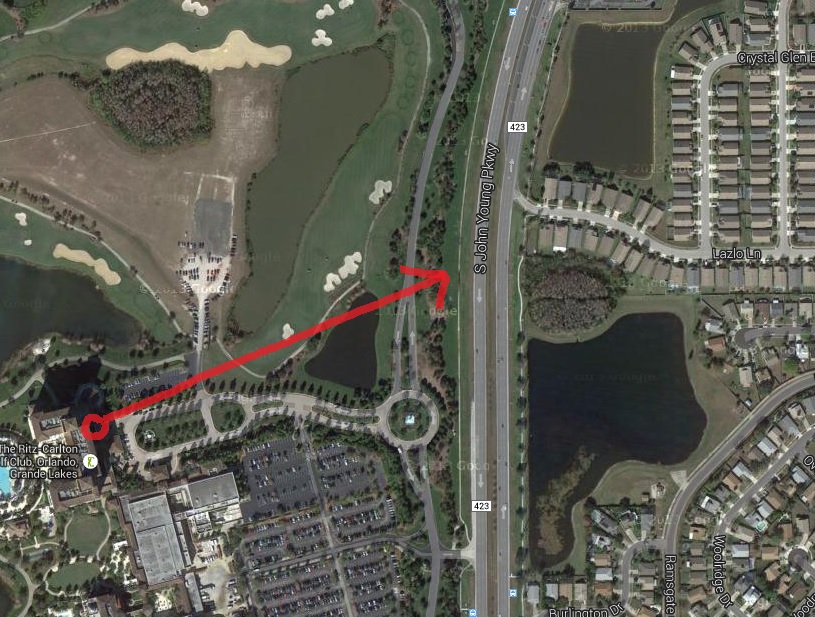
The landscape is inescapably Orlando – flatness, golf courses, those radio towers – and an Orlando I recognize from my stay at the Ritz-Calrton Orlando, Grande Lakes a couple years ago. After checking out a satellite image, I realized the room is on the other side of the hotel from where I stayed, but it appears to be a room directly above the porte-cochere/entrance, facing northeast:

ritzcarltonorlando

As for the floor and the room number – you have got to be kidding me. I leave that to people with time on their hands to call the hotel and ask themselves.

Or we can just ask the view’s submitter!

Did I mention how much time I saved this weekend by not competing in the VFYW Contest? That was until you asked me to try to find a picture and identify the window of a hotel room in which I stayed almost a year ago from the outside of the building.

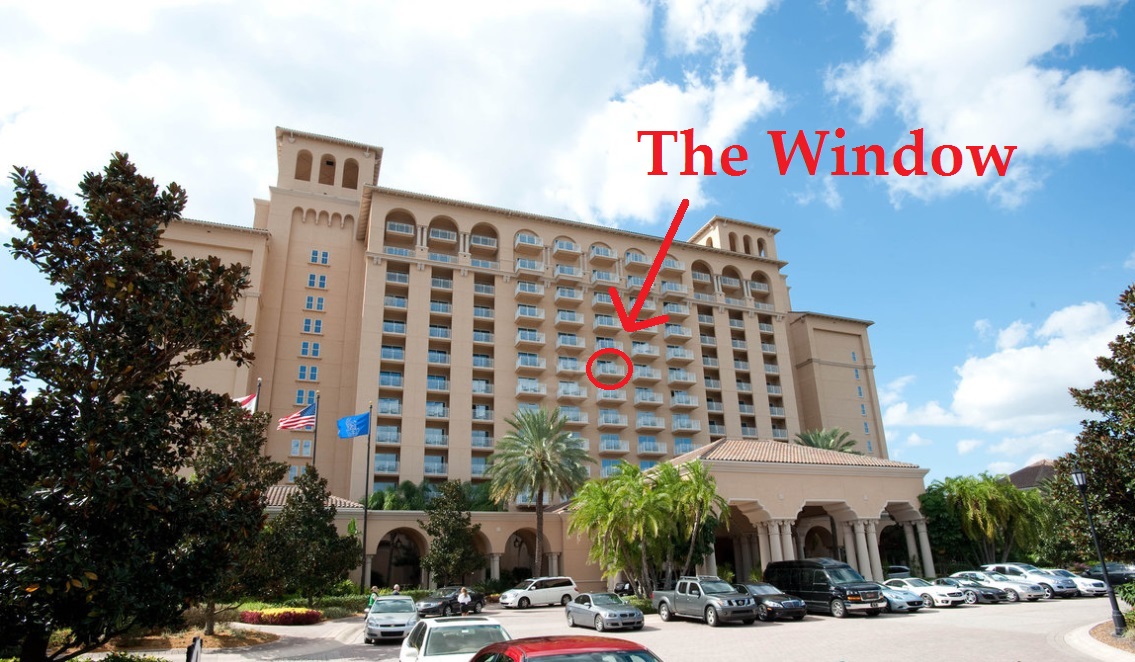
Grandelakes3

In the pictures, the Ritz-Carlton in the hefty building with the two wings and two cupolas. The JW Marriott is the narrower long building with the single cupola.  There is a low double (Ritz and JW Marriott) conference center in between the two hotels.

My room was on the not yet floor in the Ritz-Carlton in the rear in the wing that was nearer to the JW Marriott.  It faced outward toward the golf course – not inward toward the other Ritz-Carlton wing nor outward toward the conference center/Marriott. If you need a picture with a drawing, I suggest you contact the hotel directly. Nothing personal – I plan to enjoy my free time this weekend.

Another guns for the right window:

sand-trapsFlat, full of golf courses, palm trees, lakes, and tracts of dreary, identical, single-story housing. Can’t be anywhere but Florida. The state only has 1,481 golf courses so it was just a matter of looking at them all in Google Earth. I started working from south to north but luckily my wife looked at the picture and suggested the Orlando area. Only took me about 10 tries before I found the water hazard with the two distinctively shaped sand traps beside the fairway, on the course at the Ritz-Carlton Orlando Grande Lakes Resort.

The view is from a room at the front, not very high up, maybe 3rd floor, so judging by how the row of palm trees lines up I am guessing the marked window:

VFYW20140426

Other contestants got closer. Here’s a husband and wife team that has played (and guessed correctly) in every contest this month:

Our guess is that the photograph was taken from the Ritz-Carlton Orlando “Grande Lakes” Hotel, located at 4012 Central Florida Parkway, Orlando, Florida. It was taken from a guest room window in the front the of the hotel, several floors over the main entrance/lobby, with the photographer facing northeast. We spent some time working out the angles to determine the correct hotel window, but with so many to choose between, the window selection is at best a semi-educated guess, so we’re crossing our fingers for luck:

side-jpeg

The landscape of the contest photograph made us both think immediately of Florida, although neither of us has been there. My wife picked out several buildings in the distance that appeared to be hotels – including one really large one. The concentration of hotels outside of an obvious urban area suggested Orlando, because it brings in tourists for Disney World and various other attractions. My wife tentatively identified the large hotel in the far distance to the left of the contest photograph as the “Florida Hotel & Conference Center” in Orlando, and so we studied large hotels with golf courses in that area. It was my wife that found the Ritz-Carlton.

What first caught her eye was that in the paved parking lot in the contest photograph the parking spots are numbered, and all the cars are parked “backed-in.” (Likely meaning a valet-parking area). She saw an identical parking lot at the Ritz-Carlton, and from there we were able to confirm that everything else matched too.

Great entry. Another:

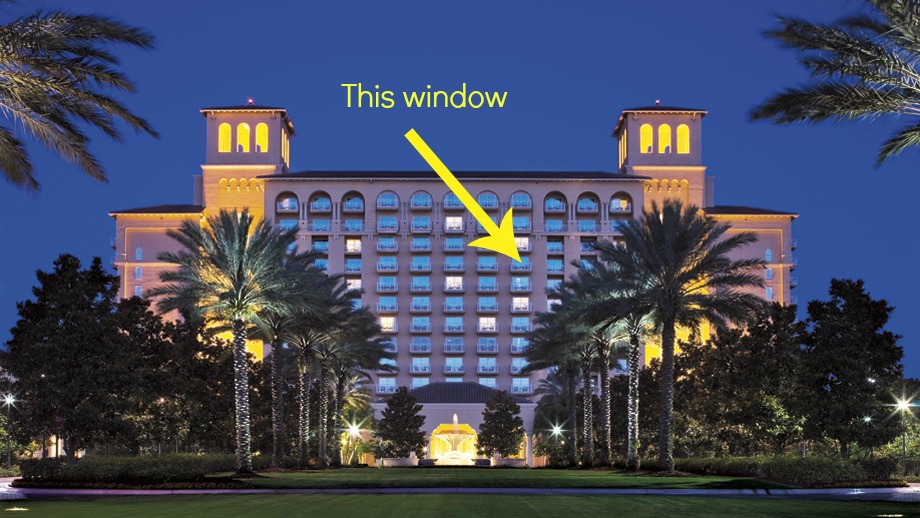
Ritz_Orlando_00233_920x518

The photo this week was taken from the Ritz-Carlton Orlando, Grande Lakes in Florida (4012 Central Florida Pkwy, Orlando, FL 32837). My guess as to window is in the attached picture. I am guessing the photo was taken from the 8th floor in an even numbered room (It appears the odd numbered rooms fact the pool rather than the front drive?)

I figure every one of these I guess correctly gets me closer to the prize. After a dozen or so contest entries, mostly correct, I got a mention in last week’s contest for my Cook pine strategy and it made my day! I still look forward to this every week, though it can be infuriating at times (there are way too many hotels on golf courses).

Succeeding in difficult contests like this one gives you leg up in future tie-breakers. Meanwhile, it appears Chini got a head start this week:

I suppose it helps to have a little advance training. A few weeks ago, an old college friend sent me a view from a building in Florida, and tracking that one down made this contest a cinch. This week’s view comes from Orlando, Florida and looks almost exactly northeast along a heading of 46.69 degrees. The picture was taken from a room on, oh, let’s say the 7th floor of the Ritz-Carlton Orlando Grande Lakes:

VFYW-Orlando-Actual-Window-Marked---Copy

Per the view’s submitter, the room number was 1033. No one even guessed the tenth floor by name, but two readers guessed it correctly via window circling. Since the hotel has 14 floors, the fifth from the top is the correct one. That means Chini nailed it, as did this week’s winner, who is a 20-contest veteran:

The photo is taken from the Ritz-Carlton Orlando Grande Lakes in Orlando. I’m going to guess it’s from the 8th floor – the room is marked here:

RITZ-MARKEDPHOTO

This one was an odd one – seemed impossible at first, going from the lack of major landmarks in the photo. But then there were a few quick bits of deduction: It’s a state with palm trees, and no front license plates – Florida. And it’s clearly from a hotel overlooking a golf course. With that to go on, my partner and I started looking at Google Earth views of Florida hotels with golf courses attached and pretty quickly hit on the Ritz-Carlton. The balcony railing matched the balcony railings in traveler photos from the hotel, and then the clincher: Finding the building in the back left of the photo on Google Street View:

BUILDINGMATCH

Picking the room was the toughest part. I’m guessing it’s above the hotel’s driveway, and between the lines of palm trees (since it’s facing to the left, and only one of the lines is visible in the photo). From rough guesses about positioning, I’m going with the eighth floor, just to the right of the center of the hotel. To guess a room number, maybe 811?

Congrats! And in case you wanted to know the identity of that matching building, the winner of Contest #166 has got you covered:

This week’s contest photo was snapped at the Ritz-Carlton Orlando, Grande Lakes at 4012 Central Florida Parkway, Orlando, Florida 32837. I’ll guess the window is on the 8th floor on the east side of the building:

Ritz Orlando overhead

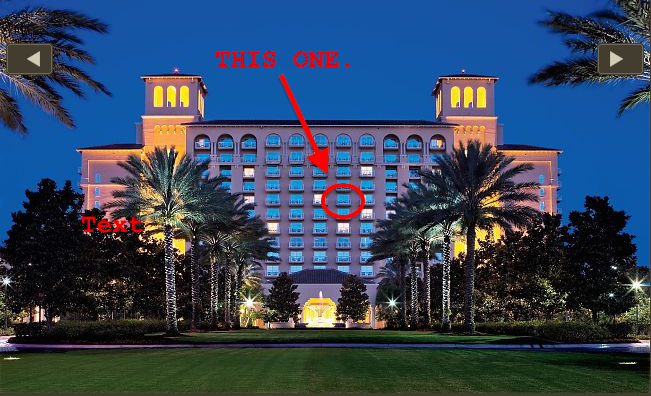
Ordinarily I would write something interesting about the city or the structures in the picture, but we’re dealing with Orlando. So I’ll just note that from the Ritz-Carlton, you can see a CubeSmart self-storage facility:

contest photo a label

See everyone for the next view on Saturday. No more golf courses, promise.

(Archive: Text|Gallery)

Sanctions Redux, Ctd

Julia Ioffe reviews the reasoning behind the new sanctions we imposed on Vladimir Putin’s cronies yesterday:

The psychological factor of naming these [Russian “crony banks”] is not to be underestimated. First of all, it removes the curtain cloaking this shadowy “crony economy,” full of small, strange banks whose business is far from obvious. It shows the Russians that we know how and by whose hands the economy runs. Furthermore, says prominent Russian economist Sergei Guriev, “the continuation of adding companies and banks indicates that future sanctions may include certain truly systemic financial institutions.” …

“I don’t think the Russians quite understand the extent to which the world financial system is integrated with the dollar and the U.S. financial system,” says one administration official involved in the sanctions deliberations. “I don’t know if these people have assets in the U.S. I always suspected most of their assets are in Europe. But once the U.S. banking system has redlined you, it’s hard to do business. You’re radioactive.”

Which is why it’s starting to work. Western financing in Russia has seized up.

But Bershidsky thinks the sanctions are too weak:

The banks are too small to matter: At worst, the holders of almost $2 billion in private deposits at SMP Bank will have to find a new bank if they plan to use their debit and credit cards overseas. Some significant omissions suggest that the list’s drafters intentionally avoided Putin’s friends’ major possessions. Volga Group, for example, holds a 23 percent stake in Novatek, Russia’s biggest independent natural gas producer, and a 32.3 percent stake in Sibur, a major petrochemical producer. Kovalchuk’s Abros holds stakes in a large pro-Putin media holding as well as one of Russia’s biggest insurance companies, Sogaz. Sechin runs state-owned Rosneft, Russia’s biggest oil company. And though Washington officials earlier suggested Gazprom chief Alexei Miller would be mentioned, he is conspicuously absent. So is his company, long used to make Ukraine toe Russia’s line.

Keith Johnson complains that the sanctions don’t hit Russia’s energy sector:

Seriously targeting the energy sector would be crucial, though, because energy exports make up more than half the Russian government’s revenue. Gas sales to Europe, in particular, are a point of vulnerability for Gazprom, since about three-quarters of its sales go to Europe. But Russia’s oil firms, especially Rosneft, are also huge producers and long-time partners of big Western firms, with ambitious expansion plans. …

Big Oil firms continue to talk up their investments in Russia, and some, such as Royal Dutch Shell, plan to ramp up investments in major energy projects in Russia. European countries continue to plan major deals with Russian nuclear power firms. Big European companies that have long-standing trading ties with Russia, meanwhile, are arguing against a ramping-up of sanctions.

So why bother with sanctions at all? Keating’s take:

The best reason for sanctioning Putin that has little to do with influencing his decisions on Ukraine may be that, as Dan Drezner argued the last time around, it will gain the U.S. some leverage for the future. Indeed, sanctions are generally pretty bad at deterring bad behavior by hostile regimes, but the carrot of lifting sanctions has been pretty effective lately. It’s hard to believe that the U.S. could have made as much diplomatic progress as it has with countries like Iran or Myanmar if it hadn’t been able to offer sanctions relief in exchange for concessions.

The relationship between the United States and Russia has been profoundly damaged, probably for years to come, by the Ukraine crisis. Even if the U.S. may not be able to do much to influence Putin now, it’s seems basically inevitable that the two superpowers will face another crisis soon and it could certainly help to have something concrete to offer Russia’s most powerful people in exchange for cooperation.

Granted, in the short term, that’s pretty cold comfort for Ukraine.

Fred Kaplan makes a moral case, even as he acknowledges that sanctions don’t often work:

Sometimes, as with South Africa’s apartheid system, sanctions are worth imposing on moral grounds. And, in that case, because the sanctions were so deep, widespread, and long lasting, they finally paid off.

In this sense, sanctions against Russia are worthwhile, too. First, the West has to do something about Putin’s incursions and threats in Ukraine, and the fact is, there’s not a lot it can do. Second, if Putin isn’t determined to invade Ukraine outright, the pain of the sanctions to date—and the threat of more pain to come if he escalates—might affect his calculations on the costs of going ahead and the benefits of keeping still.

However, it’s illusory to think that these or any other sanctions will have more than a marginal impact on Putin’s behavior, especially when it comes to Ukraine, which has been integral to Russia—as a market, a supplier, and a security buffer—for centuries. If Putin decided that it was in his vital interest to chop off eastern Ukraine and call it a part of “New Russia,” then no economic sanctions—none that the United States and Western Europe can plausibly impose—would dissuade him from doing so.

John Cassidy wonders whether Putin will respond rationally:

[I]f the previous round of sanctions—which extended travel bans and asset freezes to a number of people and institutions close to Putin—did not change Putin’s behavior, it’s questionable whether these new measures, which are basically more of the same, will have much impact. Indeed, Putin’s failure to rein in the pro-Russian forces that have seized buildings in Donetsk and other cities raises three disturbing possibilities: first, that he is not fully in control of the local militants; second, that his cost-benefit analysis doesn’t weigh the economic costs imposed by the sanctions very highly; and third, that he’s not the wily rational actor everybody has assumed him to be. He might be something else.

The Healthcare.gov Hangover

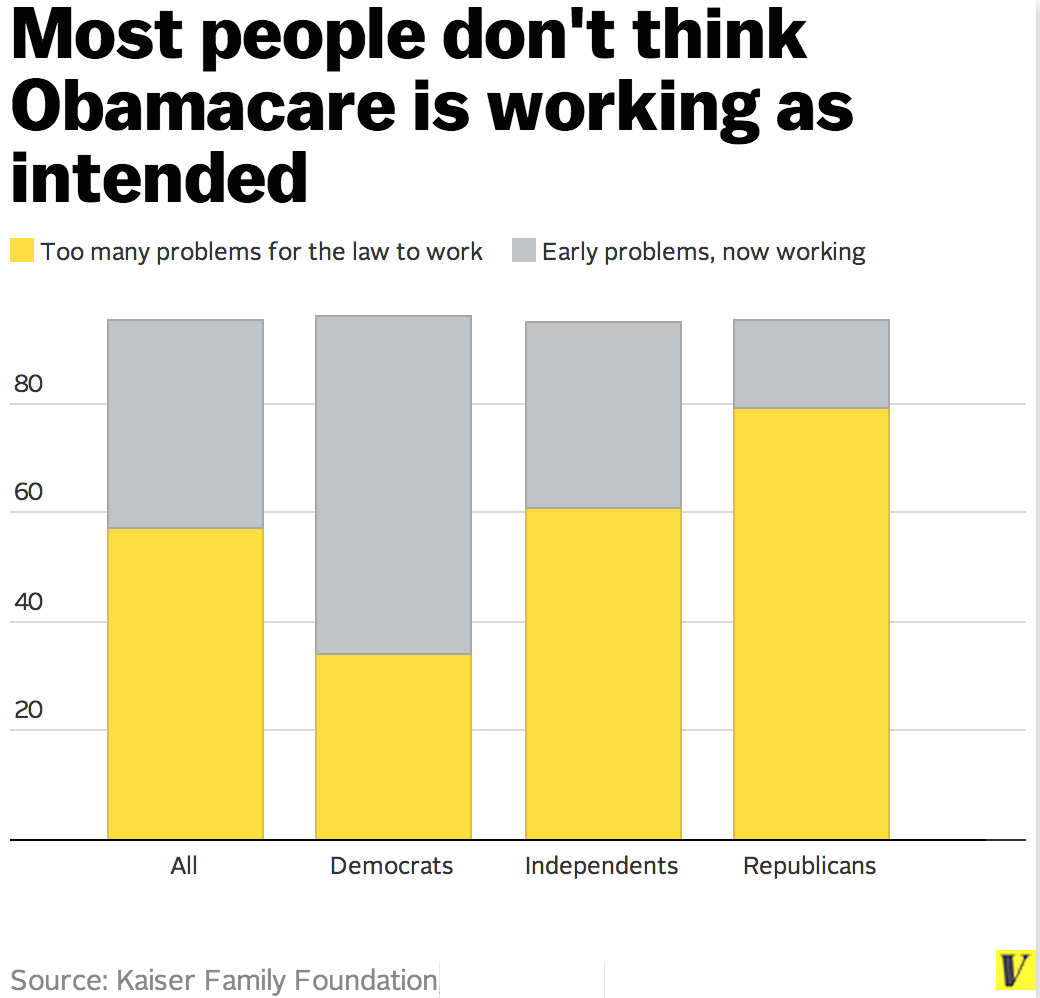
Obamacare Not Working

Kliff contemplates the disconnect between Obamacare’s success and the perception of that success. One big reason for it: Heathcare.gov:

“News about the problems with the exchanges was on a lot longer than any discussion of beating the enrollment goal,” [Kaiser’s Liz] Hamel says. “It’s possible that all the reports were still in the forefront of people’s minds.”

And its likely that most Americans are gauging their understanding of how well — or poorly — Obamacare is going from the news coverage. Most Americans already have health insurance, and aren’t shopping on the exchanges for new policies. So even if the Obamacare experience improves, most people won’t necessarily notice.

“So many people are not impacted by the law that they’re more likely to respond to messages in the media than they are to evaluate their own experience,” Hamel says. “That makes me think it will be a while before there’s any shift in how people think the law is going.”

Relatedly, Ezra listens to Scott Brown’s anti-Obamacare rhetoric:

Scott Brown, who’s now running for Senate in New Hampshire, has found the perfect position on Obamacare. He’s for it. He’s just not for calling it Obamacare.

In an interview with WBUR, he called Obamacare a “disaster.” Then he was asked what he’s for  — and he went on to describe Obamacare. … [T]he polls are clear. The American people don’t want Obamacare. However, they like what’s in Obamacare. And they don’t like it when Republicans try to get rid of Obamacare. Brown’s position shows Republicans a way out: a rebranding of Obamacare, accompanied, perhaps, by some vague tweaks and changes to be named later. Fauxbamacare, in other words.

Another Staggering Death Sentence

Egyptian judge Saed Youssef, who infamously sentenced 529 people to death last month for their alleged roles in the death of one police officer, outdid himself yesterday when he condemned another 682 defendants, including Muslim Brotherhood Supreme Guide Mohamed Badie, to hang for the same crime:

Those found guilty have been charged with contributing to the death of a police officer during a raid on a police station in August. But their individual crimes were all relatively minor, like committing acts of violence or inciting violence, and none of the 683 was charged with participating in the officer’s murder. Badie, in fact, was advocating for nonviolence during the tumultuous aftermath of former Egyptian President Mohamed Morsi’s ouster.

Badie also happened to be in a different city during the incident. … The trial itself lasted a matter of minutes, and most of the accused were tried in absentia.

Bel Trew looks at Youssef’s record:

Judge Youssef first rose to prominence in 2012 when he took over the second district of the criminal court in his hometown of Beni Suef, some 100 kilometers north of Minya. It was there he earned the nickname “The Butcher” for bending the law with his notoriously harsh verdicts:

He once sentenced a man to 40 years in jail for possessing a gun. “He gave him 15 years for the weapon, 15 years for the bullets, then 10 years for getting into the gunfight,” said lawyer Mohamed El-Zanaty, based in Beni Suef, who has worked extensively in Youssef’s courtrooms.

But Youssef only gained international notoriety last year, when he acquitted the area’s security chief and 10 of his policemen accused of killing protesters on January 28, 2011, dubbed the “Friday of Rage,” one of the bloodiest moments of the 18-day uprising that overthrew President Hosni Mubarak.

Karl Vick notes that this level of judicial complicity in oppression is unprecedented in the country:

During the rule of President Hosni Mubarak and his predecessors, Anwar Sadat and Gamal Abdel Nasser, “the judiciary sometimes acted as a brake on the government’s most authoritarian impulses,” Nathan J. Brown and Michelle Dunne of the Carnegie Endowment for International Peace recently wrote, “Now, all the instruments of the Egyptian state seem fully on board. Whereas Nasser had to go to the trouble of setting up kangaroo courts, today there is no need.” Judges have outlawed the Muslim Brotherhood, the Palestinian militant group Hamas, and now the liberal April 6 Movement, named for the date of a planned 2008 public strike in an industrial town that grew into a nationwide protest movement.

The editors at Bloomberg decry the direction Egypt is headed in and say it’s time to cut off the aid:

Egypt’s government says about 500 people have been killed in terrorist attacks since the coup, mainly security personnel. That violence flared in response to draconian policies that offered Islamists no peaceful avenue. Previous attempts to crush the Muslim Brotherhood in Egypt, notably under President Gamal Abdel Nasser, failed miserably. [Yesterday’s] death sentence against the leader of the Muslim Brotherhood, which claims membership of up to a quarter of Egypt’s population, will further aid recruitment for radical Islamist groups that preach violence. …

Al-Seesi’s Egypt is measurably more bloody and repressive than either the Muslim Brotherhood government it replaced or any of Egypt’s previous dictatorships. It’s not enough for the U.S. to merely condemn the mass trials. If the U.S. truly supports the spread of democracy and individual rights in the Middle East, as it claims, then it cannot provide the means to suppress them.

What Is Justice For Child Porn Victims? And From Whom?

Last Thursday, the Supreme Court issued a 5-4 ruling in Paroline v. United States. The court decided that, while a victim of child pornography is owed restitution from any and every person who has viewed it, a single individual cannot be held liable for the entire sum of that restitution. Lyle Denniston explains:

The decision clearly will spare a Tyler, Texas, man, Doyle Randall Paroline, from paying all of the nearly $3.4 million that lawyers for a young woman identified only as “Amy” had demanded from him.  Paroline had two images of her being photographed as her uncle sexually abused her when she was eight years old.  Now a young woman, she had testified that “My life and my feelings are worse now because the crime has never really stopped and will never really stop.”

The Court ruled that a federal district court judge must calculate how much to assess against Paroline personally.  There is no doubt, Justice Kennedy wrote, that Paroline “was part of the overall phenomenon” of distributing and keeping images of the abuse of Amy.  He should have to pay his share and, Kennedy said, it must be enough to send the message that his part in the crime was not victimless. Lawyers for “Amy” had insisted that Paroline, like everyone who has her images and looks at them, contributes to her continuing injury, so each of them should be required to pay the full amount for her losses, in whatever multiples of individuals are found and prosecuted for having the pictures.

In a dissent joined by Scalia and Thomas, Roberts argued that as the statute in question provided no formula for how to calculate such restitution, “Amy” should get nothing from Paroline. Sotomayor dissented in the other direction, arguing that Paroline should pay the full sum or collect it from other offenders himself. Rick Pildes notes that this is all Congress’s fault:

As eight Justices saw it, the text of the law suggested Congress had created a messy situation:  (1) Congress intended to ensure that victims like Amy receive some restitution; (2) Congress did not intend that they receive as much as $3.4 million in restitution from someone who possessed two images of the victim, which is what the victim sought; (3) and Congress had not provided any direct guidance in the statute itself for how courts ought to determine the point between $0 and $3.4 million at which restitution ought to be set.  Congress must have meant something between $0 and $ 3.4 million, but provided no road-map for even generally figuring out how much.  All eight Justices presumably agree it would be better for Congress to address and resolve the general policy issues.  The question is what to do when Congress hasn’t — and, perhaps, what decision from the Court makes it most likely that Congress will do so.

But Paul Cassell, one of “Amy’s” lawyers, argues that the law’s intent was already clear:

[T]he text of the statute makes clear that Congress wanted child pornography victims like Amy to recover “the full amount of their losses” — not some partial, fractional amount.  Moreover, the Court entirely ignored an amicus brief filed seven Senators who were in Congress in 1994, when the provision was enacted.  As Senators Hatch, Feinsten , Grassley, Markey, McCain, Murray, and Schumer explained in their brief, “Congress really did mean what it said.”  They provided drafting history showing that Congress had specifically decided not to include a “proximate result” limitation in the other parts of the statute — only subsection (F).  In other words, Congress meant for victims like Amy to recovery the full amount of their losses from each defendant.

Either way, it seems the matter won’t be settled until Congress amends the statute. Marci Hamilton urges them to make the perps collect the restitution money, in line with Sotomayor’s position:

There is a simple two-part fix, if you parse Justice Kennedy’s and Justice Sotomayor’s views closely enough: (1) Congress should enact a federal rule of contribution among child pornography defendants and (2) replace “proximate cause” with “aggregate causation.”  That would make it possible for the many Amys of our world to obtain restitution from even one perpetrator in the marketplace and obtain full restitution.  The best part of this solution is that it would then incentivize the one defendant forced to pay it all to identify others as contributors.  Let the defendants go after their many contacts in the market for contribution.  That reduces the restitution, even if levied against a single person, from an excessive personal fine, and puts the burden of parsing out blame on the bad guys, not the victims who never asked to be on the Internet in the first place.

Posner proposes an alternative that he considers more just:

The problems with Kennedy’s and Sotomayor’s approaches stem from the same source: When Congress drafted the provision about restitution in the Violence Against Women Act, it thought about traditional types of harms—when one person directly injures another—and not the unusual collective injury in this case. That’s why the justices’ efforts to twist the statutory language lead to unfair and bizarre outcomes.

Congress created this mess, and only Congress can fix it. Every person who is convicted of child pornography should pay a large fine into a government trust. The fine would be tailored to the wealth of the defendant and the magnitude of his wrongdoing. Then this fund would be used to compensate all the identified victims of child pornography, who would share it in proportion to the severity of their injuries. That way, not Kennedy’s or Sotomayor’s, lies fairness.

(Video: Clip from the Law and Order: Special Victims Unit episode “Downloaded Child”, based on the case of “Amy”. It envisioned a much different result than the ruling in Paroline.)

Which On-Screen Violence Is More Senseless?

Game Of Thrones author George R.R. Martin compares the violence in the series to that of drone warfare:

Taking human life should always be a very serious thing. There’s something very close up about the Middle Ages. You’re taking a sharp piece of steel and hacking at someone’s head, and you’re getting spattered with his blood, and you’re hearing his screams. In some ways maybe it’s more brutal that we’ve insulated ourselves from that. We’re setting up mechanisms where we can kill human beings with drones and missiles where you’re sitting at a console and pressing the button. We never have to hear their whimpering, or hear them begging for their mother, or dying in horrible realities around us. I don’t know if that’s necessarily such a good thing.

Zack Beauchamp thinks this is mistaken:

Martin is certainly not alone in questioning the implications of drones, and exploring the human impact of war is a major part of his work. As he’s said repeatedly, his work is designed to be a criticism of war as a human institution, the base cruelty of characters like Joffrey Baratheon and Ramsay Snow exposing what happens during episodes of organized violence. Still, Martin’s own books allow for a lot more nuance around the morality of medieval warfare than he seems to see in its more modern incarnation. The idea that killing in war is somehow better when done with a sword rather than a missile seems to cut against his critique of war itself.

What’s really troubling about both the drone program and slaughter on Game of Thrones isn’t the technology people are using to kill each other. It’s the reasons that they decide to deploy it. On the show, it’s mostly a pointless struggle over which royal family gets to wield power. In real life, it’s the willingness to kill civilians to achieve arguably dubious gains against al-Qaeda. The problem in both cases is the policy of people in power, not the weapons they use to pursue it.

Overreach For America?

Alexandra Hootnick notes that in some districts, Teach For America corps members are competing with traditional teachers for jobs:

When Teach For America started up, [founder Wendy] Kopp prioritized sending its energetic but inexperienced corps to public schools lacking licensed educators – the schools often too poor or too dangerous to attract teachers. But since the recession, with education funding across the country drying up, teacher layoffs have become more of an issue than teacher shortages. Between 2008 and 2013, 324,000 teaching positions in local school districts were eliminated, according to the Center on Budget and Policy Priorities. With TFA’s expansion outpacing needs, it has been forced to find new places for its recruits. In the process, the organization has come under increasing fire, not just from outside critics but from its own alumni ranks, which include former recruits who believe the organization’s aggressive growth strategy has compromised its mission.

One of TFA’s controversial moves has been to seek placements for recruits in wealthier school districts like Seattle’s, where teaching jobs – not teachers – are scarce. … Meanwhile, the cost of recruiting, training and supporting corps members – which is partly subsidized by taxpayers – has more than doubled over the past decade, from $22,000 to at least $47,000. (TFA disputes this, claiming that it has revised its method of accounting for these costs.) And informal data that the TFA used to track its teachers’ performance indicates that their students aren’t making as much progress as they were a few years ago.

Update from a reader:

The Onion nailed this one, of course: “My Year Volunteering As A Teacher Helped Educate A New Generation Of Underprivileged Kids vs. Can We Please, Just Once, Have A Real Teacher”