When Home Is Where You Travel

Charleston-WV 1-00 pm

Having grown up a third culture kid, Ruth Behar considers the cultural impact of “the transient places that the French anthropologist Marc Augé has called ‘non-places’ – airports, shopping malls, hotels, highways, bus terminals, and subways”:

As ‘non-places’ expand from centers to peripheries all around the world, there is renewed pressure to work hard to prevent the home from becoming a long-term hotel room. Sentimental notions of the sanctity of the home are enlisted as a means of challenging the threat of ‘non-places.’ A preponderance of guides, including websites such as Apartment Therapy and Houzz, exist for the sole purpose of assisting us in making our homes uniquely charming and irreplaceable. …

But there is another choice we can make, and that is to give up home altogether and be homeless by choice – not as a result of poverty or broken family ties, but to let go of the weight of the things that prevent us from fully engaging with the world and becoming true cosmopolitans, people at home everywhere.

(Photo by a reader: Charleston, West Virginia, 1 pm)

A Pivotal Visit? Ctd

Jaime Fuller lays out the goals of Obama’s four-country Asia trip, which began yesterday in Japan:

For this trip, this renewed effort at pivoting will focus on two policies in particular — finishing up the Trans-Pacific Partnership, a 12-country free-trade agreement that has been in the works for five years, and an agreement with the Philippines giving U.S. ships and planes more access to bases there than they’ve had since 1992. In 1991, the country asked the United States to leave Clark Air Base and the Subic Bay naval facility. The military isn’t planning to establish a permanent base again; it is just instituting rotating deployments and stocking up supplies in case of a disaster — a plan similar to one recently instituted with Australia.

Obama will also be talking to Japan about plans to revamp its military. International decisions made at the end of World War II have left Japan with a small military, but the country’s new conservative prime minister, Shinzo Abe, has made revitalizing Japan’s defense and armed forces a priority. The United States likely sees Japan’s morphing role in the region — and growing tensions between Japan and China — as an important aspect of any changes to its role there. Obama’s trip to Tokyo in 2009 was the first presidential trip to Japan since 1996.

Fred Kaplan notes that the visit has been overshadowed by events in Ukraine:

This week’s trip was planned as a makeup session of sorts. Obama’s main goals were, first, to allay the allies’ concerns about America’s commitment to their security in the face of an expansive Chinese navy and, second, to complete a trade treaty, the Trans-Pacific Partnership, which has been central to Obama’s vision of a rebalanced foreign policy.

But, once again, life has gotten in the way.

The spotlight has turned, improbably, to Ukraine. Not only has Russian President Vladimir Putin’s land grab riveted everyone’s attention, it also threatens to upend the whole concept of the pivot, at least for a while. The concept, as Obama initially laid it out, rested on three premises: a desire to get out of the Middle East’s quagmire-wars; a view of Asia-Pacific as the emerging center of dynamic growth; and an almost unspoken assumption (it seemed so obvious at the time) that Europe needed no special minding, that the era of crises on the continent had passed. The first premise is still laudable, the second still persuasive, but the third … well, clearly, the map of Europe is no longer so stable.

Fuller follows up with a refresher on the TPP and why everyone hates it:

As the Financial Times sums up the debate, “But what, precisely, is the Trans-Pacific Partnership? To some, it is the ‘gold standard’ of trade deals. They argue that the 12-member club of aspiring free-trade purists led by the US can jump-start the stalled multilateral Doha round, which the World Trade Organisation initiated in 2001 to break down global trade barriers. To opponents, the TPP is a ‘giant corporate power grab’ that would endanger food safety, access to medicines and national sovereignty.”

The TPP is very large and broad. Think of it like an omnibus bill in Congress, where a bunch of the treaty’s drafters get to toss in pork to keep their constituencies happy. No one is completely happy when an omnibus bill is passed. Same deal here. The TPP covers so many different industries, that few people remain who aren’t worried about what the final treaty may contain. Many of the complaints leveled against the Trans-Pacific Partnership are the same that were made against NAFTA 20 years ago.

Richard Stubbs blames the impasse over the deal on competing American and Asian versions of capitalism:

[O]f all the obvious divisions among the 12 TPP participants it is the clash of capitalisms that is the most difficult to overcome. The Anglo-American participants, especially the US, firmly believe in a market-led approach to economic growth. The Asian partners – notably Japan, Malaysia, Singapore and Vietnam – however, achieved much of their remarkable economic success by relying on a state-guided approach to economic development. These competing visions of how to advance economic growth affect nearly every one of the many issues that need to be negotiated – tariff elimination, reductions in non-tariff barriers, investment safeguards, protecting intellectual property rights and so on.

Clearly the leaders of the Asian partners hoped that by joining the TPP negotiations they would gain access to the US market and force their own economies into further economic liberalisation without arousing too much opposition. But they have become trapped between the rigidity of the US negotiating position and increasing resentment at home as the details of the secret negotiations have been made available.

What’s The Greatest Year In Film? Ctd

An eager reader writes:

I hope you’re going to publish some emails on this subject. I love movies. I love lists. And I love the contributions from Dish readers. If I may, I’d like to get the ball rolling:

1999 gave us Fight ClubSouth Park: Bigger, Longer, and Uncut; Star Wars: Episode I – The Phantom Menace (in retrospect a terrible film, but at the time I was jonesing for some new Star Wars); The Matrix; The Sixth Sense; The Insider; Office Space; Election; and a personal favorite: The 13th Warrior.

A more cynical contributor:

This of course is the sort of post designed to unleash a tsunami of comments, so whenever you need some time to perfect the latest think piece, you can turn out a quick “Ctd” to keep the masses engaged until it’s done.

OK, I’ll bite.

I’ve always (well, for 17 years, anyway) been partial to 1996. Any year that produces both the perfect Fargo and the equally perfect Lone Star has a good head start, but throw in Swingers, Bottle Rocket, Branagh’s Hamlet, Sling Blade, TrainspottingMars Attacks!Beautiful Girls, and Big Night – plus the docs Looking for Richard and When We Were Kings – and it’s hard to think of a better 12-month run. Even the big studio productions seem have at least sipped from the same water source as the indies, with Jerry MaguireTwister, and The People vs Larry Flynt.

The English Patient won best picture … some folks liked that one, too.

Another looks further back:

I’m sure you’ll get plenty of emails picking this year, but 1939 still gets my vote for GYIF. Just take a look at the Best Picture nominees: Dark VictoryGone With The WindGoodbye, Mr. ChipsLove AffairMr. Smith Goes To Washington (one of my all-time favorites); Ninotchka; Of Mice And Men; StagecoachThe Wizard Of Oz; and Wuthering Heights

Other great movies that year include The Rules of the Game, Gunga Din, The Hound of the Baskervilles, The Hunchback of Notre Dame, Destry Rides Again, Son of Frankenstein, Young Mr. Lincoln, and The Women. I have a hard time believing that any other year can top that.

Another recalls working as an usher in 1982:

I was hired Tuesday, June 8, on the spot. They were desperate for help, and with good reason. I started work that Friday night, June 11: the opening night of E.T. Here’s what I remember about the six auditoriums, my first night on the job:

Screen #1:  Star Trek II: The Wrath of Khan

Screen #2:  Poltergeist

Screen #3:  E.T., the Extra-Terrestrial

Screen #4:  Grease 2

Screen #5:  Indiana Jones and the Raiders of the Lost Ark

Screen #6:  The Road Warrior

The lobby, that first night, was jam-packed. Stuffed. The line, four or five people across, stretched out of the front of the theater, into the mall, circling around the corner, going back at least 50 yards, maybe more like 60. The vast majority of that was for E.T.

In the above list, those first three screens were the big rooms, capacity somewhere between 350 and 400. E.T. would remain on screen #3 until the following January. It left the Ingram 6 exactly 52 weeks later. Remember: There was no home video market at this time. If you had home movie library, it’s because you were using your VCR to record movies of HBO (using blank tapes that probably set you back $6 to $10 each).

I remember one particular scene, towards the end of Poltergeist, that always caught people off guard. The on-screen action was punctuated by a music punch, and the whole room screamed. The people in the lobby, waiting with their tickets and popcorn, were maybe 20 feet from the doors. They could hear the screaming, and a few of them got bug-eyed. “I have tickets to see that?!”

Update from a reader:

For me, the answer is clearly 1994. It has my favorite film of the 1990s (Pulp Fiction), the top-rated film in IMDb (The Shawshank Redemption), the apex of the Disney Renaissance (The Lion King), and that doesn’t even include the Academy Award winner for Best Picture (Forrest Gump).

Plus, just as a bonus, what a monster year for Jim Carrey. Ace Ventura, The Mask, and Dumb and Dumber all came out in 1994.

There’s a Youtube for that:

(Top video: 1976)

How The Senate Is Shaping Up

Nate Cohn parses a poll showing Democrats leading in Southern Senate races:

[Arkansas Sen.] Mark Pryor has a 10-point lead, according to the poll, but 16 percent of Mr. Pryor’s supporters — or 8 nearly percent of all voters — oppose the Affordable Care Act and say they could not vote for a candidate who disagrees with their stance on the issue. Mr. Pryor, of course, voted for the Affordable Care Act. If those voters flip, his opponent, Representative Tom Cotton, will have the advantage.

Other Democrats face a similar challenge: In every contest, at least 10 percent of Democratic supporters oppose the Affordable Care Act and say they wouldn’t vote for a candidate who disagrees with their stance. All four Democratic Senate candidates in these states support the law.

Beutler thinks “the GOP’s Obamacare obsession is going to start looking more and more strained and untenable”:

We’re already seeing signs of that in Senate races in Arkansas, Michigan, New Hampshire, and North Carolina. But I don’t think Republicans are going to switch scripts any time soon, both because conservatives won’t let them, and for the more fundamental reason that they don’t have any other scripts lying around.

And they may not need to. Their map is good! But if Obamacare recedes as an issue, and the projections start looking less auspicious for them, they might start wishing that they hadn’t staked everything on a single issue, the success or failure of which rests largely outside of their control.

Drum gives Democrats free advice:

Electorates in red states know that these Democrats voted for Obamacare. Their opponents are going to hammer away at it relentlessly. It’s just impossible to run away away from it, and doing so only makes them look craven and unprincipled. The only way to turn this around is not to distance yourself from Obamacare, but to try and convince a piece of the electorate that Obamacare isn’t such a bad deal after all. You won’t convince everyone, but you don’t need to. You just need to persuade the 5 or 10 percent who are mildly opposed to Obamacare that it’s working better than they think.

Finally, Douthat fears that the GOP will snatch defeat from the jaws of victory:

The best reason to bet on the Democrats doing somewhat better than expected in these races … isn’t current polling (we’re too far out, still), and nor is it merely the general pattern in which savvy incumbent senators eke out re-election in races that the red-blue map suggests that they should lose. Rather, it’s the more specific phenomenon of a Republican Party that, in the age of Obama, has proven remarkably adept at squandering winnable Senate seats and underperforming in Senate races, with all sorts of candidates, in red and purple states alike.

In part, this has happened because of primary fights that have produced freakishly bad nominees, like Sharron Angle and Christine O’Donnell and Todd Akin. But it’s also happened in slow-motion, under-the-radar ways, sometimes with establishment candidates and sometimes with Tea Partiers, in races that are close and winnable and then just … slipped … away.

Paying For The Roof Over Your Head

One Bedroom Rent

Emily Badger and Christopher Ingraham map how much it costs to rent a one-bedroom residence in every US county (interactive version here):

No single county in America has a one-bedroom housing wage below the federal minimum wage of $7.25 (several counties in Arkansas come in at $7.98).

Coastal and urban counties are among the most expensive. The entire Boston-New York-Washington corridor includes little respite from high housing wages. Marin, San Francisco and San Mateo counties in California rank as the least affordable in the country (scroll over each county in the interactive version for rankings; click to zoom). In each of those counties, a one-bedroom hourly housing wage is $29.83, or the equivalent of 3.7 full-time jobs at the actual minimum wage (or an annual salary of about $62,000). Move inland in California, and housing grows less expensive.

But renting is often a better deal than buying. Catherine Rampell is shocked that we still consider home buying a great investment:

“People forget that housing deteriorates over time. It goes out of style. There are new innovations that people want, different layouts of rooms,” [Robert Shiller] told me. “And technological progress keeps bringing the cost of construction down.” Meaning your worn, old-fashioned home is competing with new, relatively inexpensive ones.

Over the past century, housing prices have grown at a compound annual rate of just 0.3 percent once one adjusts for inflation, according to my calculations using Shiller’s historical housing data. Over the same period, the Standard & Poor’s 500-stock index has had comparable annual returns of about 6.5 percent.

Yet Americans still think it’s financially savvy to dump all their savings into a single, large, highly illiquid asset.

She follows up with concrete numbers:

Let’s imagine you bought the country’s median-priced house in 1982 for $69,000. I, on the other hand, rented a home for $400 (that’s actually much higher than what the Labor Department estimates the monthly rental value of an owned home was around that time, but I’m trying to be conservative about how expensive it is to rent vs. buy). I also invested $69,000 in the S&P 500.

To keep the example simple, let’s also assume you paid cash for the house –interest rates were about 16% in 1982, after all — and I am paying my rent out of my stock market account each year. Thirty years later, given national housing price changes, you’d be left with a house worth about $213,000, which is a little bit less than today’s national median new home sales price. (Your house is 30 years old after all, and today’s homes are bigger.) On the other hand, looking at how much rents have risen over the same period nationwide and how much the S&P 500 has grown, I’d have about $719,000 in my Vanguard account. And we both had somewhere to live.

But Rampell acknowledges that houses aren’t simply investments:

Fannie Mae, in its National Housing Survey, asks Americans about “the best reason to buy a house,” giving them two options: “financial benefits” (like investment, wealth building, and tax benefits), or ”the broader security and lifestyle benefits of homeownership” (like providing a good and secure place for your family, control to make renovations, etc.) In the March survey, 43 percent of respondents choose the  ”financial benefits,” while 55 percent chose “the broader security and lifestyle benefits.” So yes, the psychic benefits of ownership appear to be a bigger driver for buying a house than the financial ones.

But here’s the part that’s irksome: The same survey also asked people to rate different kinds of investments as a “safe investment with a lot of potential,” “safe investment with very little potential,” “risky investment with very little potential,” or “risky investment with a lot of potential.” Buying a home is almost always the option with the highest share of respondents calling it a “safe investment with a lot of potential.”

Dusting Off Obama’s Clemency Powers

Yesterday, the DOJ announced changes to the clemency process. Philip Bump lists the new criteria inmates must meet:

• Be federal inmates who would have received a substantially lower sentence if convicted of the same offense today,
• Be non-violent offenders without ties to criminal organizations or gangs,
• Have served at least 10 years of their prison sentence,
• Have no significant criminal history,
• Have demonstrated good conduct in prison, and
• Have no history of violence prior to prison.

Nicole Flatow further unpacks the news:

There are some 23,000 inmates who have served more than ten years for a non-violent crime, according to the Justice Department. Another estimate cited by CNN put the number of those who likely meet all six criteria at 2,000, and that number may likely get pared down hundreds once inmates are reviewed by the DOJ’s Pardon Attorney.

This is a small fraction of the some 200,000 inmates in federal prisons, and it won’t account for any of those individuals sentenced to five or ten-year minimums for minor crimes. But it should take on some of the longest, and would be an astronomical increase over the number of commutations Obama has granted thus far throughout his entire presidency: ten.

Sullum hopes the administration is serious:

Even if the number of prisoners freed under the new policy is only in the hundreds, Obama will look much better than any of his recent predecessors. No president has broken the double digits with commutations since Lyndon Johnson, who issued 226 over 62 months. Since then total commutations have ranged from a low of three under George H.W. Bush to a high of 61 under Bill Clinton (followed closely by Richard Nixon with 60). George W. Bush issued just 11. “The doors of the Office of the Pardon Attorney have been closed to petitioners for too long,” says FAMM General Counsel Mary Price. “This announcement signals a truly welcome change; the culture of ‘no’ that has dominated that office is being transformed.” If Obama follows through on his promises to ameliorate some of the appalling injustices committed in the name of the war on drugs, it will be one of his most admirable legacies.

But Tim Lynch fears that few inmates will be released:

The administration is really hyping this initiative and raising expectations about dramatic moves by Obama as this gets underway. I remain skeptical for a few reasons.  First, I question the narrative that it has only recently occurred to Obama that there ought to be more meritorious clemency petitions on his desk.

Second, I note that the administration is expecting to receive thousands of petitions and applications.  That language is important.  Later on, Obama’s people may say, “As expected, we received thousands of applications! We never said there would be hundreds or thousands of commutations.”

Third, there’s just no way of telling how the criteria are going to applied.  What are “significant ties” to gangs?  “Significant” criminal history?  A “history” of violence?

Quote For The Day II

“For a journalist to write a book that says, in essence, that the struggle for marital equality “had largely languished in obscurity” until 2008 and the battle over Proposition 8 in California is tantamount to saying that the black-civil-rights struggle didn’t get going until President Obama was elected president that same year,” – Frank Rich on the Becker book.

Rauch On Eich

The obvious weakness in my own and others’ case for not wanting to punish someone who donated to the pro-Prop 8 campaign six years ago is the racial analogy. After all, isn’t opposition to marriage equality morally identical to opposition to inter-racial marriage? If so, why not punish and ostracize and get someone fired for opposing marriage equality as you would in a miscegenation case? I grappled with this at the time but Jon Rauch has a helpful piece explaining our position a little better.

Basically: gendered marriage had long been a settled assumption about the nature of what marriage is when we came along with the argument for same-sex marriage. Inter-racial marriage had existed as gendered marriage for a long time in some parts of the country, alongside anti-miscegenation laws in others. We were therefore asking for a bigger change than in the past – and one that had far less traction and history behind it. When you’re asking for more, a little more patience is necessary – and a little more lee-way for opponents is appropriate. We’re talking prudence here.

Yes, the opposition to inter-racial marriage had religious roots and rationalizations.

But the theological underpinnings of marriage as a gendered institution – between one man and one woman – were far deeper and wider than any theological roots for opposing miscegenation. And since the religious conscience carries weight in America, a full-scale assault on that ancient tradition as nothing but bigotry would have repelled far more people than it would have attracted. And that’s still the case. Calling every religious opponent of civil marriage equality a bigot would hurt our cause not help it. It alienates the very people we need to persuade.

Lastly, if reason and debate and testimony and civility had met total failure and unyielding majority opposition, I can see the case for more radicalism. But these tactics actually led to as swift a shift in public opinion on a major social issue as we’ve seen in American history. It’s therefore prudent, it seems to me, to sustain the same civility to get us to the ultimate prize of equality across the nation and world. And the posture of shutting people up, of declaring their consciences objectively null and void, and punishing dissent – even as it is fast disappearing – is an unnecessary and self-defeating posture.

(Photo from Getty)

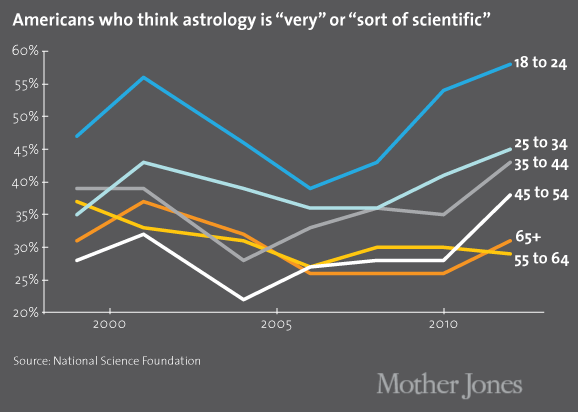
Starry-Eyed Youth

age2_0

Amanda Petrusich theorizes about why young people are more attracted to astrology than their elders:

While [Millennials are] hardly the first group to feel the draw of the unknown, it also makes sense that a generation that came of age with the whole of human knowledge in its pockets might find the ambiguity of astrology a little welcome sometimes. For people born with the web, information has always been instantly accessible, so astrology’s abstruseness – and, ironically, its promises of clarity regarding the only real unknowable: the future – becomes appealing. This generation’s predicament, as I understand it, has always felt Dickensian: “We have everything before us, we have nothing before us.”

But then I’m reminded, again, that inaccuracy, or, at least, a belief in the fluidity of truth, is at the heart of the present-day zeitgeist: Our news is often hasty and unverified, our photos are filtered and retouched, our songs are pitch-corrected, our unscripted television programs are storyboarded into oblivion, and most everyone shrugs it all off. Astrology might not offer the most accurate or verifiable information, but at least it offers information – arguably the only currency that makes sense in 2014.

Previous Dish on astrology here, here, and here.