India’s Anti-Muslim Leader?

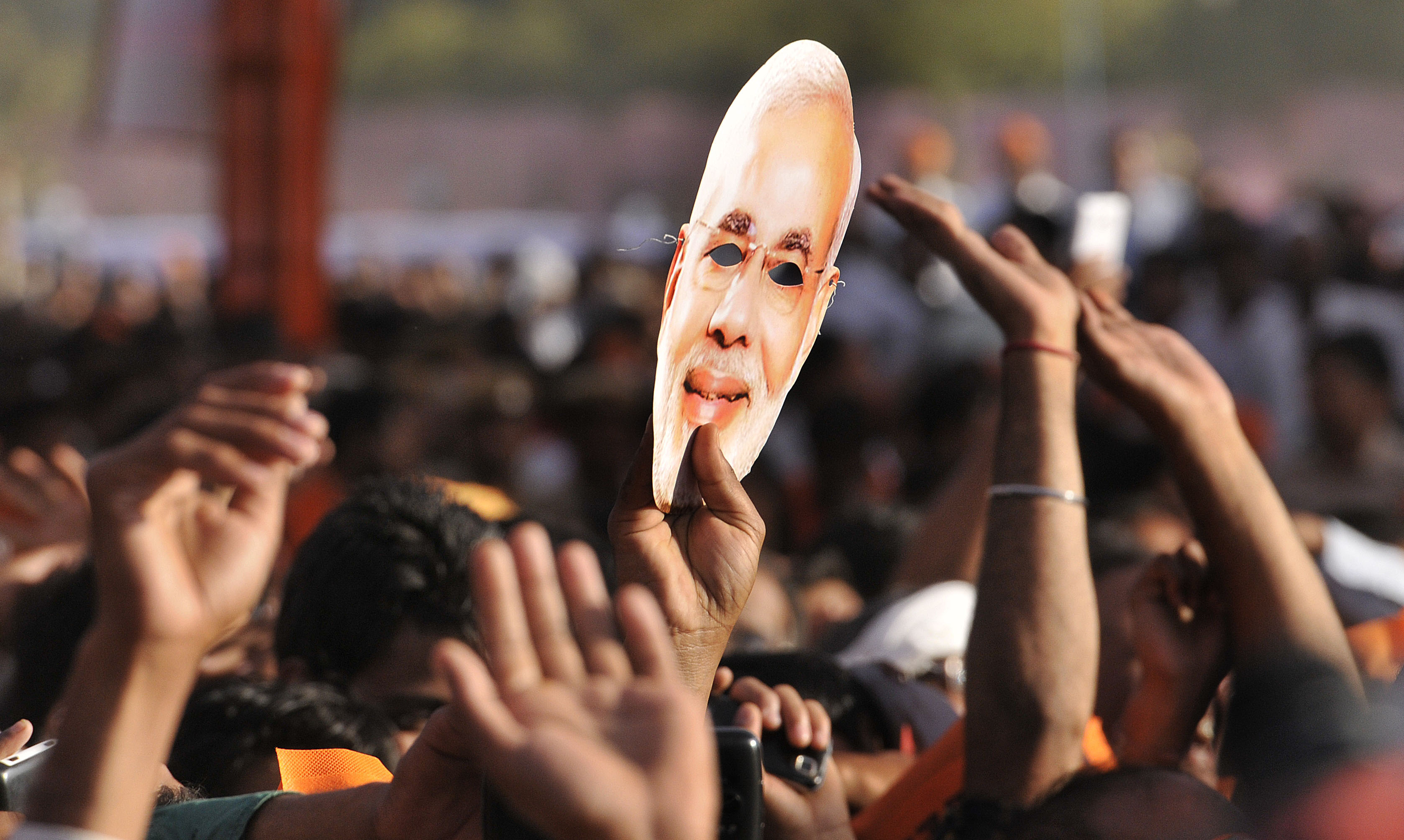
Rally Of  Narendra Modi In Gurgaon

A useful NYT video reviews the troubling record of Narendra Modi, who is likely to be India’s next prime minister. The Economist is against Modi because he never addressed the slaughter of Muslims that happened under his watch:

By refusing to put Muslim fears to rest, Mr Modi feeds them. By clinging to the anti-Muslim vote, he nurtures it. India at its finest is a joyous cacophony of peoples and faiths, of holy men and rebels. The best of them, such as the late columnist Khushwant Singh (see article) are painfully aware of the damage caused by communal hatred. Mr Modi might start well in Delhi but sooner or later he will have to cope with a sectarian slaughter or a crisis with Pakistan—and nobody, least of all the modernisers praising him now, knows what he will do nor how Muslims, in turn, will react to such a divisive man.

If Mr Modi were to explain his role in the violence and show genuine remorse, we would consider backing him, but he never has; it would be wrong for a man who has thrived on division to become prime minister of a country as fissile as India. We do not find the prospect of a government led by Congress under Mr Gandhi an inspiring one. But we have to recommend it to Indians as the less disturbing option.

Vaibhav Vats reports that officials from Modi’s party are stoking anti-Muslim sentiment:

“This election is the election of honor and revenge,” Mr. [Amit] Shah [general secretary of Modi’s Bharatiya Janata Party ] said to Hindus in the sensitive district where clashes between Muslims and Jats, a caste group within Hinduism, claimed more than 60 lives in September. “This is the time to avenge,” Mr. Shah continued. “A man can sleep hungry but not humiliated. This is the time to take revenge by voting for Modi.”

Regardless, Amy Kazmin finds strong support for Modi:

[N]ot since the days of Indira Gandhi – whose landslide 1971 election was followed by her 1975 suspension of democratic freedoms during the Emergency – has India seen such a personality cult created around a single national leader. “If you look at all the symbolism of brand Modi, it’s about him as a personality – a decisive personality that has so much force that it is going to break the incapacity of the last 10 years,” says Dheeraj Sinha, chief strategy officer for South Asia for Grey, the advertising agency.

Earlier Dish on the Indian elections here.

(Photo: BJP supporters gather during an election campaign rally of its prime ministerial candidate Narender Modi in Gurgaon, India on April 3, 2014. India has begun its 9-phase general elections. The results are announced in mid-May. By Sunil Saxena/Hindustan Times via Getty Images)
E-ternal Life

Laura Parker explores the after-death services of the startup Eterni.me, which promises clients a kind of digital immortality:

The service’s defining feature is a 3-D digital avatar, designed to look and sound like you, whose job will be to emulate your personality and dish out bits of information to friends and family taken from a database of stored information. A user will be encouraged to “train” its avatar, through daily interactions, in order to improve its vocabulary and conversational skills. Eterni.me’s co-founder, Marius Ursache, thinks of it as a more advanced version of Siri, who, ten or fifteen years from now, will be able to “respond to questions more naturally, and learn from every conversation you have with her.” …

Developmental psychologists often talk about the importance of leaving a legacy—something tied to who we are that will outlive us. But this is usually something obvious, like having children or writing a novel. An avatar with an approximation of your voice and bone structure, who can tell your great-grandchildren how many Twitter followers you had, doesn’t feel like the same thing.

And what of the period of grief in the days, weeks, and months following a friend or relative’s death? “A post-death avatar goes against all we know about bereavement,” Joan Berzoff, the director of an end-of-life certificate program at the Smith College School for Social Work, in Northampton, Massachusetts, told me.

For the time being, it seems that Eterni.me’s appeal is more philosophical than practical. “A hundred years down the track you might not only be able to talk to your mom who died a year ago, but to your grandmother who died when you were sixteen, and your great-grandmother who died before you was born,” Susan Bluck, a psychology professor at the University of Florida, said. “So it means that we could, in some way, forge relations with ancestors who lived and died well before our own lifetime.”

Want A Happy Retirement? Keep Working

employmentCats

Leonid Bershidsky highlights new research showing that people who work later in life tend to be happier:

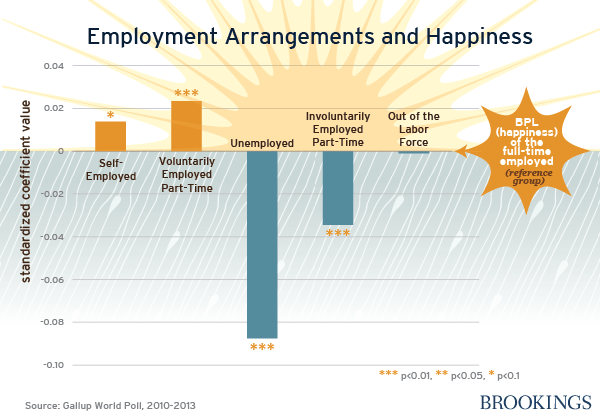
In a recent paper, [Brookings fellow Carol] Graham explored the relationship between well-being and late-life work. She found that there are “well-being benefits to voluntary part-time employment as well as to remaining in the workforce beyond retirement age.” These results are especially pronounced in countries where part-time work is the norm and people work past retirement age out of choice rather than necessity. … In the end, older people are happier, and feel healthier, when they are active and feel needed.

Graham, who provides the above chart, considers the ideal work arrangement:

Of course, not everyone has the luxury of choosing to work part-time, and many of those workers who choose to work beyond the retirement age do so precisely because they like their work.

Still, our findings provide some food for thought. Perhaps we can imagine a future where over-burdened middle- aged workers with children have more flexibility to work part-time, with late-life workers taking up some of the slack. The latter would help ease the burdens posed by fiscally unsustainable pension systems.

Looking at Graham’s country-by-country findings, Christopher Ingraham focuses on the study’s major outlier – Russia:

In most countries, the happiness curve bottoms out somewhere around middle age — 47 in the United States and 41 in Britain, for instance. This usually happens long before the average person is expected to die, with one major exception: Russia. In Russia the curve doesn’t bottom out until age 91. Essentially, life under Putin is one continuous downward spiral into despair.

Graham explains it bluntly: “What’s going on in Russia is deep unhappiness.” In the Organization for Economic Cooperation and Development’s Better Life Index, for instance, Russians rated their general life satisfaction a 3.0 out of 10. Three-quarters of Russians are “struggling” or “suffering,” with only 25 percent “thriving,” according to their responses to a 2012 Gallup survey. Contrast these figures with the United States, where life satisfaction is a robust 7.6 and nearly 60 percent are thriving.

Stigmatizing Sex Work, Ctd

A reader writes:

As someone who deals with men’s relationship to sex work on a regular basis, I don’t know that I necessarily read Katha Pollitt’s tone as moralizing. Certainly her perspective is not only shared by lifestyle dominatrixes such as myself, but also many pro-dominatrixes who provide the paid (often sexual) activities to which she is referring.

As many people’s first exposure to female domination is often through professional dommes, I end up dating a lot of men who cut their kink teeth on very transactional experiences. As a lifestyle domme, I seek to date and share real intimacy with submissive men and often find myself frustrated when the expectation they’ve developed is for me to essentially be a kink-dispenser without needs of my own, a pro-domme they don’t have to pay.

Likewise, my professional dominatrix friends frequently feel uncomfortable and even unsafe with the men who breach the boundaries of the professional relationship, who imagine themselves to be dating the woman they pay regularly to dominate them. The lines between sex work and dating are an uncomfortably blurred in my world, and it has very tangible negative impacts. I can hardly blame vanilla folks for being wary of the same paradigm impacting their chance at happiness.

For women who date exclusively in the vanilla world, this negative impact of the availability of sex for pay on dating life is probably a little more indirect. The high estimate says 1 in 5 American men have visited a sex worker, whereas anecdotally more than half of the men I date have visited a pro-dominatrix.

Twenty percent of men is still a high incidence, but maybe we should look at the majority of men that still take to heart the wide variety of messages they get about sex being for sale in one form or another, and how often this results in a leftist viewpoint used to paste over a more exploitative one. As a friend once said to me, “Whereas right-wing sexists want women to be private property, left-wing sexists want them to be public property.”

The prevailing culture that treats that all women as objects available for purchase is what causes us to treat sex workers as things available for rent, instead of human beings you pay for services and endow with labor rights. Taking a critical eye to the traditionally leftist viewpoint of sex for sale would do a huge favor for sex workers and civilians alike.

A Metaphor With Deep Roots

In a review of Manuel Lima’s The Book Of Trees: Visualizing Branches Of Knowledge, Jonathon Keats considers the enduring popularity of the tree diagram:

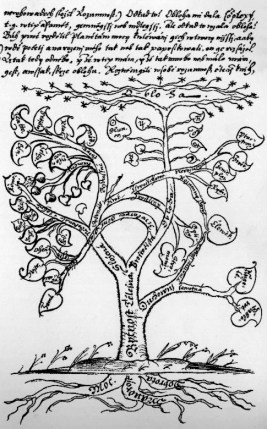
Trees were symbolically important for most ancient cultures, often worshipped and frequently present in art. Their association with immortality and their branching structure made them natural scaffolds for Centrum_securitatis_-_Tree_of_lifegenealogies, showing, for example, the lineage of Christ and of royalty. They visually established pedigree and, equally crucial in medieval societies, helped to control inbreeding by showing how closely people were related to a potential spouse.

Yet, as Lima’s book shows, the greatest impact of trees was in the realm of taxonomy, as visual representations of abstract religious and scientific concepts. Religion illuminated the way, with 13th-century scribes drawing trees to show relationships between scriptural texts, to aid memory and encourage exegesis – the practice of critical interpretation of texts common in monasteries. According to Lima, these tree illustrations supported “combinatorial invention and creativity.” His idea of exegesis is overly modern (monasteries were not tech start-ups) but it’s easy to see how visualization nurtured more systematic thinking. And, in turn, more systematic thinking nurtured more elaborate visualization.

(Image from John Amos Comenius’ Centrum Securitatis, 1625,via Wikimedia Commons)

Making Way For Making Sense

In a review of Bernard Williams’s Essays and Reviews, 1959-2002, Paul Sagar unpacks why the thinker drew a sharp distinction between philosophy and science:

In science, the big breakthroughs come from brilliant thinkers, but the rest of the time everybody else can usefully get on with collecting data and increasing the sum of human knowledge. Philosophy is not like that: in philosophy, you are not only not adding data if you are making bad, or unoriginal, or stupid, or pointlessly banal and repetitive arguments, you are getting in the way of those who are trying to make sense of our world, and who might be able to make more sense of it than those who have tried before. …

In short, Williams urged that philosophy must be a humanistic discipline. Many analytic philosophers proceed as though the sheer force of their cleverness can scythe through deep problems of human living and understanding, unaided and unencumbered by further learning and knowledge. This attitude frequently goes along with a willful philistinism:

a celebration of one’s ignorance beyond one’s academic niche, within which one prowls to do battle with the more or less clever as they dare come forth. Williams’s work stands as an indictment of this way of going about philosophy. He shows that it is most certainly an intellectual mistake. But it is also an ethical one, insofar as we rightfully find ignorance repellant and its celebration a vice. The richness and value of human experience must extend beyond being merely clever, if our lives are to have that dimension of meaning which philosophy, of all disciplines, should surely put first and foremost (the clue, after all, is in the name). For anybody wishing to undertake philosophy as a humanistic discipline, this collection of essays is an excellent place to start. But it will take many years to get up to speed, and the task will never be finished. Not for the first time, I am left wishing that Williams, who died in 2003, could have had another decade to show what a lifetime of learning can achieve.

The Best Of The Dish Today

VFYWC-199-Composite

The most trafficked post of the day remained The Quality Of Mercy; followed by the ever-viral Hounding Of A Heretic. Other popular posts on social media included my long followup to The Quality Of Mercy, a post about the perils of urban sprawl, and a final roundup of reader emails in the highly-charged thread, A Nation Defined By White Supremacy? You can comment on the posts at our Facebook page. See what people are saying about @sullydish here.

Today’s window view from Doha was especially vibrant, and the window contest was easy enough for 100 correct entries (a few dozen of which are featured in the composite seen above).  This month’s book club selection, How Jesus Became God, can be purchased here.

24 more readers became subscribers today, including not one but two readers who set their price at $4.20/month, so today’s mental health break is hereby dedicated to them. The minimum price for a Dish subscription, however, is only $1.99/month or $19.99/year. Thanks to the 28,235 of you currently aboard; you keep this ad-free site up and running.

And see you in the morning.

Ask Dayo Olopade Anything: Trimming The Economic Fat

In the next video from the Nigerian-American author of The Bright Continent, she details how Africans often turn scarcity into an advantage:

To further illustrate those points, she shares the story of a particularly resourceful project in Malawi that would put many American hospitals to shame:

Compare that with a Japanese toilet product that Dayo cited in her recent NYT op-ed on lean economies vs fat economies:

The story of Toto, a Japanese company that created the Otohime, or “Sound Princess,” illustrates the great divide. Now installed in thousands of restroom stalls across Japan, the device mimics the sound of flushing water. The Sound Princess solved a problem of affluence: women were continuously flushing public toilets to mask the sounds that come with using them. Toto’s innovation saves them the embarrassment. The portable, purse-friendly version is a best-selling consumer product in Japan.

In a lean economy, toilet-related innovation looks a lot different. In the densest areas of African cities, one time-honored form of waste disposal is the “flying toilet”:

bundling refuse into a plastic bag and chucking it as far as possible. It’s understandable: Most people in Africa’s informal settlements lack the basic dignity of modern sanitation. Waste-contaminated water breeds disease, and fear of crime keeps many from using public toilets at night. The “flying toilet” is a stopgap solution — with obvious drawbacks.

The Umande Trust, a community organization in Kenya, came up with a better plan. They helped build a massive cylindrical biodigester that composts the output of a fleet of toilets. Umande charges a few pennies per use, making about $400 per month. Better yet, the system doesn’t drain the water supply like traditional flush toilets, and it creates biogas that powers a community center and heats water for the 400 residents who also shower there every day.

The Sound Princess represents a vanity innovation for the top of the pyramid, where you can also find software that will allow you to find a parking spot or a date, to “farm” fake digital crops, to shake your iPhone to simulate the sound of a whip. They solve problems that arise when the basics are taken care of. But when the status quo is a flying toilet, anything goes. Lean economies — however challenged they might appear — translate minimal resources into maximum social impact.

In another followup on the lean/fat dynamic, Dayo reflects on the consumption bloat often found in the West:

The Bright Continent: Breaking Rules and Making Change in Modern Africa can be purchased here. Dayo’s previous videos are here.

(Archive)

The Freedom Of Fiction

Anne K. Yoder interviewed Adam Klein about his story collection, The Gifts of the State: An Anthology of New Afghan Writing, which he developed while teaching writing workshops in Kabul:

Q: You write in your introduction: “Stories keep silence and amnesia from rising like dust and obliterating life as we know it.” Reading this anthology made me realize anew how we as a nation can remain so ignorant of another culture’s narratives despite its constant presence in our newsfeed and our military presence on their soil. Given this desire to carry these voices across cultures, what was the impulse to tell fictional stories as opposed to memoir or personal accounts? Is there a greater freedom that fiction allows?

AK: Well, of course we’ve lost our own narrative, or greatly perverted it. I find American amnesia a dangerous tragedy. Guantanamo, Vietnam, our own history of slavery and systemic racism and inequality, our relationship to immigrants, to the Islamic world, and to our own aggression — these often-dishonest military interventions disappoint me. I don’t mean this as a purely liberal critique of American injustice. … I’m deeply concerned by the loss of authentic voices, investigatory voices in our leadership. …

I don’t think Afghanistan is the only country that must use fiction to reconstruct both memory and future.

Every country has a responsibility to counter the extremes of its ideological spectrum. So why did I collect fiction? It allows for the speculative, it encourages empathy, and it doesn’t limit a writer exclusively to what they believe they know. I love memoir and creative nonfiction, but in a country that has been riven by war, the narratives might not just need to be recalled, but recast, and re-imagined. I have tremendous faith in fiction and significantly less faith in memory.

In another piece exploring the literature of Afghanistan, Jay Deshpande praises I Am the Beggar of the World, a compilation of landays – traditional two-line poems – by contemporary Afghan women:

Principally at stake in I Am the Beggar is the understanding that, in a corner of the world far from the western imagination, poetry may stand for something vibrant, illicit, honest, and subversive. I Am the Beggar collects landays because they are reportorial artifacts, documenting the voices that remain silenced and sequestered in Afghanistan today. Importantly, it presents landays as a monument of feminism, enacting the “cloak-and-dagger dance around honor” that governs Afghan women’s lives.

Don’t shout, my love, my father isn’t giving me to you.
Don’t shame me in the busy street by crying out, “I’ll die for you.”

My darling, you are just like America!
You are guilty; I apologize.

I Am the Beggar groups landays by theme, crosscut with Griswold’s commentaries and Murphy’s photographs. The poems run the gamut: here are young lovers, bawdy jokesters, sexual challengers, and proud sisters. Some speak of nationalism, grief, or anger at the unfairness of the world. In total, the landays invoke a full community of female experience. And, as the poems are essentially author-less, each one carries within it the voices of hundreds of Pashtun women.

A recent series of landays was featured on the Dish here.

An Elusive Ancestor

Michael Marshall describes how the Denisovans – a now-extinct group of hominids known only through a single fragment of bone and a handful of teeth – may have been more far-reaching than the Neanderthals:

When Pääbo and Reich published the first Neanderthal genome, the big news was that on average 1.7 per cent of the DNA in modern people other than Africans comes from Neanderthals. In other words, our ancestors interbred. Did they also interbreed with Denisovans?

To find out, the geneticists looked at the few parts of the genome that vary from person to person, searching for individuals who carry Denisovan versions of these sections. Most of the people the sampled had no sign of Denisovan DNA, even if they were from mainland Asia, where our ancestors might have been expected to run into Denisovans. However, as part of the Neanderthal study, the researchers had sequenced the genome of someone from Papua New Guinea. “That was a fortuitous choice,” says Reich. “When you analysed the Papuan sequence, bang: you got this huge signal.” More comparisons showed that other Melanesian people also carried Denisovan DNA, with an average 4.8 per cent of their genome coming from Denisovans.

Clearly interbreeding did occur. But if Denisovans lived in southern Siberia, how on earth did their DNA wind up in Melanesia, thousands of kilometres away across open sea? The most obvious explanation is also the most startling: Denisovans ranged over a vast swathe of mainland Asia and also crossed the sea to Indonesia or the Philippines. That means they had a bigger range than the Neanderthals.

Previous Dish on the Denisovans here and here.