A Treacherous Climb Up The Social Ladder

While studying the causes and motivations of high school bullying, UC Davis sociologist Robert Faris found that kids who ascend the social hierarchy, especially girls, run a high risk of being victimized:

Faris was interested in understanding bullying at a deeper level, to identify “hotspots” of conflict and aggression in school-based hierarchies. He and his colleague Diane Felmlee, professor of sociology at Pennsylvania State University, investigated whether there were other reasons for students’ aggression toward one another, such as using it as a tool for social climbing.

Their results, published in American Sociological Review, suggest that kids get bullied not only when they don’t fit in, but also when they are simply trying to avoid being victims by moving up the social ladder. “As social status increases, the involvement in aggression–both as perpetrator and now as victims–also tends to go up until they get to the very top, when things start to reverse,” says Faris.

Emily Bazelon explains what this means for how we approach the problem of bullying:

Faris and Felmlee come out with one clear proposal for schools: Bullying-prevention programs should try to de-emphasize hierarchy. The more that students feel there are multiple routes to social success—the choir as well as sports, chess champion as well as class president—the better. That sounds right to me, but also hard for adults to construct. Teenagers have to have their own ways of taking each other’s measure separate from adult wishes and meddling. That’s part of growing up. The trick is for them to lead each other to social rewards that come from building other people up rather than tearing them down. This study is an important reminder that all kinds of kids benefit from making that shift, from all points in the high school universe.
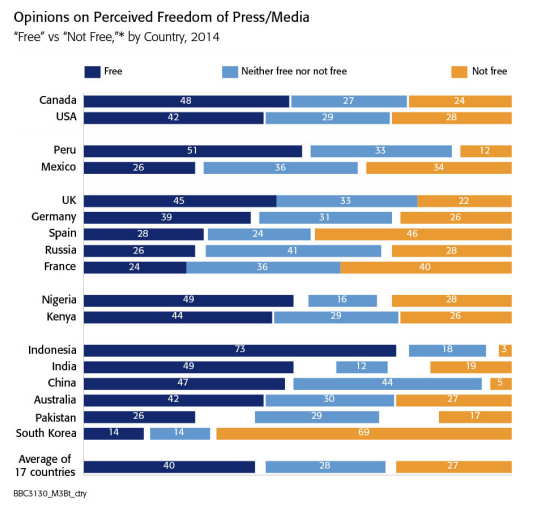

Press Not Censored, Say Readers Of Censored Press

Screen Shot 2014-04-02 at 12.53.57 PM

That’s one finding from a recent survey showing how people in 17 countries perceive their level of freedom:

Some of the results of the poll will not surprise anyone who has heard of Edward Snowden: a majority of Americans and Germans feel they are not free from government surveillance or monitoring, and only a third of Americans and Canadians, 38 percent of Britons and 27 percent of Germans feel the Internet is a safe place to express their opinions. But the eye-catching figure is that 76 percent of respondents in China said they do feel free from government surveillance and monitoring – the highest proportion among the 17 countries polled (Australia came in second with 72 percent). And 45 percent of Chinese respondents said the Internet was a safe place to express their opinions, more than in most countries polled (France rated worst on this score, at 22 percent).

Another surprise was the proportion of respondents in China – 47 percent – who said their press, which is in fact rigidly censored, is free. This was higher than the result for France (24 percent), Spain (28 percent), Germany (39 percent), America (42 percent), Australia (42 percent) and Britain (45 percent).

Over at Quartz, Lily Kuo notes that China is easing off its “more Orwellian approaches” to information control in favor of “allowing a certain degree of open debate on the Internet”:

How does this work in practice? Since 2005, dozens of local governments have been hiring Internet commentators – known as wumao for the supposed ¢50-a-post state-backed bloggers receive for interjecting pro-government sentiment into online discussions and for defusing anti-Communist Party sentiment. This is consistent with government directives, advising officials to focus less on controlling online discussion, Yang says. For instance, in 2010, a local public security department in Fujian province published a document saying Internet management should combine “damming with channeling, with more focus on channeling.”

Another way the government attempts to influence public opinion via the internet is through actual government engagement. In the city of Ji’an, in Jiangxi province, Yang explains that rather than blocking bloggers’ comments or accounts, officials have been contacting bloggers, explaining the harm of their posts and encouraging them to delete or modify them of their own accord.

#Buttflix

I love it when Twitter just becomes a punathon. That‘s what 140 characters are best at!

Surrender, Ann Friedman!

Diving - 15th FINA World Championships: Day Eight

A pundit rarely gets vindication quite as quickly as this. When Olympic star Tom Daley recently told the world he was bisexual, Ann Friedman declared that he was an icon for a newly and increasingly fluid male sexuality:

Daley also elicited a more specific sort of disapproval from certain fans — biphobia, the Advocate called it. These were the people who assumed Daley was gay but unable to fully admit it, or unwilling to relinquish the privileges of being straight … Traditional definitions of masculinity — which tend to go hand in hand with homophobia — are going through a real shake-up. More hetero men are tentatively admitting that they’re turned on by certain sex acts associated with gay men. And Daley’s ambiguous coming-out had some mainstream sports sites sounding like a Gender Studies 101 classroom. “In truth, there should be no need for him to declare his sexuality,” wrote a blogger at BleacherReport. This is progress.

I don’t doubt that male bisexuality is real, if rare. But I wasn’t buying it in the case of Daley:

Let me place a bet with Friedman: Daley will never have a sexual relationship with a woman again, because his assertion that he still fancies girls is a classic bridging mechanism to ease the transition to his real sexual identity. I know this because I did it too.

Maybe we’ll check back in in a few years’ time, and see which one of us has turned out to be right.

Friedman mocked this as impossibly vague (and she had a point) so I revised, even as I was raked over the coals by readers:

Let me rephrase my bet with Friedman. Check in in ten years’ time.

Five months later, ta-da! Tom Daley confirms he is totally gay. As I predicted. As I – and any gay man not saturated with pomo nonsense – knew. Again: this doesn’t mean that there aren’t bisexual men out there. But it does mean there’s gaydar. And Ann Friedman ain’t got none.

(Photo: Tom Daley by Clive Rose/Getty Images)

Just Looking

nasiralmulkmosque1

Mohan Matthen parses the philosophy of visual pleasure:

Aesthetic pleasure is pleasure in contemplating something. This pleasure could be sensory, like the enjoyment one derives from looking at a painting or listening to music. Or it could be intellectual, like the pleasure of reading the latest Robert Harris. In both cases, pleasure in contemplation has to be distinguished from wanting an object for other uses.

Immanuel Kant in the 18th century was among the first to understand this. His example was that of a palace. You might long to live in it, or you might hate it for its extravagance and want to destroy it. But both of these responses are distinct from the pleasure or displeasure derived from merely looking at it. Only the latter pleasure counts as aesthetic.

Discussing sexual selection, Charles Darwin wrote:

‘When we behold a male bird elaborately displaying his graceful plumes or splendid colours before the female … it is impossible to doubt that she admires the beauty of her male partner.’ Assuming that he really means beauty, and not sexual attractiveness, this is a mistake. It confuses sexual desire with aesthetic admiration. According to Darwin’s own theory, when a female looks at a male that way, she is not getting pleasure from looking at him for the sake of looking at him; rather, she is driven to mate with him. Darwin wrongly equates the lustful gaze with simple looking. Kant’s point was that aesthetic appreciation is disinterested. It is pleasure just in looking.

On the above photo by Mohammad Reza Domiri Ganji:

The stunning Nasir al-mulk Mosque hides a gorgeous secret between the walls of its fairly traditional exterior: stepping inside is like walking into a kaleidoscope of colors. Every day, the rays of the early morning sun shine through colorful stained-glass windows, transforming the halls into a dazzling wonderland of rich hues, patterns, and light that play on the floor of the mosque.

In addition to the glorious display of light and color through the stained glass, the mosque features other striking elements of design and architecture, including intricate geometric tile designs, painted arches and niches, and spectacular domes. The usage of beautiful rose-colored tiles in the interior design earned the mosque the nickname Pink Mosque in popular culture.

The mosque, located in Shiraz, Iran, was built from 1876 to 1888 by the order of one of the Qajar Dynasty lords. The beautiful structure was designed by Muhammad Hasan-e-Memar and Muhammad Reza Kashi Paz-e-Shirazi.

More stunning shots of the mosque here.

Morsi The Anocrat

Measuring his brief reign by using the Polity IV index, Shadi Hamid and Meredith Wheeler conclude that ousted Egyptian president Mohammed Morsi “was no Mandela, but he was no autocrat, either”:

The Polity index is scored from -10 to 10, with negative values representing more autocratic regimes and positive values representing more democratic regimes. The most charitable reading of Morsi’s tenure—the upper bound of our score—was a 4. However, we think the most accurate score—drawing not just on the letter of Polity’s coding guidance, but also the spirit—is a 2. In real terms, this means that Morsi’s year in office was anocratic—that is, it was democratic in some ways and autocratic in others. Morsi was democratically elected and subject to meaningful institutional and popular constraints. When he edged toward autocracy in November 2012 and made his decrees exempt from review, widespread protests forced him to backtrack. The Morsi government and the Muslim Brotherhood showed favoritism toward Islamist-aligned groups, harassed or threatened prominent opposition voices, and detained secular activists such as Ahmed Maher. However, unlike the current military-backed government, it did not systematically repress and imprison opponents. Moreover, Morsi’s winner-takes-all majoritarianism was counterbalanced by what Nathan Brown calls the “wide state,” including the military and security establishments, a powerful judiciary, and business elites.

Egypt’s next president, on the other hand …

Why We Love Sad Songs, Ctd

A reader writes:

I have a response to two different but related items at the Dish: the recent post about why we like sad songs, and the moving, thoughtful remarks about suicide prevention from Jennifer Michael Hecht.  I want to offer up one of the most poignantly beautiful songs about suicide that I know of, Lucinda Williams’ “Sweet Old World.”  Written in response to a friend’s suicide, the song basically catalogues the many things the departed friend is now missing out on.  The song manages to express mourning for the loss of the person who chose to leave “this sweet old world” and also becomes a sort of meditation on things for which we should be grateful.  It’s a remarkable song. Here’s Lucinda herself performing the song [unembeddable]. And it happens that Emmylou Harris also did a very nice cover [above]. Here are the lyrics:

See what you lost when you left this world, this sweet old world
The breath from your own lips, the touch of fingertips
A sweet and tender kiss
The sound of a midnight train, wearing someone’s ring
Someone calling your name
Somebody so warm cradled in your arms
Didn’t you think you were worth anything
See what you lost when you left this world, this sweet old world

Millions of us in love, promises made good
Your own flesh and blood
Looking for some truth, dancing with no shoes
The beat, the rhythm, the blues
The pounding of your heart’s drum together with another one
Didn’t you think anyone loved you
See what you lost when you left this world, this sweet old world

Sending thanks from NYC, a city where one can be surrounded by tens of millions of people and yet still feel quite alone …

Driven To Success

A new study (pdf) from the Urban Institute suggests that access to cars makes low-income Americans more likely to escape poverty. Co-author Rolf Pendall explains the findings:

Our evidence comes from two Department of Housing and Urban Development demonstration programs: Moving to Opportunity for Fair Housing and Welfare to Work Vouchers. Both were designed to test whether housing choice vouchers—that is, subsidies that allowed participants to choose where they live—propelled low-income households into greater economic security. …

The results? Housing voucher recipients with cars tended to live and remain in higher-opportunity neighborhoods—places with lower poverty rates, higher social status, stronger housing markets, and lower health risks. Cars are also associated with improved neighborhood satisfaction and better employment outcomes. Among Moving to Opportunity families, those with cars were twice as likely to find a job and four times as likely to remain employed.

Emily Badger considers the implications:

All of these findings are as much a reflection on the value of cars as the relatively poor state of public transit.

The underlying issue also isn’t so much that cars create opportunity. Rather, it’s that we’ve created many places where you can’t access opportunity without a car. Which also means that we’ve created places that punish people who don’t have one (or can’t afford to get one). That’s a much larger critique. …

How, though, would you increase car access among the poor in a way that doesn’t simply saddle families with even more unsustainable expenses? Car ownership, for any kind of family, comes with all kinds of related costs: in insurance, in repairs, in gas. The burden of those costs, though, tends to weigh even more heavily on the low-income. They’re more likely to access financing through a predatory loan. They may have less access in the neighborhood to a reliable mechanic. A family living in a low-income neighborhood with high crime by definition faces higher insurance rates.

Chart Of The Day

Border Deaths

Deaths near the US-Mexico border are on the rise:

The graph [above], from the Washington Office on Latin America (WOLA), shows that fatalities nearly doubled between 1998 and 2012. The only year with more deaths than 2012 was 2005. WOLA researchers Adam Isacson and Maureen Meyer explained in April 2013: “In that year, Border Patrol captured more than three times as many migrants as it did in 2012. The migrant population was far larger, but the number of deaths was similar. A much larger fraction of the migrant population is dying today.” The most recent data from the U.S. Border Patrol puts fatalities in 2013 slightly below the 2012 figure—445 deaths compared to the previous year’s 477—but that still puts 2013 ahead of every other year but 2005 and 2006.