Shelf Lives

Rachel Manwill confesses that she owns more than 850 books she has yet to read. She wonders what the point of holding on is:

There are many “big” books in my expanding, unread library – books that had an impact when they were released and continue to have an impact on literary culture and communities. Books like Freedom by Jonathan Frazen, Steve Jobs by Walter Isaacson, Behind the Beautiful Forevers by Katherine Boo, and The Brief Wondrous Life of Oscar Wao by Junot Diaz languish. And often, so often that I’ve made a joke out of it, I will reply to a query about whether I’ve read this book or that that I “own but haven’t read it.”

But these books – especially those “big” books – I feel in some ways that just having them on my shelves means something, that it’s better than nothing. I feel like I’m doing something with those books, even if that “something” isn’t reading them. I don’t know if that feeling is about supporting the authors either through money or awareness or if its about intellectual acceptance – I know OF a book, I was current enough with the trends to buy it – or if its about none of those things and I truly believe that time will slow and someday, I will get around to reading each and every one of these unread volumes.

The End Of Fast Fashion?

Keila Tyner suggests that our current era of cheap clothing is coming to an end:

From the 1900s to 1950s, American consumers spent approximately 12 to 14 percent of their annual income on clothing. Today, we spend about 3 percent. But our closets are actually bigger. The average American house has doubled in size since the 1950s and closet space has increased, too, particularly with the advent of the walk-in closet in the 1980s. We likely have more than five times as many clothing items as we did in the first part of the 20th century. The move of clothing production overseas where labor costs are low has made it possible for us to have large quantities of items without paying much for them. But this could be changing. …

At this point, the primary concern for manufacturers and retailers is rising labor costs. In China, manufacturing wages have increased by 71 percent since 2008 and are projected to rise by 10 percent this year. Manufacturers are searching for other production locations with cheaper labor, but wages are rising in those countries as well. For instance, the minimum wage is Bangladesh has risen by 77 percent as a result of much debate following the tragic Rana Plaza factory collapse on April 24, 2013, and Indonesian unions recently staged a strike in demand of a 30 percent wage increase.

Previous Dish on fast fashion here and here.

The GOP’s Anti-Obamacare Dogma

Ideologues

Dan Savage reacts to the announcement that the ACA hit its enrollment target of 7 million:

Great news! And Republicans—who will never offer a Republican alternative health-care plan and who will never acknowledge that Obamacare used to be the Republican alternative to the kind of single-payer health care plan preferred by liberals, progressives, and sane countries everywhere (countries like Canada, Germany, France, Israel, and Vatican City)—are gnashing their teeth.

Chait details how that GOP intransigence reveals a deeper divide between the parties:

One of my longstanding fixations, going back almost a decade now, is that we make a mistake when we think of liberalism and conservative as symmetric ways of thinking. On economic policy, at least, they are asymmetric. Liberals believe in activist government entirely as a means to various ends. Pollution controls are useful only insofar as they result in cleaner air; national health insurance is valuable only to the extent that it helps people obtain medical care. More spending and more regulation are not ends in and of themselves. Conservatives, on the other hand, believe in small government not only for practical reasons — this program will cost too much or fail to work — but for philosophical reasons as well.

new political science paper by Matt Grossman and David Hopkins bears out this way of thinking about American politics. The authors find a fundamental asymmetry between the Republican and Democratic coalitions. They examined survey results and other data among voters, activists, and elites, and found that Republicans express their beliefs about government as abstract ideology (big government is bad) while Democrats express their beliefs in the form of benefits for groups. The differences are enormous [as the above chart from the paper demonstrates.]

This, he argues, is why Republicans “have expressed from the beginning a theological certainty that Obamacare will fail.” Steinglass also tries to understand ACA opposition:

For the most part … opposition to Obamacare now is based on two things.

At one level, it’s a question of partisanship. Republicans have turned “Obamacare” into a word that much of the country finds inherently distasteful. No matter how well the system performs, it’s too late to reverse those associations. At another level, many dislike the basic transaction at the heart of universal coverage: richer people have to basically pay for poorer people’s health-insurance. In Kentucky, for example, Republicans are avidly working to reverse the state’s Medicaid expansion, even though the federal government pays for the entire thing initially, with the state expected to kick in 10% in the future.

Ponnuru, yet again, calls for conservatives to stop awaiting the ACA’s failure:

The likelihood of replacement would be higher if there was an alternative that didn’t take away people’s insurance — one that promised to cover roughly as many people as Obamacare does, or even more. Letting people on Medicaid buy into the market by converting much of the program into tax credits, for example, would be more viable than just kicking its new beneficiaries off the rolls. Opponents of Obamacare should always have been thinking along these lines. Now they have less and less choice.

Sex-Selective Abortion In America?

After South Dakota’s governor signed into law a new ban on sex-selective abortion last week, Tara Culp-Ressler denounced it as “an unnecessary abortion restriction that reinforces racial stereotypes about the Asian American community”:

In fact, this type of legislation is a solution in search of a problem. While female infanticide is an issue in some parts of the world, there’s absolutely no evidence that the Asian American or Pacific Islander (AAPI) individuals who live here in the U.S. are having abortions based on gender. There is no epidemic of sex-selective abortion among the AAPI community, and passing legislation to “fix” this nonexistent issue simply ends up damaging women of color. Ultimately, these laws scrutinize Asian American women based solely on their race.

Jonathan Coppage demurs, saying the Guttmacher paper Culp-Ressler cites for “no evidence” doesn’t really support that claim:

The policy review paper acknowledges the evidence, but calls it limited and inconclusive. Yet the two leading studies cited by Guttmacher policy review author Sneha Barot, and subsequently most of the authors relying on her paper, are neither especially limited nor inconclusive.

Drawing on U.S. Census data and published in the Proceedings of the National Academy of Science, study authors Douglas Almond and Lena Edlund of Columbia University open their discussion, “We document son-biased sex ratios at higher parities in a contemporary Western society. We interpret the found deviation in favor of sons to be evidence of sex selection, most likely at the prenatal stage.”

Now, as the second study‘s author, Jason Abrevaya, explains in American Economic Journal: Applied Economics, prenatal sex selection could conceivably be a result of using more advanced reproductive technologies, like IVF or sperm sorting. In practice, the high expense and rarity of such procedures means that almost all prenatal sex selection most likely takes place by abortion. He concludes his study, “This study has offered evidence consistent with gender selection at later births within the United States.”

In Hollywood, Sexism Doesn’t Pay Off

hickey-bechdel-3

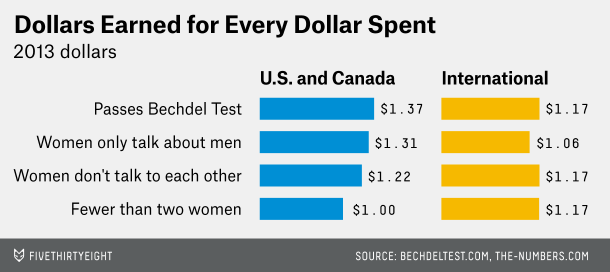
Walt Hickey employs the Bechdel test to argue that Hollywood’s exclusion of women makes no economic sense:

[T]here’s a wide-ranging perception in Hollywood that audiences — in the U.S. and abroad — simply don’t care for women in leading roles and that movies for and about men are more likely to have better cross-market appeal than movies about women. The theory is that “women will go to a ‘guy’s movie’ more easily than guys will go to a ‘woman’s movie,’” said Michael Shamberg, who produced “Pulp Fiction” (1994), “Django Unchained”(2012) and “Garden State” (2004).

This assumption is up for debate; we found that films that pass the Bechdel test tend to do better dollar for dollar than those that don’t — even internationally. …

The total median gross return on investment for a film that passed the Bechdel test was $2.68 for each dollar spent. The total median gross return on investment for films that failed was only $2.45 for each dollar spent. And while this might be a side effect of films with lower budgets tending to have higher returns on investment than films with higher budgets, it’s still a strong indicator that films with women in somewhat prominent roles are performing well.

Alyssa applauds:

This is exactly the kind of analysis that I suggested data-driven journalists could profitably contribute to entertainment reporting back when FiveThirtyEight.com launched. And it is exactly the sort of data that backs up the anecdotal evidence that those of us who would like to see more female characters, and more kinds of stories about women, have been brandishing at Hollywood for years. If skeptics of women-centered stories are able to brush off examples like the billion-dollar box office for Frozen” as some sort of fluke, maybe long-range data like Hickey presents here, and that which [journalism professor Stacy] Smith is assembling, can start to turn this titantically misguided assumption around.

Proportional Stop-And-Frisk

Christopher E. Smith’s son, a black Harvard student, was repeatedly stopped and frisked by the NYPD during his internship on Wall Street. In response, Smith recommends not curbing the practice – as is already happening – but to expand it to all New Yorkers:

As an intellectual exercise, why don’t we envision matching the application of stop-and-frisk to the demographic composition of a city? In New York City, if officers wanted to stop-and-frisk three African-American men on their shift, they’d also have to stop-and-frisk five white women and five white men – and proportionately equivalent numbers of Latinos and Asian-Americans. Someone might say, “Wait, it’s a waste of the officers’ time to impose these searches on innocent people instead of searching people who might actually be criminals.” But the evidence shows that New York City police were already imposing stop-and-frisk searches on innocent people nearly 90 percent of the time – it is just that the burden of those stops and searches has been endured almost exclusively by young men of color….

This suggestion isn’t entirely tongue-in-cheek. If police were to actually apply it, even for a short while, it would test society’s disregard for individualized suspicion and force us to think more deeply about what it means to impose stop-and-frisk on large numbers of innocent people. It is easy enough to rationalize away a “special tax” when we apply it to “them.” But how will we feel about that burden once it’s shared by all of us?

Update from a reader:

How about we just make the frisking fit the crime? The SEC should be doing “stop-and-audit”s on Wall Street.

Announcing The Dish Book Club

Well, it’s more like a resuscitation of the Book Club, since we had one more than a decade ago now. But the format will be the same. Each month, we’ll pick a book, and Dish readers are invited to read it alongside us. After three weeks, we’ll start debating it, through posts on the Dish and a reader thread fueled by your thoughts on the book. If the author is still alive, we’ll try and get him or her to do a podcast at the end (on Deep bookclub-beagle-trDish) to answer some of the questions readers have raised and keep the conversation going.

If you’re like me, you find your time for book-reading increasingly constrained by our Googled minds and our overwhelmed lives. So think of this club, as I am, as an incentive to read alongside others the kind of book you might have passed on without the prompt of a Dish discussion. In the future, we will have guests championing a favorite book – sometimes new, sometimes old – and hosting the discussion alongside Dish editors curating the reader threads. Maria Popova, of Brain Pickings, has generously agreed to host the second club.

We had been mulling re-starting this feature and then a new book arrived that clinched it. I know some of you may flinch at such a religious subject to kick off the club, but the book is written for believers and skeptics alike, and focuses on the historical exploration of what the earliest Christians meant when they claimed that a first-century rural Jewish preacher was actually God. The reason I find this such a compelling area of research is because I have honestly always wondered what Incarnation is supposed to mean. I know what it means in the abstract – but what it means in reality eludes me. It is a mystery, and yet such a mystery is the linchpin of Christianity. The key questions are: what exactly did Jesus’ followers mean when they insisted upon this after Jesus’ death; and what can it ever mean to claim that someone is the Son of God?

The book is Bart Ehrman‘s How Jesus Became God: The Exaltation of a Jewish Preacher from Galilee. Buy it through this link to join the club and thereby help support the Dish with a little affiliate revenue. Here’s the publisher’s official description of the book:

New York Times bestselling author and Bible expert Bart Ehrman reveals how Jesus’s divinity became how-jesus-became-goddogma in the first few centuries of the early church. The claim at the heart of the Christian faith is that Jesus of Nazareth was, and is, God. But this is not what the original disciples believed during Jesus’s lifetime—and it is not what Jesus claimed about himself. How Jesus Became God tells the story of an idea that shaped Christianity, and of the evolution of a belief that looked very different in the fourth century than it did in the first.

A master explainer of Christian history, texts, and traditions, Ehrman reveals how an apocalyptic prophet from the backwaters of rural Galilee crucified for crimes against the state came to be thought of as equal with the one God Almighty, Creator of all things. But how did he move from being a Jewish prophet to being God?

In a book that took eight years to research and write, Ehrman sketches Jesus’s transformation from a human prophet to the Son of God exalted to divine status at his resurrection. Only when some of Jesus’s followers had visions of him after his death—alive again—did anyone come to think that he, the prophet from Galilee, had become God. And what they meant by that was not at all what people mean today.

Written for secular historians of religion and believers alike, How Jesus Became God will engage anyone interested in the historical developments that led to the affirmation at the heart of Christianity: Jesus was, and is, God.

Join me in exploring this topic and the roots of Christianity. Atheists and non-believers are particularly invited. This will emphatically not be a debate within the confines of any religious community. It may even, I hope, be a way for religious and non-religious Dish readers to communicate with each other in the threads that will eventually emerge. We’ll start the debate the week after Easter, on April 23. So get the book now and start reading.

Update from a reader:

Fantastic idea to bring this back, and terrific selection for the first book. I look forward to reading the thread. Have to say, though, I have a real hard time reading physical books any more. Got mine for the iPad.

In fact, all of our affiliate links go to the electronic version of the book. We don’t get as much affiliate revenue doing so, but since the Dish has long championed the spread of e-books over the dead-tree version, we want to put our money where our mouth is. Also, following the lead of Popova, we will provide a link to public library access. Meanwhile, another reader shares a heartbreaking story about her Christian mother:

I just 1-clicked my way into the Dish Book Club (enjoy the affiliate revenue!).  This is a book I would never have given a second, if ever a first, glance to normally, as I am a non-believer.

A non-believer who was raised in the United Methodist church and enjoyed many aspects of the denomination (the musicality, the general welcoming of others). I was also a born-again Christian from the time I was about six years old, but as I got into my teen years, I increasingly felt like a fraud among my Christian peers. The older I got, the less I believed. In my logic-driven brain, it just didn’t add up for me. I don’t know if I lost my faith so much as I let it go. Religion just isn’t a factor in my life very much. I understand how many of my friends and family are of strong faith and I don’t fault them for that or try to take it from them. Some of them know I don’t believe and some don’t. It isn’t much of an issue, except with one person: my mother.

As I’ve become a non-believer, she’s moved towards shades of Christianist. A Baptist church. Much more politically active in the GOP. She’s been unemployed for the past several years living on nothing but social security but still thinks the Affordable Care Act is socialism.

Two years ago at Thanksgiving she cornered me in conversation and asked me point blank if I was still a Christian and I answered honestly (one of my core beliefs) and said, “no.” That basically destroyed her emotionally. This past Thanksgiving she admitted to me that she had planned her suicide because she felt she had failed at everything at life, that the only thing she’d ever done that she’d been proud of was raising me, but when I told her I wasn’t a Christian any longer, then she realized she’d failed at raising me too. As I sat opposite my mother completely stunned at that revelation, she then told me the only reason she hadn’t killed herself was that she realized if she did, she’d never see me again, since she’s going to heaven and I’m going to hell, so she has to stay here until she converts me back to being a Christian. And she said it all so matter-of-factly, I think that might have been the most disturbing part of it all.

My mom wants me to explain to her why I don’t believe in God but she doesn’t have to explain why she does. My response is to just not talk about it at all. It seems like a lose-lose conversation.

Now I’m not looking at any book to solve my problems, but I’ve got to face facts that I have to deal with the religious elephant in my family room sometime and this book seems like a sane, logical place to dip my toe in the water and have some conversations with people on both sides of the belief fence. And I really enjoy history, so bonus there.

April Fool’s Prank Of The Year

The Dish prize goes to Oakland A’s pitcher Sean Doolittle:

His reassurance is after the read-on: