The Cartoonish View Of History In Cosmos, Ctd

Lots of readers are pushing back against the following claim from David Sessions:

Bruno was killed because he flamboyantly denied basic tenets of the Catholic faith, not because religious authorities were out to suppress all “freedom of thought.”

One reader:

If the church is gracious enough to declare that it does not deny all freedom of thought, but still manages to murder you for denying the wrong tenet, pray tell, what freedom do you have if you’re at risk for declaring anything? All you have is the freedom to be afraid and live in fear.

So, was Bruno really killed because he was … flamboyant? If you can lose your life by challenging the Church’s basicGiordano_Bruno tenets, at what point is it sane or just for the church to declare that it’s not suppressing all freedom just because murder is not the response for doing so? The struggle to make the church seem rational or sane is ludicrous. Bruno was killed because he didn’t think correctly. This is about totalitarianism. Faith has absolutely nothing to do with it. Very few heroes of the Enlightenment were atheists because they would have been killed before they could influence anyone. It doesn’t seem improbable that many of the clergy who were responsible for the Enlightenment would have remained in the clergy if their lives were not at risk for leaving it.

Another adds:

Bruno may have been a mean son-of-a-bitch, but those expounding revolutionary thoughts tend to be difficult to get along with. As Cosmos writer Steve Soter noted in a response to Discover’s critique, Bruno was an “extremely difficult person,” but “so was Isaac Newton, who devoted as much time to alchemy and biblical numerology as to physics. But that has no bearing whatever on the value of his good ideas.”

Another goes into greater depth:

First, the Church long suppressed the reasons cited for Bruno’s execution. Second, these reasons reveal that Cardinal Bellarmine executed Bruno explicitly with the charge that Bruno said the Earth orbits the Sun: “The idea of terrestrial movement, which according to Bruno, did not oppose the Holy Scriptures, which were popularized for the faithful and did not apply to scientists.” Bruno was murdered precisely because the Church sought to suppress freedom of thought. Anyone who doubts this should read the historical account of Bruno’s execution, which Cosmos did not describe because it is too violent and horrible to relate to a primetime audience:

As the parade moved on, Bruno became animated and excited. He reacted to the mocking crowds, responding to their yells with quotes from his books and the sayings of the ancients. His comforters, the Brotherhood of St. John, tried to quiet the exchange, to protect Bruno from yet further pain and indignity, but he ignored them. And so after a few minutes the procession was halted by the Servants of Justice. A jailer was brought forward and another two held Bruno’s head rigid. A long metal spike was thrust through Bruno’s left cheek, pinning his tongue and emerging through the right cheek. Then another spike was rammed vertically through his lips. Together, the spikes formed a cross. Great sprays of blood erupted onto his gown and splashed the faces of the brotherhood close by. Bruno spoke no more. …

As the fire began to grip, the Brothers of Pity of St. John the Beheaded tried one last time to save the man’s soul. Risking the flames, one of them leaned into the fire with a crucifix, but Bruno merely turned his head away. Seconds later, the fire caught his robe and seared his body, and above the hissing and crackling of the flames could be heard the man’s muffled agony.

– Michael White, The Pope and the Heretic : The True Story of Giordano Bruno, the Man Who Dared to Defy the Roman Inquisition 

This violent suppression of knowledge cannot be wished away by denying the historical record. Even Cosmos’s cartoon history of Bruno’s execution is accurate, relevant, and important to know.

Another gets snippy:

I suspect that you dislike Cosmos because Tyson attacks superstition head-on in every single episode, unapologetically and using rigorous science as his weapon. Our media is filled with seemingly infinite positive references to religion every single day. Forgive me if I have zero sympathy for you if a single fact-based, supernaturalism-free mini-series makes you so uncomfortable. From where I sit – in a world where billions of people believe in idiotic ideas disproved long ago simply because hoary books promising eternal life tell them they must do so – we need more like Cosmos, and quickly.

That is simply untrue. I find the series’ candid defenses of the scientific method refreshing. It just made me wince at its cheesiness. Another considers the miniseries a work of art:

Cosmos, in its current form or in Sagan’s original, isn’t designed to teach science or history to its audience. That would be an impossible task, given the scale of the material that’s being presented. The most important thing that a program like this needs to do is to create a sense of wonder and amazement at the universe that we live in. It’s not the cartoons or the awkwardly patronizing host that keep me tuning in. Rather, it’s the beautiful renderings of our universe – deep space, vast galaxies, black holes, solar systems, micro-organisms – that I find both thrilling and exciting.

There are a few things that Cosmos needs to do, on a strictly narrative level: it needs to define terms, explain context, and demonstrate ideas. The first part is relatively boring, but essential. You can’t very well talk about the time and space without defining “light speed” or explaining what an Astronomical Unit is. The second part is where most of the Cosmic complaints seem to come from, and that’s fair. But it’s the third area where I think the series really shines. The images and animations do such a fantastic job of simply showing the audience what something is that you can almost turn off the sound and just marvel at it.

Watching Cosmos won’t make you a “master of the universe.” That’s not the goal. What it should do, though, is whet your appetite by showing you how much there is out there, how little we know, and how important it is that we keep trying to learn more. It’s a success, if you ask me.

I think it’s only fair to revisit this after I’ve watched a few more episodes of the series. They’re DVRed. Update from a reader:

I just thought I would weigh in on Cosmos through the eyes of a parent of a nine-year-old. My nine-year-old son has been tuning in to the show with me every Sunday night, and for him it is full of the wonder that one of your readers described. Now he’s a science-oriented kid to begin with (my husband is a biologist), and somewhat precocious at that, but Cosmos has a great deal to offer him. It gets his mind going and imagining all the things that could be, it makes him want to expand on the ideas that Tyson is presenting, he talks non-stop through the commercials. He sees nothing but wonder in all of it.

At one point during the first episode I asked him why he thought some people might not like to learn about the universe, was it because it made them feel small or not important? He replied: “They shouldn’t feel that way! There are so many interesting things out there, and they might be able to discover one of them!”

So Tyson and crew seemed to have pitched this just right for a young mind to cultivate a broader interest in science. At the same time, I am filling in some gaps in my complete ignorance of planetary physics, so I can hold my own in conversations with my son. It might seem simplistic to people more sophisticated in some aspects of these disciplines, including the biographies of the scientists and of Bruno, but it is serving a purpose to engage people with science who might not otherwise have reason to consider the Cosmos at all.

I guess it’s hard to do something that can truly capture the imagination of a nine year old and that satisfies a curmudgeon like myself.

A Nation Defined By White Supremacy? Ctd

I’m sorry if some were confused a little by my last post on the TNC-Chait debate (a bad case of pronoun vagueness). If I’m being completely honest – and Coates makes such honesty more possible by such intense vulnerability and candor in his own prose – I still haven’t recovered from TNC’s last post. I don’t even know quite what to do with it. But I’m going to sit with it for a while, turning it over in my head, wondering if I need to re-visit a huge amount of my previous convictions and understandings. It makes me uncomfortable. It makes these abstract debates real. It’s what writing can do.

We can and should have much more debate about how to tackle the culture of poverty, period. Ross today points out that there have indeed been discussions of white poverty on the right, and that the current state of play is indeed focusing on white poverty as much as black poverty, in fact, seeing both as a function of a relatively new kind of pan-racial culture of poverty that is entrenching social disadvantage and inequality:

The story that some of us on the right, at least, would tell about that crisis is one that’s actually reasonably consonant with Coates’s grim account of the African-American experience on these shores. Beginning in the 1960s, we would argue, a combination of cultural, economic and ideological changes undercut the institutions — communal, religious, familial — that sustained what you might call the bourgeois virtues among less-educated Americans. Precisely because blacks had been consistently brutalized throughout their history in this country, they were more vulnerable than whites to these forces, and so the social crisis showed up earlier, and manifested itself more sweepingly, in African-American communities than it did among the white working class and among more recent immigrants …

We don’t have a black culture of poverty; we have an American culture of poverty. We don’t have an African-American social crisis; we have an American social crisis. We aren’t dealing with “other people’s pathologies” (the title of Coates’s post) in the sense of “other people” who exist across a color line from “us.” We’re dealing with pathologies that follow (and draw) the lines of class, but implicate every race, every color, every region and community and creed.

And what can we do about that? In many ways, the relentless pragmatism of Obama is the only response. If we know that certain behaviors do indeed lead to worse outcomes, and if we can somehow encourage more productive ways of living, then we surely should, regardless of the burden of history and white supremacy. To surrender to total determinism is too bleak. There is, of course, an ocean of injustice in that “regardless”. But the fate of a minority is not to live in a world in which racial difference (or any distinguishing difference) is erased, but one in which it can be fought against. Interminably. Always. And in the full knowledge that racism and homophobia and sexism and so much else will never end.

It was, to take a proximate example, deeply unfair that gay people had to assert our basic humanity, to explain ourselves as human beings first to heterosexuals, to jump through hoops that were and are deeply humiliating, to be vulnerable in ways no straight person needs to be, to insist simply that we are capable of love and family, and not intrinsically morally subhuman, because our natures somehow compel us to iniquity. There have been times when the double standards have been close to psychologically crippling.

Not so long ago, the lives of gay men were not regarded as equal to straight ones, and the society reacted at first with simple complacency as hundreds of thousands of us died in agony in front of them. When I arrived in America, I had to sign an immigration form declaring that I was not a homosexual. For almost two decades, I had to fight for a chance just to stay in America because this gay disease marked me for deportation, if detected by the authorities. My marriage was trumped by absurd defenses of “public health” and remained vulnerable years after it happened. The spiritual, psychological, emotional desolation of those years made me who I am, for good or ill.

And yet, somehow, a critical mass of gay people were able to master their utterly justified rage to insist on progress and justice and fairness. We have come a long way – but even this week, we read of a new law in Mississippi that would empower individuals to fire or refuse to serve or interact with any homosexual on the grounds of religious belief. We see state-backed pogroms against gays in Russia and untold terror in Uganda and Nigeria. We know, as surely as African-Americans know, that this prejudice, this hatred, will course through humanity for as long as humanity exists on the planet.

I feel sure that TNC sees the necessity of perseverance even if it is deeply unfair, even maddening, and even if, as I believe, the predicament of an African-American in a country built on slavery is deeper than that confronting gays. I guess at some level, that is where my religious faith kicks in. Perhaps it is only psychologically possible to resist evil even knowing that evil will often have the last word on earth if there is some spiritual dimension to relieve the pain and injustice in your soul. Rationally, what King and others did may not have been humanly possible without a faith that prevents you from going mad. It never surprised me that the civil rights movement was a religious movement at its core. How could it have endured without it?

But Coates is not a spiritual leader; he is a writer. And a writer does not need – and should not try – to offer a solution. He is entitled to describe the predicament, to voice the darkness, and has no obligation to put this to practical or pragmatic ends. Which is why Ta-Nehisi’s latest post is, to my mind, as important as anything he has written in this debate:

I am a writer. And that is not a hustle. And this is not my “in” to get on Meet The Press, to become an activist, to get my life-coach game on. I don’t need anymore platforms. I am here to see things as clearly as I can, and then name them. Sometimes what I see is gorgeous. And then sometimes what I see is ugly. And sometimes my sight fails me. But what I write can never be dictated by anyone’s need to feel warm and fuzzy inside.

Amen. And I am simply glad to be a reader. Or perhaps not glad as such. Just deeply uncomfortable in the face of honesty and argument and perspective. And thinking, like TNC, and thanks to TNC. And not done.

The Calculus Of Paul Ryan’s Budget

GOP caucus

Jay Newton-Small summarizes Ryan’s new proposal:

The budget would repeal ObamaCare, including the money-saving Independent Payment Advisory Board, cutting $1.2 trillion in federal outlays. It turns Medicaid into a block grant program for states, which would save $732 billion over 10 years. It essentially aims to privatize Medicare, offering enrollees in 2024 the choice of a private plan, while raising the age of eligibility and means tests for high income seniors. All told, more than half of the $5.1 trillion [in cuts] would come from health care savings. The document, provided on an embargoed basis to reporters, did not provide detailed budgetary outlays, but rather an overview of the budget’s goals.

Surprisingly, Ryan did not renew his recommendation from years past to essentially privatize Social Security. In this budget he simply notes the problem in long-term projected shortfalls and calls on Congress and the President to begin working on solutions.

Danny Vinik pans the proposal:

Ryan could have used his budget to signal, even tentatively, an interest in [Dave] Camp’s ideas—or of a similarly reality-grounded approach to making the budget dollars add up. Instead, he did what Republicans have done over and over again in recent years: He promised fealty to principles that, whatever their individual merits, cannot exist in a fiscally responsible budget plan. In so doing, he’s making the same mistake that his old running mate, Mitt Romney, did in the presidential campaign—making it impossible to build support for a real tax reform proposal that, inevitably, would fall way short of those goals. You can see it in the reaction to Camp’s proposals, which has become so toxic that Camp himself is now running from them. (On Monday, he announced he won’t seek reelection.)

Paul Ryan had a chance to learn from Camp’s failure. He had a chance to do what Camp could not: To set expectations at a realistic level. Instead, Ryan further ensconced the impossible goals Republicans have for tax reform—and made his future job that much more difficult.

Howard Gleckman calls bullshit on the budget:

I won’t blame Ryan for this budget, which seems to be more the work of the House GOP leadership. And I don’t know if it will prove to be useful grist for campaign ads. But as a policy document, the tax section is not serious.

Suzy Khimm zeroes in on an area where Ryan goes further than before:

His new budget would cut spending on domestic discretionary programs by $790 billion through 2024. That’s cutting even more than his budget last year—imposing domestic discretionary reductions that are about 7% deeper by the end of the decade, according to estimates from Joel Friedman of the Center on Budget and Policy Priorities. What would these cuts actually mean? Ryan offers some specifics: He would end loan modifications to low-income, distressed homeowners facing foreclosure; eliminate Pell Grants for students who are less than half time; and reduce block grants for economically underdeveloped communities, among other changes.

Edwin Park warns that Ryan’s plan would devastate healthcare:

The Urban Institute estimated that Chairman Ryan’s similar block grant proposal in 2012 would lead states to drop between 14.3 million and 20.5 million people from Medicaid by the tenth year (outside of the effects of repealing health reform’s Medicaid expansion).  That would result in a reduction in enrollment of between 25 percent and 35 percent.  The Urban Institute also estimated that the block grant likely would have resulted in cuts in reimbursements to health care providers of more than 30 percent by the tenth year.  This year’s proposal likely would result in cuts that are similarly draconian.

Drum calculates that “about 86 percent of [Ryan’s non-interest cuts] are targeted at programs for those with low-incomes”:

Ryan will doubtlessly deny this, as he always does, since his blueprint doesn’t spell out all his cuts in detail. But the numbers are nevertheless clear. Maybe it’s not 86 percent. Maybe it’s 85 percent. Or 80 percent. The exact percentage doesn’t matter. No matter how you slice it, Ryan is balancing the budget almost entirely by slashing spending on the poor.

The Bloomberg editors weigh in:

Ryan’s budget blueprint overstates the threat from long-term debt and understates the stresses of poverty and unemployment. There may soon be a time when cutting taxes for the wealthy and cutting spending for the poor makes good fiscal and political sense. Nothing about the current economy or tax structure suggests that time is now.

Camp’s tax-reform proposal, like Ryan’s budget, was based on conservative principles. Only it didn’t make the poor bear the brunt of them. Camp paid for his reduced tax rates in part by cutting tax deductions, exclusions and credits — including the sacred mortgage interest deduction for homeowners — that mostly benefit the well-off. On the whole, the wealthy would have paid less in taxes but received fewer write-offs.

Jared Bernstein’s take:

I don’t think I’ve ever seen more Orwellian budget language than what the Ryan team has crafted.

Under a section called “Expand Opportunity,” Pell Grants to help students from low-income households pay for college are cut by almost $130 billion. “Strengthening the Safety Net” in Ryan-speak means turning over food stamps (formally known as SNAP) and Medicaid to the states with funding that is sharply reduced and then block-granted, robbing those programs of their essential countercyclical functions, i.e., the ability to expand in recessions. That would, of course, severely weaken the safety net and unquestionably kick tens of millions off the programs’ rolls. In fact, Ryan cuts spending in such mandatory programs by about $1.5 trillion over a decade. Orwell, himself, would blush to call that “strengthening.”

Weigel thinks the budget complicates the Democrats’ midterm strategy:

[Ryan’s budget] didn’t touch Social Security in any meaningful way. That means the GOP will go into the election with nothing meaningul tying it to one of the Democrats’ preferred attack lines—that the party wants to cut Social Security.

See, the midterm’s going to present them with an older electorate, and the Democrats want these voters to be just as afraid of Republicans as they are afraid of Obamacare. Democrats keep searching for ways to raise the specter of Social Security cuts. In North Carolina, Sen. Kay Hagan is currently looking at the 1980 Libertarian Party manifesto to prove that David Koch, the party’s vice presidential candidate that year, backs privatization. In Florida, Democrats attacked now-Rep. David Jolly for lobbying for a conservative group that backed privatization. They really, dearly want to link Republicans to something they know seniors hate.

Ryan is denying them an opportunity to do so.

But Ben Jacobs expects the plan to hurt the GOP in 2016:

[W]ith the near-unanimous support for Ryan’s budget among 2016 contenders (the only qualms had are those of Ted Cruz and Rand Paul, who both think Ryan could go further), Democrats get to target the eventual GOP nominee on favorable playing ground. It certainly doesn’t doom any Republican presidential campaign to failure in advance, but it adds a handicap for any contender—particularly those like Jeb Bush and Christie who would be trying to come across as more centrist and less Tea Party. While lowering taxes is always popular and Obamacare may be prove to be unsuccessful, supporting cuts in Medicare and drastic reductions in domestic discretionary spending doesn’t poll well and makes for great attack ads.

Andrew Flowers explains the Ryan budget’s dynamic scoring:

The mechanics of dynamic scoring in the Ryan budget work like this: His budget has a mix of policies (lower tax rates, increased defense spending, cuts to almost everything else). These policies lower federal spending over the next decade by about $5 trillion relative to baseline projections. Then his proposal assumes that the deficit reduction boosts economic growth, thus raising tax revenue, thus further reducing the deficit.

Specifically, the Ryan proposal has a “macroeconomic fiscal impact” line item (see Page 89) that shows this effect. It reduces the deficit by a cumulative $175 billion over the next decade. At 0.3 percent of gross domestic product in fiscal year 2024, it’s just enough to balance the budget in the 10-year span.

Jordan Weissmann also examines the growth calculations:

[Ryan’s] math relies in part on relatively mainstream estimates by the Congressional Budget Office. But the CBO isn’t an oracle, and much as the connection between tax rates and growth is controversial, so is the exact relationship between federal spending, interest rates, and private investment. And much of it is highly dependent on the exact state of the economy and the mood of the Federal Reserve.

Nobody really has the predictive powers to foresee all those moving variables 10 years out. So when Ryan says that dramatically cutting the budget will spur X amount of growth, to some degree he’s just picking a number out of a hat, while conveniently ignoring the possibility that slashing the welfare state might have some negative macroeconomic affects of their own. People need money to spend on food, after all.

(Photo: By Douglas Graham/CQ Roll Call/Getty)

Where Voting May Be Hazardous To Your Health

Anand Gopal checks in on the Afghan presidential election:

[T]he Taliban insurgency still rages in roughly half the country, where it often wields de facto authority. In these areas, casting a vote amounts to a death wish, because the Taliban view the exercise as traitorous. Election authorities have classified three thousand one hundred and forty of the six thousand eight hundred and forty-five polling stations as unsafe; large swathes of the country, particularly in the south and east, might see almost no turnout. …

“It doesn’t matter whom I vote for,” one woman in Salar, who would not give her name, told me. “My husband died in the civil war. I owe thousands of dollars. Who’s going to help us? Not any of these people.” Unlike in Kabul or the peaceful north, most citizens here seemed to view the polls as a dangerous imposition—a piece of Western-orchestrated theatre that would be yet another item in the long list of events and factions and policies to be endured. The international community was talking to them about democracy and legitimacy, the Taliban was threatening them, and the warlords were pressing them to back certain candidates. “They all do it for show, for their own power,” another woman, an off-duty police officer waiting for a taxi, told me. “And we suffer for it.”

Reality Check

Afghanistan

Juan Cole passes along some welcome news:

For the first time since 2007, no US troops were killed in Afghanistan in March, and for the first time since early 2003 no US troops were killed in combat anywhere in the world for a whole month.

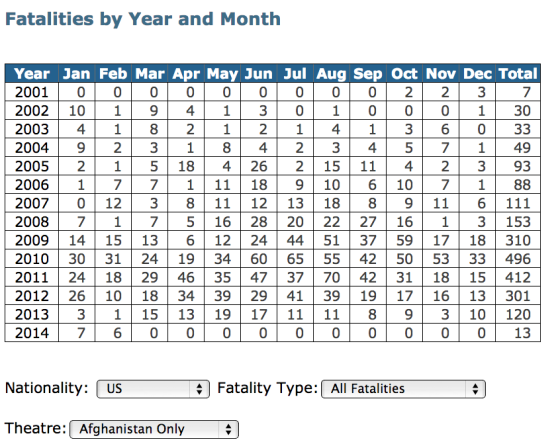
Change we can believe in. Mark Thompson posts charts recording Afghanistan and Iraq War causalities (Afghanistan chart above):

According to these charts from iCasualties.org, the best and speediest accounting of U.S. war dead, U.S. deaths in the Iraq war peaked in Nov. 2004, when 137 troops were killed. The peak in Afghanistan was Aug. 2011, when 65 died. The deadliest year in Iraq for U.S. troops was 2007, when 904 perished. In Afghanistan, 2010 was the grimmest, with 496 dead. A total of 4,486 U.S. troops were killed in Iraq, including in accidents and other non-hostile events. The toll in Afghanistan stands at 2,315.

Benen comments:

For too long, we’ve begun to think of some trends as simply unavoidable, as if a “new normal” were somehow permanent. Among them was the assumption that American troops will be slain in battle as the war in Afghanistan continues. But as we’re occasionally reminded, there’s nothing permanent about it.

Walmart: Welfare Queen

Krissy Clark investigates how big box stores profit enormously from SNAP benefits:

While we don’t know exactly how much individual stores make in EBT card sales, we know that EBT revenue really matters to stores’ bottom lines. This is something Walmart share-holders have learned firsthand. When Walmart announced disappointing profits and store sales last quarter, company executives blamed bad weather and the reduction in SNAP benefits that went into effect in November 2013, after an economic stimulus bill expired. …

Walmart is likely the biggest single corporate beneficiary of SNAP, but it’s not just Walmart. A growing number of stores have baked food stamp funding into their business models since the Great Recession. The tally of stores authorized to accept food stamps has more than doubled since the year 2000, from big-box stores like Target and Costco to 7-Elevens and dollar stores. It’s a paradox that the more people are struggling to get by, the more valuable food stamps become for business.

Elizabeth Nolan Brown doesn’t get why this is controversial:

Food stamp users have to shop somewhere, and Walmart is often cheaper than other grocery stores and has more (and healthier) options than the local bodega or 7-Eleven.

I suppose the animosity shouldn’t be surprising—Walmart can do no right in some eyes—but that Walmart is an affordable and accessible option for many on food stamps seems like a benefit to me, not a bug. If there is cause to be upset at here, it’s the fact that so many Americans are unemployed, living in poverty, and forced to rely on food stamps in the first place. It is not the fact that a company provides them with a place to buy affordable food (no matter how much you might personally not like that company).

A GOP Senate Is Getting More Likely, Ctd

Senate Forecast

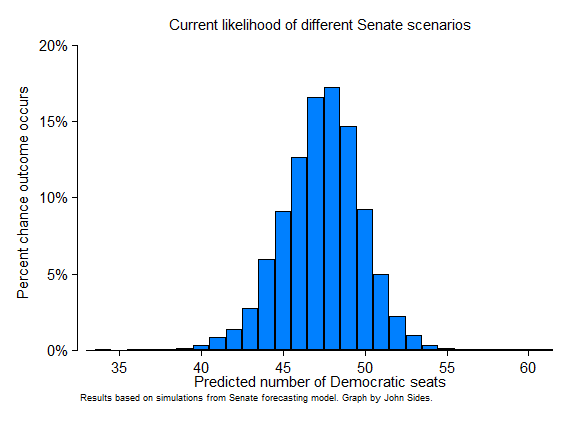
John Sides updates his forecasting model:

One key piece of information is whether candidates have held an elective office before and, if so, which one.  Unsurprisingly, political science research has long shown that candidates who have held elective office and higher levels of office tend to do better on Election Day.  They usually run better campaigns and make fewer mistakes, if only because they’ve done it before. As we have begun to incorporate candidate experience into the model, our initial sense is this: Republicans may have a far better chance of winning control of the Senate than we or other analysts previously thought. Here is a preliminary estimate: The GOP could have as much as a 4 in 5 chance of controlling the chamber.

Harry Enten looks at the generic ballot, which also suggests a rough election for Democrats:

In the closing days of the 2012 election, Democrats led the generic congressional ballot by an average of 3.2 percentage points among registered voters, according to the final five polls that released registered voter numbers (CBS/New York TimesCNN/ORCGallup,United Technologies/National Journal and YouGov/Economist). The generic ballot is a standard polling question that typically pits a generic Democrat against a generic Republican in a race for Congress. It’s one of the best indicators of the national political environment. Over the past month, the Democratic advantage among registered voters on the generic ballot is down to 0.5 points. That’s a gain of 2.7 points for Republicans.

Kilgore considers the Democrats’ turnout efforts:

The X-factor is whether the social-media-focused, voter-to-voter motivational techniques deployed by the Obama campaign to such good effect in 2012 are replicable in a midterm. In the old days, for Democrats especially, GOTV centered on “knock-and-drag”—flooding heavily pro-Democratic areas with labor-intensive campaign contacts, especially immediately prior to or on Election Day. That is not so easy with geographically dispersed young voters (other than on college campuses), and with the spread of early voting. And that’s why the new GOTV techniques—less limited in time and place—are so important.

Earlier Dish on Senate forecasting here and here.

The Silencing Of Russian Journalism

Julia Ioffe focuses on Dozhd, the last independent TV channel in the country, and its struggle to stay alive:

Given the youth and often shoestring budget of the staff, its shows can feel raw and unprofessional, but the steady pressure on the channel has instilled fear in their advertisers, not letting Dozhd expand, despite having the most educated and wealthy audience in Russia. And why do high-grossing urban professionals tune in, despite the sometimes high-school paper feel of the channel? There’s nothing else on television in Russia that isn’t controlled by the Kremlin in one way or another. On Dozhd, you can actually get information, rather than propaganda.

Now Dozhd has months to live. Earlier this month, Natalia Sindeeva, the channel’s owner, drastically cut salaries and announced that Dozhd had, at most, three months left. Then the building’s owners told her that Dozhd had to vacate its headquarters by June. Sindeeva said it’s not clear that the lights would or could come back on after such an expensive move. And that’s if anyone decides to let in a liberal entity that’s fallen from the Kremlin’s favor.

Joshua Yaffa also chronicles the crackdown on Russia’s opposition media:

As the space for independent journalism shrinks, the propaganda apparatus is working at feverish speed. Dmitry Kiselyov, a television host and media executive who represents the id of the state propaganda machine at its most grotesque, blamed this same fifth column for the sanctions imposed against more than thirty Russian and Ukrainian officials by the European Union. Kiselyov, who was among those sanctioned, cited Putin’s speech as evidence to blame the fifth column for compiling the blacklist. “Putin legalized that term in the political language of Russia,” he said. “We know their names. We know how they wrote our names and sent them to these Western embassies.”

Irina Kalinina looks at Russian TV’s portrayal of Ukraine:

Perhaps the most vivid propagandist on Russian television, especially these last few weeks, is Vladimir Zhirinovsky, the vice chairman of the Russian Duma, who recently proposed to divide Ukraine between Russia, Poland, Romania, and Hungary. Most Ukrainians and a lot of Russians as well have long considered Zhirinovsky a fool for his tendency to make exceedingly strange proposals. He has advocated, for example, that Russia seize Alaska and use it as a deportation dumping ground for Ukrainians. Not long ago, he claimed that a meteor shower was a test of a new American weapon.

These days, Zhirinovsky is no less surreal in his predictions—but we find ourselves wondering if there just might be a suggestion of Russian policy in his pronouncements. “If you want presidential elections in Ukraine,” he said on Russian television, “you want fascists to win them.” There is a certain twisted logic to this. Russian policy in Ukraine is based upon the strange premise that only Russia can protect the world from Ukrainian fascism. (In fact the opposite is true: The only way radicals in Ukraine would have a chance is if Russia continues its invasion of the country.)