Hard Times For French Socialists

They managed to elect the first female mayor of Paris … and that’s about it. Consider:

At a second round of voting on March 30th, Mr. [Francois] Hollande’s Socialist Party lost over 150 towns, most of them to the opposition centre-right. … Among the more dramatic losses were Toulouse, a city in the southwest that it had thought was safe, Roubaix  and Tourcoing, two industrial cities in the north with a deep left-wing heritage, and a string of other cities, including Amiens, Caen, Tours, Reims and Limoges, held by the left since 1912. Even some towns in the Paris region, which had been governed by Communist Party since the second world war, such as Villejuif, swung to the right.

The centre-right UMP was the primary beneficiary of this disillusion, and of a high abstention rate. Overall, the second-round result gave the combined mainstream right 46 percent of the vote, compared with 40 percent for the Socialists, Greens and other left-wing parties. This translates into 572 mayors for the right in towns of a population over 10,000, to 349 for the left, reversing the outcome in 2008.

Robert Zaretsky calls the far-right Front National “the real winner” of the elections:

The party captured only around 5 percent of the popular vote, but presented candidates in only 600 of the 32,000 towns and cities that held elections over the weekend. This indisputable victory not only could lead to the capture of several city halls, but perhaps more importantly, has already redefined France’s political landscape.

He elaborates:

While no one has suggested shooting illegal immigrants from Romania or North Africa, the FN long ago called for the expulsion of three million “illegals” from France. More recently, FN leader Marine Le Pen has spoken about an “Arab occupation” of many French cities, while Florian Philippot, the FN candidate who is poised to win the mayor’s race in the Alsatian city of Forbach, insists on the term “invasion.” In response, the mainstream French right has adopted the same language, sometimes with even greater ferocity. … becoming the leader of the UMP, Jean-François Copé has upped the ideological ante, asserting that the children of illegal immigrants born on French soil should not automatically become French citizens. The so-called droitisation, or pushing to the right, of the UMP’s discourse, is clearing the ground for tacit alliances with the FN.

Dan Bilefsky also examines the National Front’s sudden emergence as a major third party:

“The French Far-Right Isn’t Scary Anymore and That’s the Problem,” declared an English-language blog in the French daily Liberation.

Renée Kaplan, the blog’s writer, noted that many were mortified by the realization that the tendency by the French intelligentsia to dismiss the National Front as marginalized pariahs no longer corresponded to reality. She wondered ruefully: “Maybe this France — a real voting part of which supports a far-right, anti-immigrant, anti-European, nationalist party — actually is France today.”

The telegenic Ms. Le Pen has sought to rebrand the National Front as mainstream by distancing herself from her father, the founder of the party, and a man widely viewed as anti-Semitic. She has even vowed to take legal action against anyone who characterized the party as “extreme right.” Yet the National Front has cleaved to its mantra of France for the French. Last summer, Mr. Le Pen called the Roma community in Nice, in the south of France, “smelly” and “rash-inducing.”

Meanwhile, Gregory Viscusi and Helene Fouquet view the election as “a referendum on Hollande’s almost two years in power,” noting that the current president is the least popular one to hold office in more than half a century. Alexander Stille blames Hollande’s mismanagement of the economy for his party’s poor showing:

The reasons for voter dissatisfaction with the Hollande government are not hard to find. … When he came into office, in May of 2012, he listed unemployment, economic stagnation, and declining economic competitiveness as his highest priorities. France’s economy actually shrunk slightly in both 2012 and 2013, still mired in the recession from which most other industrialized nations have begun to emerge. France’s unemployment rate is now at about eleven per cent, even higher than the approximately 9.5 per cent rate when Hollande came into office. Hollande seems to have tinkered around the edges—fulfilling some of his campaign promises, such as hiring more teachers and increasing scholarships and jobs programs for younger people—but he has lost sight of the bigger picture. He ended up taxing far more than the richest strata of French society to pay for policies that failed to deliver significant results. Hollande seems incapable of articulating a vision of what he wants for France and how he intends to achieve it.

Veronique de Rugy zooms in on how grand gouvernement contributes to France’s economic problems:

France’s tax haul stands at more than 45 percent of GDP-one of the highest in the Eurozone. Sarkozy did implement some small but beneficial pension reforms, which Hollande promptly overturned and replaced with a measly and insufficient increase in the pension contribution period. Not only is the new president unconcerned with the sustainability of the French pension system, but he refuses to follow the example of Europe’s periphery by liberalizing French labor and product markets.

Hollande’s commitment to big government hasn’t won him any friends. The French rank him as the least popular president of the Fifth Republic, and young people are voting with their feet. According to the data from French consulates in London and Edinburgh, the number of French people living in London is probably somewhere between 300,000 and 400,000. That’s more than the number of French people living in Bordeaux, Nantes, or Strasbourg.

She has little faith, however, that any party will attempt to shrink the state:

[W]hile François Hollande and his irresponsible and backward socialist policies and rhetoric have accelerated France’s economic demise, in addition to several waves of brain drain, right-wing presidents Sarkozy and Chirac pursued many of the same policies when they were in power. Under Sarkozy, spending on everything from special interests to social welfare went up, while French people were subjected to over 200 new tax increases. While he made some gestures toward increasing the retirement age, he didn’t do much to free the labor market from regulatory asphyxiation.

John Lloyd sheds more light on the domestic scene:

At a time when many other European economies are showing some growth, output in France’s manufacturing and service sectors is contracting. Unemployment is rising, with a quarter of those under age 25 jobless. A recent report showed an uptick in manufacturing, but the country has a long way to go to make up for the declines of the recent past. …   Disenchantment with the EU is now sweeping France. The mainstream parties, where the official position has long been supportive of the EU, are challenged to be more skeptical. The liberal political philosopher Pierre Manent writes that “life for European citizens is determined more and more not by the familiar national debate … but by the outcome of a European process that is much less comprehensible.” This simple truth – that most people are unfamiliar with and thus cannot relate to the forces that govern their lives – has been the theme that Le Pen and her comrades have hammered at mercilessly, finally catching the popular mood.

Andrew Stuttaford looks ahead:

The next thing to watch will be the elections to the EU parliament scheduled for late May. On some projections, the National Front (which is, not so incidentally, committed to taking France out of the euro) will come top in the French vote , which would be another sign that economic incompetence and the stifling Europhile consensus of the EU’s establishment  is not only radicalizing increasing numbers of voters, but leaving them with few places to turn other than to parties that were pariahs just a few years ago.

Toward A Reckoning On Torture

abugrahib4_gallery__470x3750.jpg

So we are approaching the moment when we will have some measure of understanding of the scale and breadth and severity of the war crimes authorized by the last administration. We don’t – infuriatingly – have the full Senate Intelligence Committee report on the Bush-Cheney torture program, but we are beginning to get clues and assessments from people who have actually read the report. That means we should be careful in jumping to conclusions. But, so far, we’re seeing why the CIA has done all it possibly can to keep their war crimes hidden from public accountability.

That avoidance of accountability was not just to the American people, but also to their representatives. The report, we’re told, shows how the CIA deliberately conflated intelligence breakthroughs secured by ethical intelligence work and by torture. Here’s one example:

One official said that almost all of the critical threat-related information from Abu Zubaida was obtained during the period when he abuse184_3.jpgwas questioned by Soufan at a hospital in Pakistan, well before he was interrogated by the CIA and waterboarded 83 times. Information obtained by Soufan, however, was passed up through the ranks of the U.S. intelligence community, the Justice Department and Congress as though it were part of what CIA interrogators had obtained, according to the committee report.

“The CIA conflated what was gotten when, which led them to misrepresent the effectiveness of the program,” said a second U.S. official who has reviewed the report. The official described the persistence of such misstatements as among “the most damaging” of the committee’s conclusions.

This is not terribly surprising. Once a constitutional republic has decided to adopt torture, the gravity of the decision makes it a necessity for those inflicting it to prove it worked. But of course, it doesn’t work – which leads to lies and misrepresentations to insist that it did. In turn those lies help perpetuate the torture. In almost all torture regimes, this tight epistemic closure is routine.

There are also hints and guesses of further barbarism. We find, for example, that torture methods well-documented in the Bush-Cheney war on terror can be combined for particular sadism. And so freezing prisoners to near-hypothermia is documented elsewhere in the war, as is waterboarding. But these can be put together! Hence:

At the secret prison, Baluchi endured a regime that included being dunked in a tub filled with ice water. CIA interrogators forcibly kept his head under the water while he struggled to breathe and beat him repeatedly, hitting him with a truncheon-like object and smashing his head against a wall, officials said. As with Abu Zubaida and even Nashiri, officials said, CIA interrogators continued the harsh treatment even after it appeared that Baluchi was cooperating.

The perpetuation of the torture beyond any intelligence needs is also a feature of torture regimes. Once prisoners have been completely dehumanized – blindfolded, stripped, frozen or beaten, strung from shackles that force them into excruciating crucifixion-style stress positions – they become easy prey for pure sadism. This is human nature. When CIA officials have been given the green light to do as they want with prisoners, to experiment with various torture techniques with a guarantee of being beyond the reach of the law, the worst will always happen.

What’s truly encouraging about the report is that it apparently has exhaustive records on every single tortured prisoner, and the intelligence they did or did not provide. It could offer some real finality. And then it will offer this democracy a choice. When war crimes have been committed so brutal and foul, so horrifying and sadistic, so useless and immoral, are we simply going to say: no one will ever be held accountable? No one who ordered this will ever face sanction?

That is the second reckoning that this country will have to make. I wish I had confidence that we will not again simply decide to look away. What I do know is that a democracy that does look the other way is no longer a democracy.

Quote For The Day

“The introduction of same-sex civil marriage says something about the sort of country we are. It says we are a country that will continue to honour its proud traditions of respect, tolerance and equal worth. It also sends a powerful message to young people growing up who are uncertain about their sexuality. It clearly says ‘you are equal’ whether straight or gay. That is so important in trying to create an environment where people are no longer bullied because of their sexuality – and where they can realise their potential, whether as a great mathematician like Alan Turing, a star of stage and screen like Sir Ian McKellen or a wonderful journalist and presenter like Clare Balding,” – Conservative Prime Minister David Cameron, celebrating the dawn of marriage equality in Britain.

The Painted Selfie

Michelangelo,_Giudizio_Universale_31 2

In a review of The Self-Portrait: A Cultural History, Peter Conrad argues that early self-portraiture was “averse to vanity”:

Unusually, Hall’s history begins in the middle ages, because for him self-portraiture emerges as a reflex of Christian conscience, a homage to Christ’s imprinting of his agonized face on the Turin shroud. But the imitation of Christ takes courage, and it usually ends in the artist’s self-castigation. Previewing the Last Judgment in the Sistine Chapel, Michelangelo actually flays himself: St. Bartholomew grips the painter’s empty epidermis, which has been painfully peeled off with a butcher’s knife.

Such stark portrayals are averse to vanity. Behind the sedate married couple in The Arnolfini Portrait, Van Eyck includes his miniaturized self reflected in a mirror – a kind of signature, but also, according to Hall, a recollection of Seneca’s claim that mirrors were invented as an aid to self-knowledge, not to encourage primping and preening. Even Dürer’s florid tresses, waxed into permanent waves when he paints himself as Christ, are more than a fancy coiffure: his hair, growing directly out of the brain, testifies to the efflorescence of his spiritual thoughts.

Mark Hudson sees something recognizably modern in such work:

The notion of the artist constructing themselves as a character in their own work may sound like an arch postmodern conceit, but from the late 15th century artists were manipulating their self-images, making themselves appear older or younger to suit their purposes, taking on fictional and biblical roles to heighten their brand profiles. Andrea Mantegna, the “richest and most famous artist of the time”, portrayed himself as a grim-faced Roman in his memorial bust, “his tumescent bulldog features” conveying a “visceral machismo”. Comparing himself in the accompanying inscription to Apelles, court artist of Alexander the Great, he brought the reflected glory of the Greek conqueror on himself and his patrons, the Gonzagas.

Meanwhile, Frances Spalding notes that self-portraits have attracted relatively little attention from art historians:

It’s hard to understand why self-portraits, as a genre, have until now been so little discussed. They include some of the greatest works of all time. Among those featured in this book are Velázquez’s Las Meninas and Courbet’s The Artist’s Studio, as well as such masterpieces as the 1665 self-portrait by Rembrandt at London’s Kenwood House, a painting seemingly devoid of any agenda other than what it feels like to carry into old age the weight of being human. Yet despite such riches, this genre has, until now, remained largely overlooked (Laura Cumming’s recent bookA Face to the World, is an exception), existing merely as subset within portraiture, which is a relatively under-investigated subject. Perhaps the huge diversity within self-portraiture, and its leaning towards bombast, have kept scholars at bay.

(Image: detail from MichelangeloThe Last Judgment via Wikimedia Commons)

How Inequality Damages The Wealthy

David Lay Williams, author of Rousseau’s Social Contractexplains what Rousseau had to say on the subject:

[P]erhaps the most pernicious effects of economic inequality, for Rousseau, are wrought on the soul.  Tremendous wealth, on his reasoning, enfeebles the conscience.  We social animals are always driven to distinguish ourselves, to prove ourselves better than others.  This is not always socially destructive, insofar as distinction is granted for the right reasons – namely, civic and sociable behavior.  Society, however, has increasingly not only rewarded distinction with wealth, but made wealth a distinction worthy of respect. Where this happens, one’s status owes not just to one’s wealth per se, but to one’s wealth relative to the poverty of others.  Rousseau worried that in the most unequal societies, the rich would acquire a “pleasure of dominating” that renders them “like those ravenous wolves which once they have tasted human flesh scorn all other food, and from then on want only to devour men.”  Against a mind degraded in this way, addicted to the pleasure of domination, no appeal to justice, fairness, or any other value we like to think defines us, can have any effect; and no just society can stand on such foundations.

Truth In Advocating

Dan Gillmor argues that the reporting of advocacy organizations is becoming more and more like real journalism:

Yes, BuzzFeed, Vox, and ESPN’s new FiveThirtyEight, and a host of other large and small new media operations are extending the news ecosystem. But so are Human Rights Watch, the American Civil Liberties Union, the Cato Institute, and a host of other organizations that do serious reporting about some of the key issues of our time. The latter are doing advocacy journalism—coverage with a clearly stated worldview—and often leading the way for traditional journalists.

In my most recent book I called them “almost-journalists,” because I believe that advocates’ media work doesn’t always take note of opposing alternative viewpoints and facts. At this point, I’m ready to drop the “almost” part of the expression. I’m not saying they’re doing journalism of the type that rose to prominence in American newspapers in the second half of the 20th century—the by-the-numbers, “objective” coverage that still can serve a valuable purpose. Rather, they’re going deeper than anyone else on topics that they care about that are vital for the public to understand, but which traditional journalists have either ignored or treated shallowly. Then they’re telling us what they’ve learned, using the tools and techniques of 21st-century media.

Hyperactive Prescribing?

ADHD Drugs

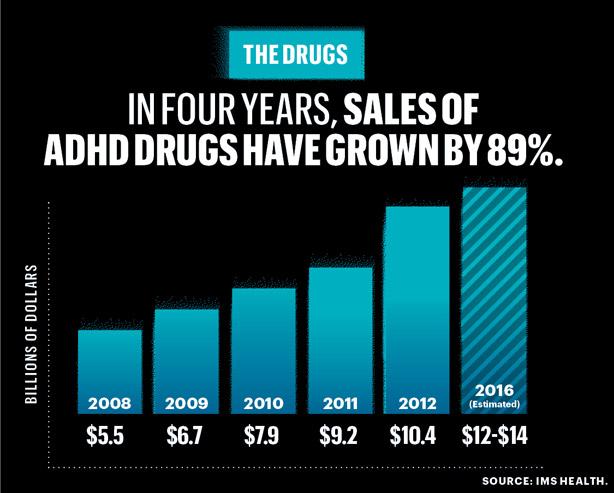
Ryan D’Agostino worries ADHD is being over-diagnosed:

Falsely diagnosing a psychiatric disorder in a boy’s developing brain is a terrifying prospect.

You don’t have to be a parent to understand that. And yet it apparently happens all the time. “Kids who don’t meet our criteria for our ADHD research studies have the diagnosis—and are being treated for it,” says Dr. Steven Cuffe, chairman of the psychiatry department at the University of Florida College of Medicine, Jacksonville and vice-chair of the child and adolescent psychiatry steering committee for the American Board of Psychiatry and Neurology.

The ADHD clinical-practice guidelines published by the American Academy of Pediatrics—the document doctors are supposed to follow when diagnosing a disorder—state only that doctors should determine whether a patient’s symptoms are in line with the definition of ADHD in the DSM. To do this accurately requires days or even weeks of work, including multiple interviews with the child and his parents and reports from teachers, plus significant observation. And yet a 2011 study by the American Academy of Pediatrics found that one third of pediatrician visits last less than ten minutes. (Visits for the specific purpose of a psychosocial evaluation are around twenty minutes.) “A proper, well-done assessment cannot be done in ten or fifteen minutes,” says Ruth Hughes, a psychologist who is the CEO of Children and Adults with ADHD (CHADD), an advocacy group.

Only one significant study has ever been done to try to determine how many kids have been misdiagnosed with ADHD, and it was done more than twenty years ago.

Stinking Water

More than two months after the chemical spill that contaminated the tap water of more than 300,000 West Virginians, Marin Cogan finds that many don’t trust state officials’ assurances that the water is safe to use again:

Every morning before he leaves for work, [Robert Thaw] takes a wineglass and fills it with tap water. He dips his nose into the glass. “I can smell it right now,” he says. “It’s definitely there.”

Of all the barriers keeping people from trusting the water again, the smell might be the strongest. The scent still lingers around the site of Freedom Industries as though the spill had happened yesterday. This month, a study by scientists examining the impact of the spill showed that humans can detect the odor at an estimated .15 parts per billion—meaning that long after officials said it was safe, residents were still smelling it in their water. Robert likes to say that “humans did not make it this far eating and drinking things that don’t smell right.” They trust their noses over the government.

In a lengthy feature, Evan Osnos explores what the spill means for the politics of the coal industry:

By harnessing the most powerful technologies of political influence—campaign finance, public relations, politicized research—West Virginia’s coal industry has recast an economic debate as a cultural debate: a yes-or-no question, all or nothing. Viewed in that light, a vote for the industry is a vote for yourself, your identity, your survival. The coal industry has created the illusion of vitality. … The arguments for making sacrifices to protect the coal industry will become more difficult to sustain. With the most accessible seams depleted, and West Virginia coal facing competition from inexpensive natural gas, the U.S. Department of Energy forecasts that by the end of the decade coal production in the region will have dropped by half. In anticipation, the West Virginia Center for Budget and Policy, a progressive think tank, has called for using natural-resources taxes to create a “future fund” that would promote diversification by investing in infrastructure, education, and job-training programs.

The Death Penalty In Black And White

Death Penalty By Race

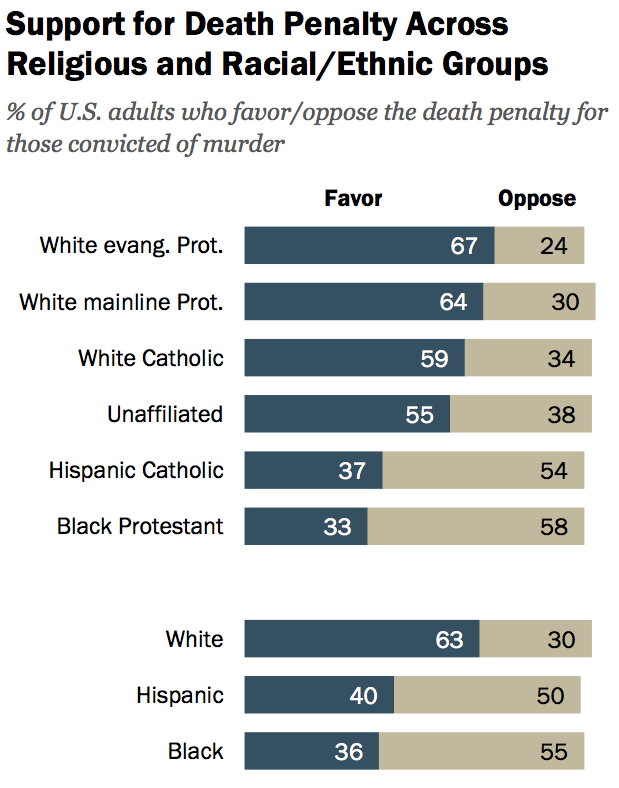
A Pew survey released on Friday found that capital punishment is becoming less popular:

55% of U.S. adults say they favor the death penalty for persons convicted of murder. A significant minority (37%) oppose the practice. While a majority of U.S. adults still support the death penalty, public opinion in favor of capital punishment has seen a modest decline since November 2011, the last time Pew Research asked the question. In 2011, fully six-in-ten U.S. adults (62%) favored the death penalty for murder convictions, and 31% opposed it.

Bouie examines the racial divide illustrated in the above chart:

Our cultural attitudes are unconsciously shaped by our collective history as much as they are consciously shaped by our current context. When you consider the death penalty as a tool of racial control—a way for whites to “defend” themselves from blacks—then Pew’s poll results make sense. What we’re looking at is the inevitable result of that history expressed through public opinion, and influenced by racialized ideas on crime and criminality.

If you’re still skeptical, consider this: In 2007, two researchers tried to gauge racial differences on capital punishment and assess how blacks and whites responded to arguments against the practice. Their core findings with black Americans weren’t a surprise—in general, blacks were receptive to any argument against the death penalty.

Their findings with whites, on the other hand, were disturbing. Not only where whites immune to persuasion on the death penalty, but when researchers told them of the racial disparity—that blacks faced unfair treatment—many increased their support.

But Andrew Gelman disputes Bouie’s conclusion that white support for executions is all due to racism:

He’s attributing the difference in attitudes to historical racism among white southerners. But the gap in attitudes has increased during recent decades, when racism has declined. Whites have become more politically conservative, but that’s not the same as becoming more racist. To accept my argument, you don’t need to believe that there is no racism among American whites. All you have to accept is that white racism is much lower than it was in the 1950s, which seems clear enough to me, given survey evidence on direct questions about racism.

Meanwhile, looking at the lower rates of support among younger Americans, Allahpundit wonders whether public opinion is turning against capital punishment for good:

Whether this is now a fixed star in millennials’ liberal-ish ideology or a simple reaction to the fact that they’ve grown up in a safer America, which could change if/when the crime rate does, is obviously unclear.