An All-Consuming Communion

Meg Favreau reflects on the centuries-old practice of “sin eating”:

The belief [hundreds of years ago] was that, by consuming food and drink that had been passed over the body of the deceased, sin-eaters could take on the sins of the dead. Generally, these sin-eaters were poor, paid a pittance for their work, and treated with disdain in a community. Sometimes, however, the sin-eating was performed by more prominent members of the community or even members of the funeral party. In 2010, BBC News reported on efforts to restore the grave of Richard Munslow, a prominent Ratlinghope farmer who was buried in 1906 and purported to be the “last-known sin eater.” And the 1894 edition of Bye-Gones: Relating to Wales and the Border Countries, includes a letter from woman named Gertrude Hope, who had this note about an 1892 funeral in Shropshire:

Directly the minister ended, the woman in charge of the arrangements poured out four glasses of wine and handed one to each bearer present across the coffin with a biscuit called a ‘funeral biscuit.’ One of the bearers being absent at the moment, the fourth glass of wine and biscuit were offered to the eldest son of the deceased woman, who however, refused to take them, and was not obliged to do so. The biscuits were ordinary sponge biscuits usually called ‘sponge fingers’ or ‘lady’s fingers.’ They are however also known in the shops of Market Drayton as ‘funeral biscuits.’ The minister, who had lately come from Pembrokeshire, remarked to my informant that he was sorry to see that pagan custom still observed.

While sin-eating might indeed have pagan origins, the sin-eating in this case was conducted as part of Christian funerals.

The Makings Of A Nuclear Disaster

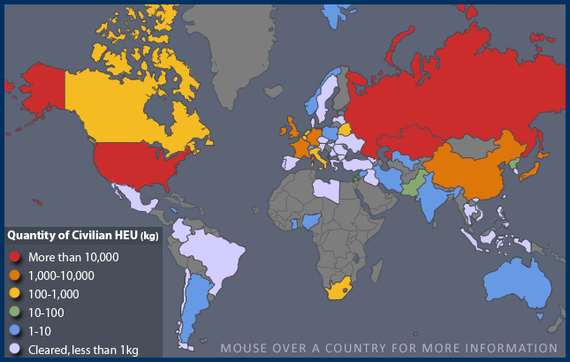
The size of different nations’ highly enriched uranium (HEU) stockpiles:

Nuclear Stockpiles

Graham Allison is happy that, “in just the last five years, the number of states with nuclear-weapons material that could fuel a terrorist’s bomb has shrunk by more than one-third”:

In Europe, six nations—Austria, the Czech Republic, Hungary, Romania, Serbia, and Ukraine—have become nuclear-weapons-material-free in the past five years. Belarus and Poland are the only countries preventing Eastern and Central Europe from becoming the second [nuclear-weapons-material-free zone (NWMFZ)]. In Africa, only one state, South Africa, continues to keep a cache of nuclear weapons material large enough to allow terrorists to build more than 20 nuclear bombs. South America could complement its status as the first NWFZ by becoming an NWMFZ—if it could persuade the single holdout, Argentina, to dispose of its 17 pounds of highly enriched uranium.

But, even if uranium supplies are further reduced, Douglas Birch illustrates the difficulties associated in getting nations to give up their plutonium stockpiles:

The call to restrict plutonium production — which applies to both military and civilian programs — is a departure and nettlesome to some countries.

Japan, India, and Russia, for example, plan to build new energy systems based on advanced plutonium-burning reactors. France and Great Britain have produced plutonium under contract for other countries. Separately, India, Pakistan, and Israel produce plutonium for weapons, according to a 2013 report by the International Panel on Fissile Materials.

As a result, while the global stocks of weapons-grade uranium have been shrinking after the Cold War, the stocks of plutonium have been growing. They are now estimated at 490 metric tons – enough, in theory, to fuel tens of thousands of weapons.

Affirmative Action Beyond Black And White

W. James Antle III wants Republicans to take note of Asian-American discomfort with the practice:

California lawmakers seemed poised to advance a constitutional amendment allowing the state’s universities to consider race in admissions. Senate Constitutional Amendment 5, which easily passed the Democratic-controlled Senate, would have exempted universities from Prop 209’s edict: “The state shall not discriminate against, or grant preferential treatment to, any individual or group on the basis of race, sex, color, ethnicity, or national origin.”

In the end, it was the Democrats – for the most part, the party that really matters in California state politics – who folded on SCA 5. And it was Chinese-Americans who were the pivotal group in the measure’s defeat. Olivia Liao, president of the Joint Chinese University Alumni Association, was quoted in the local press describing the initiative as racist. “[Legislators] feel like the Chinese-American community isn’t paying attention to politics,” Liao said, according to the Pasadena Star News. “We are concerned citizens. We need to stand up when things are not right; we need to be heard. We shouldn’t have any [exceptions] related to race. After all, America is a free country.”

Shikha Dalmia suggests affirmative action is “profoundly at odds with Asian-American interests”:

They form about 12 percent of the Golden State’s population, but in 2008, they constituted 40 percent of the student body at UCLA and 43 percent at UC Berkeley – California’s most selective public universities – as well as 50 percent at UC San Diego and 54 percent at UC Irvine. They have an admission rate of 73 percent compared to 63 percent of all in-state applicants. …

Yet, with each passing year, getting into top universities gets harder and harder. For example, between 1982 and 2004, the number of applicants to selective private four-year colleges increased 36 percent but enrollment increased 0.7 percent. Things are a bit, but not a whole lot, better in public universities.

Under such increasingly competitive circumstances, it’ll be a losing battle to ask Asians to conform to the mentality of white liberal guilt. They won’t apologize for their success or abandon their dreams – especially since they themselves have been repeatedly subjected to white discrimination.

But The Economist notes that Asian-Americans are far from united on the issue:

Asian-Americans, the country’s fastest-growing minority, are a notably diverse bunch, bundled together for convenience more than analytical accuracy. As Karthick Ramakrishnan, a political scientist at UC Riverside, points out, the SCA 5 campaign was dominated by Chinese-Americans. Indians did not play much of a role; south-east Asians, poorer and less likely to attend university, tend to back affirmative action. Even some Chinese-Americans declared support for SCA 5. California’s demographic changes have upended politics in new and curious ways; there are plenty more to come.

The Brutality Of Barrel Bombs

Damaged Sites

Human Rights Watch decries Assad’s use of the weapons:

Using satellite imagery analysis, Human Rights Watch identified at least 340 distinct sites in Aleppo city’s opposition-held neighborhoods that were damaged between early November and February 20, the date of the most recent image reviewed. The majority of these identified sites have damage signatures that are strongly consistent with the detonation of barrel bombs – unguided high explosive bombs, which are cheaply made, locally produced, and typically constructed from large oil drums, gas cylinders, and water tanks, filled with high explosives and scrap metal to enhance fragmentation, and then dropped from helicopters.

Lama Fakih, a researcher at HRW, wants the international community to do more to stop these bombs. She talked to Syrian refugees:

Most were leaving Syria because of the barrel bombs that were raining on Aleppo and the countryside. These unguided, high-explosive bombs — which are cheaply produced locally and filled with explosives, scrap metal, nails, or other material to enhance fragmentation — are pushed out of helicopters, dropped on densely populated areas by the Syrian army. Used in this way, the bombs are incapable of distinguishing between civilians and combatants, making the attacks unlawful under international humanitarian law. “If he left us one corner to hide in,” one woman exclaimed, “we would stay.”

The attacks had become so frequent that many civilians had concluded that the government was intentionally hitting them. One local group, the Violations Documentation Center, estimates that 2,321 civilians have been killed by barrel bombs in Aleppo since the aerial campaign began in November.

Quote For The Day

“I know Rumsfeld well enough at this point to know that he’s never going to have this kind of epiphany. He’s never going to have this introspective moment where he realizes, even though we had the best intentions, that many of his decisions turned out to be disasters. It was rare that he would ever admit that he was wrong about anything. Part of his defense was that he was very adept at putting caveats into everything that he said so that he could go back later and cite the caveat. “I never said how long the war would last.” “I never said how many troops would be needed.” “I never said how much it would cost.” He was very slippery. You couldn’t pin him down on things. And his favorite technique, of course, was to challenge the premise of your question and never actually answer it,” – Jamie McIntyre, former senior Pentagon correspondent at CNN, and now at NPR’s All Things Considered.

Meanwhile, At The D.C. Circuit Court Of Appeals …

Alec MacGillis examines the other big Obamacare case:

As readers may recall from our previous coverage of this challenge, it revolves around an argument put forward in 2011 by Jonathan Adler, a law professor at Case Western University, and Michael Cannon, a health care analyst at the libertarian Cato Institute and a committed Obamacare foe. They argue that the law is being carried out in contravention with its text: The section decreeing that people will get federal subsidies to help them pay for private insurance plans says that the subsidies are available for those buying plans on new exchanges established by the states – and makes no explicit provision for subsidies for those buying plans in states where governors and state legislators left the creation of the exchange up to the federal government. …

The stakes in the challenge are enormous – 36 states have chosen not to set up their own exchanges, which means that if the courts side with the challengers, the millions of people who have bought coverage in those states (the vast majority of whom have receives subsidies to do so) would lose their subsidies and be left unable to afford coverage. This would in turn throw the individual insurance market into disarray as many of these people dropped their coverage – except, presumably, the sickest of people with the most incentive to keep it.

Adam Serwer says that case hasn’t been going well for the administration:

While a majority on the Supreme Court appeared sympathetic to a challenge to the Affordable Care Act’s mandate that insurance companies provide birth control, blocks away, two out of three judges on the D.C. Circuit Court seemed willing to gut the rest of the law based on what supporters say is, at worst, a mere drafting error. “If the legislation is just stupid, I don’t think it’s up to the court to save it,” said Judge A. Raymond Randoph Tuesday.  Randolph had other choice words for the law, calling the law “Janus-faced,” “cobbled together” and “poorly written,” later describing its launch as an “unmitigated disaster.”

Jason Millman worries that Obamacare subsidies are in danger after yesterday’s oral arguments:

The subsidy question is central to the future survival of the law. … About 85 percent of those signing up for insurance in federal-run exchanges have qualified for financial assistance to purchase coverage. Without those subsidies, the insurance would be less affordable, leaving those with the greatest health needs with more motivation to purchase coverage. That makes for a worse risk mix, driving up the cost of insurance to cover the sicker pool of people, creating what’s known as an insurance “death spiral.”

Of course, oral arguments aren’t always a reliable indicator of how a judge will decide on a case. But it’s safe to call Randolph’s and Edwards’s respective votes here, making Judge Thomas Griffith as the panel’s apparent swing vote. Griffith, a President George W. Bush appointee, was the only judge who didn’t seem to have his mind already made up, and he challenged the Obama administration on some key points.

Philip Klein considers the stakes:

Were the case to succeed, it would mean that dozens of state governments opposed to Obamacare could significantly narrow its scope by refusing set up exchanges, thus preventing residents from claiming subsidies. In those states, employers wouldn’t be penalized for failing to offer qualifying insurance (which is triggered by workers seeking federal subsidies), meaning that anti-Obamacare states could become more attractive to businesses trying to get around the employer mandate. It would also increase pressure on Congress to undo the individual mandate.

On the flip side, such a ruling would also place pressure on anti-Obamacare governors, who would be forced to decide whether to stand firm in opposition to Obamacare or to set up their own exchanges so residents can apply for subsidies.

Kilgore tries to looks on the bright side:

As MacGillis [notes], an adverse decision by this panel could be appealed by the government to the full D.C. Circuit, and the disposition of similar cases in other Circuits could differ enough that the whole case winds up before the Supremes. This will all take time, which means the Affordable Care Act would continue to operate for a good while, becoming part of people’s lives – a fact no court could completely ignore. That, along with the absurdity of stipulating that Congress passed a gigantic landmark piece of legislation designed not to work at all, is probably the best defense for ACA against this particular attack.

“The Most Uncharitable Name Ever Conceived For A Charitable Group”

Dallas Cowboys  v Washington Redskins

That’s what Josh Levin dubs Redskins owner Dan Snyder’s new “Washington Redskins Original Americans Foundation”:

If you want my money, he’s saying, you’re going to have to choke down my nickname along with it. This is the essence of Dan Snyder: He can’t do good works without shoving his badness in your face.

Arturo García is equally unimpressed:

Snyder reached out to 26 tribes over a four-month period before launching the foundation, which has already distributed more than 3,000 winter coats and basketball shoes to several tribes, as well as a new backhoe for the Omaha Tribe in Nebraska. But, as Indian Country Today Media Network noted, there are more than 300 reservations in the U.S. , meaning Snyder is relying on approval from .08 percent of the country’s Native population. As Racialicious has previously reported, a study released last October by the National Congress of American Indians (NCAI) showed the team’s name was met with disapproval from 80 percent of Native communities.

Will Bunch piles on:

I’m not against the concept of philanthropy. And certainly America’s Native Americans, especially those still living on isolated reservations, need a helping hand to deal with crippling poverty and the social problems that stem from that. But there should be no such thing as billionaires buying a “Get Out Of Doing What’s Right, Free” card. I was struck by what Peter Buffett wrote last year about philanthropy and “what I would call ‘conscience laundering’ – feeling better about accumulating more than any one person could possibly need to live on by sprinkling a little around as an act of charity.” Now here’s Dan Snyder to take “conscience laundering” to a new ridiculous height.

But Marc Tracy sees it as a small step in the right direction:

Is this a clever act of jiu-jitsu that, months and years from now, will be seen as having gotten Snyder out of the corner his stubbornness had previously trapped him in? Or did he just make a significant concession that has led him one step closer to changing the name? Many will say it’s the former. I say it’s the latter.

Find the comprehensive Dish thread “Do Mascots Need Modernizing?” here.

(Photo: Fans of the Washington Redskins cheer against the Dallas Cowboys at FedExField on December 30, 2012 in Landover, Maryland. The Redskins defeated the Cowboys 28-18. By Larry French/Getty Images)

What To Expect From Hobby Lobby, Ctd

Ilya Shapiro offers his take on the case’s day in court:

While Solicitor General Don Verrilli gamely pressed the plight of the “third parties” who would lose out if the challengers get an exemption – employees whose contraceptives wouldn’t be paid by their employer – there didn’t seem to be a majority on the Court who saw it that way. Justice after justice probed such issues as whether the government’s interest here was really that compelling given all the exemptions it had already granted (to small employers, religious nonprofits, and grandfathered plans) and whether there was no other way to achieve the same goal. And those are probably the points on which this case will ultimately turn: (1) the contraceptive mandate was not one of the Obamacare requirements that became mandatory as of January 1 (or whenever the administration stops illegally delaying them), and (2) the government could’ve ensured the provision of the contraceptive mandates a different way (e.g., new tax credits or existing public health programs). Despite the parade of horribles invoked by Justice Sotomayor regarding religious objections to blood transfusions and vaccines, at least five justices seemed to recognize that religious-liberty claims are meant to be adjudicated on a case-by-case basis – maybe six, given Justice Breyer’s lukewarm and infrequent interjections.

Dahlia Lithwick fears the contraception mandate is “doomed”:

The rights of millions of women to preventive health care and workplace equality elicit almost no sign of sympathy or solicitude from the right wing of the bench today. Nor does the possibility that religious conscience objections may soon swallow up the civil rights laws protecting gay workers, women, and other minorities. Religious freedom trumps because we’re “only” talking about birth control.

But as Jeffrey Toobin notes, “there was little doubt where the Court’s three female Justices stood”:

After Paul Clement, the lawyer for Hobby Lobby, began his argument, twenty-eight of the first 32 questions to him came from Ruth Bader Ginsburg (four questions), Sonia Sotomayor (11), and Elena Kagan (13). The queries varied, of course, but they were all variations on a theme. The trio saw the case from the perspective of the women employees. They regarded the employer as the party in the case with the money and the power. Sotomayor asked, “Is your claim limited to sensitive materials like contraceptives, or does it include items like blood transfusion, vaccines? For some religions, products made of pork? Is any claim under your theory that has a religious basis, could an employer preclude the use of those items as well?” Clement hedged in response. When Clement asserted that Hobby Lobby’s owners, because of their Christian values, did care about making sure that their employees had health insurance, Kagan shot back:

I’m sure they want to be good employers. But again, that’s a different thing than saying that their religious beliefs mandate them to provide health insurance, because here Congress has said that the health insurance that they’re providing is not adequate, it’s not the full package. …

There is no such thing as a women’s position on this case or on any other issue. But there is such a thing as women’s voices, and with this case, especially, it was important that they be heard. On this day at the Supreme Court, they were.

Brian Beutler expects bad things to happen if Hobby Lobby wins:

Hobby Lobby’s owners have many options if they genuinely don’t want to offer their employees health insurance that covers contraception. They could stop sponsoring insurance for their employees altogether, though this would require giving up one of those lucrative tax preferences, and possibly paying a steep tax penalty. They could lobby to eliminate the employer mandate or the contraception mandate by statute. They could ask Congress for a limited exemption that would apply to companies, on the condition that they advertise the missing benefit to prospective employees, or push for the creation of a much smaller, subordinate penalty for companies that provide all guaranteed benefits except for contraception. That’s just for starters.

But if they obtain an exemption from the court on religious grounds, even one drawn very narrowly, the unintended consequences could reach much further than the relatively narrow dispute over contraception, significantly altering the balance of competing liberties and private interests in secular spaces, and be very difficult to reverse.

But Sam Kleiner thinks a ruling in favor of Hobby Lobby may not be a big deal after all:

At oral arguments today, Roberts may have “appeared to tip his hand,” as the Wall Street Journal’s Jess Bravin put it. While the government claimed that allowing Hobby Lobby to exempt itself from laws based on a religious claim would have far-reaching implications, Chief Justice Roberts in his questions appeared to be searching for a way to distinguish this case from claims that could be brought by a larger publicly traded company. We could, he noted, “simply say that it’s in this type of Chapter S Corporation that is closely held. Whether it applies in the other situations is—is a question that we’ll have to await another case when a large publicly traded corporation comes in and says, we have religious principles, the sort of situation, I don’t think, is going to happen.”

Guessing about decisions based on questions from the Supreme Court is a risky exercise, but we shouldn’t be surprised if the opinion comes out as a narrow victory for Hobby Lobby that tries to curtail the scope of its ruling to not included publicly traded companies. The decision certainly would be problematic; it would entangle the Supreme Court in having to determine which religious convictions are genuine enough from a corporation to warrant exemptions to laws. However, it would not be the kind of far-reaching assertion of corporate rights that liberals are dreading.

Meanwhile, Patrick Deneen argues provocatively that even if Hobby Lobby wins, Christianity has still lost:

Hobby Lobby is a significant player in a global economy that has separated markets from morality. Even as it is a Christian-themed brand, it operates in a decisively “secular” economic world. It is almost wholly disembedded from any particular community; its model, like that of all major box stores, is to benefit from economies of scale through standardization and aggressive price-cutting, relying on cheap overseas producers and retail settings that are devoid of any particular cultural or local distinction. The Hobby Lobby near us—on Grape Road in nearby Mishawaka – is about as profane imaginable a place on earth, accessible by six lanes of concrete roads where there is a heavy concentration of large chain retailers, where it anchors a sensory-deadening row of retail store fronts that border acres of cracked and barren pavement, awash in discarded plastic bags and crumpled fast food wrappers. … It defends its religious views as a matter of individual conscience, of course, because there is no moral, social, or religious context to which it can appeal beyond the autonomy of its own religious belief. Lacking any connecting moral basis on which to stake a social claim, all it can do in the context of a society of “disembeddedness” is seek an exemption from the general practice of advancing radical autonomy. Yet, the effort to secure an exemption is itself already a concession to the very culture and economy of autonomy.