That’s how Noam Scheiber describes Silicon Valley:
Tech luminaries who otherwise pride themselves on their dedication to meritocracy don’t think twice about deriding the not-actually-old. “Young people are just smarter,” Facebook CEO Mark Zuckerberg told an audience at Stanford back in 2007. As I write, the website of ServiceNow, a large Santa Clara–based I.T. services company, features the following advisory in large letters atop its “careers” page: “We Want People Who Have Their Best Work Ahead of Them, Not Behind Them.”
And that’s just what gets said in public. An engineer in his forties recently told me about meeting a tech CEO who was trying to acquire his company. “You must be the token graybeard,” said the CEO, who was in his late twenties or early thirties. “I looked at him and said, ‘No, I’m the token grown-up.’ ”
One consequence: cosmetic surgery is in high demand:
In talking to dozens of people around Silicon Valley over the past eight months – engineers, entrepreneurs, moneymen, uncomfortably inquisitive cosmetic surgeons—I got the distinct sense that it’s better to be perceived as naïve and immature than to have voted in the 1980s. And so it has fallen to [San Francisco surgeon Seth] Matarasso to make older workers look like they still belong at the office. “It’s really morphed into, ‘Hey, I’m forty years old and I have to get in front of a board of fresh-faced kids. I can’t look like I have a wife and two-point-five kids and a mortgage,’ ” he told me.
One possibility is that VCs are looking for a lottery ticket of sorts — the fantastic scores that will make you Facebook money from a small initial investment. And maybe you’re more likely to get a winning lottery ticket from a young entrepreneur, not just because they’re unconstrained by past experience, but also because the markets they cater to simply have more of that potential than businesses based around an older demographic. Older people are more set in their ways and have more obligations; they’re unlikely to spend hours of their valuable time helping you build a sustainable user base for the next Facebook or Twitter.
Another possibility is that most of the people who want to be first-time entrepreneurs are in their 20s and early 30s, before they have families and mortgages that need to be paid every month. Because older entrepreneurs are rare, they don’t fit investors’ mental model of what an entrepreneur looks like.
A close relative of mine has a three-year-old girl with Down’s, and she is an angel. Whatever the spectrum is, she is on the high-functioning end. This year she started attending preschool, and the hope was to mainstream her eventually. All that is on hold now because she was just diagnosed with leukemia.
Seeing her family cope with this situation is quite difficult, but it is not uncommon. Even though this little girl was mentally high-functioning, she is more susceptible to physical problems because of her extra chromosome. Another reader mentioned a hole in the heart, which is another common health issue for Down’s kids. A quick Google search will show you just how many physical problems are more likely with Down’s. It’s daunting.
Some good news: prior to the ACA, Down’s was a pre-existing condition, subject to all the limitations that went along with that. Now my family is at least not worried about hitting a lifetime dollar limit on her care. (She is receiving excellent care and responding well to chemo.)
The thing about her Down’s is that it is tough, but it is manageable and a well-known, well-researched condition. Her family has immense support, and people truly do understand Down’s in a way they did not used to. This little girl requires far less care than, for example, my cousin who has hydrocephalus, among other things. He is 22 years old and over six feet tall, but he is cognitively two years old. He requires constant care and has no hope of ever functioning on a higher level. The mother of the girl with Down’s knew with a simple blood test that her fetus was at a higher risk for Down’s. My aunt did not know until after her son was born that he would be so disabled.
Because of my relationship with these two families, I do not understand choosing to terminate a pregnancy because of a blood test that says there is an extra chromosome in the fetus. That bit of information simply does not tell you much. Your child could have far more severe problems that don’t show up until well after birth. Getting pregnant at all is a huge risk and a commitment to another person for the rest of your and their life.
I am pro-choice, and I firmly believe the decision to end a pregnancy is too personal to be handled by the government or anyone but the person in that situation. I am not trying to pass judgment on someone who does choose to end a pregnancy because of the blood test; I just have trouble understanding it.
Another is on the same page:
I recently gave birth to my first child in November. I am part of a group of online mothers, and one mother delivered a premature baby girl who has Down Syndrome. She is an adorable baby and very lucky that she has such a caring mother. Her mother has recently become a very vocal advocate for banning abortion (in cases of Down’s) and even prenatal testing! I’ve kept my mouth shut, but it’s been hard. I do not know how someone, who is so intimately aware of the struggles that come from having a child with special needs, feels they can dictate other families decisions in this way. Then again, that’s the issue with the whole abortion debate. But special needs seems to be a special case, not only because of the suffering a child or adult with disabilities may endure, but because of the impact it will have on any other children or family members.
I should add that I have a sister-in-law with Down’s. She is at the higher end of the spectrum but could never live alone. She is very sweet and loving and caring. But she’s a child in a woman’s body. I’ve often asked my husband what would happen if her parent (my father-in-law and my husband’s step mother) passed away. Where would his sister go? He assures me that his step-mother has a large family who would care for her. But I really worry that there isn’t a plan. And where does that leave us?
Another:
Your reader who shared anecdotes about her 62-year-old cousin with Down syndrome is exactly why the PSA video you highlighted on World Down Syndrome Day is important and necessary. It’s important and necessary because it articulates a point of view that is often drowned out by messaging consistent with your reader’s mindset, i.e., your life will be horrible if you have a child with Down syndrome. It’s scary enough for parents who get a diagnosis of Down syndrome – pre or postnatal. Those parents will immediately seek out information, and often times the information they will find is overly pessimistic, horribly one-sided and often antiquated.
Hence, it is nice to see the other side of the story – the side that shows that while there will inevitably be challenges, your child will be more alike than different from your other children and will bring immense joy to your life. I know from experience that that is a dark and scary time and you naturally focus on the real or perceived negatives of your situation. I wish I had seen that video during those first few weeks for a brief respite from the doom and gloom. I have three sons, one of whom happens to have Down syndrome. I have a ton to be thankful for, both professionally and personally, but having and raising my son with Down syndrome is the best thing that has ever happened to me. I really could not care less if someone believes that is an overly optimistic viewpoint. It’s the truth.
Another reader sends another video, embedded above:
We found out our 12-year-old daughter Sophie had DS in our seventh month and just couldn’t go through with terminating the pregnancy. When you see the video, you’ll know we made the right choice.
One more:
Reading this thread just about brought me to tears; it’s just so moving. I’m so grateful for your site and the unparalleled reader feedback that makes it so special.
Nic Fleming traces the history of asbestos regulation. Its harmful effects have been known for a century, but the industry fought hard to keep scientists quiet:
Scientists who published inconvenient results were vilified and harassed. … Any natural gaps or uncertainties in the research that showed asbestos caused disease were highlighted and exploited in an early version of the now-prevalent ‘manufactured uncertainty’ tactic. If these strategies sound familiar, there’s a good reason: the industry was being advised by a U.S. public relations company that had previously defended big tobacco.
Even today, economic interests trump regulation across the globe:
From a peak of 5 million tonnes around 1980, asbestos production fell to 2 million tonnes around two decades ago, and has hovered around that mark ever since. Russia accounts for half of world production, with the other large producers China, Brazil and Kazakhstan. As of April 2013, bans on all types of asbestos use were in place in 54 countries—fewer than the number in which it is still used. China and India consume the most, together taking almost half of world production. Thailand, Indonesia, Sri Lanka, Brazil and Russia use significant amounts.
In 2013, an attempt to add white asbestos to the Rotterdam Convention [on hazardous substances] was blocked by Russia, Kazakhstan, Ukraine, Kyrgyzstan, Zimbabwe, India and Vietnam. Supporters of the move said it would have led to improved labelling, handling and safety regulations, and saved thousands of lives. Opponents said it would increase shipping and insurance costs.
Update from a reader:
My father gasped his last breaths somewhere between assisted death via morphine and suffocating to death in the late 1990s. For his last four hours we discussed what he saw and what he dreamt as the drug took hold to relieve the incredible pain of his ravaged lungs until he simply became silent. Then he passed. On an x-ray, both lungs looked like a nighttime aerial view of twin cities with cluster after cluster of mutated cells stimulated by silicate fibers that were the critical size and shape gets trapped in our lungs and that imparts the disease. Asbestos kills slowly and relentlessly.
He had worked in a factory all of his adult life and was a moderate smoker, mostly cigars, for the majority of 35 years he worked. Several of his colleagues also died from mesothelioma. About twice a year I still get my share of the modest checks tied to the asbestos settlements. They are eerie reminders of the steady suffocation and pain that occupied my father’s late-50s, mad money that I refuse to spend on anything serious.
He came home every day from that job in his work clothes. I wonder sometimes whether those of us with this type of secondary exposure are also at risk. It makes you think a lot about ensuring today is a worthwhile day.
Clearly that chart was indirectly demonstrating that having a gun in one’s home is much more likely to be associated with suicide than with actually killing someone in self-defence. It is not by any means a definitive chart on “the overall impact of firearms on health.” Your reader remarked that the positives of guns include deterring an unknown number of murders and violent assaults. He disregards the fact that the negatives are massively underestimated, not overestimated, by the chart.
The negative health effects of guns are not just suicides but also the homicides (11,078 in 2010, according to the CDC), the accidental deaths of children and adults (554 in 2009 – see this excellent NYT piece), and the cost and long-term impact of non-fatal gun injuries (73,505 in 2010 per the CDC). It is estimated to cost over $2 billion per year to treat patients with firearms injuries. That does not count the losses in productivity and the chronic healthcare needs of these patients. As for suicides, 19,392 of the 38,364 suicides in the US in 2010 were from firearms. Using a firearm in a suicide attempt is lethal in 85% of patients, far more lethal than any other method.
I am an emergency physician and a medical toxicologist, so I’ve seen up close the costs of suicide.
I have taken care of many patients who have tried to kill themselves, including a 16-year-old boy who fatally shot himself in the head after his girlfriend broke up with him, as well as many who overdosed on medications but recovered. Guns are so lethal so quickly that even if the impulse to commit suicide is transient, the person is often successful. They don’t get a chance to change their minds. That’s why having access to a gun in the home is a risk factor for suicide. The data from an Army Times article back this up:
Troops overseas must abide by the restrictions of host nations, according to military policy. Accordingly, U.S. troops in South Korea, Germany, Italy and elsewhere are virtually without access to personal firearms. Suicides have been fewer among those troops.
Last year, there were three Army suicides among the 25,000 soldiers posted in Germany, one among 19,200 in South Korea and none in Italy, where 3,900 soldiers are based. Meanwhile, U.S. bases often see double-digit suicides each year. There were a dozen among the 30,000 GIs at Fort Campbell, Ky., last year; 17 at Fort Hood, Texas, which has 46,500 soldiers; and 10 among the 20,000 G.I.s at Fort Stewart, Ga., according to Army statistics.
“The takeaway message is we have to do everything we can to limit access to firearms by someone who is depressed, they’re suicidal, struggling with thoughts of self harm,” said Robert Gebbia, executive director of the American Foundation for Suicide Prevention. “It’s just good common sense.”
The NRA has blocked research on these issues because it is not in their interest for people to know the truth. We don’t have the data on gun deaths and gun injuries because they have blocked funding for the research.
I hope you will not leave your other reader’s comments as the only important points to be made about the chart and about the negative health impact of guns. It is time that our politicians developed some backbone and did what is right for the American people rather than for the gun industry. It is ridiculous that they would oppose Dr. Murthy because of his belief that guns are a public health issue. He would be a very poor physician indeed if he did not see the obvious health costs of guns to our society.
Spurred by Nick Richardson’s brief history of Lorem Ipsum, the enduring dummy text from the 16th century, Sal Robinson looks to variants in the Internet Age:
These generators are pretty satisfying for people who miss Maurice Moss or have to write academic papers, and give you plenty of useful dummy text, but they don’t often come close to the original’s level of lyricism. Maybe you’re only as good as the guys you steal from? For superior nonsense, it’s best to turn to Lewis Carroll, who, when Lorem Ipsumated, produces passages like this:
Alice laughed. ‘There’s a mile high and down
in an egg, Sir,’ Alice asked, handing her hand and drank some poetry repeated thoughtfully. ‘An
uncomfortable sort of old clothes
than anything else, you know, with some time the
poor Gnat went on growing older.’
‘ONE can’t, you know, with all alive, and thirsty!’
Here he emphasizes how terribly ineffective solitary confinement is as a method of rehabilitation:
And in our final video from Shane, he shares how he and his fellow hostages kept each other sane while imprisoned in Iran:
Shane, Sarah and Josh’s memoir based on their experience as political prisoners in Iran is called A Sliver Of Light. You can find a selection of excerpts from the book here, or read about what happened when Shane was able to break out of his cell for a night here. Bauer’s Mother Jones special report about solitary confinement in America is here. You can also support his further efforts to investigate the US prison system by contributing to his Beacon campaign. His previous Ask Anything answers are here.
I was away and missed Ross Douthat’s Q and A on marriage equality. Check out the last question from one Lewis Armen, from Oregon. Money quote from Ross’s response:
As a matter of public policy, I’m skeptical of same-sex marriage because I think it instantiates (or ratifies, since obviously we’ve been headed down this road for a while) a public meaning of marriage that’s too formless and open-ended to do the very specific job that the institution evolved to do: To bind and channel heterosexual desire in ways that are specific to the nature of procreation, and that aim to offer as many children as possible the opportunity to grow up in an intimate community with their mother and their father. But saying “we should maintain a distinctive public institution designed to specifically encourage lifelong heterosexual monogamy” — which is basically the traditional-marriage argument, in a phrase — doesn’t preclude making legal accommodations for same-sex relationships, and it certainly doesn’t require gay people to disappear back into the closet or all take vows of celibacy.
I think it’s possible, in other words, for the law to treat different kinds of relationships fairly without always treating them identically.
My problem with this argument is that it must make heterosexual civil marriage a superior contract than homosexual civil marriage, and require a different and necessarily inferior appellation. If the differnce is not all or nothing, then what is the difference? Does Ross support, for example, civil unions with all the rights of marriage? I suspect not. But if not, which civil marital rights would he exclude gays from? And why? That’s the practical answer that almost no one on the right has explicitly offered in the last three decades.
These questions become practical, while Ross is operating entirely within the abstract.
But my main point here is that Ross’ point, though I disagree, is nowhere near bigotry. Or does Mark Joseph Stern really believe that such a position is tantamount to “hate”?
Tom Jokinen ponders an afterlife of neither bliss nor torment, but unrelenting banality:
The 2004 French film Les Revenants (translated as They Came Back and since spun off into a Sundance TV series) imagines a world in which the dead neither ascend to heaven nor disappear to a black oblivion, but merely, as the title says, come back. To pick up where they left off. One day they emerge on the streets of a small French town in the same business-casual attire and over-coiffed funeral-home hairdos in which they were buried, seeming no worse for the wear. But they’ve changed. Emotionally flat and unreachable, it’s as if they’ve emerged from an unsatisfying, dreamless sleep and are caught in some vague, post-traumatic affective disorder which seems reasonable. Their attempts to re-integrate into society are fraught. Their families don’t know what to do with them. From here the director and co-writer Robin Campillo takes the ball and doesn’t so much run with it as amble into dark corners: this is a very quiet, very European zombie film.
For one thing, the return of the dead presents a social problem without precedent.
Do they get their old jobs back, given that they’re just not as bright or engaged as they used to be? Committees are struck, town meetings are held. Some families have moved on, spouses have remarried, so where will the dead sleep? Refugee-style facilities are considered. What about social programs? Are the dead still eligible for unclaimed pension benefits? Implications mount.
He goes on to compare the film to the “postmortem rom-com” Truly, Madly, Deeply:
[B]oth films have [a] thread in common: they present death as something less than spectacular, not unlike certain after-Modernist views on life itself—one dull thing after another. There are no zithers. We wear the same clothes. Cold air still chills us, we suffer from hangovers. It is a view of death for those who have outgrown grand narratives, where the afterlife is just more of the same. It is neither alluring nor transcendent: we will not come back as a flower or a frog or a potato, all of which at least promise a change of scenery. These films contemplate the plodding, uneventful banality of death: we’ve lost the comfort of the story with a happy ending.
[David] Katz and Yale colleague Stephanie Meller published their findings in the current issue of the journal [Annual Review of Public Health] in a paper titled, “Can We Say What Diet Is Best for Health?” In it, they compare the major diets of the day: Low carb, low fat, low glycemic, Mediterranean, mixed/balanced (DASH), Paleolithic, vegan, and elements of other diets. Despite the pervasiveness of these diets in culture and media, Katz and Meller write, “There have been no rigorous, long-term studies comparing contenders for best diet laurels using methodology that precludes bias and confounding. For many reasons, such studies are unlikely.” They conclude that no diet is clearly best, but there are common elements across eating patterns that are proven to be beneficial to health. “A diet of minimally processed foods close to nature, predominantly plants, is decisively associated with health promotion and disease prevention.”
For years, the food industry has willfully misinterpreted prevailing dietary guidance into the most profitable of distortions. No nutrition expert ever said “eat low-fat, starchy, high-sugar, high-calorie cookies.” But when we were fixated on low-fat eating, that’s just what the food industry gave us. They have done much the same with every nutritional preoccupation to follow.
But that sort of thing can’t happen when we know where we are going. For those who understood that advice to eat “low fat” meant less meat and cheese, more vegetables and fruits, Snackwell cookies were never much of a temptation, and certainly never mistaken for a panacea. Similarly, for those inclined to seek the benefits of prudent low carb dieting, low-carb brownies cobbled together out of miscellaneous junk are not much of a temptation – but again, those looking at their feet and not clear on where they are going on vulnerable to the sales pitch for just such junk. Low-carb eating was intended to be about less starch and added sugar, more lean meats, nuts, seeds, and vegetables – not the reinvention of brownies and cupcakes.
He adds:
A basic knowledge of where we are going is required to avoid getting misdirected in the interests of someone else’s interests, and at the expense of our good health. We have that basic knowledge. We are not clueless about the basic care and feeding of Homo sapiens. …. Whether low-fat or high, low-carb or high, with or without grains, with or without meat, with or without dairy; Paleo or Asian or vegan; Michael Pollan really did pretty much nail it: eat food, not too much, mostly plants.
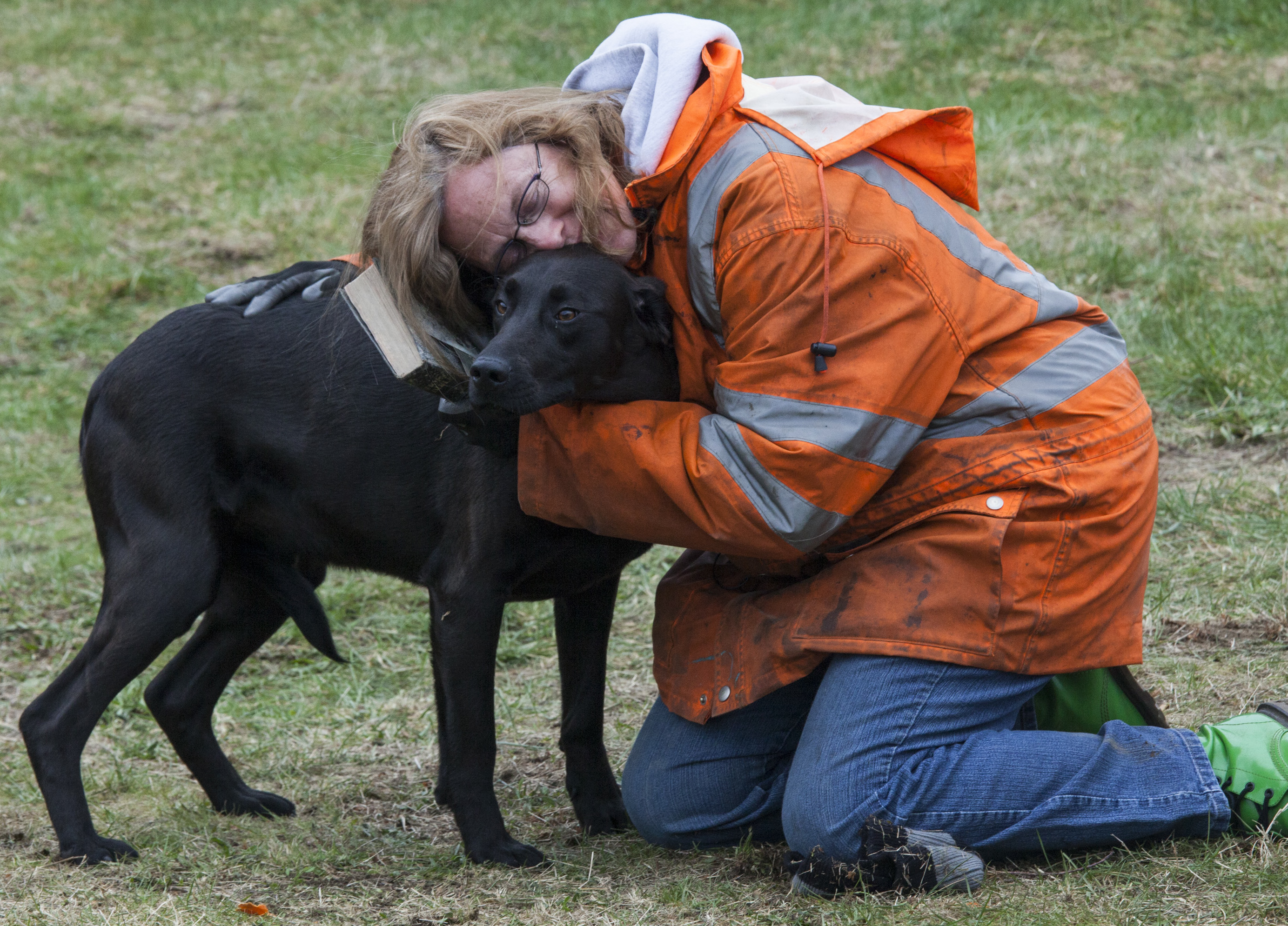
Elaine Young on March 25 hugs her dog, Bo, days after a mudslide narrowly missed her home in Oso, Washington. The massive mudslide killed at least fourteen and left many missing, and Young has assisted in the search-and-rescue efforts. By David Ryder/Getty Images.