Sticks And Stones And “Homosexual”

The NYT just ran a piece on the apparent disfavor the word now has among some homosexuals. I have a pretty good guide to figuring out what to do with such a question which is to check out what GLAAD is saying and believe the opposite. As a writer, there are few things that piss me off more than being told which words I can and cannot use. Fuck that shit. (See? It’s good to have a blog.)

The impulse, sigh, is political:

The Gay and Lesbian Alliance Against Defamation, or Glaad, has put “homosexual” on its list of offensive terms and in 2006 persuaded The Associated Press, whose stylebook is the widely used by many news organizations, to restrict use of the word. George P. Lakoff, a professor of cognitive science and linguistics at the University of California, Berkeley, has looked at the way the term is used by those who try to portray gays and lesbians as deviant. What is most telling about substituting it for gay or lesbian are the images that homosexual tends to activate in the brain, he said. “Gay doesn’t use the word sex,” he said. “Lesbian doesn’t use the word sex. Homosexual does.”

“It also contains ‘homo,’ which is an old derogatory,” he added.

But I like the term “homo”! I use it all the time – about myself and others, although I also often use “fag” as well. The gay thought-police would be aghast, but the intent is what matters. Mine is mostly benign. Mostly. But mainly, one great legacy of the gay community has been our love of freedom, especially of speech. For centuries and decades, the right to free speech was our only truly secure constitutional right. We were always about enlarging what was sayable, rather than restricting it. Banning “homosexual” also reeks of insecurity. We are not so tender we cannot handle a clinical, neutral term, or even a slur or the re-appropriation of a slur. “Queer” was one such reclamation, although that’s much more pointed than “homosexual” and certainly doesn’t reflect how I feel about my orientation. There’s nothing queer about being horny and falling in love or lust or getting married. They’re among the most common activities known to humankind. But I sure don’t mind others using it – and more and more heteros want to call themselves “queer” too. But my main objection to getting rid of “homosexual” is that we would lose a not-too-easily replaced non-euphemism.

We have too many euphemisms about our orientation and they bespeak the weak-kneed lameness that’s the real thing that should be fading away:

While the Times article notes that “scholars expect the use of the term to eventually fall away entirely,” it doesn’t really consider the problems that loss could cause. It’s worth noting that gay has contested meanings as well, and by my definition of that word—which, very generally, has far more to do with a historically and geographically specific constellation of aesthetic tastes, artistic styles and modes of relating than with genitals—there are far fewer gay people around these days than there are homosexuals.

One of Slate’s commenters went all Stoppard on us:

AE Housman: “Homosexuals”? Who is responsible for this barbarity?

Chamberlain: What’s wrong with it?

AE Housman: It’s half Greek and half Latin!

Chamberlain: That sounds about right.

When I wrote Virtually Normal, I had to decide on a unifying adjective. “Homosexual” seemed to me to be a way of reaching those who would read and hear the term as an indicator that I was not rigging the argument with pro-gay rhetoric. I’m fine with “gay”, and use it all the time. But persuasion is best done on neutral ground. Maybe the word has become less neutral since 1995. But I cannot think of a better one.

Still, while I’m at it, there is a “word” that seems to me worth retiring. Not by fiat, just by trying to avoid or ignore it. It’s the unpronounceable p.c. acronym: LGBT. God I hate that “word”. It describes no single person; it cannot be spoken easily; it reeks of bullshit.  No one started using that word of their own accord as a way to describe herself. It was created by leftists who believe that all oppressed groups are primarily defined by their oppression and that the very different lives and identities of gay men, lesbians, bisexuals and transgender are somehow all one. I know it’s an effort at inclusion. I appreciate the good intent. And if it had any wit or originality, instead of sounding like a town in Croatia, I could live with it. But it doesn’t.

So fuck that shit.
The Down’s Spectrum, Ctd

The discussion thread deepens:

Yes, there is a spectrum. My 16-year-old son, James, has Down’s. We knew that before he was born. We also knew that there was a problem with his esophagus. As it turned out, he was born with no esophagus at all. After several months in the NICU, he was operated on and the surgeons created an esophagus. We have to be very careful about what he eats. Happily, he is devoted to yogurt and hot cereals, which do not get stuck.

He is also very developmentally delayed and has some autistic tendencies. He has a few words but knows how to communicate his needs. He is very social and his receptive language is very good. He is the happiest person I know.

He has two older siblings, now 20 and 23. My wife and I recently talked to them about the decision that we made, including for them, when we decided to have James. They acknowledged that at some point they will be his care givers, at least to some extent. But, when we started to essentially apologize to them, they looked at us like we were crazy. “What are you talking about? He’s our brother.”

It has been hard, but none of us regret the decision we made. The commenters who are looking in at families like ours from the outside should think twice, because they have not experienced firsthand the joys that come with the difficulties.

Another mother of a disabled son shares her story:

Parental care of a medically and developmentally disabled child is sufficiently stressful that it has been found to inflict damage on the parents’ own DNA. This leaves the main caregiver (usually the mother) vulnerable to lethal diseases, shortening her genetically determined lifespan by an average of 13 years.

I am the mother of one such child, now in his thirties, whom my husband and I care for at home. Our son functions at a two-year-old level. He requires frequent surgery (over 20 major operations since his premature birth). He has been diagnosed with autism, cerebral palsy, severe vision loss, hydrocephalus, and retardation. He has had to endure horrible pain throughout his life. Most recently, he has become oxygen dependent again, much as he was following his preterm birth.

I am in my mid-sixties and nearing the end of my “three-year life expectancy” following a cancer diagnosis. Both literally and figuratively, we are asking parents to sacrifice their lives when abortion is banned in afflicted pregnancies or when sick, disabled newborns are medically “rescued” and handed over to their family for life-long care.

Another reader:

My brother, born in 1966, had Down Syndrome and was profoundly disabled, so he was in that 3% to 12% of children with Down’s who are unable to be without assistance. When he was born, his stomach was not attached to his intestines, and his heart had a “hole” in it. My parents were counseled to leave him at the hospital after his birth. They did not, and they chose surgery for his stomach, but not for his heart. When he died at age 17 months, he had never even lifted his head himself. He had not spoken, or crawled. He did not recognize his name, or respond much to others.

I’ve often wondered how I would be different if he had lived; I was raised as an only child. I do know, though, that were he still alive, and as disabled, I would be responsible for his care, as my parents are both deceased. I certainly wouldn’t have been able to care for him at home, and I truly wonder what kind of life he would have had.

After my brother died, my parents didn’t talk much about him – it was too painful, I assume – but my dad did tell me once that a friend of his was so moved that he, the friend, donated a substantial sum to research that led to amniocentesis. So maybe, because of my brother’s life, other parents can have vital information about their own children. Had abortion been an option, I have no idea what my parents would have done, but when I was pregnant, my father was adamant that I be tested. And my perfectly healthy son is named for my brother.

Quote For The Day

“I’m a black man. I’m happy to be black, and anybody that is not happy to be black will point around and ask for that kind of sympathy. But the thing is, let’s not ask nobody for no more sympathy. Let’s get together ourselves and support ourselves.

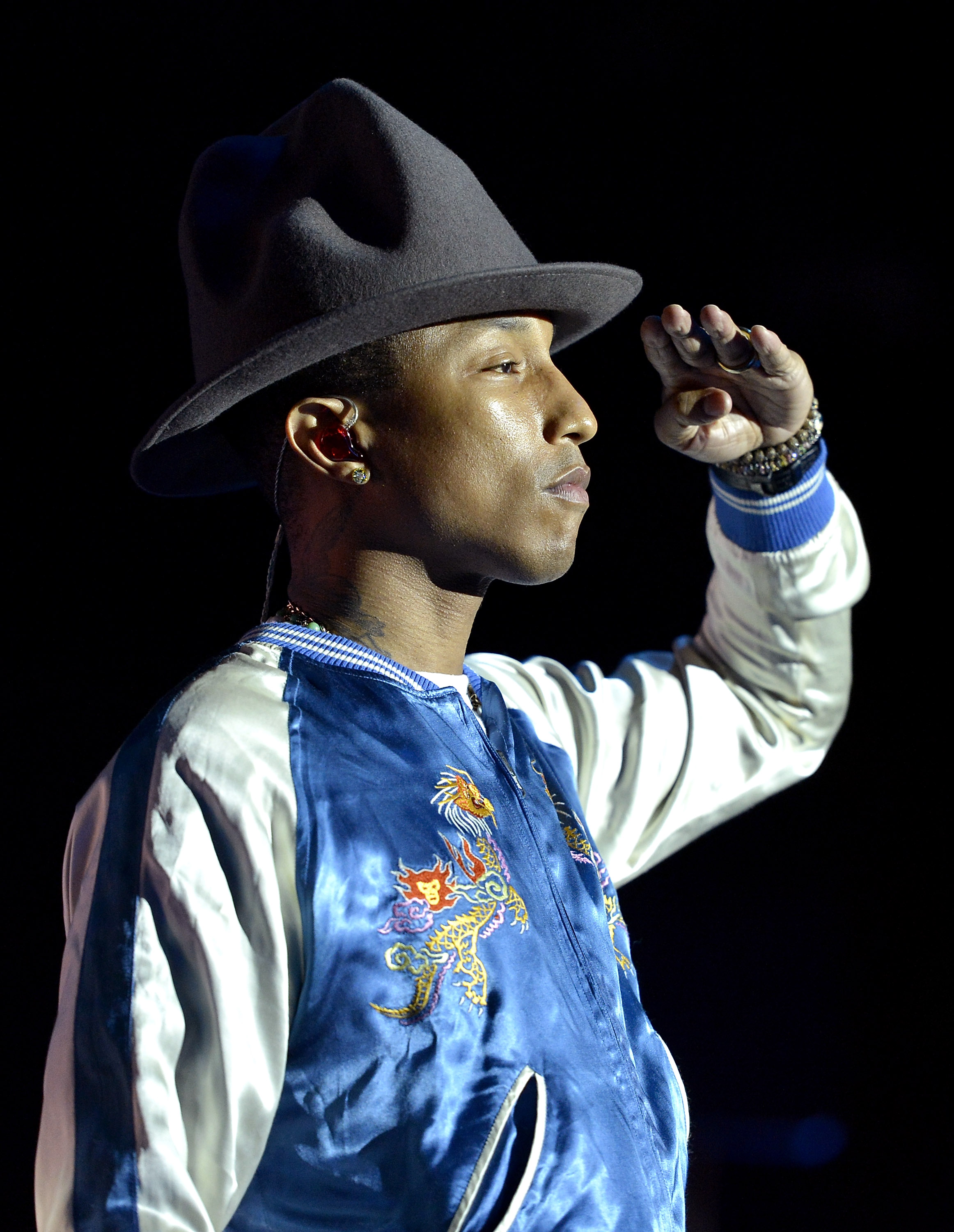
Pharrell Performs Live In BrisbaneIt doesn’t make sense to me. That kind of divisiveness is not necessary at a time when we’re supposed to be unifying. That’s what happiness is all about, and if you look at my “Happy” video, I had everybody in there: fat, skinny, gay, straight, purple, polka-dot, plaid, gingham print, houndstooth, alien. I fuckin’ had dogs in there! I had children in there! I had kids in there! I’m the most indiscriminate person that there is! I believe in equality.

So which is it? Is President Obama black or not? Since you’re so mad: Is he black or not? Come on, man! We ain’t got time for that. We are black people. This is the new black. Oprah Winfrey: That’s the new black. She’s a black billionaire. President Obama: He is a black American president. Regardless of what you think about him, this is his second term. That’s the new black. LeBron James: the first black man ever shot on a Vogue cover, a black man. Me: a guy that’s written a song at 40! Nominated for an Oscar, four Grammy awards—at 40! That’s the new black! And by the way: a song that has transcended my lyrics, my own intention, and has become a movement and helped cancer patients. That’s the new black! Black ain’t a color: Black is a spirit, and it is ubiquitous. In fact, there’s more black out in space than there is stars. We have nothing to be insecure about,” – Pharrell Williams, GQ.

I found it a helpful complement to this.

(Photo: Pharrell performs live at The Riverstage on March 12, 2014 in Brisbane, Australia. By Bradley Kanaris/Getty Images.)

What Can We Do For Uganda’s Gays? Ctd

On Sunday, the Obama administration finally followed the lead of European countries and NGOs by cutting aid to Uganda. In addition to withholding funds from Uganda’s Inter-Religious Council, which helps combat the HIV/AIDS epidemic, the US will suspend programs that might endanger gays and lesbians:

[B]ecause the law makes “promoting homosexuality” illegal, a U.S. funded study to help identify populations at risk of contracting HIV/AIDS has been suspended. The study, which was going to be conducted by a Ugandan university and the Center for Disease Control, has been suspended out of fear that both staff and survey respondents could be put in danger. [And] because any LGBT person or LGBT ally who now enters Uganda is at risk, money intended for tourism programs will be redirected. And finally, the Department of Defense had several events scheduled in the country later this spring and those will be moved to other locations.

Some worry that Obama’s escalating efforts this week to help Uganda hunt down the elusive warlord Joseph Kony sends a “mixed message” (NYT):

“Who wouldn’t want to get rid of this brutal rebel group?” said Sarah Margon, acting Washington director of Human Rights Watch, in a reference to the Lord’s Resistance Army, the guerrilla group led by Mr. Kony that has terrorized civilians in Uganda, the Central African Republic and the Democratic Republic of Congo. “But they’re not a direct threat to [Ugandan president Yoweri] Museveni right now, and what he gains by this is continued American support to his military, and legitimacy, just when he signed this [anti-gay] law.”

In a recent interview with Towleroad, Ugandan activist Richard Lusimbo discussed how tricky it’s been to cut aid to Uganda:

“If aid is just cut in general terms, the local person is going to suffer. This includes LGBTI people. It will promote the isolation of the LGBTI community and we will continue to be marginalized. People like David Bahati that have been promoting homophobia are going to go on the radio and say, ‘Look, people are dying because of the homosexuals. We can’t have medicine in hospitals because of homosexuals. We can’t have good water because of homosexuals.’ These are government responsibilities but because our economy hasn’t reached a point where President Museveni can support this, we are still depending on foreign aid.”

Lusimbo added: “We need to look at sectors where the government will feel a direct pinch. If that funding that the US gives to the army, if that were stopped, then that would have a direct effect. Donor countries should rethink and go back to the drawing table and look at how they could actually fund.

The concern is if aid is cut due to the anti-homosexuality bill, the pinch could have a trickle down effect on Ugandan taxpayers, Lusimbo said. “We have seen billions disappear in scandals. The money sent through the prime ministers office to support the development of Northern Uganda, didn’t go to any work, it was just swindled away. Ugandan taxpayers money was used to pay it back.”

Previous Dish on how to help Uganda’s gays here and here.

A Poem For Tuesday

redlaced

“Tuesday” by Jim Moore:

Some days, I am capable

only of caring about my new chestnut-colored shoes
with the red laces, which in Italy
seem demure, but in Minnesota
will give off the faint whiff
of a clown gone overboard, drowning
in his own ridiculous sea.

Previous poems from Moore here and here.

(From Invisible Strings © 2011 by Jim Moore. Used by kind permission of Graywolf Press. Photo by Tim Samoff)

So Why Do Employers Make Our Insurance Choices Again?

As Hobby Lobby arguments continue, Margaux J. Hall takes issue with the status quo:

[F]or decades we have allowed our employers virtually unfettered freedom to make all health coverage decisions – not just those related to contraceptivess – on behalf of employees and, in many instances, their family members. Why? Isn’t it time to rethink how we got to this place and whether we should do something about it?

Americans often fail to notice that a striking imbalance exists in health insurance purchasing: Although health insurance belongs to the employee, the employer gets to decide what that insurance will cover and under what terms. While contraceptives are the current lightning rod for controversy between employers and employees, tensions have emerged over the years around a whole range of health services, including treatments for autism spectrum disorder, in vitro fertilization, and bariatric surgery.

Why does health insurance actually belong to the employee? Because the employee pays for it – directly and indirectly. Though both employees and employers generally co-finance insurance premiums (in 2012, employees reportedly paid an average of 18 percent of individual plan premium costs, and 39 percent of family plan premium costs), employees functionally fund 100 percent of premium payments.

Russia Loses Its Seat At The Table

https://twitter.com/ianbremmer/status/448423006843703296

Ioffe calls the G8’s transformation into the G7 “a clarifying moment”:

Russia insists that it is a European country, and insists on maintaining its membership in various Western clubs and treaties, but when it is accused of violating post-War European norms—guess which government faces the most suits in the European Court of Human Rights?—howls about Russia’s uniqueness and European chauvinism and double standards.

It’s been tough balancing act to maintain, one that Russians call “sitting with one ass in two chairs.” Today, the West and Japan provided a clarifying moment by pulling one chair away, ending the agony. And it’s about time. Russia, in insisting on its mystical duality, has been, increasingly, a thorn in the organization’s side—as well as its own.

Larison expects the move to accomplish little:

Since Putin now seems interested in appealing to a more nationalist audience at home, I doubt very much that keeping it out of G-8 meetings will “sting” at all. After all, being “banished” from the company of Western governments is what many of Putin’s supporters at home desire. … The other members of the G-8 are obviously free to exclude Russia from their meetings, but it is silly to think that this punishes Russia in any meaningful way. The more that Western governments try to ostracize Russian leaders, the easier it will be for them to ignore Western complaints and demands, which defeats the purpose of the ostracism.

Allahpundit suspects that Russia wouldn’t have to do much to get back in the club:

Given the EU’s palpable reluctance to alienate Russia’s energy sector — the price of natural gas just went up in Kiev, don’tcha know — and the continent’s wider terror at a new round of Russian military adventurism, how little would Putin have to do for the G-7 to pronounce him rehabilitated and to re-admit Russia to the group? They’re desperate to keep things on a “diplomatic track”; if Putin turned around tomorrow and said he’d pull Russian troops off the Ukrainian border and return to that track in exchange for western recognition of Crimea as Russian territory, would the G-7 go for that? If instead Putin made a move on eastern Ukraine and then, having occupied it, renounced further claims on the country, would that be enough to turn the G-7 back into a G-8? My sense is that there’s virtually no limit to the slack the west will cut him in return for putting his guns down, so long as he doesn’t make a move on a NATO country.

It’s OK To Bareback … On The Toilet, Ctd

Readers keep the very important thread going:

I wanted to share a useful tip for using paper toilet-seat covers (or “ass gaskets”, as they’re commonly known). If you deploy it the “normal” way, so that the flap hangs down and touches the water in the bowl, it quickly wicks up water and pulls itself partially off the seat before you get a chance to sit down. I’ve found that they work much better if you fold the center “flap” down and leave it outside the toilet bowl.

Another puts things in perspective:

Here’s the thing: the germs to fear in a public restroom are on your hands. So taking a paper cover and using your hands to fix it to the seat is significantly more disgusting than having germs on your outer butt cheeks. The last thing you need is your hands on the seat.

So if you want to avoid the germs of a public restroom, wash your hands thoroughly, then only touch the faucet and door handles with a paper towel.  Try not to think about the germs from all those badly washed hands covering the doorknob as you go back out into the world.

Another woman’s strategy for avoiding germs:

My grandmother used to carry a full-size can of Lysol and spray the seat prior to use and then wipe with toilet paper. She rejoiced when Lysol came out with a purse size can so she doesn’t have to carry a huge pocketbook anymore. My sisters and I have also kept the habit. When my babies were young, I would Lysol the changing table and then dry with spare diaper just for that purpose. I also “cleaned” up after my kids when they “missed” aiming while potty training.

I found that if people care, they clean up after themselves. For example the public restrooms in Walmart are universally a mess whereas the ones in Target are generally clean. The cleanest public bathroom I ever found was at the African-American Baptist Church in Jacksonville, Florida. The church ladies not only cleaned up but would scold anyone who “made a mess”.

Another notes a flawed technology:

I used to live in Chicago, which meant I used O’Hare airport with some regularity. At some point in the last 20 years, O’Hare switched from relatively normal public-type toilets to commodes with electric-eye-operated automatic toilet-seat-cover dispensers. Every time a person would enter (or leave, I guess), there’d be a little whirring sound and a fresh segment of plastic wrap would circle round the toilet seat. Voila! I can only image the cost of this system.

The only problem was that either to make the engineering functional or to save money on plastic toilet seat wrap, the bowl and toilet seat are shrunk to about 70 percent of their normal size and are perfectly round. This complete disdain for ergonomics (in a place one would hope they’d be paramount) means that using one of these toilets is akin to squatting over a cellophane wrapped coffee can. Not exactly conducive to the peace one hopes to attain through one’s Morgenscheisse (to employ a favorite Dish-found word).

Toilet-seat covers are a boondoggle, and I’m glad I now live near Boston, whose Logan Airport has normal shitters.

Update from a reader:

No reader has addressed the most criminal flaw in public toilet technology: the auto-flush that flushes when you are mid-stream, spraying god-knows-what onto your nethers. This is far more distressing than any germy seatcover could ever be.