Will Christianity Empty The Churches?

800px-tolentino_basilica_di_san_nicola_cappellone_14

That’s the point made by my friend, Damon Linker, who’s been writing up a storm at his perch at The Week. He recently made the strong case that liberal and conservative ideas about human equality have deep roots in Jesus’ universalization of the call to love and forgiveness. And that very powerful idea has indeed propelled women’s and gay rights in this century. I’ve never made an explicit connection between my Catholicism and my support for gay equality – but it’s probably, along with my own self-respect, the key driver for my activism. But as modern Western society embraces gay and female equality in principle and increasingly in practice, the churches that remain implacably opposed to full equality for men and women in the church are beginning to feel the strain.

Damon thinks Mormonism (currently fast-growing worldwide) and Catholicism (currently in deep flux) are the primary victims. And the most glaring fact about them is restricting priesthood for men and men alone:

Think about it: Men and women in the pews now live in a world in which nearly all obstacles to women’s equality have been torn down. Where once women were relegated to submissive and subservient roles in the family, now domestic gender egalitarianism is the norm. Where once women were excluded from participating in politics — including denial of the vote — such strictures are now unimaginable. Colleges and universities that were once all-male have become coed. Just about every career that once excluded women is now open to them — including that most traditionally masculine occupation, military service. And so forth.

I should say that by far the biggest influences on my faith have been women: my mother and grandmother. Richard Rodriguez and I spoke about this at length when discussing religion and civil rights:


I find the arguments for a male-only priesthood to be as weak as Damon does. Just because Jesus’ 12 disciples were men? Please. From everything we know about the early church, it was unusually filled with women, just as Jesus refused to abide by the idea of excluding women. Only women and his beloved John were at the foot of the cross; it was to women that the risen Christ first revealed himself. Ed Morrissey offers another theological reason for the exclusion of women from the altar:

The belief in the actual presence of Christ in the Eucharist and the Liturgy of the Eucharist as a connection to the one sacrifice at the eternal wedding feast forms the substantial argument for ordaining only men to the priesthood … However, it’s at least a fair point to admit that many Catholics never hear this teaching, for reasons of poor catechism at home or in churches and schools …

Furthermore, the Church’s role isn’t to change with the times anyway. It’s to defend what it teaches as revealed truth, and to spread the truth rather than take polls. That may indeed produce an impulse for congregants to leave, but that may be a symptom of poor catechesis rather than a refusal to change doctrine to suit the modern temperament. If an exodus occurs, that would be the cause, not a refusal to rewrite doctrine.

Seriously? A theological metaphor that sees all Christians as women and Christ as our groom? I know the theology but find it as weak as mere recitation of precedent. And the argument here is not that the church should bend with the times, but that the church should always be considering and reconsidering whether what it does is fully in the spirit of the Gospels. Excluding women is something Jesus never ever did. Why shouldn’t the church follow his example?

(Painting: Detail of Mary Magdalen kissing the feet of the crucified Jesus, Italian, early 14th century. Via Wiki.)

What To Expect From Hobby Lobby

As Sam Baker sees it, “the legal battle over Obamacare’s contraception mandate is essentially tied as it heads into Tuesday’s Supreme Court arguments”:

Both sides have suffered some bad losses in lower courts, and the weaknesses that hurt them before could spell trouble again on Tuesday. The Court has combined two cases on the birth-control mandate – one the government won, and one it lost. Both challenges were filed by for-profit companies that say the mandate violates the religious beliefs of their owners. Five federal appeals courts have heard such challenges, and their rulings are a mess of conflicts. The courts not only disagree with each other, they’re also divided internally. As judges agreed on one question but disagreed on another, the 10th Circuit Court of Appeals cobbled together four different majorities in one ruling against the mandate. (That case, filed by Hobby Lobby, is one of the challenges before the Supreme Court this week.)

In other words, there are good reasons why each side might lose at the Supreme Court.

Tom Donnelly considers the conundrum facing Chief Justice Roberts:

On the one hand, Roberts is confronting the ACA for the first time since the conservative firestorm over his decision largely upholding the Act. There’s little doubt that he’ll be tempted to throw conservatives a bone, siding with Hobby Lobby and against the ACA.

On the other hand, a vote in favor of Hobby Lobby requires the chief justice to do at least three things that threaten major disruptive consequences and present serious downstream risks for the Court as an institution.

First, he must conclude that corporations have the same rights to religious freedom as living, breathing humans – something that the Supreme Court has never done. Second, he must unsettle centuries of well-established corporate law practice – a move at loggerheads with the Roberts Court’s (and John Roberts’s own) pro-corporate leanings. And, third, he must extend unprecedented protections to a secular employer, therefore opening the floodgates to new religious freedom challenges to countless other laws. In short, a vote for Hobby Lobby means endorsing a radical departure from well-settled precedent—perhaps nowhere more strikingly than in the realm of religious freedom.

Beutler says the Hobby Lobby case may expose hypocrisy on the conservative arm of SCOTUS:

If Hobby Lobby et al. manage to successfully pierce the veil, to the end of avoiding the contraception mandate, the court’s ruling, if drawn broadly enough, could be used to expose shareholders to liabilities that incorporation is intended to eliminate. It stands to reason that this contradiction at least partially explains why major corporate trade associations have either remained neutral in this case or actually come down on the side of the government.

It also creates an interesting test for this particular court, which, under the leadership of Chief Justice John Roberts, has been remarkably solicitous of corporate imperatives, but has also been sensitive to those who claim their religious liberties have been threatened or curtailed.

Scott Lemieux adds:

Before tomorrow’s oral arguments, let me note again that people interested in the latest ad hoc legal challenge to the ACA should definitely look at Marty Lederman’s series of posts, helpfully collected here. We’ve already discussed one of his crucial points, namely that there is no contraception “mandate.” Hobby Lobby is not legally required to compensate its employees with health insurance at all. The regulations imposed by the ACA are on insurance plans, not on the corporations per se. What is erroneously described as a “mandate” simply means that if corporations choose to take advantage of the tax benefits for compensating employees in health insurance rather than wages, the insurance has to meet minimum coverage standards. As is often the case with specious religious freedom arguments, the corporation wants it both ways, to get the tax benefits without providing the full benefits to employees.

Lowry dissents:

The truth is that the Obama administration wants to bring Hobby Lobby to heel as a matter of principle. In its pinched view of religion, faith should be limited as much as possible to the pews. In its attenuated regard for civil society, it believes government should overawe any person, business, or institution whose beliefs run counter to officially sanctioned attitudes.

Meanwhile, Volokh responds to critics of Religious Freedom Restoration Acts who say that a lot of religious exemption claims don’t have any real support in the Bible:

The American law of religious exemptions is individualistic. The right to a religious exemption belongs to a particular religious believer because of his sincere religious beliefs, whatever they might be. Small denominations are protected, to the same degree as large denominations. The same is true for dissenting groups within denominations. It’s even true for idiosyncratic religious believers. One doesn’t need a note from one’s priest to prevail in a religious exemption case.

Moreover, American courts are constitutionally forbidden from determining what the Bible – or any other religious work – really means. Courts are forbidden from determining whether a belief is reasonable.

Noah Feldman insists the issues go beyond the ACA, religious liberty and contraception:

If all this weren’t enough for you, the fourth issue is arguably more important than the first three: whether corporations are people, too. In Citizens United v. FEC, decided in 2010, the Supreme Court held that free-speech rights should extend to corporations because organizing people to speak more effectively in concert was one of the functions that corporations serve. The case – which as interpreted by the lower courts gave us super-PACs – involved a nonprofit corporation, but it extended to for-profit companies as well. Criticized by Obama in the Supreme Court’s face during a State of the Union address, the decision has been a touchstone for those who would brand the Roberts court as activist and pro-corporation.

The Hobby Lobby case requires the justices to decide if the rule they announced for the free speech clause of the First Amendment applies to the free exercise part of the same amendment. For some liberals, this means an opportunity to reargue Citizens United. For conservatives, it’s an opportunity to depict the rights of corporations in a far more attractive light than corporate political speech. Many sincerely see no difference between a company’s owners and the company itself. Liability should be limited, they believe, but not fundamental free exercise rights.

And finally, Jason Millman suggests Hobby Lobby isn’t necessarily the case to watch today:

At the same time Tuesday morning, the District of Columbia’s Circuit Court of Appeals will consider whether Obamacare allows premium subsidies to flow through federal-run health insurance exchanges. That case has been called “the greatest existential threat” to the survival of the health care law by one of Obamcare’s staunchest supporters. … If we’re just thinking about what these cases could mean for Obamacare’s future, the cases related to federal subsidies are a much bigger deal. Opponents to the law are challenging the IRS interpretation that Congress authorized individuals in states with federal-run exchanges to access premium subsidies.

If the opponents’ challenge is successful – and the law’s supporters say the cases are a real longshot – it would deal a major blow to the law in the 36 states with federal-run exchanges.

The View From Your Window Contest: Winner #197

vfyw_3-22

A reader thinks he recognizes an important landmark in this week’s photo:

It’s the Oh Shit Bridge!

Rather, the bridge in the far background, mostly hidden behind the similar-looking one, is the Naval Academy Bridge across the Severn that crosses from the Naval Academy and the town of Annapolis towards the Bay Bridge and the Eastern Shore. When you’re coming back from leave, the Academy comes into full view when you start crossing the bridge, hence its name among midshipmen, as in, “Oh shit, I’m almost back at the Naval Academy!” This photo has been taken further up the Severn, looking out towards the Chesapeake.

Another:

Bridge geek here. Older steel bascule bridge on the far left, AASHTO-type girders front and center on both the harbor bridge and the channel elevated bridge. Other than that I have no idea, so I am going to guess Pensacola, FL, since I am about 80% sure of this: it’s the South, we are looking west, and it’s not the Keys.

Another reader:

This sure looks like it could be the bridge from San Diego to Coronado. I’ve only been there once, actually a year ago this week, to stroll about the famous Hotel del Coronado with a dear friend, a woman I hadn’t seen in 52 years. It was great.

Another heads inland:

This is my first time submitting. This looks to be the boat dock in Decatur, Alabama located on the Tennessee River.  The bridge appears to be one I have crossed many times on my way to Interstate 65 via Decatur.

Or is it way up north?

The boats are parked at the Canarsie Pier in Brooklyn, NY, with the Belt Parkway in the background. If not, it sure looks a lot like it.

Another heads down Interstate 95 for a look at the boating scene:

The long, low bridge and types of boats shown here take my thoughts to southern Florida, perhaps south of Miami, or somewhere in the Keys. Sailboats, which can be demanding to operate even in the lightest weather conditions, are heavily outnumbered here by motor yachts. Those vessels bespeak an older population of owners: cautious, conservative, and comfortable, who may never even leave the harbor, but who enjoy the ambience of the marina and, from time to time, perhaps invite the boat owner on the other side of the dock to come have a tall one and shoot the breeze for a while. The chairs up on the main dock are very inviting.

Another:

This picture just reeks of the Southeastern US, but I can’t find any set of bridges that matches the configuration seen in the photo. Biloxi has plenty of casino hotel rooms to provide views of this sort, so that is my guess. I can’t wait to see what people came up with for tracking down boat registries.

Or sales listings, which we’ll get to. This reader gets the right state:

Looks like Morehead City, North Carolina, and in particular, a view from the waterfront Marriot.  Spent a weekend there last summer and traveled back in time – just a quaint, historic little piece of North Carolina.

Another reader, like the majority of our contestants this week, identifies the correct town and hotel:

This one came fairly quickly to me, as it definitely looked like a coastal area in the Carolinas.  I ruled out any areas in the Lowcountry region of South Carolina due to a lack of palmetto trees or marsh, so North Carolina came to mind.  The bridges help it determine that it’s New Bern, as there are several crossings of the Trent and Neuse Rivers, which meet at the point where historic New Bern was founded.  A beautiful and historic town!

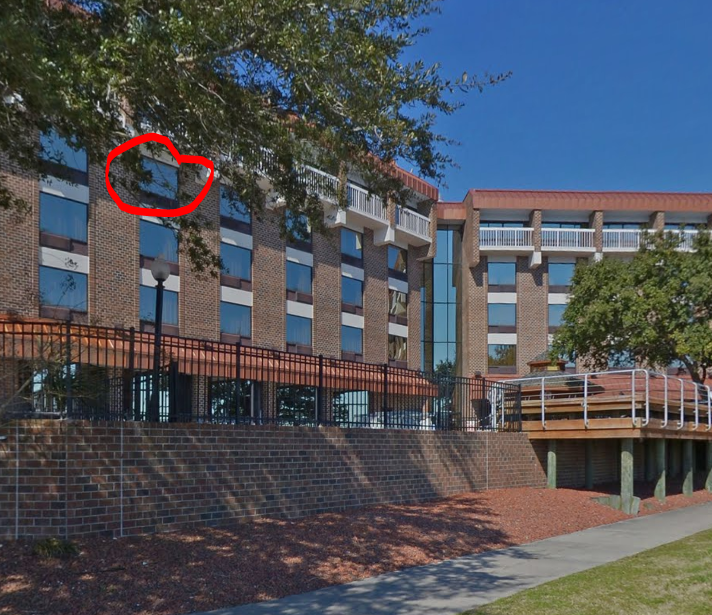
The view is one towards the southeast and appears to be from the fourth floor of the DoubleTree by Hilton Hotel that was built in bicentennial park, overlooking a second story pool and the docks, which are angled acutely to the shore.

This is my first time entering into the event!

A local is also ecstatic:

Oh. My. God.  I cannot begin to tell you how excited I was to see this week’s VFYW.  It’s right in my home town of New Bern! I’m so giddy I can barely type this email.  I’ve never gotten closer than the country of a contest in the past, so imagine my surprise when I scrolled down your site and thought – holy shit, that’s where I live!  Somehow, I’ll find a way to lose this contest, I just know it.  Just know that someone in New Bern, North Carolina loves Andrew Sullivan (& Co.) and is a founding (and renewing) member and is more excited than he should be that he knows this week’s answer.

Well, now for some details.  This shot is out of the rear window of the main building of the Doubletree Inn, formerly the Hilton, formerly the Sheraton, overlooking the now privately-owned Marina.  Next door are some recently completed condos, making the hotel complex effectively three separate buildings.  Not bad for a town of about 30,000.  In the back, you can see the recently renovated cantilever bridge that caused a lot of controversy down here when it was built (long story).  The deck at the bottom left hosts live music events in the summer.

New Bern itself is the colonial capital of North Carolina, the sister city of Bern, Switzerland, and bearFlagcelebrated its 300th anniversary in 2010.  Out mascot is the bear. Go ahead and Google our former mayor Lee Bettis if you want some good laughs. The Marina sits at the confluence of the Trent and Neuse Rivers and today it is absolutely gorgeous here.  Ah, New Bern.  I can’t believe it!  I am nearly certain someone who doesn’t live here will also know the answer, will send you pictures of the window from which the picture was taken, complete with graphs and charts.  But I bet nobody else will tell you that they’ve had drinks at the table with the blue and white umbrella (I have), or that the last deck party at the hotel that they attended was two weeks before the birth of their first child (my wife got some disapproving looks that night).  So if I lose because someone gets more specific about the picture, so be it.  I’ll have a story to tell my kids.

By the way, New Bern got a shout-out in last night’s “Better Know A Disctrict”; evidently the town was featured in The Notebook. Another reader:

At first glance, I thought of Tampa Bay, but then switched to New Bern, NC. For such a tiny town, New Bern has an impressive array of bridges. The airport is small – the person who checks you in runs round the back and loads your bags, then checks your boarding pass at the gate. It’s also near the awesomely (and aptly) named Dismal Swamp. If it’s New Bern, the pic would probably have to be from the Bridge Point hotel, as I can’t think of another one directly on the water. That’s the extent of the research/trolling through my memory I’m willing to do given that it’s probably actually somewhere in China, and someone else will have hacked a NASA satellite to take a picture of the person currently occupying the correct room shaving in the bathroom mirror.

It was the structure at the base of the closest bridge that did it for me; it looks familiar:
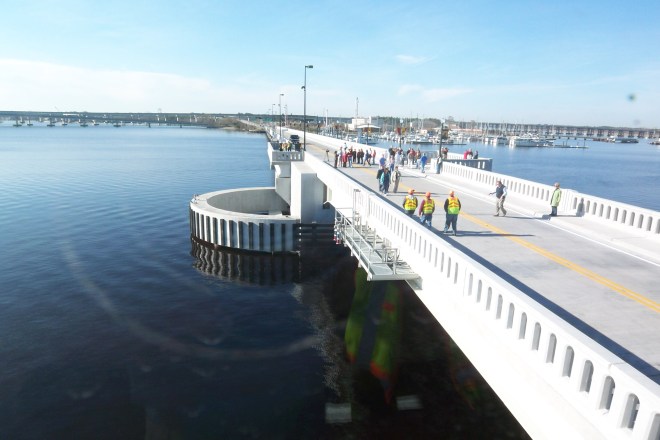
New Bern Bridge

Many readers focused on the boats for clues:

My immediate gut reaction was Coronado, CA, but a quick check of Google Maps and Street View indicated that the bridge was wrong. My next thought was somewhere along the Florida keys; but it only took about 5 minutes of scrolling along US 1 in Google Earth to recall that the majority of the bridges in the keys were flat and not arched. I figured I best step back and really take in the clues.

My first thought was to check boat registrations on the two names that are easily visible – Carpe Diem and High Five, but there are just too many possibilities and it didn’t look like I could easily sort it out that way. The next step was to search on Neptune. That one boat in the foreground has several banners on it and then the Carpe Diem named boat next to it has one so it looked like it was a tour boat service of some sort.

I messed around with a couple of Google searches using Neptune boat tours and kept coming up with wine tours in San Fran. When I was searching for boat registrations for High Five, I noticed a bunch in the Virginia area and that got me thinking about the Chesapeake Bay. When I searched on “neptune boat chesapeake” I immediately go a hit on that logo and noticed the Trident shaped E matched the one in the photo – Bingo!

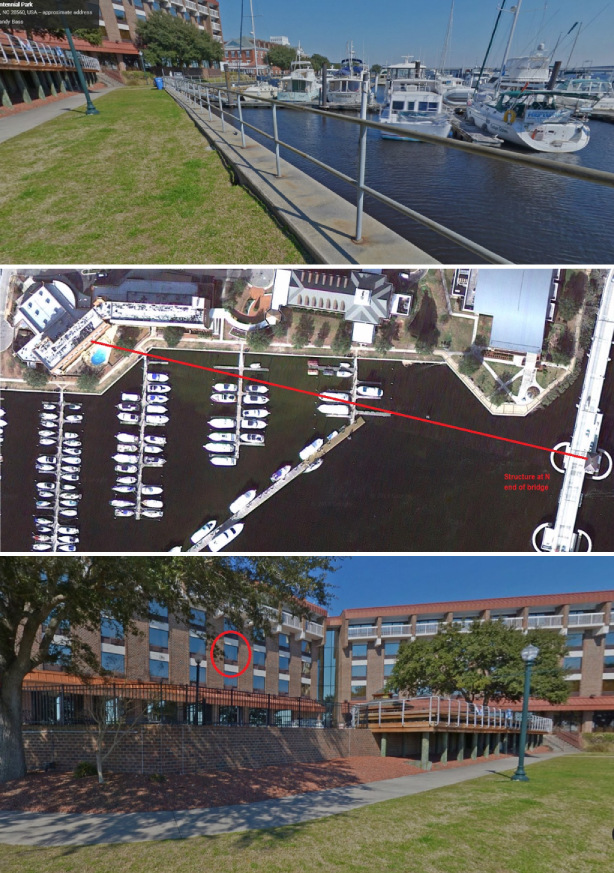
From there it was a quick search of the Neptune Yacht sales website to see that they’re in New Bern, NC. Just typing in New Bern, NC into Google Earth and you can immediately see the arched/curved bridge and the perpendicular one. X marks the target zone (and the marina):
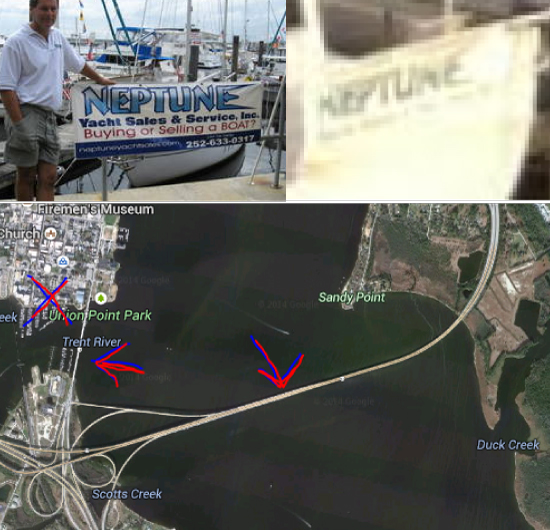
image-5

Zooming in on the marina you can pretty quickly spot the pool and fence that shows up in the photo. Ximage-12 marks the fence and pool chairs that belong to the Double Tree/Hilton. The room clearly looks out over the pool, facing South East – the camera view is just slightly beyond the pool. The circle is the room, the line is the view, the X are the pool chairs. In the frame of the photo, you are just to the right of the fence line that returns towards the hotel so I think it’s that 5th window from the end. The question is which floor…

The view is relatively high up, but there are no signs of the balcony, which is only on the top/5th floor. My bet is therefore the window on the 4th floor, circled below:
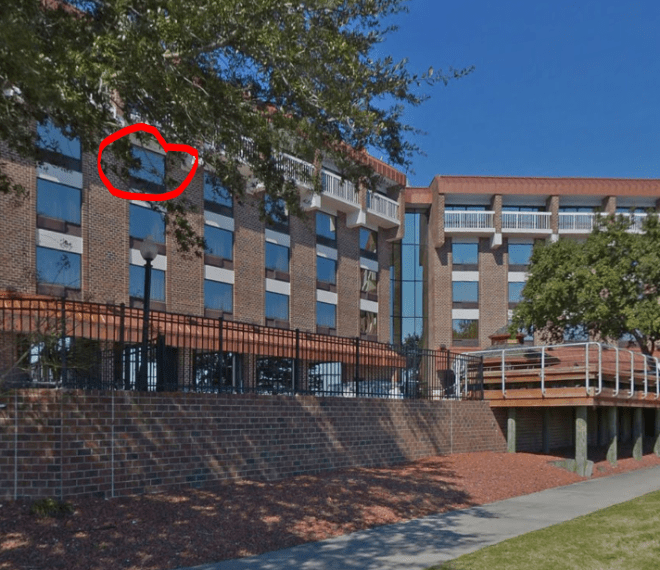
image-11

Another has more on the boat:

Using the marina and landmarks in the distance, I’m guessing that the picture was taken from the seventh room from southwest corner of the south tower. According to a reviewer in Trip Advisor, the fifth floor is the only floor with walkout balconies, so this along with the angle leads me to believe the room was on the third floor.

As an aside for the nautically interested, the sailboat “Carpe Diem” in the middle of the marina, is a well maintained 1995 Beneteau Oceanis 400 for sale and recently reduced to $98,900:
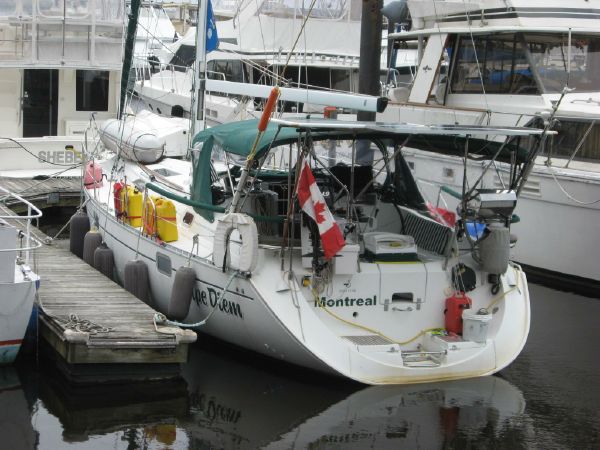
CarpeDiem

If anyone’s interested in buying the boat, several admiring readers passed along the link. Another:

I know people usually name the room number, but I have NO idea how they do that. So … let’s go with room 302, which might instead be numbered 319, 332, or 339, depending on how rooms are numbered on the floor plan. Or maybe 303/318/333/338???

You’ve won my dad’s interest in this contest. So we’ll be doing these together now, and since he did the legwork on the city, he’ll get the book if we win this time.

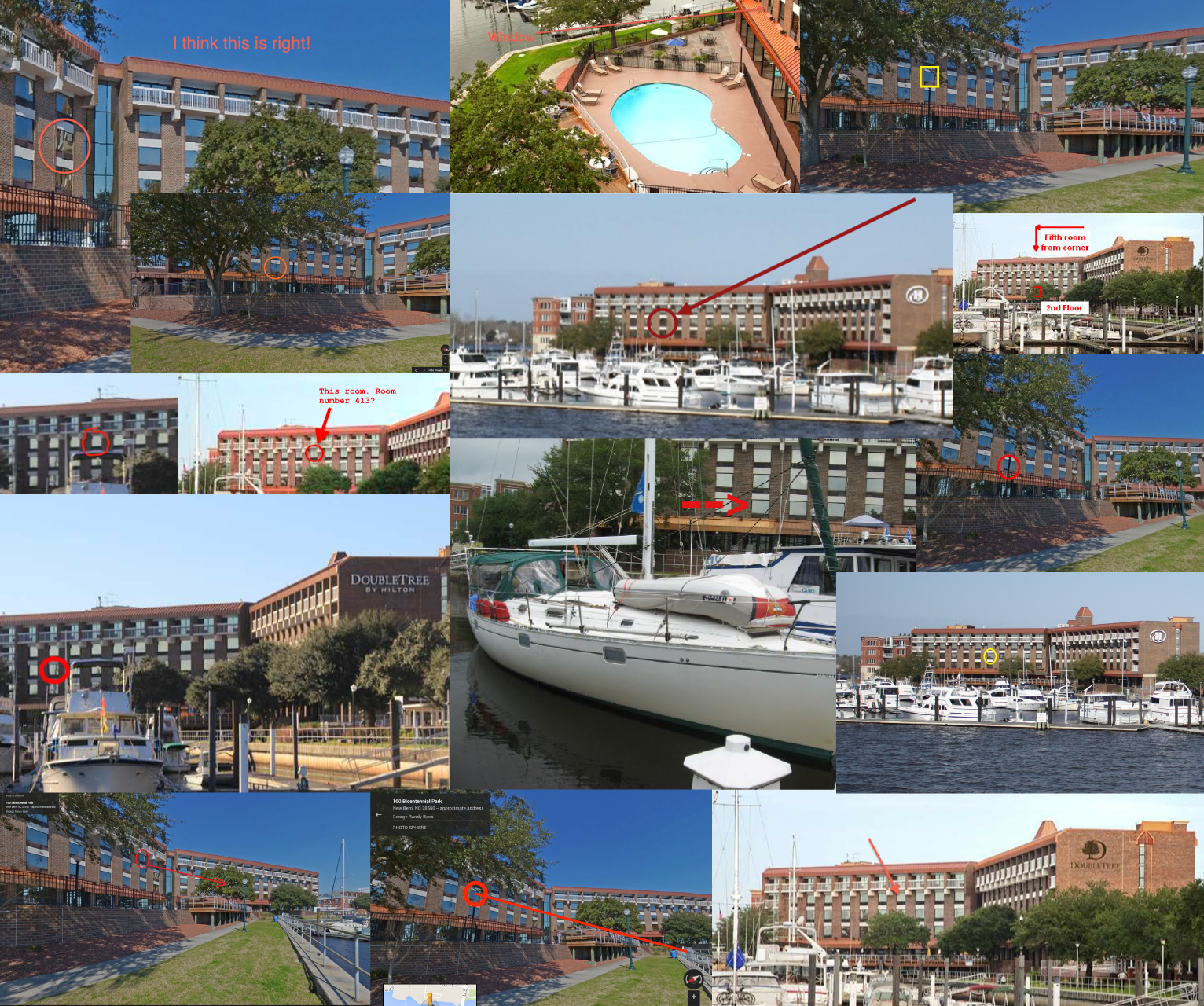
You two were close! Many readers guessed correctly this week, but nobody picked the right room number, not even Chini. Here is a composite of many of the (incorrect) window choices this week:
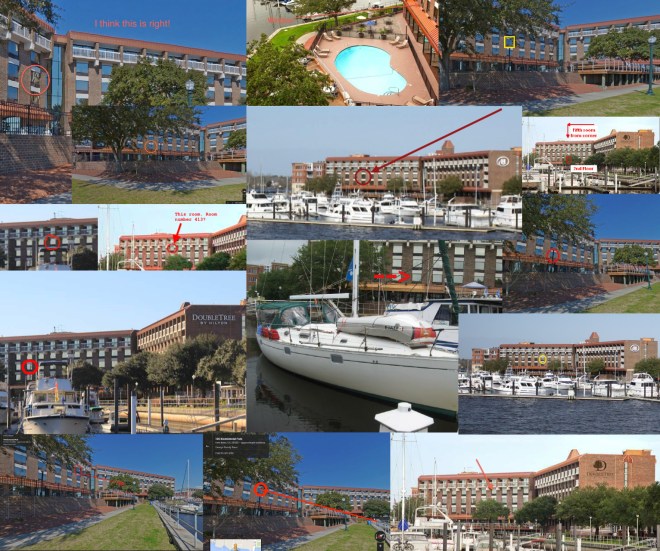
new-bern-vfyw-composite

Of the few people who guessed the correct window, the following reader had the most previous correct guesses without a win, so he gets the prize this week:

First thing that popped into my head this week was “Tampa Bay.” A quick map check showed that was not right, but it seemed something along the intra-coastal waterway or maybe up the east coast of the US. Once I figured out the configuration of the bridges – with three distinct spans at the right side of the picture – I spent some time panning around maps looking for them. No luck.

neptuneNext I decided to search on the names I could see on the boats. Do you know how many different boat-related enterprises use the word “Neptune”? Do you know how many people name their boats “Carpe Diem”? Finally I stumbled across the logo of Neptune Yacht Sales and Service of New Bern, NC, which looked like a match.

And there it was, the New Bern DoubleTree, overlooking the marina and the bridges. I found a picture from 2005 with a similar scene; there is a drawbridge span that has clearly been replaced since then. Going to Street View and looking back from the structure at the north end of the bridge – probably a drawbridge control room – gave me a line to the room. Street View also had a picture taken at the back of the hotel which shows the same two Neptune boats and the back of the hotel. Looking at the angle I guessed it was the third floor, and based on the overhead I figured fourth window over from the right.

VFW-20140322-Window

I got last week’s hotel right but miscounted the floors, missing the correct window by one. Hoping I am a little more accurate this time.

Accurate enough for a big win. From the original submitter:

This picture was taken on February 17, 2014, from the window of my hotel room (#307) at the Hilton Doubletree Hotel in New Bern, North Carolina. I believe it was the 4th window from the center of the hotel (the hinge or bend), on the 3rd floor, behind the top of the tree on the left. A sleuth can discern that the scene is in New Bern by the several banners advertising Neptune Yacht Sales, a business located in New Bern.

(Archive)

A Staggering Death Sentence

https://twitter.com/jonleeanderson/status/448176865929613312

The numbers:

An Egyptian judge on March 24 sentenced 529 Muslim Brotherhood supporters (147 in custody, the rest at large) to death for the killing of one police officer—in the largest capital punishment conviction in modern Egypt. Though the sentences can still be appealed, they offer a stark illustration of the depths to which Egypt’s political conflict has plunged.

Magdi Abdelhadi calls the decision “preposterously self-defeating”:

[M]ost observers will conclude that the verdict is political, designed to send a message to the Brotherhood and its backers abroad – in Cairo this usually means Turkey and Qatar, which have made no secret of their unwavering support for the Brotherhood– that the Egyptian state is still in no mood to compromise with the Islamists: surrender or annihilation.

But coming down with a sledgehammer on anything that moves makes the government look more like a raging bull than a confident operator playing by the rules. It also adds to perceptions of the Brotherhood in the outside world as clear victims, despite the fact that government action against the Islamists still enjoys broad support in Egypt itself.

McBain was repulsed by the reaction within Egypt:

So is the judge Saeed Elgazar acting on a personal grudge against Morsi’s Islamist party, or is he coming under political pressure? This isn’t clear, but what is more evident, and deeply disturbing is that several Egyptian news channels welcomed the verdict. One TV presenter argued yesterday that: “The state cannot meet violence with violence? What should it meet it with? A wedding procession? Ball gowns?”

Lucia Ardovini and Simon Mabon add historical context:

What must be remembered is that what is happening in Egypt is not new but can be traced back to several previous periods in recent history. This cycle of Islamist engagement within politics followed by violent repression also occurred under Nasser, Sadat and Mubarak. What is clear is that the Muslim Brotherhood faces the most severe challenge to its long-term stability since the time of Nasser.

Anna Newby believes that Egypt won’t actually kill all the convicted Muslim Brotherhood members:

The convicted group can appeal the ruling, and legal experts say the case is likely to be overturned or rejected by the Grand Mufti, the country’s official authority for issuing religious edicts, who reviews all capital punishment sentences. The court determined that a final verdict would be issued on April 28. In any case, the idea that Egypt would actually execute the 529 people it sentenced to death today is far-fetched. A state execution on that scale would be unprecedented, and as Karim Medhat Ennarah of the Egyptian Initiative for Personal Rights points out, it would be impossible to prove that each of the 500 people had a significant part in the killing of a single police officer. He adds: “Clearly this is an attempt to intimidate and terrorize the opposition, and specifically the Islamist opposition.”

Juan Cole weighs in:

Among Middle Eastern countries, the most execution happy is Iran, with over 300 a year. With just one trial, Egypt has made itself more Draconian than Iran.

And it appears to be just the beginning:

Update from a reader:

This seems minor, but it strikes me as odd: It seems that the Guardian and McBain both called the judge who handed down the sentence “Saeed Elgazar” (or in the case of some Guardian articles, “Saeed Youssef Elgazar”). The problem: “Saeed Elgazar” in Arabic literally translates to “Happy the Butcher.” I thought this was awfully poetic, so I searched for the name in Arabic sources. All I could find as far as clear references to him were in Brotherhood-related sources; the relatively reputable Almasry Alyoum, for its part, gave his name as simply “Saeed Youssef” in its original article on the sentencing (article is in Arabic). I suspect we may have a bit of Brotherhood spin leaking out. If I am wrong and that is his name, of course, it is delightfully if darkly poetic.

Yglesias Award Nominee

“Changing the employee conduct policy to allow someone in a same-sex marriage who is a professed believer in Jesus Christ to work for us makes our policy more consistent with our practice on other divisive issues. It also allows us to treat all of our employees the same way: abstinence outside of marriage, and fidelity within marriage,” – Richard Stearns, president of World Vision U.S., one of the largest evangelical aid organizations in the world, in Christianity Today, evangelicalism’s flagship publication.

If You Don’t Like Your Coverage, You Can Upgrade It

Underinsured

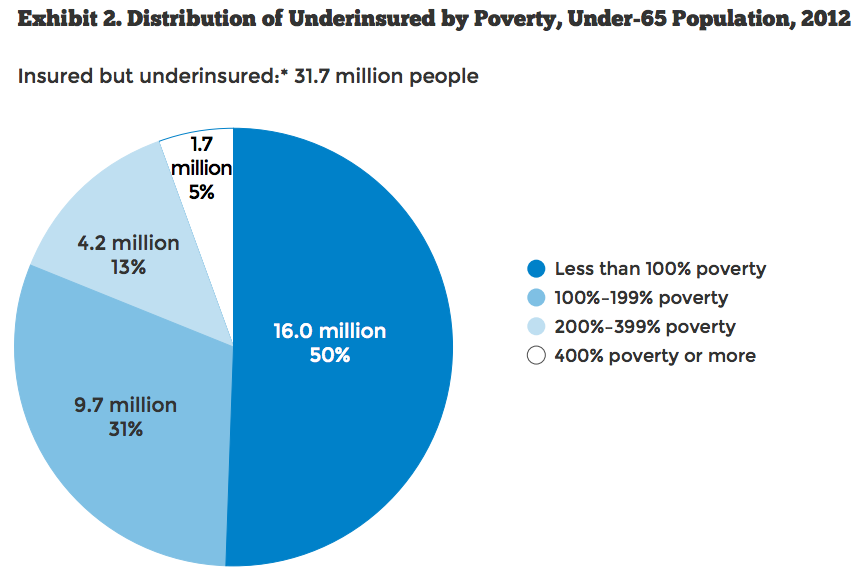
Cohn points to a new report (pdf) by the Commonwealth Fund indicating that Obamacare will help the underinsured:

According to the report, which became public early Tuesday morning, some 32 million non-elderly Americans were in households that spent a “high share of income on medical care” during 2012. That’s a little more than one in ten non-elderly Americans. The majority, though by no means all, are poor or near-poor. …

“The Affordable Care Act will significantly reduce underinsurance since it sets a national floor for benefits, requires that plans cover a minimum level of costs, bans pre-existing condition exclusions as well as lifetime and annual benefit limits, and increases cost-sharing protections for people with low and moderate incomes,” says Sara Collins, who is the Fund’s vice president for Health Care Coverage and Access and a co-author of the paper. “The problem of underinsurance is most pronounced among low and moderate income families and the provisions of the law are well-targeted at significantly improving coverage for people who have in the past spent large shares of their income on health care.”

Meanwhile, Khazan emphasizes that the uninsured are still massively confused about Obamacare:

Perversely, insured people and richer people had more knowledge about the ACA, and about how health insurance works in general, than did the uninsured. Knowledge about both the law and concepts such as premiums and deductibles increased with income. People who would qualify for the Obamacare subsidies were only able to answer an average of four of 11 questions about the law. Women were more ignorant than men were about healthcare reform, even though they arguably stand to benefit more.

A GOP Senate Is Getting More Likely, Ctd

Nate Silver responds to the DSCC’s criticism:

Our forecasts could be wrong in November. In fact, they probably will be wrong — it’s unlikely that Republicans will win exactly six seats. But we think it’s equally likely that our forecast will be biased in either direction. If Democrats retain just one more seat, they’ll hold the Senate. Or Republican gains could grow to seven seats, or quite a bit more.

And here’s the least surprising news: Political campaigns are hypocritical. At the same time the DSCC is criticizing our forecasts publicly, it’s sending out email pitches that cite Nate Silver’s “shocking, scary” forecasts to compel Democrats into donating.

You’d do well to shut out the noise the next time the DSCC writes a polling memo.

Weigel believes that “the Silver backlash was inevitable”:

Silver’s cachet on the left, which was high after 2008, became incomparable after 2012. That was the year FiveThirtyEight became a digital security blanket for liberals, a site they could refresh and refresh and refresh some more when their other news sources warned them that Mitt Romney might actually win.

Cillizza offers a few reasons why Democrats are so worried about Nate Silver’s latest predictions:

Know who REALLY listens to what Nate says? Major Democratic donors. They follow his projections extremely closely and, if he says the Senate majority won’t be held, they take it as the gospel truth. That, of course, is a major problem for the DSCC and other Democrats focused on keeping control of the Senate — particularly given that major outside conservative groups led by Americans for Prosperity are already spending heavily on ads bashing vulnerable Democratic incumbents. If the major donor community concludes that spending on the Senate isn’t a worthy investment, [Guy] Cecil and his Democratic colleagues know that their chances of holding the majority get very, very slim. Nate’s predictions move money in Democratic circles. Cecil knows that. Hence the memo.

Kilgore tries to stay optimistic:

Comparing 538’s forecast to its most credible rival, the Cook Political Report, is instructive. Cook’s Jennifer Duffy lists Arkansas as a toss-up race; Nate shows a 70/30 probability that Mark Pryor will lose. Similarly Cook shows the two vulnerable Republican seats, Kentucky and Georgia, as toss-ups. Nate gives Democrats a 25% chance of winning Kentucky and a 30% chance of winning Georgia. But his numbers would change rapidly with a few more likely-voter surveys in any of these states showing Democrats running even or ahead; Duffy tends to project races as very close until evidence emerges that they are not so close.

But there’s not a great deal of divergence in the factors used by 538 and Cook—polls, electoral history, money, national trends—and it’s very likely their forecasts will converge as we get closer to November.

Rumsfeld: Obama Worse Than A “Trained Ape”

What’s truly striking and amazing about Dick Cheney and Donald Rumsfeld is their persistent refusal/inability to reflect in any serious way on the immense moral, fiscal, and human costs of their failed wars. They are post-modern creatures – Rumsfeld never tackled an insurgency, he just “redefined” the word, just as he re-named torture – and you see this most graphically in Errol Morris’s small masterpiece, The Unknown Known. And so the very concept of personal accountability and responsibility is utterly absent. There was one flash of it: when Rumsfeld offered his resignation after the torture program’s reach and migration was revealed in the photos from Abu Ghraib. But even then, Rumsfeld was resigning because of the exposure – not because of the war crimes which he directly authorized.

And so it is fitting, perhaps, that after the massive misjudgment of the Iraq invasion and occupation, and after neglect in Afghanistan made that country even less safe from the Taliban, that Rumsfeld has the gall to attack the sitting president in a clear case of dealing with a foreign leader. Here is Rumsfeld, unable (unlike McNamara) to find a conscience within his massive, brittle ego, lashing out at the president yet again:

This administration, the White House and the State Department, have failed to get a status of forces agreement. A trained ape could get a status of forces agreement. It does not take a genius.

Here is the man who derided half of Europe and told the Brits they weren’t even needed on the eve of warfare talking about diplomacy:

United States diplomacy has been so bad, so embarrassingly bad, that I’m not the least bit surprised that he felt cornered and is feeling he has to defend himself in some way or he’s not president of that country. We have so mismanaged that relationship … I personally sympathize with him to some extent. Nobody likes to hear a foreign leader side with Putin on the Crimea the way he has. But I really think it’s understandable, given the terrible, terrible diplomacy that the United States has conducted with Afghanistan over the last several years.

So having described the first black president as inferior to a trained monkey, he actually sides with a current adversary of this country against his own commander-in-chief. There was a time when I would have been shocked by this. But Rumsfeld and Cheney can permanently reduce one’s ability to feel shock at anything.

A reader adds:

Rumsfeld fails to give his audience any hint of the fact that this is a problem that he made. America used to have no problem concluding SOFAs with its allies. Those agreements addressed Americans in uniform and provided that owing to the need for military discipline and control, the soldiers, sailors and airmen (and women) would be subject to military justice rather than the criminal justice system of the host government. However, under Rumsfeld, the footprint of the American military changed dramatically, and contractors came to constitute a majority of the force the US deployed. At the same time, American military and civilian justice failed utterly to deal with the contractors (think of the Blackwater contractors who massacred 14 Iraqis and wounded 20 more at Nissour Square in Baghdad in September 2008, for instance). These circumstances led both the Iraqis and the Afghans to refuse to sign a SOFA in the form the US sought, because the US’s terrible record (Rumsfeld’s record) of non enforcement. Thus, Rumsfeld created the problem and has made it increasingly difficult for the US to get these agreements.

The key problems, Iraq and Afghanistan, were problems under Bush as well as Obama, and were handled by the same professional team at the Pentagon. They really have next to nothing to do with the White House, under either Bush or Obama. But they have an awful lot to do with Rumsfeld and his scandalous mismanagement of the Pentagon.

Why Hasn’t Ukraine’s Revolution Spread?

Farid Guliyev and Nozima Akhrarkhodjaeva observe that “the Euromaidan protests did not spark similar political activism in other post-Soviet semi-autocratic regimes.” Among the reasons why:

Over the years, the ruling regimes in Azerbaijan, Belarus and Russia adjusted their repression strategies and adopted new ones to squash any signs of a color revolution. All three regimes were “late risers” during the color revolution wave. As Mark Beissinger shows, state elites in “later risers” have an advantage over those in “earlier risers” in that they know about actions and strategies used by protesters in the initial wave and therefore can adapt.

Institutional screws were tightened as post-Soviet autocrats took preemptive measures. Russia played a leading role in spreading various diffusion-proofing strategies. Examples include Russia’s restrictive legislation on non-governmental organizations in 2006 and the 2012 law requiring foreign-funded NGOs to register as “foreign agents”. Such measures foreclosed the success of anti-Kremlin mass rallies on the Bolotnaya Square in Moscow. And as Julia Ioffe rightly noted, “much of the stringency and verticality of the Russian political system is a direct result of [reaction to] Ukraine’s Orange Revolution.”

Ask Shane Bauer Anything: Iran’s Other Inmates

In the latest video from Shane, he discusses some of the prisoners, including a member of al-Qaeda, he came to know while behind bars in Iran’s notorious Evin Prison:

In a followup, he offers his take on the meaning of Rouhani’s election last year:

Shane Bauer is an investigative journalist and photographer who was one of the three American hikers imprisoned in Iran after being captured on the Iraqi border in 2009. He was held for 26 months, four of them in solitary confinement. He subsequently wrote a special report for Mother Jones about solitary confinement in America, and is also currently running a Kickstarter-like campaign to enable him to spend a full year investigating America’s prison system. Shane and his fellow former hostages, Sarah Shourd (now his wife) and Josh Fattal, have co-written the memoir A Sliver of Light based on their experiences. Except here. Shane’s previous videos are here.

(Archive)