Psychiatry’s State Of Mind

Joseph Pierre tackles claims of over-diagnosis in his profession:

The diagnostic creep of psychiatry becomes more understandable by conceptualising mental illness, like most things in nature, on a continuum. Many forms of psychiatric disorder, such as schizophrenia or severe dementia, are so severe – that is to say, divergent from normality – that whether they represent illness is rarely debated. Other syndromes, such as generalised anxiety disorder, might more closely resemble what seems, to some, like normal worry. And patients might even complain of isolated symptoms such as insomnia or lack of energy that arise in the absence of any fully formed disorder. In this way, a continuous view of mental illness extends into areas that might actually be normal, but still detract from optimal, day-to-day function. …

The truth is that while psychiatric diagnosis is helpful in understanding what ails a patient and formulating a treatment plan, psychiatrists don’t waste a lot of time fretting over whether a patient can be neatly categorised in DSM, or even whether or not that patient truly has a mental disorder at all. A patient comes in with a complaint of suffering, and the clinician tries to relieve that suffering independent of such exacting distinctions. If anything, such details become most important for insurance billing, where clinicians might err on the side of making a diagnosis to obtain reimbursement for a patient who might not otherwise be able to receive care.

Vaughan Bell praises Pierre’s piece as a “surprisingly good snapshot” of the field, but he has reservations:

Probably the most important thing it underlines is that most psychiatrists are less obsessed with diagnosis than people who are are obsessed about the fact that psychiatrists make diagnoses. Most psychiatrists typically don’t think that ‘every diagnosis is a disease’ and recognise the fuzziness of the boundaries – as indeed, do most medical professionals. …

I would also say that the piece reflects mainstream psychiatric thinking by what it leaves out: a sufficient discussion of the psychiatric deprivation of liberty and autonomy – and its emotional impact on individuals. Considering that this is the thing most likely to be experienced as traumatic, it is still greatly under-emphasised in internal debates and it remains conspicuous by its absence.
Bronies And Bullies, Ctd

A reader confides:

I’m a 41-year-old straight male … who likes to get dressed up in ball-gowns. So I can completely sympathize with those boys and men who get bullied and ridiculed for being feminine. I lived years feeling ashamed about it – pretty much since puberty – and it’s directly related to my sexuality. It’s really only been in the last year that I started to put out feelers with really close friends about it, including my wife, and I finally said “fuck it” after Frozen came out and I decided to “Let it Go”.

The response has been great for the most part, and I’m probably the happiest I’ve ever been. In a way, it’s just another step along accepting the “other” that I think the Internet will continue to encourage. First it was race; then it was homosexuality; now we’re starting to get into transgender, cross-dressing, cross-dreaming. None of these aspects of the human condition harm anyone. It’s only the fear of the unknown that causes the problems.

So many of these prejudices are simply because people are in the closet. Heck, in some cases there are conditions that people aren’t even awared exist (like cross-dreaming, which is the condition of becoming aroused by thinking you’re the other sex). The more people are exposed to the spectrum of human sexuality, the better it’ll be.

Is Big Data That Big A Deal?

Mark O’Connell, who recently read Uncharted: Big Data as a Lens on Human Culture, questions whether massive data analyses “typically tell us anything that we didn’t already know”:

We get stuff about how Helen Keller was “a hero to millions, a symbol of the triumph of the human spirit over adversity” and how “Marcel Proust became famous for writing good books,” which is one of those facts so incontrovertibly true that stating it sounds a mysteriously false note. And a data-mining examination of the history of fame, whereby we learn that Adolf Hitler is the most famous person born in the past two centuries (i.e., mentioned in the most books), leads to the insight that “darkness, too, lurks among the n-grams, and no secret darker than this: Nothing creates fame more efficiently than acts of extreme evil. We live in a world in which the surest route to fame is killing people, and we owe it to one another to think about what that means.”

After a while, you begin to suspect that this sort of wan reflection might be compensating for the fact that the data itself reveal little that is new.

The book is mostly entertaining, and its authors [Erez Lieberman Aiden and Jean-Baptiste Michel] are an amiable presence. But the claims that they make about the impact of their work—and the larger impact of big data on the humanities—are imposingly serious. “At its core,” they write, “this big data revolution is about how humans create and preserve a historical record of their activities. Its consequences will transform how we look at ourselves. It will enable the creation of new scopes that make it possible for our society to more effectively probe its own nature. Big data is going to change the humanities, transform the social sciences, and renegotiate the relationship between the world of commerce and the ivory tower.”

We are, in other words, deep in TED territory here, where no innovation can ever be merely useful or profitable, and must always mark something like a turning point in human history.

But Quentin Hardy spots a new and highly practical trend:

What if big data, that much-proclaimed multibillion-dollar hope of the enterprise software industry, is just a feature of something else?

On Wednesday, a company called New Relic announced that its product, used by information technology professionals to monitor the performance of software applications, would also carry real-time analytics about customer usage. That is the kind of thing that is useful to marketing departments, which are now spending money on custom big data systems. “We monitor how fast an application is, why it might be taking so long to load, why a line of code’s database query took so long,” said Lew Cirne, New Relic’s founder and chief executive. But the company can also tell “not just how long it took Airbnb to load an app, but what the best price point was in New York for completing a deal, or what products on Disney are getting the most customer hits.” …

The change in the product signifies [the] tendency for software developers to work in different parts of the company — the marketing department, for example — and not just in information technology. “The big trend we’re riding is that software will be in everything, and you’ll interact with it everywhere,” said Mr. Cirne.

Milk Doesn’t Necessarily Do A Body Good

Aaron Carroll challenges the conventional wisdom:

In another dietary diatribe, Baylen Linnekin criticizes the government’s Dietary Guidelines Advisory Committee:

The DGAC is actively dreaming up ways for the government to meddle in your diet. A look through the transcript of last week’s hearing reveals the word “policy” (or “policies”) appears 42 times. The word “tax” appears three times. And the word “regulation” appears 13 times. The words “meat,” “salt,” “soda,” “sugar,” and “trans fats” came up countless times in the context of things you really should be eating less frequently. One of the most nefarious things I’ve seen about the DGAC recommendations so far is the suggestion that the government involve itself in the lives of obese people by sending them regular text messages. (I’ve dubbed this this the DGAC’s “Chubby Checkers” program.)

The Victims Of False Rape Accusations, Ctd

A reader revives the thread with an upsetting story:

My daughter was falsely accuse of raping her girlfriend in October of this year. I know she was falsely accused because the girl who accused her said things happened in my home while I was supervising the girls. The girl who accused my daughter has an active fantasy life and had published a story online about being raped in exactly the way she claimed my daughter had raped her almost a year before they met. When the police asked me about what happened, I explained that it could not possibly have happened because my wife and I were supervising the girls the entire time my daughter’s friend visited.

Our exculpatory testimony was ignored. My daughter’s denials were ignored.

She was pulled out of school without the opportunity to talk to her parents and processed at the district court. She was not placed at an alternative school until almost two months had passed.  She was placed on electronic monitoring prior to trial. During that monitoring period (October 24 – January 22), she was not permitted to leave the house, even to exercise.

I was ordered to pay for a court-appointed attorney or find one for my daughter. We ended up paying almost $10,000 in attorney fees to defend my daughter. We intended to contest the matter in court but eventually had to take a plea deal because we ran out of money. My daughter’s guilt or innocence wasn’t really important because our justice system decides guilt or innocence based on your ability to pay.

I don’t doubt that rape happens far more often than false rape accusations. To believe that rape is so uniquely damaging that it is always worse than a false rape accusation is to place an inordinate amount of faith in our legal system. Considering how many innocent men have been sent to death row enjoying far greater legal protections than common defendants, it’s hard to understand how anyone could have that much faith in our legal system. Justice may be blind, but she is somehow able to tell how much you’ve got in your pockets.

Breaking Better

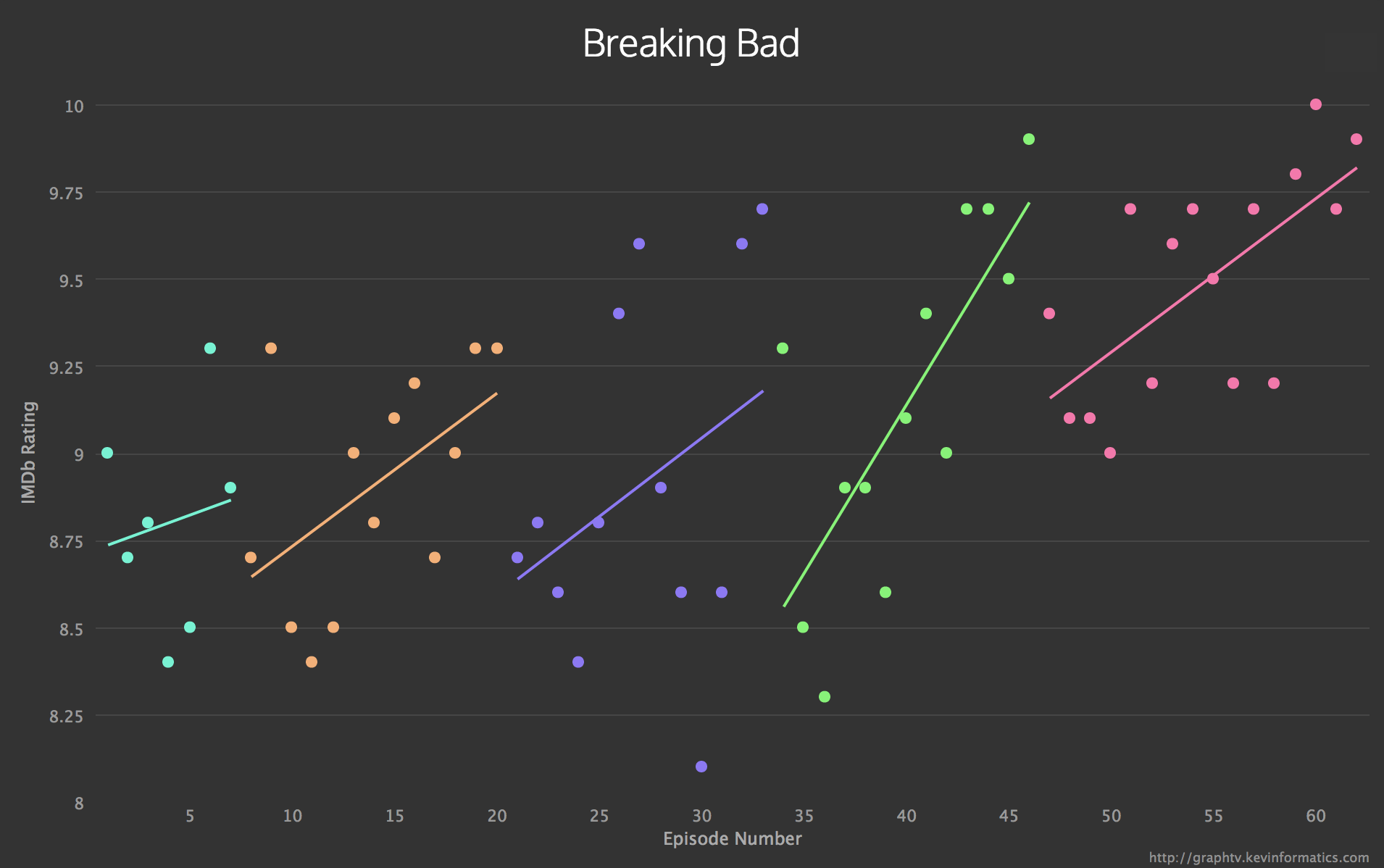
GraphTV - Breaking Bad

Dan Selcke introduces a new graphing tool:

Arguing the merits and demerits of a favorite TV show is an exercise plagued with uncertainty. What some viewers see as a well-developed, three-dimensional character, others may see as a grating waste of space, and one person’s daring plot twist is another person’s nonsensical cop-out.

With Graph TV, this is no longer a problem. The website, created by software engineer Kevin Wu, looks up the IMDB user ratings for every episode of a given TV show and turns them into points on simple graphs that show the ebb and flow of public opinion over the course of a series. Each season of the show is coded with a different color, so users can see, for example, which seasons of Dexter received more praise as they went on and which ones tumbled down the Y-axis faster than an Olympic bobsled team with nothing left to lose.

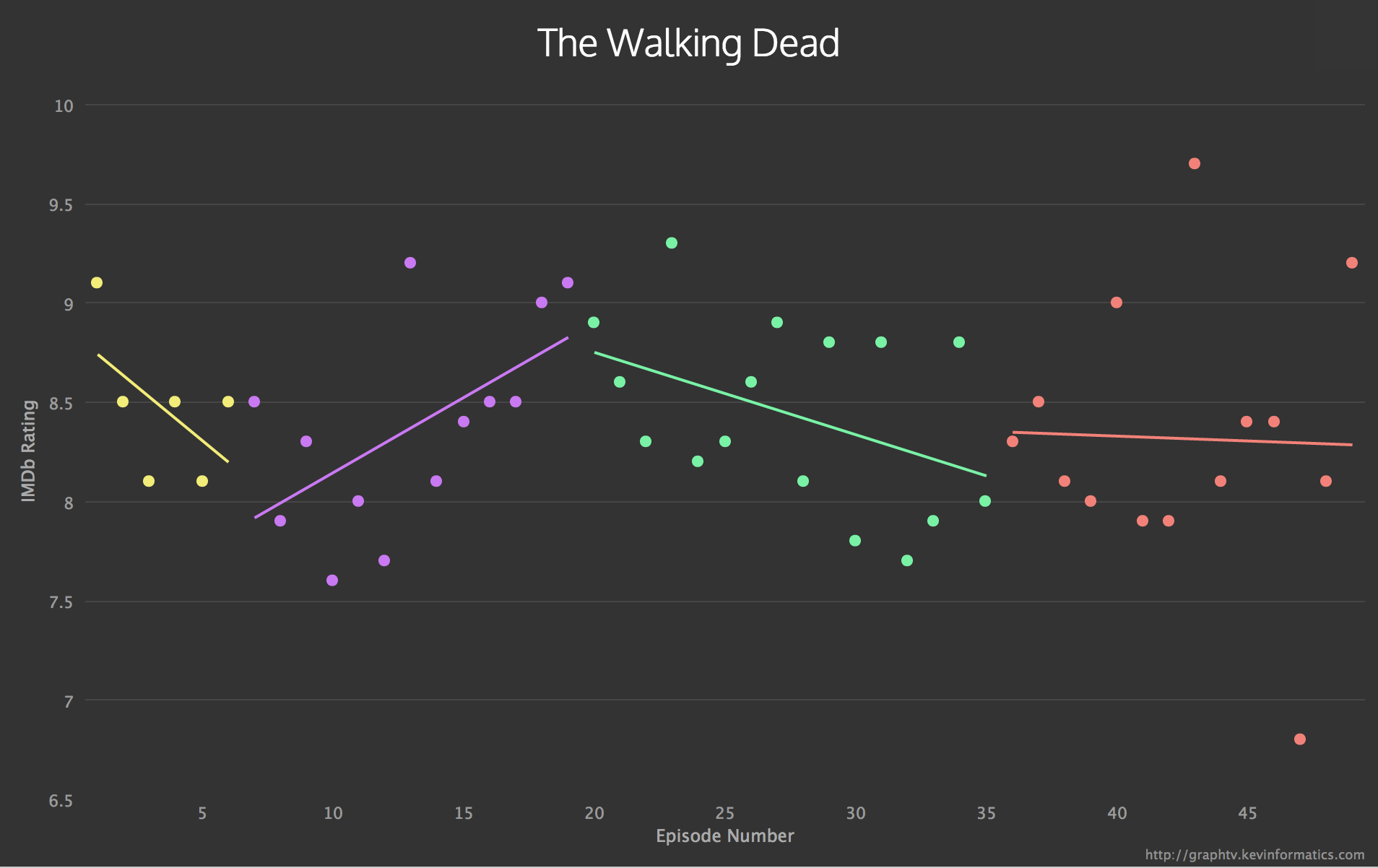
The Walking Dead‘s inconsistency is charted below:

GraphTV - The Walking Dead

A Faith-Based Tax

Mark Movsesian describes a disturbing move by the Islamic State in Iraq and the Levant (ISIL), an al-Qaeda offshoot:

ISIL has taken the eastern [Syrian] town of Raqqa and reinstated the centuries-old dhimma, the notional contract that governs relations with Christians in classical Islamic law. According to the dhimma, Christians may live in an Islamic society as long as they pay a poll tax called the jizya, accept restrictions on their activities—for example, they may not engage in public religious displays, affect equality with Muslims, or carry weapons—and refrain from cooperating with Islam’s enemies. If they break the terms of the contract, Christians forfeit the protection of Islamic society and become subject to retaliation. ISIL has updated the dhimma for Raqqa’s several thousand Christians. For example, Haaretz reports,

According to the 12 clauses in the accord, the Christians will commit to pay a twice-yearly poll tax of “four gold dinars”—which at today’s rate, comes to about $500 per person—with the exception that members of the middle class will pay half this amount, and the poor will pay a quarter of it, on condition they do not conceal their true financial situation.

Rashid Najm talked to an Egyptian scholar who calls the tax “theft”:

The imposition of “jizya” on Christians in Syria is nothing but “a new fad, one of many launched by terrorist groups stemming from al-Qaeda, which have no legal authority to issue such edicts and rulings,” said Sheikh Abdul Zahir Shehata, a lecturer at Egypt’s Al-Azhar faculty of sharia and law. This imposition is “a form of theft that uses religion as a cover,” Shehata told Al-Shorfa. “Jizya” is not a pillar of Islamic law, he said: It emerged during the Islamic expansion era and was paid by non-Muslims who were capable of fighting in return for protection, while zakat was collected from Muslims, with proceeds going to the Muslim treasury where public funds were held.

“ISIL contradicts itself,” Shehata said. “On the one hand they say they are implementing the provisions of Islamic sharia, including the ‘jizya’, however the Islamic state must be a full-fledged state and recognised by its citizens and subjects, which is not the case in the areas where ISIL is imposing its control by force and bloodshed.”

But Mark Cohen argues that premodern dhimmi status meant Jews were better off in the Mideast than in parts of Europe:

In the premodern Muslim world Jews, like all non-Muslims, were second-class subjects, but they enjoyed a considerable amount of toleration, if we understand toleration in the context of the times. They were a “protected people,” in Arabic, dhimmis, a status that guaranteed free practice of religion, untrammeled pursuit of livelihood, protection for houses of worship and schools, and recognition of communal institutions—provided that able, adult males paid an annual head-tax, accepted the hegemony of Islam, remained loyal to the regime, and acknowledged the superiority of the Muslims. …

On the plus side, Islamic society was a pluralistic mosaic of different religions and ethnic groups and Jews were not the only marginal group. Moreover, as the smallest of the minority groups, Jews were rarely singled out for special attention. In Latin Europe, by contrast, Jews constituted the only non-conforming religion (heretics were considered bad Christians), and accordingly suffered more frequent and severe persecutions.

Quote For The Day II

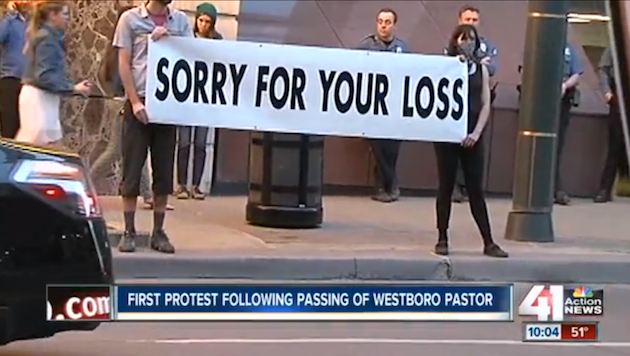
Westboro Baptist Church Case to be Heard by Supreme Court

Loss

“At times we are able to humiliate our worst enemy. Inevitably, his weak moments come and we are able to thrust in his side the spear of defeat. But this we must not do. Every word and deed must contribute to an understanding with the enemy and release those vast reservoirs of goodwill which have been blocked by impenetrable walls of hate,” – Martin Luther King, Jr., Dexter Avenue Baptist Church; Montgomery, Alabama, Christmas Sermon, 1957.

(Photo by Michael S. Williamson/The Washington Post via Getty Images. Details of the KSHB screenshot here.)

Pre-K Prejudice?

Harsher punishments for African-American students start in preschool, according to a new Department of Education analysis:

Black children constitute 18 percent of all kids attending preschool but account for 48 percent of all students suspended more than once, the new data show. Across K-12 schools, black students represented 16 percent of the student population but 42 percent suspended more than once in the 2011-12 school year.

Earlier studies have found that these high suspension rates for black students – males in particular – exist among older students as well, Yale associate professor Walter Gilliam said. The race gap “was bad then, and it’s bad now,” Gilliam said. “You don’t have to be able to split hairs to see how disproportionate it is.” Gilliam’s own research has found high expulsion rates among black preschoolers, but there has been little prior research on suspension.

Bouie notes that the disparities aren’t limited to suspensions:

Compared to their white counterparts, black boys are three times more likely to be placed in remedial or “problem” classes, as opposed to receiving counseling or a diagnosis. School-related arrests are depressingly common, and in 70 percent of cases, they involve black or Latino students. The same goes for referrals to law enforcement – in one Mississippi school district, for example, 33 out of every 1,000 students have been arrested or referred to a juvenile detention center, the vast majority of whom were black. This has far-reaching consequences. Suspensions lead to more absences, as students become disconnected from the school. In one study of 180,000 Florida students, researchers found that just one suspension in ninth grade can drastically reduce a student’s chance of graduating in four years.

Marcotte sees a larger problem:

Social-justice activists have been raising the alarm for years now about the “school-to-prison pipeline,” which the ACLU describes “as a disturbing national trend wherein children are funneled out of public schools and into the juvenile and criminal justice systems.” It works like this: Students, especially students of color, are hit with outrageous and disproportionate disciplinary measures in the school system. At best, that causes them to fall behind in their classes, but it can also result in students being suspended or shuffled off to separate classes for troublemakers, causing higher dropout rates and the subsequent higher unemployment and imprisonment rates. Sometimes schools turn to the police, who then arresting kids for minor infractions, treating them as criminals instead of young students who need support.

Related Dish on the subject here.

Plagiarism As Poetry

MoMA poet laureate Kenneth Goldsmith takes the spotlight in the following preview for Noriginals: The Art of Uncreativity, a “multi-platform feature documentary” exploring creativity in the age of algorithms:

Meanwhile, Johannah King-Slutzky explores the field of robopoetics (RP):

Is anything about computer-generated poetry radically new? Mostly, yes. Robopoetics challenge several conventional theories about literature and bolster other claims (like Barthes’ death of the author) with hard, non-theoretical proof. In electronic literature there is no dyadic author and text: the new creative schema is a triad of programmer, robotic author, and text. Robopoetics shifts the burden of creativity onto programming and the selection of source materials. (If you’re feeling contrarian you might argue that this contemporary triad isn’t so different from the classical muse-author-text model, but anyway.) …

I’ve written and read more than the average amount of poetry, but somehow amidst all the difficult poetry, I forgot that relatability and straightforwardness are the marks of a mature poet, too. Once, I read computer-generated poetry for 10 hours straight. The next week I could only stomach plainspoken Du Fu. I had to turn the clock back 1200 years. In this and other ways, games like Bot or Not might be a good learning tool. The same skill you refine by playing Bot or Not—the detection of gibberish—can also assist in separating the livejournal from the laureate. … In the words of Bot or Not’s creator, “The ability to tell whether something is of human or computer provenance … might become really important. We will all be like blade runner people, trying to tell if a text is human.”