
Buenos Aires, Argentina, 1.56 pm
Buenos Aires, Argentina, 1.56 pm
https://twitter.com/Timcast/statuses/446766583005077504
Juan Cole summarizes:
At midnight last night, Twitter went dark in Turkey after the service was lambasted by Prime Minister Tayyip Erdogan. News of his massive corruption has been leaking out on social media, with damning audio clips and other evidence. Erdogan controls the old media – television and the print press – in Turkey, but has no way to stop the ten million Turkish Twitter users from sharing around the leaked material (which he maintains is fraudulent). So Erdogan said, “We Will eradicate Twitter.” Erdogan’s Justice and Development Party (AKP) is facing local municipal elections at the end of the month and it may be he hoped to close down conversations about the corruption issue in the run-up to them. If AKP does well in those elections, they will form a platform for his anticipated run for the presidency in five months.
If the audio clips are actually fraudulent, it should be possible for Erdogan to have forensics performed on them and to discredit them. In a democracy, you deal with allegations by debating them, not by trying to close down national discussions. Erdogan is demonstrating an increasingly troubling tendency toward dictatorial methods.
Brian Merchant isn’t surprised:
My colleague Tim Pool, broke the news from Istanbul. He tells me that “the reaction seems to be anger and confusion. I see a lot of people on facebook just asking ‘is twitter down for you?'” Erdogan called Twitter a “menace to society” when a popular uprising swept the country last year, and has made noise about curtailing social media use in Turkey ever since.
Prime minister Recep Tayyip Erdoğan huffed, “We now have a court order. We’ll eradicate Twitter. I don’t care what the international community says. Everyone will witness the power of the Turkish Republic.” But the ban doesn’t doesn’t appear to have been that successful:
Not even a day after Prime Minister Recep Tayyip Erdogan said the social media service would be “eradicated” from the country, Turks were still actively tweeting by the millions through a variety of workarounds. A Turkish website, Zete.com, said 2.5 million tweets had been posted since the ban, reportedly setting traffic records in Turkey.
Yoree Koh and Danny Yadron detail another way people are circumventing the ban
Twitter has relationships with carriers in many countries, including four in Turkey, that have provided Twitter with short codes that allow users to send tweets. Users type in the code – either 2444 or 2555 in Turkey to signal the start of a tweet. The website then matches the sender’s phone number with their Twitter account. It makes for a handy back up plan when other methods may be compromised. Users receive all the texts sent by accounts they follow.
On Thursday, Twitter advised users in Turkey to text their tweets shortly after news stories of the shutdown surfaced. Twitter offered the same suggestion to users when the Venezuelan government restricted certain access to the service last month.
David Kenner notes that it’s not just the opposition that’s up in arms:
[T]he ban also appears to have exacerbated divisions within Erdogan’s party. President Abdullah Gul, who visited the headquarters of Twitter in 2012, said a ban on the site was “unacceptable” – and to add insult to injury, he made his comments via his Twitter account.
Gul isn’t alone. Melih Gokcek, the mayor of Ankara and another member of the ruling party, also continued to tweet. His first message after the ban was announced could’ve been interpreted as support or defiance – whatever he meant, it was retweeted thousands of times by Twitter users within Turkey:
:-)
— İbrahim Melih Gökçek (@06melihgokcek) March 21, 2014
Michael Koplow views the ban as a mistake:
Erdoğan, whose political instincts used to be top notch, appears to have badly miscalculated this time. The courts are denying that they issued any shutdown orders, other countries and NGOs are criticizing him left and right, and the economy has taken yet another dip in response to his latest move. Even if the local elections at the end of the month go the AKP’s way, Erdoğan’s own political viability has never been more in question. He may have some more tricks up his sleeve, but it is difficult to envision how Erdoğan ever recovers the colossal stature he had only a couple of short years ago.
Sarah Gary rounds up ridiculous cable news segments on MH370. Nick Martin tackles CNN’s Don Lemon, who is featured in the clip above:
Lemon has spent the last several days exploring every crazy conspiracy theory on the internet, like something out of InfoWars or an Art Bell broadcast.
On Sunday, he brought up the possibility that “the supernatural” was somehow involved in the disappearance. On Monday, he floated the idea that the plane could be hiding in North Korea. But [Wednesday] night, he really outdid himself, asking a former U.S. Department of Transportation inspector general whether the airplane was somehow sucked into a black hole. Yes, a black hole.
“I know it’s preposterous,” he said to her, “but is it preposterous?”
Abby Ohlheiser fact-checked Lemon:
A somewhat gruff Columbia astronomy professor named David J. Helfand told The Wire by email that, simply put, “black holes comparable to the mass of an airplane or somewhat bigger that could attract and swallow a plane do not exist.”
Even if a black hole capable of swallowing a plane out of the sky did exist, Peter Michelson, a professor of physics and Stanford University added, “a lot of other things would be missing as well.” when asked for examples of what we’d notice missing, Michelson said, “probably the Earth.”
Bateman piles on:
My problem is not that [individuals at CNN] are focusing on what they see as a story at the core of their capability because that is to be expected. And I do not mind at all that they are looking all over for experts. Quite a few of those they ring are obviously both professional and appropriate. My problem is that their reporters and some of their editors are doing so in such an incompetent manner.
Ambinder mounts an uncharacteristically unpersuasive defense of CNN. The strongest part:
The criticism of CNN is larded with slippery assumptions. One is that, at some point, CNN lost its way, and that’s why it no longer commands the respect and viewership it once did. That’s a tenuous theory. Competition, and CNN’s unwillingness to lose or change its ways in the face of it, helped fragment the national cable audience. We don’t get our breaking news now from cable. We get it from the internet, or radio (still). When CNN was the only place news junkies could plug in to, CNN could pretty much set whatever standard it wanted. Once Roger Ailes masterfully realized that partisan television could attract as many eyeballs as talk radio grabbed ears, most people’s expectations of cable news changed accordingly.
Jaime Weinman’s theory about why the story has boosted CNN’s ratings:
What can account for this split personality on CNN’s part, between the successful purveyor of big ongoing stories and the brutally unsuccessful network that operates on all the other days of the year? The clue might be in something veteran media analyst Brad Adgate said to Reuters last year: “CNN, despite its ratings woes, is still a destination network for the light and casual news viewers. They have been around longer than anyone else.” The people who follow something like the Flight 370 story may, in many cases, be people who don’t usually watch 24-hour news. But when a story breaks that they’re interested in following all day and all night, CNN is still the place they instinctively go. It has the brand name left over from the Gulf War in the ’90s; it has the resources for doing this kind of saturation coverage. CNN is the first network that comes to mind for this type of story.
But when there isn’t a story this juicy, with this kind of crossover appeal to people who aren’t news junkies, then CNN is lost.
Meanwhile, Chris Beam believes China was wrong to tell its media not to “independently analyze or comment on the lost Malaysia Airlines flight”:
News may be the one industry in which, rather than helping out domestic business, the Chinese government actively punishes it. China takes its international news efforts seriously, targeting overseas audiences with China Radio International, CCTV America, and China Daily—all key elements of the Party’s “soft power” push. But by forcing Chinese journalists to sit out a major story like MH370, they’re actively undermining their own quest for global influence.
Robots with a fixed gaze don’t seem that convincing:
Sean Andrist at the University of Wisconsin-Madison and his team have a number of other tricks to make a humanoid robot seem “alive.” One is to introduce small random movements into a robot’s head rotation motor, so that instead of appearing stationary, the robot’s head twitches slightly now and then. A face-tracking camera can ensure a robot always looks at the person it is interacting with, but instead of staring straight at their face, the team have programmed in a tendency for the robot to avert its gaze from time to time. The idea is to mimic the human habit of glancing fleetingly to one side when thinking of an answer to a question.
The team asked 30 students to assess conversations with Nao robots programmed to act like librarians or job interviewers, some of which had been set up for gaze aversion. They found that people thought robots that glanced around seemed more purposeful and thoughtful.
Previous Dish on robot-human interaction and the uncanny valley here, here and here.
Suzy Khimm summarizes key parts of a new Brookings paper:
Three Princeton University economists found that only 11% of Americans who are long-term unemployed find steady, full-time work a year later, according to data from 2008 to 2012. What’s more, only 39% have found work at all during that year—even for a brief period of time, “highlighting that the long-term unemployed frequently are displaced soon after they gain reemployment,” the authors Alan Krueger, a former Obama economic adviser, Judd Cramer, and David Cho wrote in their paper.
What has happened to everyone else? Of those unemployed for six months or longer, about 30% are still looking for work and failing to find it a year later. But even more people have simply stopped looking for work altogether: 34% are no longer in the labor force, according to the paper presented at the Brookings Institute Thursday.
Danny Vinik wishes Congress would get serious about this problem:
This is the most frightening consequence of the Great Recession: working-age, able-bodied Americans who have given up. Instead of contributing to the economy, they will collect benefits from the government, such as Social Security Disability Insurance, for decades to come.
Congress can prevent this. On the supply side, unemployment benefits keep the long-term unemployed in the labor force by requiring them to continue searching for work if they want to collect unemployment. House Speaker John Boehner is blocking an extension of unemployment insurance for no legitimate reason. On the demand side, Congress could offer employers financial incentives—like a tax credit—for hiring the long-term unemployed. Even better, the government could set up a jobs program that targets the long-term unemployed. Neither side seems particularly eager for that.
Tyler Cowen considers the paper “evidence for a notion of zero marginal product workers”:
Furthermore, in my view (I am not speaking for the authors here), right now further inflation is as likely to harm as to help these individuals. To ask whether the Fed “should give up” on the long-term unemployed is a biased framing which is more likely to mislead us than anything else.
Ylan Q. Mui highlights another finding from the paper:
There is no sign that long-term unemployed will make a big career switch. Despite lots of discussion about retraining workers for jobs in fast-growing industries such as health care, they tend to find employment in the fields they know best.
Binyamin Appelbaum also notes the “striking evidence that few people are finding jobs in new industries”:
Professor Krueger and his colleagues draw the conclusion that government may be able to help. The authors write, “These results suggest that assisting unemployed workers to transition to expanding sectors of the economy, such as health care, professional and business services, and management, is a major challenge.” But if long-term unemployment is more common in industries recovering more slowly, because would-be workers are trapped in those industries, this too suggests that the problem may be economic rather than personal.
There is a way to resolve the question. Fiscal and monetary policy makers could try to help, and we could all see what happens.
Instead, the debate seems increasingly likely to remain purely academic, and the long-term unemployed permanently lost.
Kevin D. Williamson cuts Paul down to size:
Nearly every election cycle, a poll comes out suggesting that many Americans, and a big chunk of swing voters, think of themselves as “fiscally conservative but socially liberal,” and therefore possibly open to libertarian candidates who want to police the deficit but not your sex life. These voters are the political equivalent of people who describe themselves as “spiritual but not religious.” It’s basically an empty formulation to avoid picking a side or a fight; it’s shallow, but it sounds good. The problem, at least for Rand Paul, is that “fiscally conservative but socially liberal” is not a long way of saying “libertarian.” Paul’s libertarianism is intended to offer a little something for everybody, on the left and right—spending cuts for the Republican base, legal relief for potheads, a presidential pat on the head for gay people. But if he gets serious about substantive reform along these lines, his libertarianism is instead going to offer something to outrage everybody.
Jonathan Bernstein predicts that Paul will lose in the primaries:
Think Paul has a chance? Then either convince me that he’s acceptable to the Republicans who support the policies he opposes – or show me that those people have little clout. He can win only if one of the above is true. These days, you can’t be nominated by accident.

We’re one step closer to it:
Sometime in the future, technicians will go over the scene of the crime. They’ll uncover some DNA evidence and take it to the lab. And when the cops need to get a picture of the suspect, they won’t have to ask eyewitnesses to give descriptions to a sketch artist – they’ll just ask the technicians to get a mugshot from the DNA.
That, at least, is the potential of new research being published [yesterday] in PLOS Genetics. In that paper, a team of scientists describe how they were able to produce crude 3D models of faces extrapolated from a person’s DNA. “We show that facial variation with regard to sex, ancestry, and genes can be systematically studied with our methods, allowing us to lay the foundation for predictive modeling of faces,” the researchers wrote in their paper. “Such predictive modeling could be forensically useful; for example, DNA left at crime scenes could be tested and faces predicted in order to help to narrow the pool of potential suspects.”
Sara Reardon explains:
[Mark] Shriver and his colleagues took high-resolution images of the faces of 592 people of mixed European and West African ancestry living in the United States, Brazil and Cape Verde. They used these images to create 3D models, laying a grid of more than 7,000 data points on the surface of the digital face and determining by how much particular points on a given face varied from the average: whether the nose was flatter, for instance, or the cheekbones wider. They had volunteers rate the faces on a scale of masculinity and femininity, as well as on perceived ethnicity.
Next, the authors compared the volunteers’ genomes to identify points at which the DNA differed by a single base, called a single nucleotide polymorphism (SNP). … Then, taking into account the person’s sex and ancestry, they calculated the statistical likelihood that a given SNP was involved in determining a particular facial feature. This pinpointed 24 SNPs across 20 genes that were significantly associated with facial shape. A computer program the team developed using the data can turn a DNA sequence from an unknown individual into a predictive 3D facial model.
Peter Aldhous notes the research opens up “the intriguing possibility of producing facial reconstructions of extinct human relatives”:
Even for Neanderthals, where there are numerous fossil skulls, palaeoanthropologists have little idea about the soft tissues of the face. “We don’t know how far out their noses extended,” says Shriver. This means that artists’ impressions of what the species looked like are partly guesswork. Shriver hopes that there will be enough overlap between the Neanderthal and modern human genomes for variants that influence face shape to start filling in such gaps.
(Image via PLOS Genetics)
Ioffe sizes up the sanctions announced yesterday:
These sanctions will not just ban travel to the U.S. or freeze assets (most of which these guys keep in Europe and in various tax shelters around the world), but will effectively bar them from participation in the world financial system. That is going to sting and it’s going to hurt, and it’s going to hurt in the exact right places. Sources inside the administration say that Europe’s list of sanctions, which is forthcoming, overlaps very significantly with the American one. The administration is also discussing whether to distribute the sanctions to family members, given that these men officially may own very little themselves, but have stashed their wealth in shell companies, and wives and children who function as shell companies. But just having a last name that’s on the U.S. Treasury sanctions list may be hurt enough. And, as the White House has emphasized repeatedly, this is only the beginning.
But there are people who are not on the list who are already cringing at the anticipation of the blow: Russian liberals. They were largely horrified by their country’s invasion of Ukraine and are happy to see Putin’s cronies punished by the West, but they know that the Kremlin, unable to lash out at Washington, will take its fury out on them.
Bershidsky doubts Europe’s sanctions will be as harsh as America’s:
Most of the Putin cronies on the list have known assets in Europe and Caribbean offshore areas. They will suffer serious damage only if the European Union puts them on its list of sanctioned individuals — which is doubtful because of the U.K.’s desire to avoid damage to London banks and the city’s reputation as an international financial center. The U.S. sanctions are also designed to cause minimum economic damage: They don’t touch Russia’s major government-owned companies, such as Gazprom or Rosneft, headed by long-time Putin associate Igor Sechin. Keeping them out of the U.S. would be a heavy blow.
The sanctions’ intent is easily readable to Putin. Even if he is not as close to the men on the list as their history and the government contract breakdown suggest, he will know Obama wanted to strike at those who are, to the best of his knowledge, his best friends, possibly even the keepers of his personal fortune.
Charlemagne also looks at Europe’s response:
In the bureaucratic jargon of Brussels, the annexation of Crimea merits only “Stage 2” sanctions: visa bans, asset freezes and political wrist-slapping. The latter includes suspending G8 meetings, halting formal bilateral summits and stopping negotiations on Russia’s membership of the OECD, a rich-world think-tank, and the International Energy Agency. Stage 3 sanctions, comprising unspecified “far-reaching consequences for relations on a broad range of economic areas”, would be triggered by further Russian actions “to destabilise the situation in Ukraine”.
Larison asks about the purpose of America’s sanctions:
One thing that the administration should have also learned by now is that it gets little or no credit from its critics for its hawkish measures, and most of its critics will continue to condemn its response as “weak” no matter what it does. It won’t matter to those critics how much the U.S. tries to punish Russia, because it will never be seen as good enough. Meanwhile, punitive measures can inflict damage on Russia, but there is no good reason to believe that sanctions will ever cause it to change its behavior in the way that Washington wants. Punitive measures have to be aimed at forcing Russia to give up Crimea, and if they’re not then they don’t serve much of a purpose other than riling Moscow and provoking retaliation. Since that goal seems entirely fanciful, what are these punitive measures supposed to be achieving?
Anne Applebaum calls the new sanctions “only a signal”:
Far more important, now, are the deeper strategic changes that should flow from our new understanding of Russia. We need to reimagine NATO, to move its forces from Germany to the alliance’s eastern borders. We need to re-examine the presence of Russian money in international financial markets, given that so much “private” Russian money is in fact controlled by the state. We need to look again at our tax shelters and money-laundering laws, given that Russia uses corruption as a tool of foreign policy. Above all we need to examine the West’s energy strategy, given that Russia’s oil and gas assets are also used to manipulate European politics and politicians, and find ways to reduce our dependence.
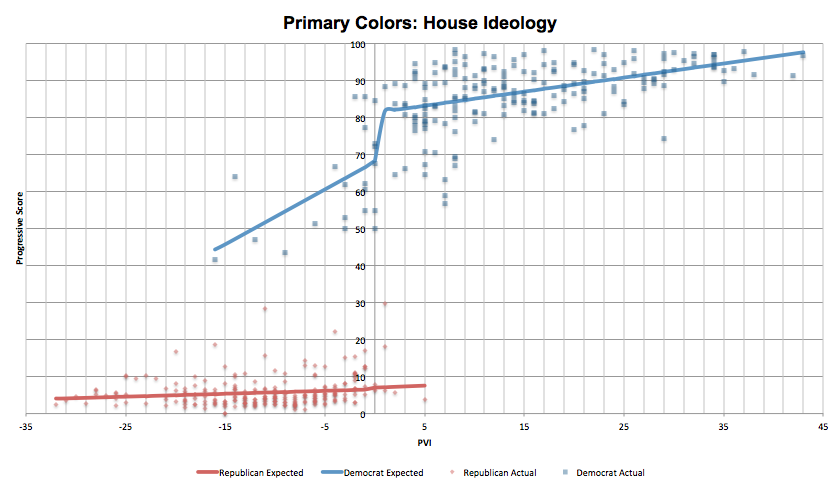
Ryan O’Donnell explains the above chart, which shows the relationship between political districts’ ideology and their representatives’ votes:
Obviously we’d expect Democratic politicians to vote more conservative the more conservative their district gets, and more liberal the more liberal their district gets. And by-and-large, they do. But Republicans don’t really follow that trend, as you can see in red on the graph [above] … If you only take away one thing from this graph, it should be that the expected value for Republicans is nearly a perfect horizontal line. Translated into plain English, that means Republicans vote conservative almost no matter what. It doesn’t matter what type of districts they represent.
The lesson Matt Steinglass draws from this:
This doesn’t predict what might happen if Republicans gained control of the Senate, or of the presidency. It’s possible that with more power Republicans would feel freer to disagree with each other. With their backs to the wall, out-of-power Democrats might feel the need to present a more united front. But basically Democrats have less voting discipline than Republicans. …
In other words, if all else fails, the gridlock of the American government will probably end the next time the country elects a Republican president, since Republican legislators have the discipline to stonewall Democratic presidents while Democrats are more willing to compromise. That asymmetry is probably infuriating to Democrats, but unless their legislators adopt different voting behaviour, it’s not going to change.
A reader sees it moving to TV:
With all the discussion about The Atlantic, Buzzfeed and others blurring the line between journalism and sponsored content, I thought this might add to the discussion. Robert Feder is a longtime Chicago media journalist who has moved from his spot at the major papers in town to the blogosphere. This afternoon, he posted this blog post about the disturbing trend of the local Fox affiliate (and to a lesser extent, WGN TV) is airing segments during their news programming that are paid for by companies looking to promote their products. At the end of segments, a brief “this segment was sponsored by [company name]” is all that tips viewers that what they have already watched is not news and should be viewed with a degree of suspicion.
This, to me, is every bit if not more disgusting than the proliferation of sponsored print content, as it is much less obvious than even the best camouflaged sponsored piece on Buzzfeed. Viewers should not have to watch every segment with suspicion that it is a paid piece in case such a revelation is made at the end of a four minute interview. I assume that if it’s happening here, it’s happening elsewhere, and that both chills and repulses me.
 The Dish