Ask Dave Cullen Anything

by Chris Bodenner

Dave wrote the definitive book on the Columbine shooting, which is about to have its 15th anniversary next month:

Columbine won the Edgar Award, Barnes & Noble’s Discover Award, the Goodreads Choice Award, and several others. It spent thirteen weeks on the New York Times bestseller list, and made two dozen Best of 2009 lists, including the New York Times, LA Times and Publishers Weekly. Columbine was declared Top Education Book of 2009 by the American School Board Journal. Cullen spent ten years writing and researching Columbine. He has written for New York Times, BuzzFeed, Times of London, Newsweek, Guardian, Washington Post, Slate, Salon, and Daily Beast and is a frequent television analyst. He is currently working on a book about two gay colonels, who he has followed for twelve years.

Here’s more about that forthcoming book, Soldiers First:

This book began for me in 2000 with a long piece on gay soldiers for Salon. I spent five months with a group of them in Colorado Springs and was stunned to discover how their world was completely different than what I’d seen, heard and described on the outside. It was easy for them to find quick, meaningless sportsex under the policy, but nearly impossible to find a boyfriend. So we named the first half of that piece: “Don’t Ask, Don’t Tell, Don’t Fall in Love.” It was the best thing I ever wrote prior to my first book and it won the GLAAD Media Award for best on-line story of the year. The article was published in two parts, here and here.

Among the scores of good reviews for Columbine came from The LA Times’ David Ulin:

Forget everything you thought you knew. The girl who professed her faith in God before being gunned down in the library. The Trenchcoat Mafia and the feud between the goths and jocks. The idea that Eric Harris and Dylan Klebold — the two Columbine High School seniors who, on April 20, 1999, killed 12 of their fellow students and one teacher in what was, at the time, the worst school shooting in the history of the United States — were disaffected, unpopular, motivated by resentment or revenge. Even the fact that the killings took place on Adolf Hitler’s birthday was a coincidence: The boys had planned to do it a day earlier but hadn’t been able to get the ammunition in time.

All of this, Dave Cullen notes in “Columbine,” his comprehensive account of the tragedy and its aftermath, is the story we’ve been given, the mythic version, the one that (if anything can) aspires to make a kind of sense. It’s a rendering in which the pieces fit together and the terror of the day is mitigated by small moments of redemption, whispers of epiphany and grace. The problem, however, is that none of it happened — or more accurately, none of it happened exactly like that.

A more succinct review:

What would you like to ask Dave? Submit your questions via the survey below (if you are reading on a mobile device, click here):

[POLL NOW CLOSED]
The Down’s Spectrum

by Chris Bodenner

A reader writes:

The PSA you posted highlights how people with mild cases of Down Syndrome can flourish. The degree of impairment due to Down’s, however, is a spectrum. I have a close relative with Down’s who is severely affected. She learned to speak only for a year or two, then it was all forgotten. She is now in her mid-thirties and has not once slept through the night. In fact, as she has gotten older, she has developed Parkinson’s disease. She requires a cocktail of medications that sometimes leads to complete sleep deprivation.

Her kind and loving parents have rejected suggestions to institutionalize her throughout her life and given her the best life they possible could. But they are now elderly, and are her primary caregivers, taking turns spending all night awake with her. I know they do not have an ounce of regret for the choice they made to keep their child, but I would not judge other families who lack their strength.

Ask Shane Bauer Anything: The Guantanamo Effect

by Chas Danner

In another video from the former hostage, he notes how both he and his Iranian jailers would try to cite Guantanamo to their advantage:

He goes on to try and explain the bizarre and twisted relationship he had with his interrogators, who tried to behave as both enemy and friend:

Shane Bauer is an investigative journalist and photographer who was one of the three American hikers imprisoned in Iran after being captured on the Iraqi border in 2009. He was held for 26 months, four of them in solitary confinement. He subsequently wrote a special report for Mother Jones about solitary confinement in America, and he’s currently running a Kickstarter-like campaign to enable him to spend a full year investigating America’s prison system. Shane and his fellow former hostages, Sarah Shourd (now his wife) and Josh Fattal, have co-written the memoir A Sliver of Light based on their experiences. Except here. Read about what happened one night when Shane’s guards left his cell open here. Shane’s previous videos in the series are here.

(Archive)

A Case Of Technophobia

by Patrick Appel

David Blumenthal explains why the health care industry hasn’t embraced digital medical records:

The reason why the medical profession has been so slow to adopt technology at the point of contact with patients is that there is an asymmetry of benefits. From the patient’s perspective, this is a no-brainer. The benefits are substantial. But from the provider’s perspective, there are substantial costs in setting up and using the systems.

Until now, providers haven’t recovered those costs, either in payment or in increased satisfaction, or in any other way. Ultimately, there are of course benefits to the professional as well. It’s beyond question that you become a better physician, a better nurse, a better manager when you have the digital data at your fingertips. But the costs are considerable, and they have fallen on people who have no economic incentive to make the transition. The benefits of a more efficient practice largely accrue to people paying the bills. The way economists would describe this is that the medical marketplace is broken.

Richard Gunderman provides another perspective:

[Dr. Paul] Weygandt [a VP at a medical communications firm] believes that contemporary medicine has allowed too many intermediaries—financing, technology, and the way practices are structured—to come between patients and doctors. Too much time is focused on generating revenue rather than quality. Too many technological systems are built in ways that make sense to computer engineers but not to doctors. And too much time is spent pointing and clicking rather than capturing the essence of a patient’s story.

What can be done? Weygandt argues that doctors need to play a more active role in all aspects of healthcare’s future, not just implementing but also designing it. Too often, such decisions are currently being made by people who do not take care of patients, and in many cases, have never cared for patients.

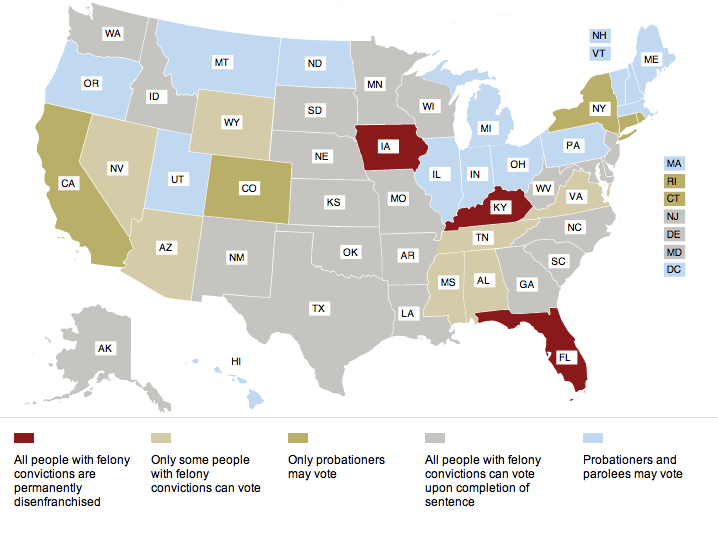
A Felon In Florida? No Vote For You

by Tracy R. Walsh

Screen Shot 2014-03-20 at 4.13.06 PM

Jessica Chiappone laments losing her rights at the ballot box after pleading guilty to conspiracy to possess cocaine:

I served seven months in a federal prison in Texas, where I was subjected to strip searches every other day after being sent into a forest to chop trees. I spent one year in a halfway house in Brooklyn, and then three years on supervised release – one year earlier than projected. I graduated from college with a degree in criminal justice. I found a job and paid my taxes. I became a mother, graduated from law school and passed the New York State Bar Exam. … Despite my time served and my accomplishments as a legitimate contributing member of society, my fundamental right to vote in Florida was denied – along with several other rights that are supposed to be inalienable in America.

The United States passively accepts the existence of second-class citizenship. Rather than provide an opportunity for automatic restoration of voting rights, Florida imposes a subjective review process that leaves the formerly incarcerated with no clear standard to meet: intrusive and uninformed questions about financial stability, substance abuse and HIV/AIDS – none of which are barriers to voting for those not convicted of crimes, nor should they ever be.

Last month, Eric Holder urged states to “fundamentally reconsider” the practice. Recent Dish on the subject here.

(Map of state felony disenfranchisement laws via ACLU)

Ask Dayo Olopade Anything

By Chas Danner

[Updated with new questions submitted by readers, which you can vote on at the bottom of this post]

Sarah Rothbard introduces us:

Nigerian-American journalist Dayo Olopade spent two years traveling through 17 African countries. Butbright it’s still difficult for her to talk about the continent[:] 800 million people live in Africa, most of whom she has not met. Nonetheless Olopade, author of The Bright Continent: Breaking Rules and Making Change in Modern Africa, is trying to reorient Western views of the continent. Six of the world’s 10 fastest growing economies are located in sub-Saharan Africa. Twenty-three African countries are now middle-income, she said, with their feet on the first rung of the ladder toward posterity. And over 300 million people make up Africa’s emerging middle class. They earn 10 times the poverty benchmark of $2 per day. Right now, unbeknownst to the West, Africa is incredibly dynamic and energetic. It is young—70 percent of the population is under 30 years old—and increasingly urban, with 50 cities of more than a million people and more than half the continent living in urban, cosmopolitan settings.

Dayo believes one of the reasons that Africa’s progress often goes unnoticed is because of “poverty porn”:

Many of the images that come out of Africa—from commercials featuring celebrities speaking on behalf of hungry children to Toms shoes—come from sources with business models that rely on people feeling badly about Africa. Poverty porn also exists at an institutional, global level. Olopade was shocked to see a poster that won a United Nations-sponsored contest depicting the torsos of leaders of the G-8 nations as skinny, African kids waiting in line at a refugee camp from the waist down.

We_are_still_waiting_Einarsson_Final_72dpi

The caption: “‘Dear World leaders. We are still waiting.’” But in Africa, “people, in my experience, wait for no one,” said Olopade, recounting the astonishing amount of commerce that takes place in the middle of traffic on the roads of Lagos, Nigeria. From your car, you can buy everything from mobile phone airtime to live animals. Congested roads aren’t an opportunity for self-pity but for marketing.

Let us know what you think we should ask Dayo via the survey below (if you are reading on a mobile device, click here):


This embed is invalid

Time And Punishment

by Jessie Roberts

Ross Andersen interviewed philosopher Rebecca Roache about how life-extending technologies may come to be applied to prisoners:

Suppose we eventually learn to put off death indefinitely, and that we extend this treatment to prisoners. Is there any crime that would justify eternal imprisonment? Take Hitler as a test case. Say the Soviets had gotten to the bunker before he killed himself, and say capital punishment was out of the question – would we have put him behind bars forever?

Roache: It’s tough to say. If you start out with the premise that a punishment should be proportional to the crime, it’s difficult to think of a crime that could justify eternal imprisonment. You could imagine giving Hitler one term of life imprisonment for every person killed in the Second World War. That would make for quite a long sentence, but it would still be finite. The endangerment of mankind as a whole might qualify as a sufficiently serious crime to warrant it. As you know, a great deal of the research we do here at the Oxford Martin School concerns existential risk. Suppose there was some physics experiment that stood a decent chance of generating a black hole that could destroy the planet and all future generations. If someone deliberately set up an experiment like that, I could see that being the kind of supercrime that would justify an eternal sentence.

Ari N. Schulman criticizes Roache for raising concerns about future uses of biotech without sufficiently addressing reasons not to pursue the technology:

It’s the same from doping the populace to be more moral, to shrinking people so they’ll emit less carbon, to “after-birth abortion,” and on on: Imagine some of the most coercive and terrible things we could do with biotech, offer all the arguments for why we should and pretty much none for why we shouldn’t, make it sound like this would be technically straightforward, predictable, and controllable once a few advances are in place, and finally claim that you’re just being neutral and academically disinterested; that, like Glenn Beck on birth certificates, you’re just asking questions, because after all, someone will, and better it be us Thoughtful folks who take the lead on Managing This Responsibly, or else someone might try something crazy. …

[W]hen transhumanists claim to be responsibly shining a light on a hidden path down which we might otherwise blindly stumble, what they’re really after is focusing us so intently on this path that we forget we could yet still take another.

Creative Sparks

by Patrick Appel

Sterns 2

How Phillip Sterns describes his series, High Voltage Image Making:

Through the application of high voltage and various chemical agents, this project explores and extends the expressive capacity of instant photographic film technology beyond its ability to capture images of the world. These treatments approach the film technology as a recording media, capable of creating images from physical, electrical, and chemical transformations.

Joseph Flaherty provides more details on the process:

The light from the sparks accounts for some of the bluish colors in the background of the shots, but the electrical “tree” structures, technically called Lichtenberg figures, are created when the electricity vaporizes the silver halides embedded in the film. Stearns adds blooms of chemical color to the compositions by pouring liquids like bleach, vinegar, hydrogen peroxide and rubbing alcohol onto the film and arcing electricity through them. Electrified bleach, for instance, reacts with dyes to produce some nice yellow and magenta hues.

More images of Sterns’s work herehere, and here. You can help fund Sterns’s work through his Kickstarter.

The Adult Case Against Homework, Ctd

by Tracy R. Walsh

Dana Goldstein provides another reason not to help the kids with homework:

In the largest-ever study of how parental involvement affects academic achievement, Keith Robinson, a sociology professor at the University of Texas at Austin, and Angel L. Harris, a sociology professor at Duke, mostly found that it doesn’t. The researchers combed through nearly three decades’ worth of longitudinal surveys of American parents and tracked 63 different measures of parental participation in kids’ academic lives, from helping them with homework, to talking with them about college plans, to volunteering at their schools. In an attempt to show whether the kids of more-involved parents improved over time, the researchers indexed these measures to children’s academic performance, including test scores in reading and math.

What they found surprised them. Most measurable forms of parental involvement seem to yield few academic dividends for kids, or even to backfire – regardless of a parent’s race, class, or level of education.

How We Abet Animals In Their Bad Decisions

by Tracy R. Walsh

Christopher Kemp explains what the boozy monkeys of St. Kitts (seen above) can teach us about how humans affect ecosystems:

According to biologist Bruce Robertson at Bard College in New York, the monkeys are caught in an “evolutionary trap.” Their enjoyment of alcohol exists for a very good reason, he says: they evolved to crave energy-rich foods. But now that piña coladas are easier to obtain than bananas, it has become a liability. “It’s an incorrect behavior that happened because we changed the environment too fast for evolution to catch up,” Robertson says.

Evolutionary traps – also called ecological traps – are everywhere. They have been found in almost every type of habitat, affecting mammals, birds, reptiles, amphibians, fish and insects. Bamboozled by rapid environmental change, these animals can no longer accurately assess the suitability of food resources, mates, habitats, or much of anything else. Bad choices look like good ones, and the animals are lured into an evolutionary dead-end. In this new world, a male giant jewel beetle lands on a beer bottle and tries to mate with it. … A Cuban tree frog swallows a fairy light in a backyard in Florida, responding as if the bulb were a tasty insect.