by Chris Bodenner
NDT appears to have gotten into the THC:
NDT appears to have gotten into the THC:
About a decade ago, members of the Raëlian religion began raising funds for a so-called Pleasure Hospital in Burkina Faso, which would restore the clitorises of women who had undergone female genital mutilation. The hospital had been slated to open in early March, but it was blocked by the local government. Sue Lloyd-Roberts reports that the American surgeons, led by gender-confirmation surgery expert Marci Bowers, moved their operating room to a local doctor’s clinic:
Bebe, a 24-year-old, is among the first. Is she scared? “No, I am not scared,” she says. “I am just angry. They cut me when I was four and it still hurts. Whenever my husband approaches, I just don’t want him.”
Bebe is given a local anaesthetic for the procedure which is a surprisingly simple one. Bowers investigates to see how badly Bebe has been mutilated. “No matter how severe it is,” Bowers explains, “we can always find the clitoris.” Although the visible part of the clitoris is cut off during FGM, it remains below the surface. “Voilà,” Bowers says as she finds it and pulls it up. “The clitoris now looks amazingly normal, part of an unaltered female anatomy.”
By the end of the first day, the team have “restored” eight women. The word is getting out, beyond the borders of Burkina Faso. By day three, women from Senegal, Mali and even Kenya come to the clinic to ask for the operation.
But the government swiftly canceled the licenses of the foreign doctors:
An official at the Health Ministry tells me that the opening was cancelled because Clitoraid [the organization behind the Pleasure Hospital] had not provided essential documents. All of which sounds reasonable until the Health Minister tells another journalist that “medical organisations should be focused on saving lives and not advertising their religion in an attempt to convert vulnerable people.”
Wendy Syfret talks to Clitoraid spokeswoman Nadine Gary:
How central is orgasm to Raëlian philosophy?
Pleasure is the most important part of the Raëlian philosophy, but the central part is simply explaining that life on planet Earth was created scientifically by people like us. Ladies like us and men who were created in their image. When you enjoy your clitoris, you can think that women creators have a clitoris just like you and have created you in their image, so you can enjoy yourself like they enjoy themselves. So is orgasm central to the Raëlian philosophy? Yes. You know we don’t masturbate every second of the day, but we don’t shy from it.
Previous Dish coverage of FGM here.
Andrew Cohen applauds the coalition of animal rights groups, civil liberties organizations, and media groups challenging Idaho’s three-week-old “ag-gag” bill:
The statute creates the crime of “interference with agricultural production” by punishing anyone who makes an unauthorized “audio or video recordings” of what transpires inside food processing facilities in Idaho with up to one year in prison. It is designed, as its lengthy legislative record suggests, to help Big Ag prevent the public dissemination of images of animal abuse or unsafe conditions. Images like those posted in April 2011 as part of an award-winning investigation into the state’s dairy industry by the Boise Weekly. Or the video of farm workers in Idaho kicking and stomping on cows that the Boise Weekly posted in October 2012. It was this investigative work that caused one concerned lawmaker to lament recently not the cruelty, or unclean food, but the injustice of these farm operators being “tried and convicted in the press or on YouTube.”
Ken Paulson of the First Amendment Center weighs in:
There is a certain redundancy to all the ag-gag bills. They invariably try to limit investigative work by criminalizing things that already are criminal. … You violate the law if you enter a farm by “force, threat, misrepresentation or trespass.” Each and every one of those is already prohibited by multiple statutes. If you were trying to eliminate coercion and fraud and trespass, you would not need to pass this bill. If you were trying to limit the scrutiny of the agriculture industry, you would need to pass this bill.
It is not only constitutionally suspect, it’s terrible public policy on the part of the legislature. Give me the very best argument for why this needs to be in place and then tell me why you wouldn’t then pass similar legislation for day-care centers. Would anyone suggest that you would send someone to prison for documenting child abuse? Is there anyone who is going to run on that platform?
Katie Valentine argues such laws have already had a chilling effect elsewhere:
In the six other states that have ag gag laws on the books, activists and journalists have said they’ve stopped attempting to document abuse on farm operations for fear of prosecution. This chilling effect means that the public in these states has little chance of seeing footage that can expose cruel and dangerous practices on agricultural operations and lead to major change in the agriculture industry. In 2008, for instance, an undercover video exposed “downer” cows, which can’t stand on their own and are sometimes diseased, being used for beef. The video led to the largest meat recall in US history and prompted the US to ban the use of downer cows for meat.
An expert weighs in:
As you can see from my email signature, I do financial aid for a living and have done so for 20 years. There are two issues I want to touch on with regard to that post, and I’ll take them one at a time.
First, the new FAFSA is the greatest innovation in student aid in the last 20 years. Hands down. There is nothing at all complicated about it and the Time article is full of shit. I give a FAFSA completion workshop for parents and students every year, so I know of what I speak. The current FAFSA takes the average low- or middle-income student/parent about 15 minutes to complete, especially if they use the wonderful DRT (data retrieval tool) from the IRS. The questions in Section I that were highlighted in that article only need explained once and the vast majority of parents and students will answer $0 to almost all of them. If they go to a similar workshop the first year, they will never need help again. In fact, attendance at my workshops have decreased over the last 2-3 years since the DRT was implemented because the form has become so easy to complete.
For the critics who think there is anything “complicated” about the current FAFSA, they should direct their ire at Congress. It is because of their rules for federal student aid that those questions are there and they cannot be gathered through IRS documentation. Instead of criticizing what the Department of Education cannot change, they should yell at the people who created the situation or, at the very least, provide the DoE with solutions. Good luck with that.
Second, I have no sympathy whatsoever for the reader who wrote in whining about having to try to hide or sell assets in order to pay for college. He or she is very, very, very lucky to have enough assets to play games with regarding a child’s education. Isn’t this why parents make investments and build savings? So a rich parent has to move some of his/her vast piles of money around and has a vacation home that is counted among the parent assets? Big freakin’ deal. Try being a single parent living on minimum wage or a two-parent family making less than $50,000 a year with two kids in college. Try being one of the foster kids who come to my campus. Or try being one of the five kids on our campus who had a primary earning parent who died this past year.
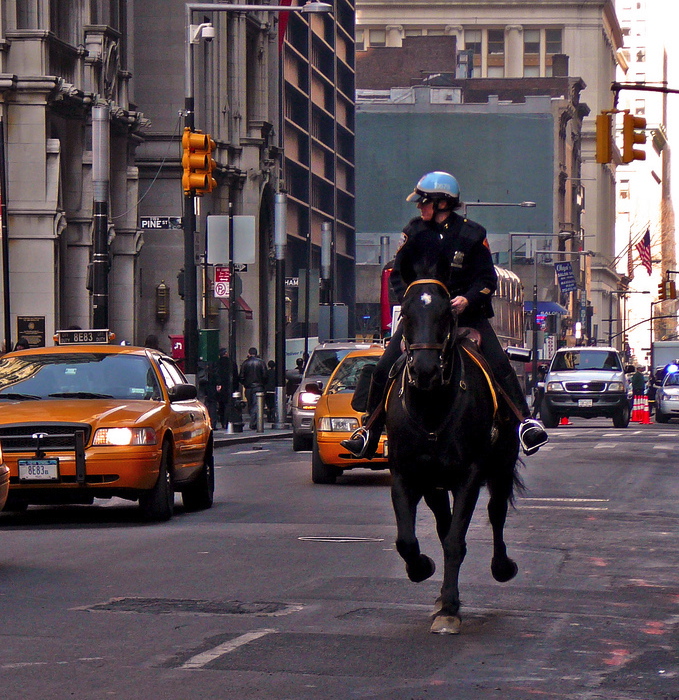
In some cities, at least:
When you factor in all the expenses for training, feeding, stabling, and outfitting, funding a single police horse is decidedly expensive. And horse units, usually deployed at large public events, perform poorly on typical accountability metrics like arrest rates. With so many more cost effective alternatives, mounted police have been forced to make the case that their units still belong.
Last month, Portland, Oregon, became the latest city to consider dropping its horse program. City Commissioner Steve Novick, hoping to redirect the $860,000 the city chips in annually to other budget concerns, had some harsh words for the department’s fleet:
“The mounted patrol is largely ornamental.” He explained to his fellow commissioners, “The primary justification for the unit, as I understand it, is ‘crowd control.’ But marauding crowds have not seemed to be a major source of crime in Portland for quite some time.” In Waterloo, Ontario, budgetary concerns similarly led to the disbanding of its program. And in New York City, there are signs Mayor Bill de Blasio’s high-profile campaign against the city’s “inhumane” horse-drawn carriages could extend to the NYPD’s mounted unit.
Blake Zeff thinks de Blasio would be foolish to push the carriage issue so soon after winning a battle over pre-K funding:
Like President Obama, the mayor expended a tremendous amount of chits early in his first term on an enormous new social program that looks likely to pass by a hair, with alterations to the initial design. … If you’re the City Hall senior staff right now, you could sure use a steady, stable few months of quiet, if you can control it. It’s not the time for more fights.
(Photo by Flickr user Campra)
Timothy Frye focuses on economic issues:
One big question is whether the anticipation of a slowing economy and lower personal popularity in the future will make Russia more likely to repeat a Crimean scenario in Eastern Ukraine, Transdniestr, Kazakhstan or the Baltics as a way to divert attention from deeper problems or whether these negative trends would moderate Russian foreign policy. Empirical support for the diversionary theory of war is mixed at best, but this is a question that bears watching. It also bears remembering that while attention is focused on President Putin’s skyrocketing approval ratings and his triumphant speech in Moscow, events in Crimea will likely divert Russia from addressing its most important problems.
Sarah Sloat uses psychology to explain Putin’s recent behavior:
Earlier this month, NPR’s Shankar Vedantam floated the idea that something called “prospect theory” could explain Russian President Vladimir Putin’s invasion of Crimea. A behavioral economic model developed in the late 1970’s, the theory states that people are more cautious when they have the upper hand and riskier when they don’t. If this indeed explains Putin’s actions, it would mean he perceives Russia as losing power in the world, and is willing to take risks—like annexing Crimea, and perhaps even more of Ukraine—to recover what his nation once lost.
The GOP goes Girls:
Alex Pareene pareenes “Scott Greenberg”:
Just your typical millennial here, wearing tortoiseshell glasses and a cool leather jacket and also really concerned about gas prices. They really eat into your typical millennial’s paycheck!
Now it’s true that millennials, on average, are less likely to buy or own cars than any other current generation of Americans. One-third of households headed by millennials under 25 had no car in 2011 (and only one-third of millennials actually head their own households), and fewer 16-24-year-olds had driver’s licenses in 2011 than at any point in the last half-century.
But give the RNC some credit: Most millennials still believe that they need or will need to own a car (which, in most of America, is a completely accurate belief), they just find the cost of car ownership a burden. Just like Scott here! And that’s why Scott is a Republican: Because they support an “all of the above” energy policy, which Scott sums up as, “solar, wind, shale gas, oil, whatever!” I mean, increased domestic energy production doesn’t necessarily lower fuel prices in the U.S. because it is a worldwide market, and “all of the above” is actually the energy policy of both parties, but, you know, “whatever,” as the millennials say. “LOL,” they sext one another. “Let’s frack some shale gas, YOLO.”
Mystic aside, the NSA claims that collecting your phone metadata doesn’t violate your privacy because it doesn’t tell them much about you. Well, researchers at Stanford have been studying that claim since November, and even they were surprised at how staggeringly false it turned out to be:
We did not anticipate finding much evidence one way or the other, however, since the MetaPhone participant population is small and participants only provide a few months of phone activity on average. We were wrong. … The degree of sensitivity among contacts took us aback. Participants had calls with Alcoholics Anonymous, gun stores, NARAL Pro-Choice, labor unions, divorce lawyers, sexually transmitted disease clinics, a Canadian import pharmacy, strip clubs, and much more. This was not a hypothetical parade of horribles. These were simple inferences, about real phone users, that could trivially be made on a large scale.
The study’s implications are pretty major:
“This is striking,” Fred Cate, a law professor at Indiana University, told Ars by e-mail. “It highlights three key points.
First, that the key part of the NSA’s argument—we weren’t collecting sensitive information so what is the bother?—is factually wrong. Second, that the NSA and the FISA Court failed to think this through; after all, it only takes a little common sense to realize that sweeping up all numbers called will inevitably reveal sensitive information. Of course the record of every call made and received is going to implicate privacy. And third, it lays bare the fallacy of the Supreme Court’s mind-numbingly broad wording of the third-party doctrine in an age of big data: just because I reveal data for one purpose—to make a phone call—does not mean that I have no legitimate interest in that information, especially when combined with other data points about me.”
Derek Mead adds:
Remember, these inferences are solely based on phone metadata, which includes phone numbers and call time. Phone metadata is an extremely powerful tool—the NSA wouldn’t be so dedicated to collecting it if it wasn’t—and it’s absolutely, unequivocally isn’t anonymous. As the researchers write, it’s “unambiguously sensitive, even in a small population and over a short time window.” I asked [Stanford’s Jonathan] Mayer if there was anything he’s seen that people could do to limit the usability of their metadata. The answer was pretty simple: Unless you stop making calls, there’s nothing you can do.
Casey N. Cep views moviegoing as “a collective escape: something we do with others, something we experience together”:
Just as we go looking for the lives of others on the screen, we get to look at them around us in the theater. In the age of bowling alone, when so many community organizations and spaces are in decline, the movie theater remains a place where the many become one: various ages and varied professions all watch the talkies together.
That mix is what I miss most when I watch a movie at home:
The chatty teenagers near the concession stand, the gossiping couples who are always first in their seats; the collective sighs and gasps and enthused whispers of commentary during the film; even the hokey clapping at the movie’s end. I suppose we have comment sections and message boards as digital surrogates, but I live for the unexpected conversations that follow movie screenings; even if I’m only eavesdropping, those conversations are as memorable to me as the movies themselves.
But as technology shifts us away from the cinema, Cep worries that “cinemas are well on their way to making moviegoing a luxury experience”:
It might be that in a few years only a limited number of movies debut in theaters and the rest of what’s on offer will have already proven itself in the direct-to-video market, or that everything on cinema screens is a few years or even decades old, screened not as a test, but as a celebration of popularity. Our cinemas will become something like museums, displaying what has already proven popular or earned acclaim, instead of galleries, where new art appears first for assessment. The picture shows won’t end, but they’ll become the last rather than the first stop for Hollywood.
Elise Viebeck warns of one:
Health industry officials say ObamaCare-related premiums will double in some parts of the country, countering claims recently made by the administration….” … I think everybody knows that the way the exchange has rolled out … is going to lead to higher costs,” said one senior insurance executive who requested anonymity. The insurance official, who hails from a populous swing state, said his company expects to triple its rates next year on the ObamaCare exchange.
Cohn throws cold water:
As usual, the real news here is more complicated and ambiguous.
The possibility of higher-than-normal rate increases in some parts of the country is real enough, for several reasons. Chief among them: Insurance companies may have expected a better mix of beneficiaries—in other words, more healthy people and fewer sicker ones. If so, the companies could discover that the premiums they set for this year are too low to cover the medical bills they must pay to doctors, hospitals, pharmacies, and the like. If that happens, the insurers could respond by raising premiums next year, perhaps substantially. Serious, honest people are worried about this scenario unfolding, based in part on rumblings they are picking up from within the insurance industry. “There is extensive concern about rate increases next year,” Caroline Pearson, vice president of Avalere Health, told the Fiscal Times. “Particularly since exchange enrollment is skewed toward older enrollees, some are concerned that plans will need to raise prices in 2015.”
But as Pearson also pointed out—and as all the “could”s and “if”s in the above paragraph imply—nobody really knows what’s going to happen.
Mcardle is somewhat skeptical of Viebeck’s report:
Insurance executives have every incentive to be as alarmist as possible. The administration and the insurers are now engaged in a lengthy negotiation about what you might call “The Obamacare Exchange Rescue Package of 2014.” In response to public outcry, the administration has made a bunch of changes to the rules — allowing people with “grandfathered” plans, for instance, to keep their policies. Those rule changes are going to cost the insurers a considerable sum. So the administration is proposing more rule changes, this time to funnel money to the insurers.
The insurance industry would like the funnel to be as big as possible. One way to encourage this is to tell reporters that you’re planning to triple policy premiums in “a populous swing state” — during an election year.

