by Chas Danner & Chris Bodenner
A reader gets wistful:
Savannah, Georgia. The state that broke my heart. Twice.
Another goes way west:
This is Guilin, China.
Another wild guess:
If I’m correct, this picture is taken right off the Bosphorus River, in Istanbul. I think the bridge is the Ataturk Bridge. Hope I’m right! This is my first ever try for a VFYW, so does that cut me some slack?
A little but not enough. A reader gets the right continent:
The license plates look European, and the flag on the front of the boat looks blue. I’m going with northern Greece, somewhere near Albania.
Another thinks he’s got the right river:
I spent a summer studying abroad in the Czech Republic. Made a trip to Linz one weekend to see what was there. Linz’s waterfront looks very similar to that picture and so does the bridge. Also the cruise boat makes me think its somewhere on the Danube.
A few others thought it was the Danube as well. But another gets closer:
Like many other readers, I suspect, I have been meaning to subscribe, but I’ve not yet gotten around to it. As far as the VFYW, this is the first time I’ve ever had a real glimmer of recognition. The bridge and gently-sloping hills in the background strike me as Rouen, one of my favorite towns in France.
Another gets the right country:
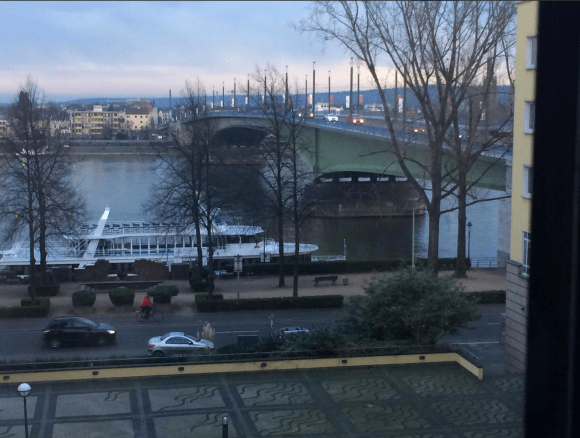
This bridge looks very much like one that I crossed on foot with a suitcase about 20 years ago, when I was a graduate student studying in Germany for a year. I remember taking a ferry down the Rhine from Mainz to Koblenz, walking across the bridge to a fleabag hotel I where I spent the night (the guidebook I used them called the decor “cheesy” and the facilities “a little worn”). The wintry scene, the German-style apartment houses in the background, the European economy cars and the bicyclist all make me think of Koblenz.
Another gets really close:
This appears to be in Cologne. The view seems to be looking from the left side of the Rhine over to Deutz (a neighborhood in Cologne) on the right side. If it’s not Cologne, it must be somewhere along the Rhine.
It is. Another gets the right city:
I think your contest photo is a picture of Bonn, Germany. That’s the bridge running over the Rhine, if I’m not terribly mistaken. Two summers ago I walked over that bridge every morning to my German classes. Terrible classes, but my wife and I had a lovely time in the city all the same.
Another nails the right hotel in Bonn:
I’m a loyal reader but fairly new subscriber, and this is the first contest I’ve ever entered. If I get this right, then a million other people probably will, too, given my very rudimentary search technique skills. Right off the bat, this looked like Germany to me, and the Rhine River, and for some reason I immediately thought “Bonn”, a city I’ve been to a few times. Then a couple of image searches and some basic Google mapping and lo and behold … Hilton Hotel, looking out over the Kennedy Bridge. I’m too lazy to even try to figure out exactly which room the photo was taken from, which means someone else will probably take the prize. Please tell me I’m right, as I’m already shaking with excitement …
Yep you’re right. But more than 50 readers correctly guessed the Hilton Hotel. Here’s a fantastically thorough entry:
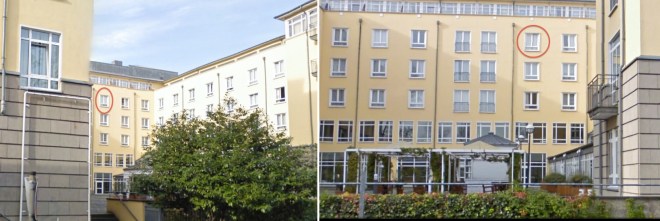
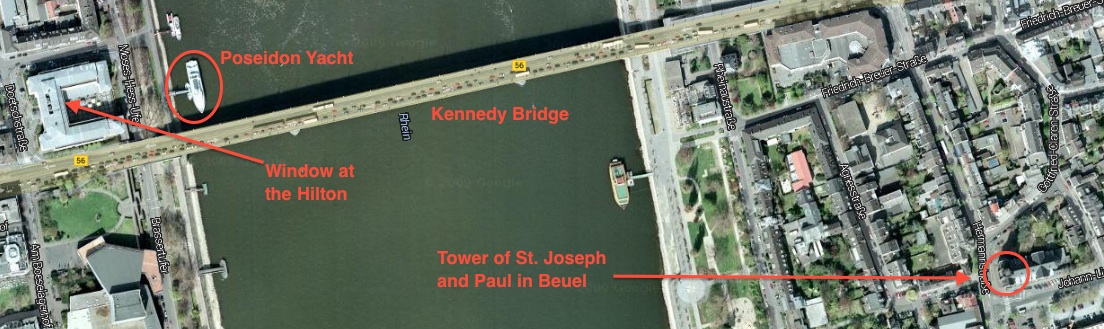
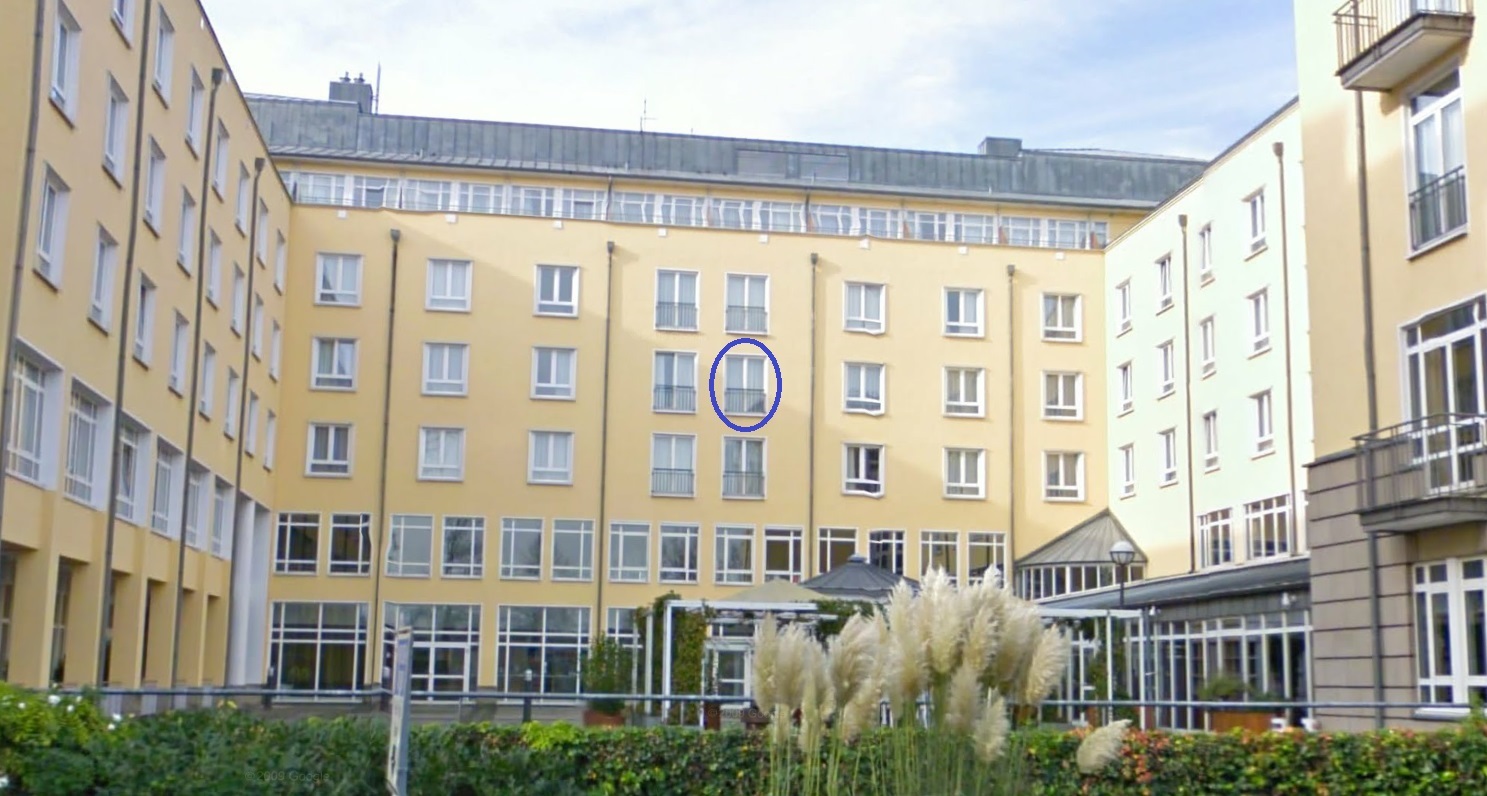
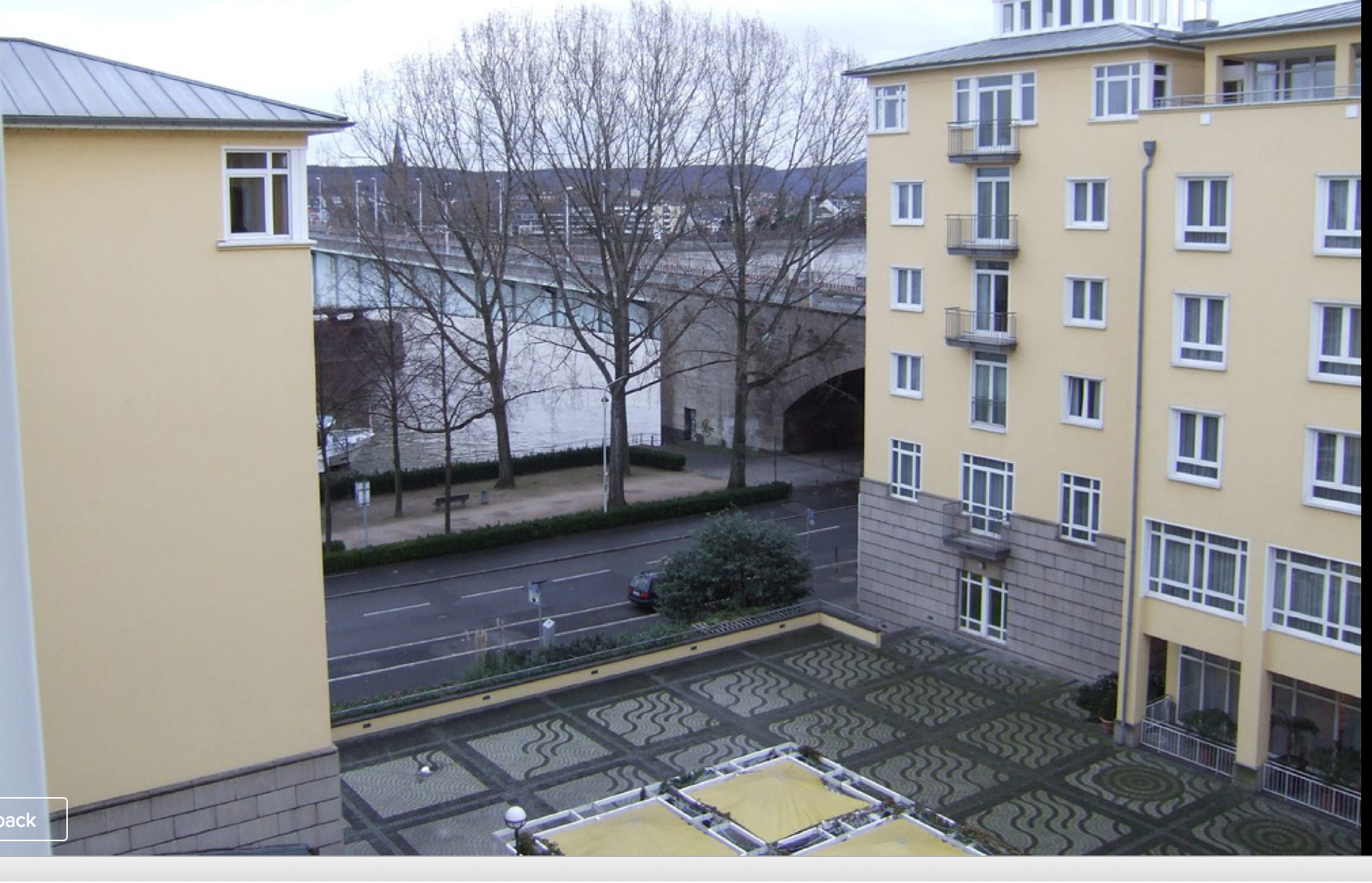
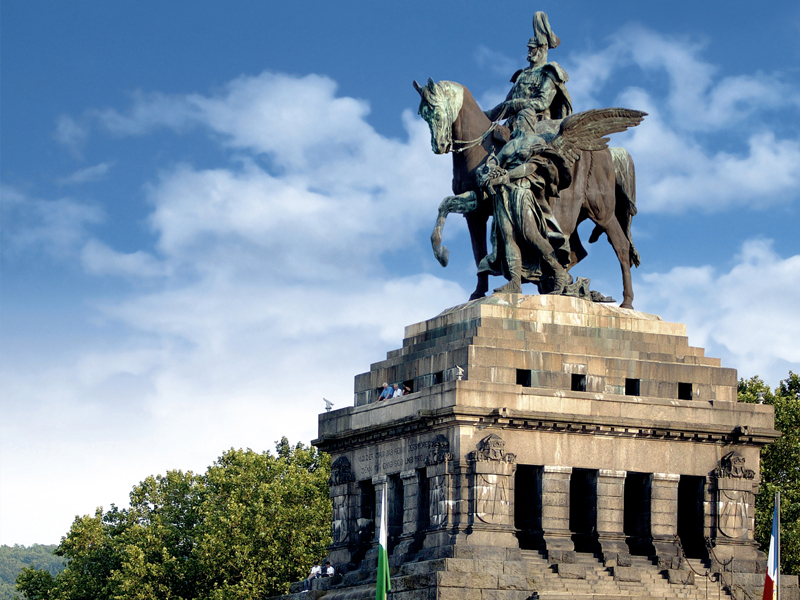
This week, I first traveled the Danube and the Elbe before navigating down the Moselle to join the Rhine at Koblenz, where Kaiser Wilhelm I and his genius loci survey the rivers’ confluence at the German Corner. From there, it was a short ride to the Poseidon Yacht anchored in front of the Hilton Hotel at Berliner Freiheit 2 D-53111 in Bonn, Germany, where this week’s contest window is located. Beautiful scenery the whole way. I’ll guess room number 410, on what we in America accurately call the fifth floor. I compared this photo – that seems to have been taken from the same room – with a photo looking out of room 326 to help estimate the room number. Even if it’s not room 410, [above] are two pictures with the window circled. [Below] is an overview photo with labels for the hotel, the Poseidon Yacht, the Kennedy Bridge, and the church tower that is through the trees and across the Rhine from the contest window:

The Poseidon Yacht looks better in all its neon glory at night. But the city’s most famous landmark is not in the picture; Bonn hosts the corporate headquarters of Haribo, the company that gave the world gummy bears.
Perfect timing for a German riverboat trip, as I have been reading Patrick Leigh Fermor’s A Time of Gifts. Fermor walked across Europe before the war, starting a few months after the Nazis took power. He made his way up the Rhine by barge in December 1933 just before Christmas, with stops in Bonn and Koblenz. The war and the Holocaust are still in the distance, but they hang over the memoir. It’s a wonderfully written adventure with digressions into history, art, language, and religion. I recommend it to other Dish readers.
Another geeks out on the bridge:
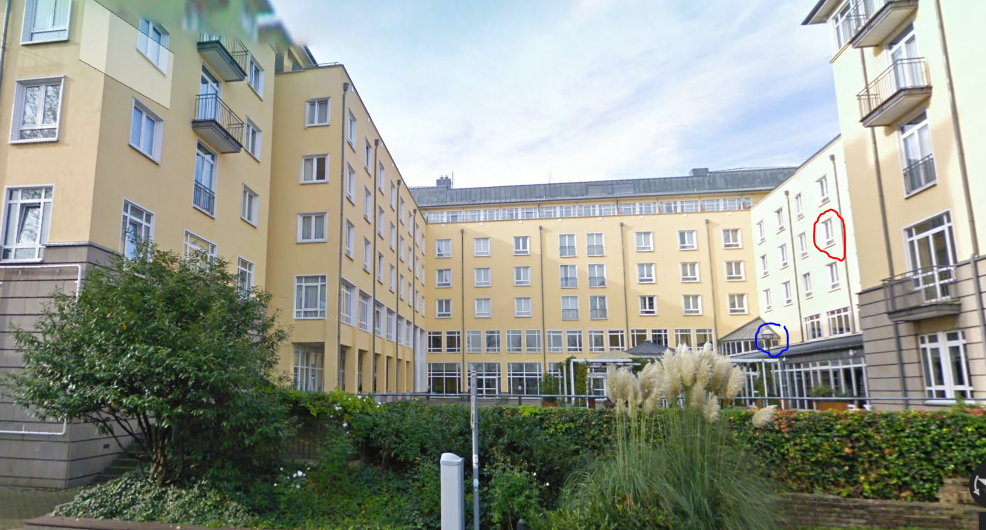
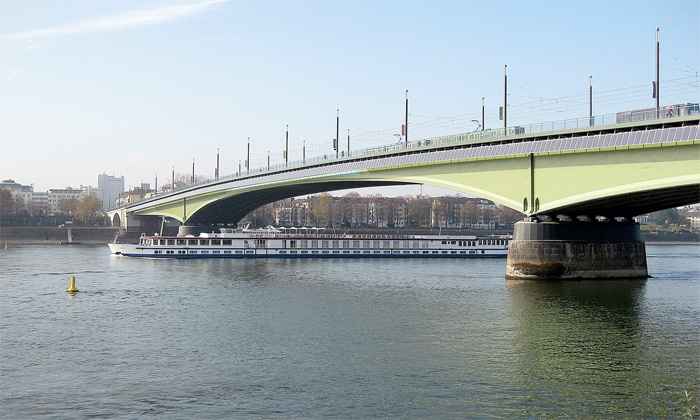
Finally got one! Kennedy Bridge, near where the Allies reached the Rhine in 1945. I couldn’t read the sign on the boat, but I had some sort of advantage – bridges! This one is strange for the US – the piers are wrong, and the Coast Guard HATES having fixed steel bridges that low over navigable waterways. Plus, the buildings looked vaguely European/Scandinavian. After finding a web database of bridges, and sorting to “multiple girder steel bridge over water” and finding a picture of a bridge in Strasbourg with similar features, then realizing we just passed the date of the allied advance, I traveled down the Rhine in Google Earth until I found it. I got thrown off the trail a bit because the photo clearly shows six girders, but the Streetview/Earth photos show it before its recent renovations with expansion to six girders. Here’s the hotel the photo was taken from:
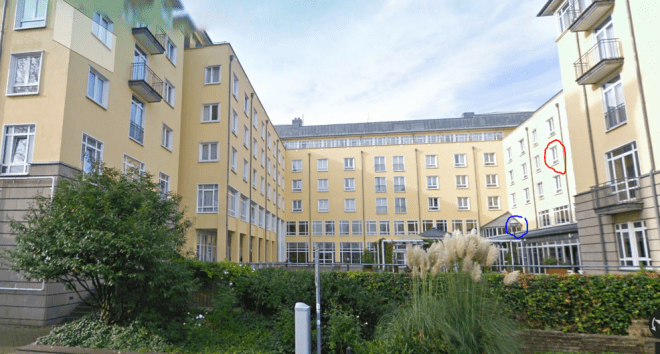
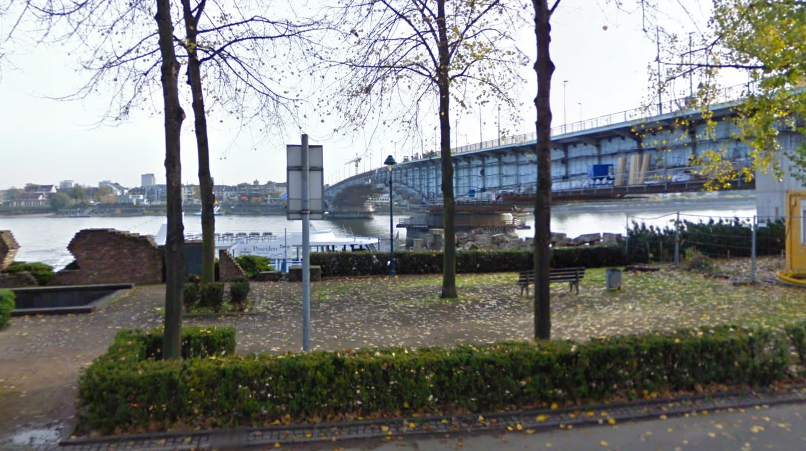
The lamp post (blue) is kind of to the left of the photographer, but they are close to it. I am going to guess: 3rd floor, middle of north wing (red circle). Here’s the Streetview of the bridge, same direction as shot:
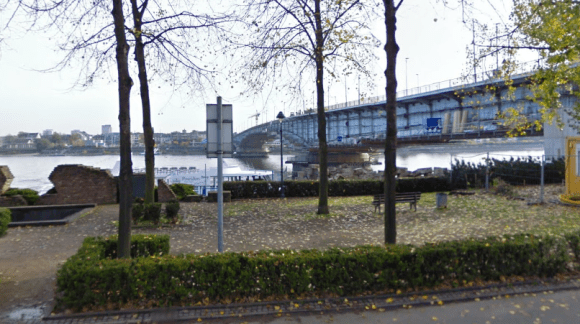
A nearby resident shares more info on the bridge:
The Kennedy Bridge had been renamed in December 1963 in honor of President John F. Kennedy, who had visited both Bonn (Germany’s capital at the time) and Berlin half a year earlier in June 1963 to commemorate the 15th anniversary of the Berlin Airlift and give his famous “Ish bin ein Bearleener” speech. The name of the street leading up to the bridge, Berliner Freiheit, translates to “Freedom of Berlin”, and the street faces pretty much in the direction of today’s capital of Germany.
Another adds:
The street below was previously known as Matthias-Erzberger-Ufer, after the Catholic politician and vice-chancellor of the Weimar Republic, who had signed the armistice at Compiègne in 1919, and was vilified by conservatives and right-wing press and politician until his assassination in 1921. It was renamed in 2011 after Moses Hess, the Jewish philosopher, who was an important precursor to Marx and Engels as well as to Zionism, and who, different from Erzberger, was actually from Bonn. You can see, in the lower left, across the street, a memorial for the Jewish community of Bonn, a fragmentary star of David, erected from the stones of the nearby synagogue, that had been destroyed during the pogrom of November 9, 1938. Strange contrast with the “party yacht” Poseidon moored behind it waiting for customers for a joyful booze cruise on the Rhine.
Another:
The best part of these puzzles is all the trivial knowledge I gain playing; this week: street lamps, European river cruises and EU vehicle registration protocol! I have yet to summon the courage to involve the front desk in getting exact room number. Maybe next time.
Another claims some bragging rights:
Yes! I beat my husband! (I always do.) I found the Hilton Bonn, Berliner Freiheit 2, 53111, Bonn, Germany after a Google search for solar energy bridges, while he was still going through all the bridges on the Danube : ) Here’s a picture of my guess for the exact window (my graphic skills aren’t quite as advanced as some of your readers’):
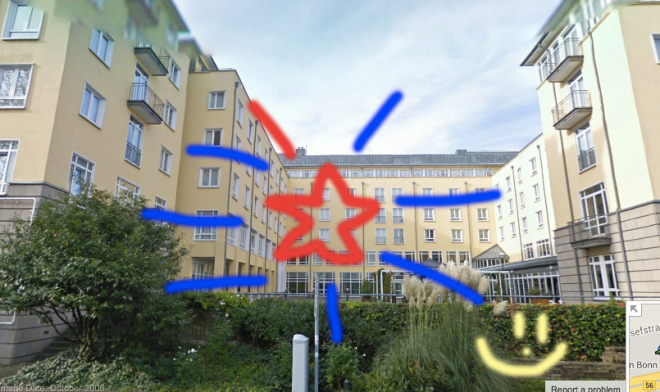
But there’s a hitch in this week’s contest, as the original submitter can’t remember the room number. What to do when that happens? In Chini we trust:
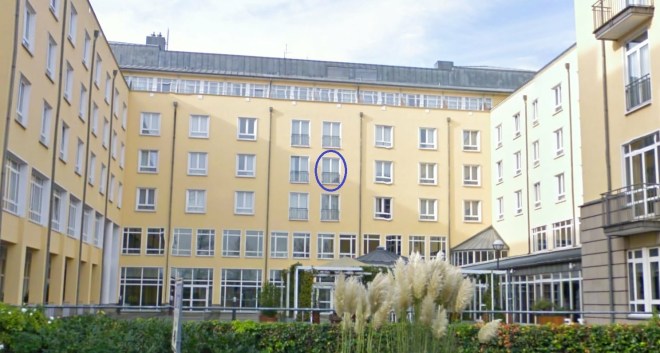
At first this seemed like it might be a toughie, but once I saw that there was a dead giveaway clue I knew you’d get quite a few correct guesses. This week’s view comes from Bonn, Germany. The picture was taken on the 3rd floor of the Bonn Hilton and looks due east to the town of Buele on the far bank of the Rhine.
One notable feature in the image is the Kennedy Bridge on the right. As you might guess, based on its aging pillars and abutments, the current structure is a post World War II replacement. The original, far more beautiful bridge was blown up by the retreating Wehrmacht on March 8th, 1945. Fortunately the demolition of the Bonn bridge was too little, too late. On March 7th, the U.S. First Army had captured the Ludendorff Bridge at Remagen just 13 miles upriver and the door into Germany swung wide open. Here’s a black-and-white image of the original bridge and a marked overhead view of it from 1943:
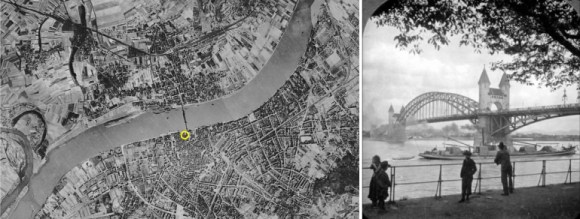
For the truly curious, here’s a documentary on the capture of the Remagen bridge.
Several readers agreed with Chini’s window selection, but the prize this week goes to the reader with the most correct guesses in previous contests without yet winning:
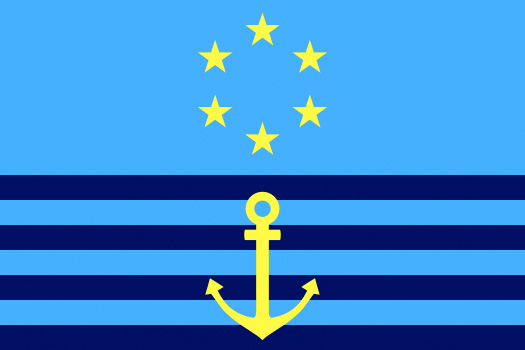
I was upset with myself for not entering the past two weeks. I had a general sense of where the images were taken, but didn’t get to the right city quickly enough, and didn’t have the time to look further. I committed to solving this week’s image no matter how difficult. I started with the sense that we were looking at a northern European city, 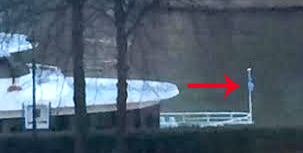 obviously on a river. But, all cities in Europe were built on rivers. Looking for clues, I noticed a light blue flag on the boat docked in front, and thought I’d start there. The blue colored European country flags were Greece, Sweden, and Latvia. It couldn’t be Greece, as this city looked northern. But, the flag was too light in color for it to be any of these countries. Nonetheless, I searched some cities in Sweden and Latvia before I abandoned that approach. After striking out in Sweden and Latvia, I tried to find the distinctive patio flooring that is shown in the picture. I couldn’t find it.
So, back to the flag. I found this flag for the Central Commission for Navigation on the Rhine. The color seemed 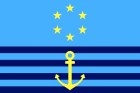 right, and so did the river. Now, I really have no idea if this is the flag on the boat, but it brought me to the Rhine. So, I took a journey down the Rhine. After looking around at images in Basel, I decided to get more efficient with my search. So, I searched for Rhine bridges. The search quickly brought me to the Kennedy Bridge in Bonn, and it was a match:
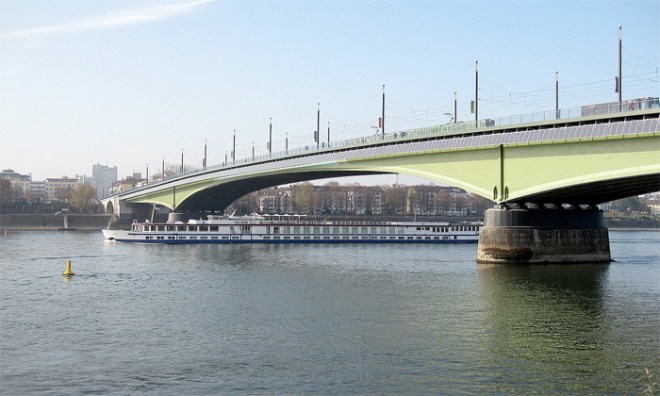
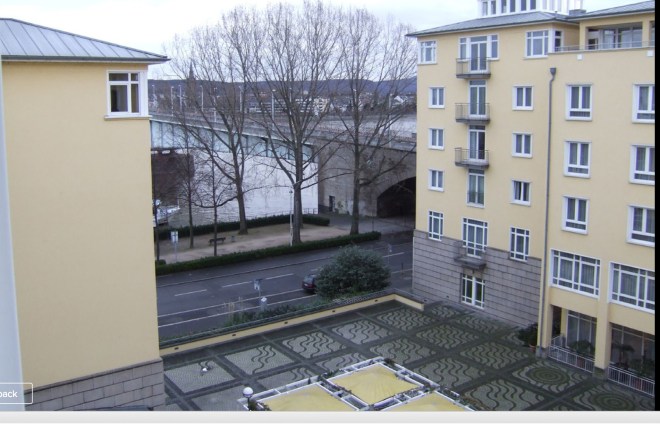
The original bridge was completed in 1898. To see the animated gif of the stereoscopic view of that bridge, go here. The Bonn Hilton at Berliner Freiheit 2 is where this week’s picture was taken from. Here is a picture that shows the distinctive courtyard—the courtyard that I had hoped would help me on my search, but didn’t:
And where was the picture taken from? I think it was from the room I boxed in red:
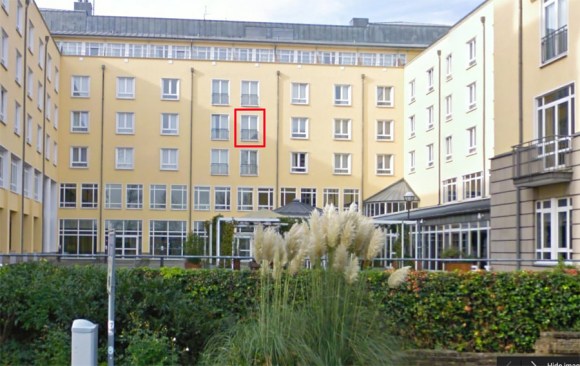
I know that your consistently winning players always know the room numbers. That frustrates me, as I have never found a floor plan for hotel guest floors. Someday, I am going to win this thing.
Well that someday is today. From the reader who submitted the contest view:
Unfortunately, I don’t remember my room number from that trip. I want to say it was 311, which would be the fourth floor because, like most European buildings, the ground floor is considered “zero”. However, I would not bank on that memory of my room number, or even my floor.
I’ve stayed at the Hilton in Bonn several times, but this was the first time I had that river view, which I found immediately compelling. I took the picture just after sunrise and thought it captured a scene from that part of Germany perfectly – the bicyclist, the bridge, the boat, and the architecture across the river. Bonn is mostly a university town, and I often tell people it’s like Albany, in that it was a small city to be a capital, with a good university, and is often overshadowed by its larger, more well-known neighbors, Cologne and Dusseldorf.
I took the picture the first week of February, in the heart of winter. While news of the polar vortex was dominating the news at home, Europe was having the mildest/warmest winter I can remember. I was able to take a few long runs along the Rhine in shorts, with just a long-sleeved shell on top. Normally, at that time of year in Northwest Germany, I run indoors on a treadmill because it is too cold to run outside. In fact, I chose the Hilton precisely because they have a good modern gym and I expected to use it that time of year, but I ended up just running outside along the river every morning.
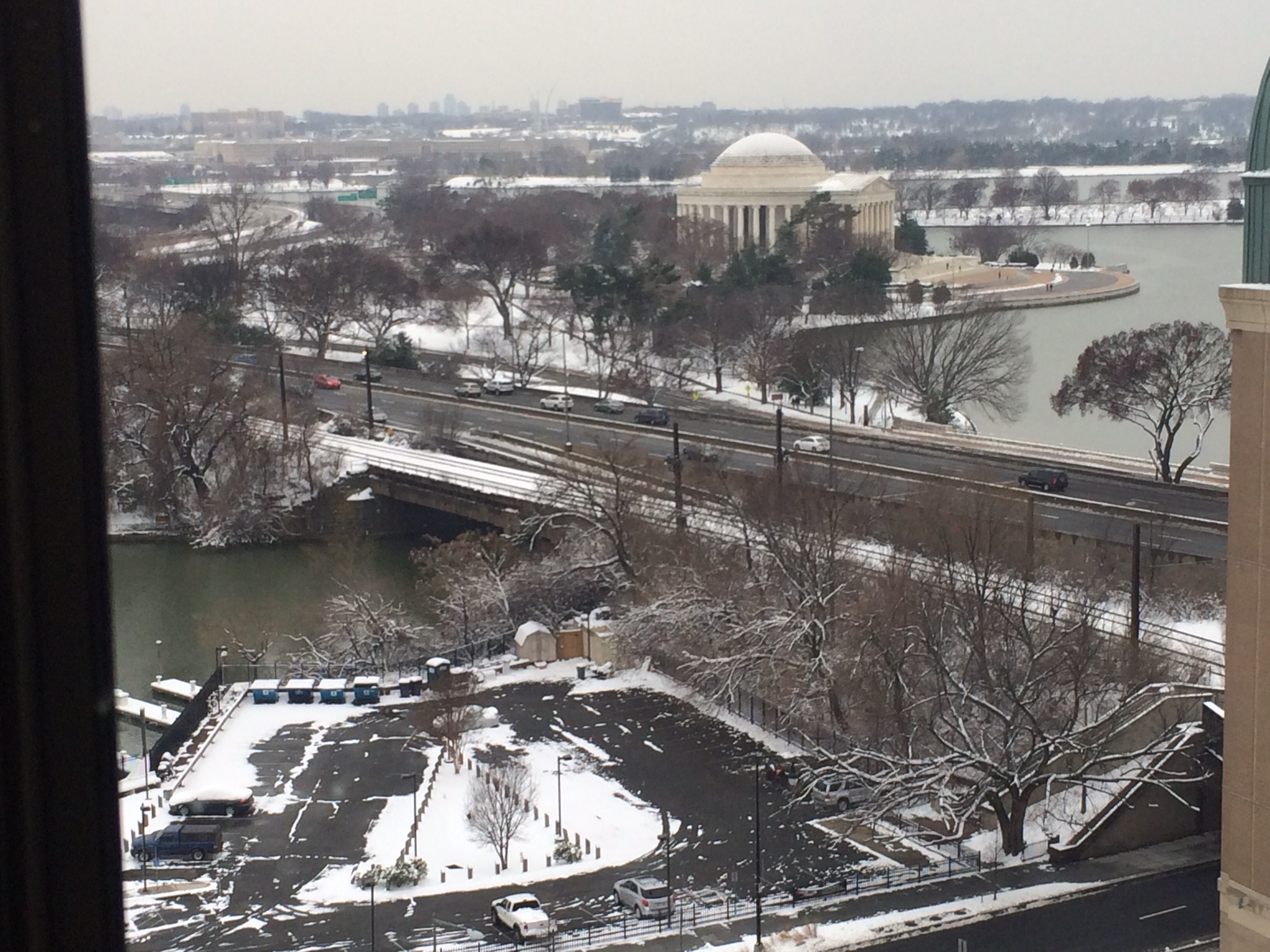
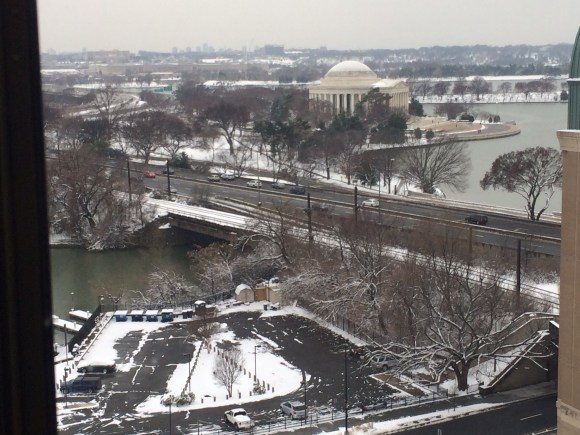
It is apropos that you used my photo this week. While Andrew is enjoying warmth and sunshine on his vacation, I am stuck in his hometown of DC, which just got yet another generous helping of snow. Still, as I write you from my current hotel room, I can’t complain about my view:
(Archive)