Paying A Premium For Prime

by Katie Zavadski & Patrick Appel

With Amazon raising the price of Prime by $20, Yannick Lejacq wonders how far Amazon can push consumers:

Giving up a few beers or a dinner out doesn’t seem like much of a sacrifice compared to all the time and money Amazon Prime has saved me over the past few years. But I have to wonder what the current price jump portends for the future of Amazon. The company knows that I’m an addict. And like any addict, I’m not entirely reasonable when it comes to my spending habits. I say that Prime saves me money, but really I’m just assuming it does. The real convenience is that it saves me from lurking on countless other websites just to find the best possible deals.

So once I’m hooked, what’s another $20? Or another $50? How far can Amazon push Prime before it starts to lose customers rather than continue to gain?

Derek Thompson fits Prime into Amazon’s overall business strategy:

For investors, Prime represents a key lever for generating profits in the future. Many of the analysts I spoke to for my business column last year on Amazon said they didn’t think it could raise prices dramatically on most of its merchandise. Instead, they said Amazon could always raise the price of Prime on its most passionate customers and add hundreds of millions of dollars to its bottom line just like that. …

The power of memberships isn’t just that they represent dependable revenue for Amazon in the topsy-turvy world of retail. It’s also that they’re sticky for customers. Couch potatoes have a hard enough time canceling their $90-a-month gym memberships, thanks to status quo bias and general laziness. It’s even harder to justify canceling a $8.25-a-month membership that gets you free fast shipping to the biggest online store, a great digital video offering, and more, just because the price went up by less than $2 a month.

Jordan Weissmann crunches the numbers:

The fact that Prime has stayed as cheap as it has for so long is one more small testament to Jeff Bezos’s willingness to sacrifice short-term profit margins to lure long-term customers. If you only adjust for inflation, a $79 Prime account nine years ago would be worth $94 today. Unlike when it debuted, subscribers also get access to Amazon’s library of streaming TV and movies. As the company has noted, shipping costs are up—the price of diesel fuel for trucks has just about doubled since 2005. And finally, it says subscribers are using the service more often, which by default makes it more expensive for Amazon to run. It costs more to serve up an all-you-can-eat buffet when the diners start pigging out.

Calculate whether Prime is worth it for you here.

Crimea, Russian Federation

by Jonah Shepp

Unrest in Ukraine

Russia annexed the peninsula this morning:

Last night, the Kremlin website posted an approval of Crimea’s draft independence bill, recognizing Crimea as a sovereign state. Today, Putin spoke for close to an hour about the history of Russia, Crimea, and the West, before overseeing the signing of document, citing the will of the Crimean people as justification and decrying the West’s attempt to stop the union.

In the speech, Putin made the expected point that there’s not that much the international community can do to prevent two willing, sovereign entities to merge. He made the case that Russia has acted in accordance with international law, and that thousands of Russian troops on the ground in Crimea had nothing to do with it.

John Cassidy parses Putin’s speech at the annexation ceremony, in which he said Russia had been “robbed” of Crimea in 1954:

At least as regards Crimea, and give or take a few rhetorical flourishes and judgments, this is a roughly accurate representation of what happened, or, at least, of what recent history felt like to many Russians. (It felt quite different to the Crimean Tatars.) Thus the strong public support for Putin’s actions. To some in the West, and to certain liberal Russians, such as Garry Kasparov, this looks eerily like Hitler’s grab of the Czech Sudetenland in 1938. Most Russians, and even Mikhail Gorbachev, beg to differ.

Crimea’s return to Russia “should be welcomed and not met with the announcement of sanctions,” the former Soviet leader said in a statement that was released on Monday. “If until now Crimea had been joined to Ukraine because of Soviet laws that were taken without asking the people, then now the people have decided to rectify this error.”

Putin’s defenders are skating over the fact that Russia has violated Ukraine’s sovereignty; stomped on international commitments it made during the nineties; destabilized the eastern part of Ukraine by shipping in agitators; and even, quite possibly, broken its own laws, which stipulate that new lands can join the Russian Federation only after the country to which they used to belong has made an agreement with Moscow. For all these reasons, sanctions are justified.

But there is still the strategic point. If Crimea’s status as part of Ukraine is regarded as an accident, or a blunder by Khrushchev, the sight of it rejoining Russia can be regarded as a tidying up of historical loose ends—a delayed but inevitable part of the redrawing of boundaries after the collapse of the Soviet Union.

Timothy Garton Ash rallies the West to defend what remains of Ukraine:

Putin scored a few telling hits on US unilateralism and western double standards, but what he has done threatens the foundations of international order. He thanked China for its support, but does Beijing want the Tibetans to secede following a referendum? He recalled Soviet acceptance of German unification and appealed to Germans to back the unification of “the Russian world”, which apparently includes all Russian-speakers. With rhetoric more reminiscent of 1914 than 2014, Putin’s Russia is now a revanchist power in plain view.

Without the consent of all parts of the existing state (hence completely unlike Scotland), without due constitutional process, and without a free and fair vote, the territorial integrity of Ukraine, guaranteed 20 years ago by Russia, the US and Britain, has been destroyed. In practical terms, on the ground, that cannot be undone. What can still be rescued, however, is the political integrity of the rest of Ukraine.

Stewart M. Patrick fears the precedent that Crimea’s accession to Russia sets:

Hundreds of minority populations around the world might in principle insist on secession, throwing existing borders into chaos. Not for nothing did Woodrow Wilson’s Secretary of State Robert Lansing bemoan that the principle of national self-determination advanced by his president was “loaded with dynamite.”

Moreover, Russia’s aspirations are not limited to Crimea, and its successful annexation could clear a path for the Kremlin to seek to regain de-facto sovereignty over territories in the former Soviet Union with large Russian minority populations, under the pretext of protecting “oppressed” compatriots. We have seen this movie before, most obviously in Georgia. In 2008, the Russian military intervened to assist two breakaway republics, Abkhazia and South Ossetia. In the aftermath of that intervention, Moscow pledged to remove its troops. They remain there today. Or consider Moldova, where Moscow has for more than two decades supported the statelet of Transdniester, allowing it to become a veritable Walmart of arms trafficking.

(Photo: Name plates on the walls of the Crimean parliament building are removed after the annexation of Crimea by Russia on March 18, 2014. By Bulent Doruk/Anadolu Agency/Getty Images)

Putting The Midterms On Cruise Control

by Patrick Appel

Ponnuru warns Republicans against it:

Take a look at the Huffington Post’s poll averages. Obama’s net job-approval rating is slightly up since the start of February. His rating on the economy has been improving since early December. He has been rising on foreign policy since late September. While the president is still “upside down,” as the operatives say, on all those measures, Republicans would be foolish to assume that the trend is their friend.

And even if Republicans succeed by taking the path of least resistance, they will be storing up future trouble. What if they win the Senate? In that case, Congress will have to move legislation. Republicans will have to come up with attractive conservative bills then, so that Obama will either feel it necessary to sign them or pay a political price for vetoing them. They will be in much better shape if they have campaigned on some of these ideas.

He is interested in the GOP “coming up with an agenda, selling it to the public and refining it as they go.” Douthat doubts that will happen:

I don’t think you’re likely to see real movement until after the 2016 campaign. The House Republican caucus is just too dysfunctional to unite around anything except modest budget deals and insufficient alternatives, and if they did unite around something more substantial they’re too distant from the White House ideologically to cut a deal. That’s probably still going to be the case after the midterms, and the lame duck phase of presidencies rarely produce much policy movement anyway. So for the ideas currently circulating to actually come up for votes that mean something, I think you’d need a change in the correlation of forces in Washington D.C. – and in particular, you’d need a clear leader capable of pushing them, which basically can only happen if there’s a Republican in the White House.

As for what happens to these kind of proposals if it’s Hillary Clinton in the White House instead, with a Republican House and a divided Senate? Honestly, I no idea – but I can’t say I’m optimistic.

The Poverty The Right Doesn’t Want To See

by Jonah Shepp

Agunda Okeyo reviews Maria Shriver’s HBO documentary Paycheck to Paycheck: The Life and Times of Katrina Gilbert:

What makes Gilbert’s story so compelling is that she challenges almost every stereotype underpinning right-wing rhetoric about poverty, single mothers and the underemployed. Gilbert isn’t looking for a government “handout,” and she doesn’t blame others for her plight. She’s also remarkably patient and affectionate with her children, even as she raises them by herself. (As we learn, a significant portion of her childcare burden is relieved by the Chambliss Center , a 24-hour, seven-day-a-week childcare facility that offers a range of educational and counseling services for low-income families on a sliding scale. “If it wasn’t for them,” Katrina declares, “I wouldn’t be able to work because I would just be paying for daycare. How would you pay your bills? It’s impossible.”)

Gilbert’s tale also offers a refreshing reminder to conservative politicians that economic hardship is not the exclusive domain of ethnic minorities. Like Monica Potts’ illuminating feature in The American Prospect, “What’s Killing Poor White Women,” “Paycheck to Paycheck” explores the complex texture of inequality — and examines why white women are an oft-ignored face of poverty in modern America.

But L.V. Anderson worries that by focusing on an exemplary individual like Gilbert, the film undersells the many more imperfect Americans also in desperate need of a leg up:

[F]ew people, be they rich or poor, behave with as much forbearance, compassion, and hopefulness as Gilbert does in Paycheck to Paycheck. This isn’t a criticism of Gilbert—she truly is amazing. But the poor people who are less extraordinary and less overtly likable than Gilbert need help, too. Watching Paycheck to Paycheck, I couldn’t help thinking about the New York Times’ gripping “Invisible Child,” Andrea Elliott’s recent profile of an 11-year-old homeless girl in New York named Dasani. Dasani is surrounded by adults who often make bad decisions, and Dasani makes some bad decisions, too—but Elliott makes it clear that they would all benefit considerably from robust social safety nets.

Earlier Dish on poverty and the GOP here and here.

A Bang-Up Job

by Chris Bodenner

A reader tees up the viral video:

Professor Andrei Lindi receives news that his decades-long life’s work has proven fruitful: observations confirm gravity waves consistent with a rapid inflationary period in the first moments of the universe. It’s being hailed as one of the most important physics results in decades, on par with experimental observation of the Higgs Boson by the LHC. (Maybe it’s not a Face of the Day, as that’s a photo feature, but just watch the video – Lindi about passes out. It’s pretty touching.)

Here’s a video from Nature explaining the basics. For me, here’s the highlight: We often talk about the Cosmic Microwave Background Radiation (CMB) as “the echo of the big bang.” While it’s the (highly redshifted) light of the first photons able to escape the primordial cosmic soup, they date it to about 379,000 years after the Big Bang. So while it’s less than 1/10,000 of the universe’s age, it’s still a long time after the initial moment in human terms.

The BICEP2 results are a direct observation of an event that took place when the universe was 10^-34 seconds old. I just tried to write that out as a decimal, but a decimal point followed by 33 zeroes is just, well – the second time I lost count, so I gave up. That’s 47 orders of magnitude earlier than our previous view. It’s a truly mindboggling result. Talk about a Nobel slam dunk!

Transplanting Technology

by Jessie Roberts

Regulations in the US prohibit the recycling of implanted medical devices after their owners die, but Frank Swain reports that there’s “a growing trend to recover them for use in the developing world”:

At $4,000 for a pacemaker and $20,000 for an ICD [internal cardiac defibrillator], a second-hand implant is the only way that millions of people will be able to afford this life-saving equipment. In the UK, charity Pace4Life collects functioning pacemakers from funeral parlours for use in India. In a similar effort, the journal Annals of Internal Medicine recently published the results of a US programme called Project My Heart Your Heart, which found that 75 patients who received second-hand ICDs showed no evidence of infection or malfunction. The group are now applying for FDA approval to send recycled heart devices overseas.

Back in Nashville, Standing With Hope has adopted a similar approach by shipping prosthetic limbs to Ghana.

Chart Of The Day II

by Patrick Appel

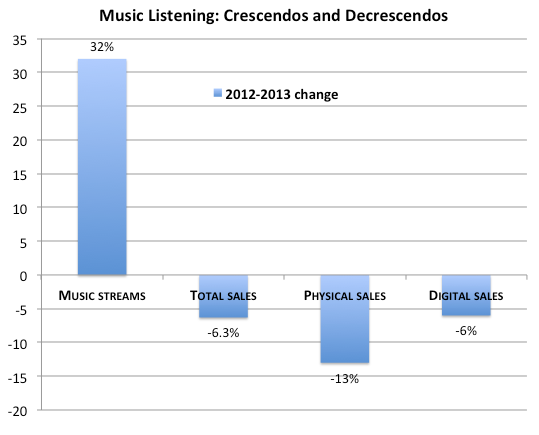
Streaming Growth

Derek Thompson covers the growth of music streaming:

This is at least the third destructive wave for the music industry in the last decade and a half. First, Napster and illegal downloading sites ripped apart the album and distributed song files in a black market that music labels couldn’t touch. Second, Apple used the fear and desperation of the record labels to push a $0.99-per-song model on iTunes, which effectively destroyed the bundling power of the album in the eyes of millions of music fans (even though country album sales are still pretty strong). For a decade, music sales plummeted. Third, digital radio and streaming sites got so good that now many music fans wonder why they need to buy albums in the first place. So, they don’t.

The Poisons In Our Pantry

by Katie Zavadski

James Hamblin sinks his teeth into the so-called “silent pandemic” of toxins hidden in our everyday items. A team of researchers identified a dozen common poisons – such as ethanol, lead, and mercury – that leech IQ points:

The greater concern lies in what we’re exposed to and don’t yet know to be toxic. Federal health officials, prominent academics, and even many leaders in the chemical industry agree that the U.S. chemical safety testing system is in dire need of modernization. Yet parties on various sides cannot agree on the specifics of how to change the system, and two bills to modernize testing requirements are languishing in Congress. [Mount Sinai’s Philip] Landrigan and [Harvard’s Philippe] Grandjean’s real message is big, and it involves billion-dollar corporations and Capitol Hill, but it begins and ends with the human brain in its earliest, most vulnerable stages. …

Economist Elise Gould has calculated that a loss of one IQ point corresponds to a loss of $17,815 in lifetime earnings. Based on that figure, she estimates that for the population that was six years old or younger in 2006, lead exposure will result in a total income loss of between $165 and $233 billion. The combined current levels of pesticides, mercury, and lead cause IQ losses amounting to around $120 billion annually—or about three percent of the annual budget of the U.S. government.

Low-income families are hit the hardest. No parent can avoid these toxins—they’re in our couches and in our air. They can’t be sweated out through hot yoga classes or cleansed with a juice fast. But to whatever extent these things can be avoided without better regulations, it costs money. Low-income parents might not have access to organic produce or be able to guarantee their children a low-lead household. When it comes to brain development, this puts low-income kids at even greater disadvantages—in their education, in their earnings, in their lifelong health and well-being.

Beard Of The Week

by Chris Bodenner

A reader passed it along:

I thought you might want this as a Beard of the Week. My colleague Matthew Bingley took the photo while covering the World Women’s Curling Championship in Saint John, New Brunswick.

Previous BOTWs here. And, because Andrew’s away from the blog, here’s a babe of the week.