Let The Teens Sleep In, Ctd

by Chris Bodenner

A reader goes in depth on the subject:

I’m all in favor of later start times for high schools so that students who need to sleep in can, but Suderman’s suggestion that vouchers and school choice will help accelerate solution overlooks two intractable reasons why schedules haven’t changed much: transportation and competitive sports.

Private schools could experiment with later starts, but that becomes difficult if they rely on public school buses, which has been true of most of the Catholic schools and most of the evangelical Christian schools I’ve known in the three states where I’ve lived. These days almost all students ride buses, and the bus routes add considerable time to the school day.

Secondly, sports create scheduling problems at the end of the school day, when public and private school teams compete.

Football is a weekend sport, but basketball, soccer, wrestling, field hockey, volleyball and numerous other sports compete one or two weeknights, and teams that travel to compete may have to miss the end of the school day if their school starts later. Game times are not going to change for private schools or for one or two enlightened high schools, as the New York Times story notes. So it’s nice to think school choice could solve the scheduling problem, but high school athletics are separated from education and transportation issues are resolved, school boards will be limited in their choices. High school sports fans and coaches may also oppose school choice if it leads to recruiting competition in public schools, since public schools already suffer from having private schools skim off top athletes in certain districts.

More generally, I have never been particularly enthusiastic about school choice because I think certain public schools will be left with the students who are discipline problems or costly to educate, such as special education students.

The only way out of the current bind that I see is total upheaval: going to year-round school. My preference would be for schools to run in quarters with a week’s vacation or somewhat more between quarters. (Other people with more knowledge of summer camp programs, church activities, and sports and marching band practice can probably come up with more refined schedules.) I’d also like to see state laws changed to mandate a total number of hours of instruction rather than “days in school.” This would also give schools more flexibility, particularly in high school, to adopt more of a college approach to scheduling where each day doesn’t have an identical schedule.

In order to continue with sports schedules after school, going to year-round school would allow athletes to have shorter days before game nights because there would be more time throughout the year to make up classwork that is currently missed when athletes leave early for games. There are some subjects that can be effectively taught through online instruction or with assistance online, so athletes and other students who want to work could manage class loads more flexibly. Sports should be severed from academics so first, there’s no pressure on teachers to pass students so they stay eligible for competition, and second, so sports teams are geographically based and, while they may compete for a specific school, rules would be in place to limit obvious competitive recruitment. This would allow home-schooled students and students at very small high schools to be part of larger community teams without prejudice.

To provide school choice as Suderman wants, I would favor school vouchers if the vouchers came with strings. Any school that accepts vouchers must accept any student who applies to the school, just as a public school does, and must assign open places based on a lottery the first year of voucher use. In subsequent years, siblings of students in the school would be accepted for open places, and then the remaining places would be open to lottery winners. Private schools can continue to stay private if they wish and reject vouchers, but vouchers would not flow to schools where admission criteria screen out certain applicants. Unused vouchers would be repurposed each year by being pooled and divided up to assist, on a per capita basis, schools with the most economically disadvantaged children.

Separate transportation vouchers would also be issued to each student and distributed, no matter which school the student is attending, to the transportation operation providing bus service or be used to purchase public transport where appropriate, with one big exception: public school districts would continue to serve a designated geographic area. A family outside the district who takes their kids and vouchers and moves them elsewhere would not be guaranteed transportation on a particular bus system. This is just a practical solution. In general, schools will not be able to provide transportation to far-flung students on standard transportation vouchers. Transportation vouchers must also be based on mileage and cost of transportation, not block grants that reward small, densely populated districts at the expense of rural schools.

Finally, along with the upheaval in the school system wrought by year-round school, I would favor another major social change in the U.S.: reduce the standard work week from 40 hours to 36 hours. It would give parents more flexibility and help create more jobs.

Update from a reader:

Your reader went on a short tangent:

I have never been particularly enthusiastic about school choice because I think certain public schools will be left with the students who are discipline problems or costly to educate, such as special education students.

The reader doesn’t need to speculate very much. Through the combination of a shaky public school foundation, suburban flight, extreme concentration of wealth, and an explosion in charter schools, Washington, D.C. has, if not de facto school choice, at least a bevy of options that results in most families opting out of their geographically-appropriate schools. The Washington City Paper ran a great cover story recently that highlighted one case that was fairly representative of the city’s problems with turning the system around.
First-Responding Robots

by Jessie Roberts

When Michael Belfiore visited the DARPA Robotics Challenge (DRC) in December, he was “by turns delighted, amused, and spooked” by advances in general purpose robotics. He suggests that although smart appliances “are often seen as expensive novelties reserved for those who can afford them, they might well come to be viewed as necessities for a growing [and rapidly aging] population”:

The DRC programme manager Gill Pratt looks at those trends and sees robots – robots helping people in their homes just as dishwashers and vacuum cleaners do now. Nor does Pratt want to limit DRC-style bots, whose prototypes are relatively expensive, to big, high-profile disasters such as Fukushima. He foresees a day when large production runs will make them affordable enough for fire departments around the world. In that scenario, they would be just another tool available to first responders along with fire trucks and defibrillators. …

If DARPA’s deputy director Steven Walker is right, we can expect the robots competing in the future DRC Finals to demonstrate the ability to smoothly and efficiently perform such tasks as walking from place to place, using power tools, and perhaps even driving cars with their own processors doing most of the work of interpreting human commands. From there – if the road taken by driverless cars is any indication – humanoid robots will be just a few years of development (by companies such as Google) away from much greater autonomy.

The World’s Growing Hunger For Meat

by Jessie Roberts

Bee Wilson checks in on meat-eating habits across the globe:

Currently, the whole of Asia gets through around 18 billion chickens a year. If consumption continues to rise at current levels, by 2050 this figure will have increased more than tenfold to 200 billion chickens.

But China and India will never be able to live like this – ‘simply because there isn’t enough to go around’. [Farmageddon author Philip] Lymbery appears to hope that higher meat prices will force consumption down, but since meat-eating is a consequence of wealth, prices would need to rise astronomically to have an impact. It would be as easy to persuade Americans to take their turn at eating dal and rice for a few centuries – it’s only fair – as it would to tell the new Asian middle classes not to buy meat for their families.

In Planet Carnivore, an excellent short ebook, Alex Renton looks into how much meat we’d have to give up in order to be sustainable. Renton points out that even though eating meat has become more popular in India, ‘the average Indian consumes a thirtieth of the meat that an Australian or an American does – around 4.4 kg in 2009’ whereas in the US it is ‘120 kg per head per annum, as much or more meat than anyone’. To reduce our consumption enough to mean that intensive farming could be abandoned would entail getting much closer to Indian levels, which for many would feel like virtual vegetarianism.

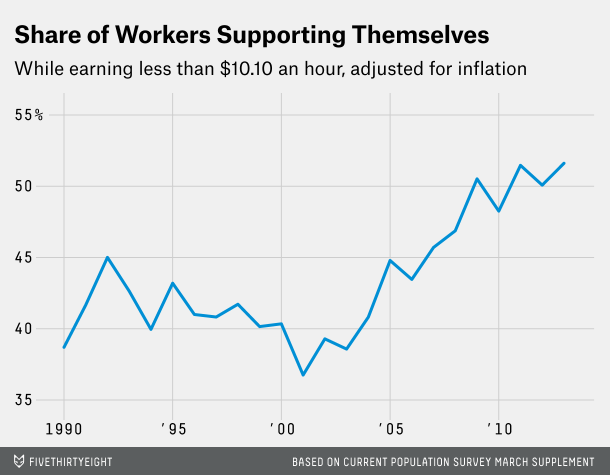
Chart Of The Day

by Patrick Appel

Low Wages

Ben Casselman puts the low-wage workforce under the microscope:

[O]ne thing is clear: A larger share of low-wage workers are trying to support themselves today than in past years. About 39 percent of workers earning under $10.10 an hour — adjusted for inflation — were supporting themselves in in 1990, compared to more than half today. Back then, nearly a quarter of low-wage earners were teenagers, compared to just 13 percent today.

He goes into more detail in a second post:

Someone working full time for the federal minimum wage earns about $15,000 a year. Only about a fifth of all minimum-wage earners made less than that in 2013, according to data from the Census Bureau. But about half of minimum-wage workers had family incomes of less than $40,000, and nearly 70 percent had incomes below $60,000, which is roughly the national median.

Most minimum-wage workers, in other words, have other sources of income. Still, most are solidly in the bottom half of the income spectrum.

What Can We Do For Uganda’s Gays? Ctd

by Chris Bodenner

While many European countries and international groups have cut aid to the Ugandan government, the White House seems stuck:

Since Ugandan President Yoweri Museveni signed legislation imposing up to a lifetime prison sentence for homosexuality, Obama administration officials repeatedly have said there would be a “review” of U.S.-funded programs in Uganda, but have declined to discuss details of that review or options for reallocating funding. This is a touchy subject, since the United States has allocated more than $400 million in aid to Uganda for HIV and other health programs. While the Obama administration may want to send a message about LGBT rights and avoid funding organizations that might turn in LGBT people — some current grantees have even openly backed the anti-gay law — the administration also does not want to appear to be cutting off anti-retroviral therapy to those relying on those programs. … More than half of the 88 countries receiving assistance from the President’s Emergency Program for AIDS Relief (PEPFAR) already criminalize homosexuality.

Secretary Kerry’s paltry response is to send “experts” on homosexuality to discuss things with Museveni – whose wife, by the way, just offered these illuminating thoughts on the anti-gay law: “Uganda’s First Lady has said if cows can’t be gay, then humans can definitely not be gay.” Meanwhile, more horror stories are coming out of the country:

“As a lesbian living in Uganda, it has been very difficult,” [says gay-rights activist Clare Byarugaba]. “My mom said, ‘I’m going to hand you into police.’ What that means is corrective rape. That I can’t see my family anymore. I have received so many death threats. And now I’m facing seven years to life imprisonment simply because of the work I’m doing—and because of my sexual orientation.” …

After Byarugaba was involuntarily outed by a Ugandan tabloid “witch hunt” earlier this year, she had to take a week off from work to cope with the personal fallout. “Coming out was supposed to be my journey,” she said. “Unfortunately the media did it for me when I was not ready.” She has seen friends lose their jobs and get assaulted by the police. “A transgender friend, a mob attacked her and undressed her in public,” Byarugaba said. “I know people who have tried to commit suicide. People call me on a daily basis and say, ‘Give me five reasons why I shouldn’t kill myself.’”

Previous Dish on the crisis in Uganda here.

A Bang-Up Job, Ctd

by Katie Zavadski & Chris Bodenner

From Michael Lemonick’s explainer on the discovery of the “first direct evidence of cosmic inflation” (visualized in the above video referenced by a reader):

[J]ust .0000000000000000000000000000000000001 seconds (give or take) after the Big Bang, the [Inflationary Universe theory] said, the cosmos underwent a burst of expansion so furious that it was briefly flying apart faster than the speed of light. Exceeding light speed is supposed to be impossible, except that that law applies only to something moving through spacetime, not spacetime itself expanding. Just as with gravitational waves, there’s plenty of reason to think it really happened, but again, no proof.

Not until now, anyway. … The telescope the researchers used—the [BICEP2]—is tuned to see the critical kind of polarization in background radiation, but there was no guarantee it ever would. Inflation theory comes in several versions, all of which posit different intensities. “In some,” says MIT’s Alan Guth, who was one of the inflationary universe theory’s original inventors, “the waves are so weak they could never be detected. To see them turn up is beautiful.”

Theoretical physicist Matt Strassler dives deeper. Jamie Condliffe describes how the BICEP2 crushes the competing popular idea of a cyclic universe:

The cyclic model, championed by Neil Turok, director of the Perimeter Institute in Canada, predicted that the Universe expanded and contracted over very long cycles. Starting with a Big Bang and ending with a Big Crunch, the growth of the Universe, Turok reckoned, would be tempered by gravity pulling it pack together, in an endless cycle of expansion and contraction. … The main benefit of the now-debunked cyclic model was that it neatly sidestepped the fact that all the matter in the Universe, every atom around us, had to come from somewhere. As far as it was concerned, everything had been here forever.

The inflation model, however, defines a very clear starting point to our Universe, before which there was… well, nobody quite knows.

MIT physics professor Max Tegmark further contrasts Inflationary Cosmology (IC) with the now-discredited Traditional Cosmology (TC):

Q: What caused our Big Bang?
TC: There’s no explanation – the equations simply assume it happened.
IC: The repeated doubling in size of an explosive subatomic speck of inflating material.

Q: Did our Big Bang happen at a single point?
TC: No.
IC: Almost: it began in a region of space much smaller than an atom.

Q: Where in space did our Big Bang explosion happen?
TC: It happened everywhere, at an infinite number of points, all at once, with no explanation for the synchronization.
IC: In that tiny region – but inflation stretched it out to about the size of a grapefruit growing so fast that the subsequent expansion made it larger than all the space that we see today.

Q: How could an infinite space get created in a finite time?
TC: There’s no explanation — the equations simply assume that as soon as there was any space at all, it was infinite in size.
IC: By exploiting a clever loophole in Einstein’s general relativity theory, inflation produces an infinite number of galaxies by continuing forever, and an observer in one of these galaxies will view space and time differently, perceiving space as having been infinite already when inflation ended.

Q: How big is space?
TC: There’s no prediction.
IC: Probably infinite.

Nature‘s conversation with lead BICEP2 researcher John Kovac is here. He and his team’s discovery finally allows Stephen Hawking to claim victory in one of his famous bets. Sarah Gray looks ahead:

Despite meticulous checking by the [BICEP2] team, there is no way to be 100% certain of these results. The findings have to be verified, but according to Time, several research projects are already underway to test the results. Researchers are also already building BICEP3, which hopes to be operational by next summer. This discovery is just the tip of the iceberg in terms of learning about the expansion of the universe[;] it opens the door to new discovery and helps narrow down possible theories.

The Eurasian Idea

by Jonah Shepp

Pankaj Mishra explores the anti-Western, chauvinist ideology that Putin’s Russia reflects:

Eurasianism is presently articulated by the political scientist Aleksandr Dugin, the son of a KGB officer, who reportedly has many attentive listeners in the Kremlin and the Orthodox Church. Dugin and his acolytes acknowledge that centuries after Tamerlane’s conquests, which redrew the map of the world, Eurasia remains, as U.S. policy maker Zbigniew Brzezinski put it in 1997, “the chessboard on which the struggle for global primacy continues to be played.” Accordingly, Dugin has advocated a new anti-Western alliance between Russia and Asian countries. Revanchists such as Dugin have enjoyed a fresh legitimacy in the post-Yeltsin era, when the empire created by Soviet Communists fragmented and a struggling Russia appeared to have been deceived and undermined by a resurgent and triumphalist West. …

Putin himself rose to high office on a wave of support from the Russian masses, which had been exposed to some terrible suffering caused by Russia’s westernization through economic “shock therapy.” Bending Crimea to his will, or calling for a religious revival, Putin seems to be realizing the old Eurasian fantasy of a strong ideological state dedicated to restoring Russia’s distinctive national and civilizational “otherness.”

With that ideology in mind, Timothy Snyder notes that Putin’s view of the Ukrainian revolutionaries is more than a little ironic:

It is deeply strange for an openly right-wing authoritarian regime, such as that of Vladimir Putin, to treat the presence of right-wing politicians in a neighboring democracy as the reason for a military invasion. Putin’s own social policy is, if anything, to the right of the Ukrainians whom he criticizes. The Russian attempt to control Ukraine is based upon Eurasian ideology, which explicitly rejects liberal democracy. The founder of the Eurasian movement is an actual fascist, Alexander Dugin, who calls for a revolution of values from Portugal to Siberia. The man responsible for Ukraine policy, Sergei Glayzev, used to run a far-right nationalist party that was banned for its racist electoral campaign. Putin has placed himself at the head of a worldwide campaign against homosexuality. This is politically useful, since opposition to Russia is now blamed on an international gay lobby which cannot by its nature understand the inherent spirituality of traditional Russian civilization.

Ask Shane Bauer Anything: An Ill-Advised Hike

By Chas Danner

When considering Iran’s imprisonment of American hikers Shane Bauer, Sarah Shourd and Josh Fattal, many (including Dish readers) have insisted that the trio shares responsibility for their fate by electing to travel near Iraq’s border with Iran in the first place. In today’s video from Bauer, he defends their choice to vacation in Iraqi Kurdistan, while admitting their mistake in not realizing how close they were to the border. In a followup, Shane adds that they did not cross into Iran accidentally as many have presumed. In fact, they were made to cross the unmarked border by Iranian guards on the other side, something one of those guards has since reached out to them to apologize for:

When Shane and his friends were first captured, I remember feeling annoyed about the risks they’d taken, particularly because I was worried their story might divert attention from Iran’s brutal crackdown on the Green Movement that summer. But let’s be clear, no one deserves to spend years in prison for forgetting to buy a map, let alone 400+ days in solitary confinement like Sarah had to endure. Injustice is injustice.

In yesterday’s video, Shane detailed how difficult it was to readjust to life outside of prison, as well as how the perspective he gained from his experience has helped him report on the plight of prisoners here in America. Along those lines, Bauer has since written a special report for Mother Jones about solitary confinement in American prisons. Also he, Sarah (now his wife) and Josh have co-written the memoir A Sliver of Light, which comes out today. Excerpt here.

(Archive)

The Global Workspace In Your Head

by Tracy R. Walsh

review of Stanislas Dehaene’s latest book, Consciousness and the Brain, lays out the cognitive scientist’s theory of awareness:

Dehaene takes the “global workspace” model of consciousness developed by psychologist Bernard Baars and boldly extends it, identifying consciousness as the process of brain-wide information sharing. At any time, millions of short-lived mental representations of your world are being created by unconscious processing, he says. Consciousness selects one and makes it available to distributed, high-level decision systems through a brain-wide “broadcast”. … Consciousness, thinks Dehaene, may have evolved to pick out what is relevant from this huge amount of parallel activity, and keep it active within the global workspace while different parts of the brain evaluate it. It is necessary so we can deal with one important thing at a time and enable a kind of “collective intelligence” to be reached. That would include providing access to memory and mental associations, as well as to language processors which could describe the ongoing experience, Dehaene suggests. It all takes time, which may explain why consciousness seems to run about a third of a second behind reality.

Previous Dish on Dehaene’s work here.

Faces Of The Day

by Chris Bodenner

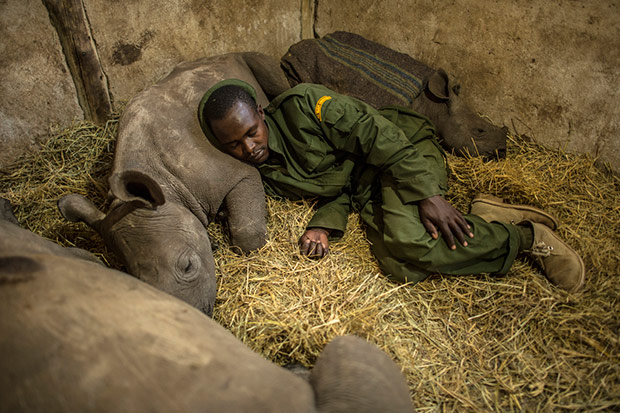
Ami-Vitale_02

Yusuf, a keeper, sleeps with three orphaned baby rhinos at the Lewa Wildlife Conservancy in northern Kenya. The youngest rhino on the right was orphaned when poachers killed his mother on Ol Pejeta Conservancy. The largest rhino, Nicky, is not an orphan but is being hand-raised because her mother is partially blind. On the woman who took the photo:

Montana-based photographer and filmmaker Ami Vitale is shedding some much-needed light on the illegal wildlife trade and poaching of animals taking place in northern Kenya. She recently launched a crowdfunding campaign in conjunction with The Nature Conservancy and the Northern Rangelands Trust (NRT), using photography as a platform to show how local communities are working to protect their wildlife from the heavily armed criminal networks of poachers that are devastating to the rhinos, elephants and many other plains animals of Africa. … While her initial goal has just been reached, she has now turned her sights on to other related and achievable goals, like providing educational, visual storytelling initiatives for the NRT—a collective of 26 indigenous groups in northern Kenya.

In addition to Vitale’s website, you can follow her work on Twitter, Facebook, Instagram, Nikon, her Montana workshops, and her storytelling seminars with NatGeo. Previous Dish on animal poaching here, here, here, here, here, and here.