The Boring, Relentless Advance Of Obama’s Agenda

If there has been one consistent feature of the Obama years, it has been the resilience of a ferocious opposition and its simultaneous, accumulating irrelevance. That can always change, of course. Another shellacking in the mid-terms and a bungled presidential race, and we could be looking at serious attempts at rollback. But so far, even as critics and opponents have thrown wrench after wrench into the administrative and legislative churn, some core changes look set to endure. The drawdown in “defense” has not produced the kind of popular revolt the neocons would prefer – and has support among key factions of the Republican party. A slightly higher tax hit for the rich was effectively endorsed in Dave Camp’s tax reform proposal. The massive increase of investment in solar and wind energy will not be soon undone – alongside the fracking revolution. And, as we’ve seen in Crimea and Syria, public appetite for a hegemonic, interventionist foreign policy is close to non-existent.

But obviously the core domestic achievement of the president – the expansion of healthcare to the working poor – is the main event. The repeal of it has been the prime cause for the GOP since 2010. They hope to win the mid-terms on it. And yet, as a new Bloomberg poll reveals, the actual key elements of the law garner widespread popular support:

Screen Shot 2014-03-13 at 12.20.48 PM

Even on the mandate, the verdict is pretty even.

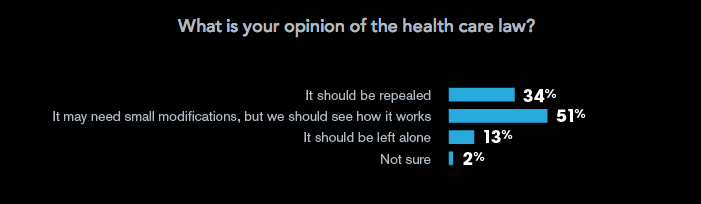
Now it may be that a Republican alternative, which does its best to meet these same goals, could be fashioned. But if it is, and if it is somehow wrestled into law, aren’t the key reforms above still in place? And isn’t that a victory for Obama after all? Added to this is a majority emerging that wants to see the current law as the basis for further reforms:
Screen Shot 2014-03-13 at 12.37.15 PM

When 64 percent of Americans want to see the law fixed or left alone, you have the recipe for long-term resilience.

Has this dented in any way Republican fury at the law? Not so far as you can see from the messaging being unveiled for the midterms, where repealing the law is front and center in the campaign. Karl Rove may be prescient in noting that Obamacare may not be sufficient to win back the Senate – in part because it’s not as potent an electoral ploy as populist hostility to big banks. But his party doesn’t seem inclined to listen.

My own view is that this entire debate over the last few years reveals a core truth about our current politics. One party has taken a ruthlessly pragmatic approach to governing, while the other has taken a ruthlessly rhetorical approach to opposition.

It is as if the Republicans had decided that their opposition to the president would become a kind of performance art version of all their previous tricks. Obamacare is a function of a tyrant! The president is a mom-jeans-wearing weakling compared with Putin! He’s coming to take away your guns! He’s robbing white seniors to pay for poor blacks! And almost none of their critiques has carried the kind of decisive bite that could actually arrest Obama’s relentless chugging forward. In a war of attrition, one side is all histrionics, and the other all action. It reminds me a bit of the 2008 primary race. One side was crusading for the first woman president; the other was quietly counting delegates.

Some of this is inherent, of course, in one side being the government and the other the opposition. But the absence (until very recently) of any Republican legislative proposal that might attract serious, bipartisan support on the budget or climate change or immigration, and the absence in particular (until very recently) of even a modestly practical and palatable alternative to Obamacare reveals the core disparity. 50 votes to repeal Obamacare is not smart politics; it’s entertainment. One side is theater – and often rather compelling theater, if you like your news blonde, buxom and propagandized. The other side is boring, relentless implementation. At any one time, you can be forgiven for thinking that the theatrics have worked. The botched roll-out of healthcare.gov, to take an obvious example, created a spectacular weapon for the GOP to hurl back at the president. But since then, in undemonstrative fashion, the Obama peeps have rather impressively fixed the site’s problems and signed up millions more to the program. As the numbers tick up, the forces of inertia – always paramount in healthcare reform – will kick in in defense of Obamacare, and not against it. Again, the pattern is great Republican political theater, followed by steady and relentless Democratic advance.

Until the theater really does create a new majority around Republican policies and a Republican candidate, Obama has the edge. Which is to say: he has had that edge now for nearly six years. Even if he loses the entire Congress this fall, he has a veto. And then, all he has to do is find a successor able to entrench his legacy and the final meep-meep is upon us. And that, perhaps, is how best to see Clinton. She may not have the stomach for eight years in the White House, and the barrage of bullshit she will have to endure. But if you see her as being to Barack Obama what George H.W. Bush was to Reagan, four years could easily be enough. At which point, the GOP may finally have to abandon theater for government, and performance art for coalition-building.
The Clinton Machine Picks Up Steam

Mark Halperin reports on Ready For Hillary’s preparations:

There is now talk among Ready officials about finishing 2014 with 5 million supporters and 2 million active volunteers, numbers that would likely dwarf the assets of all the GOP wannabes combined. If realized, that would be substantially more than the piddling grassroots effort that Clinton mounted against Obama six years ago. Could anyone, Democrat or Republican, catch the Clinton machine this time? “I don’t know,” [Craig] Smith says. “I think it takes a long time to build a grassroots operation. These things don’t pop up overnight.”

He claims the president is nervous about his people’s involvement:

Obama’s advisers have had to reassure the President that the early embrace of Clinton by his far-flung team is a good thing. He has fretted to aides about the leadership role his campaign manager Jim Messina has taken on in another pro-Clinton super PAC, Priorities USA Action, and worried that the early organizing might distract from his effort to limit losses in the looming midterm election.

Ben Jacobs explains how Ready For Hillary is also poaching Obama’s Iowa corps:

With its deep connections to key players like [Obama’s 2008 state director Jackie] Norris and [Obama’s 2008 Iowa field director Mitch] Stewart on Obama’s first presidential campaign, it is clear Ready For Hillary is trying to woo as many former active Obama supporters as possible and using a wealth of information generated more than six years ago to do so. This not only means that a potential 2016 campaign by Clinton will be that much stronger, but preempts other potential Democratic candidates, like Vice President Joe Biden, from being able to build on Obama’s fabled Iowa organization.

This strategy is already paying dividends. For instance, while [Ready For Hillary spokesman Seth] Bringman admitted that his group fell short of their 99 county goal last Saturday, they were still able to deploy 250 volunteers in an impressive 84 counties across the state. About a third of those volunteers were Obama supporters in 2008, he said.

When Will Europe Get Serious About Its Own Defense?

NATO Spending

Looking at the long-term implications of the Ukraine crisis, Doug Bandow thinks “Washington should force Europe to take over responsibility for its own defense”:

In early March the administration undertook what Secretary of State John Kerry termed “concrete steps to reassure our NATO allies.”  Actually, Washington should adopt the opposite strategy.  America’s friends should understand that if they are not willing to defend themselves, no one else will do so.

At the same time, Washington should rethink nonproliferation policy.  It’s too late for Ukraine, but Kiev gave up Soviet nuclear weapons left on its soil in return for paper border guarantees.  Possession of even a handful of nuclear-tipped missiles would have changed Moscow’s risk calculations.

But Ted Galen Carpenter doubts the Europeans are willing to boost their defense budgets:

Even Russia’s jarring actions in Ukraine are unlikely to dislodge the NATO countries from their fondness for free-riding on the security exertions of the United States. The Baltic republics and other nations directly on Russia’s border have made some comments about the need to increase their military spending, but only time will tell whether they turn out to be more than yet another episode of empty talk. And the major Western European powers show few signs of altering their policies or budgets.

Indeed, even the vulnerable Eastern European countries are spending more energy trying to get the United States to enhance its military commitment to the region than they are on boosting their own defenses. Lithuanian President Dalia Grybauskaite, for example, warns that “Russia is a threat to the whole of Europe, and Europe must understand what it is dealing with.” However, just a few years ago, she led efforts to cut Lithuania’s already meager defense budget. Today, the country spends barely 0.8 percent of GDP on defense.

Also, as Carlo Davis points out, the US doesn’t devote nearly as much of our military might to NATO as we used to:

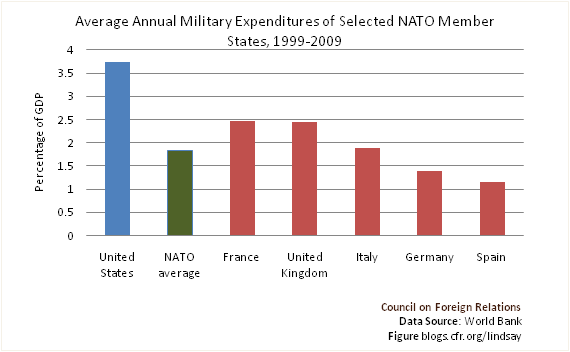
NATO relies heavily on the United States to project power and deter external threats. The U.S. provides 22 percent of NATO’s common-funded budget and is the organization’s largest member—its military spending represents nearly three quarters of all NATO members’ military spending combined. As a result, notes Stratfor Chairman George Friedman in his prescient book The Next 100 Years, NATO’s collective defense guarantee is “effective only if the United States is prepared to use force.”

Concerned Poles and Balts seeking hard evidence behind America’s rhetorical support for NATO are bound to be disappointed. Obama’s “pivot to Asia” is only the latest stage in a multi-decade drawdown of U.S. forces in Europe. Only 64,000 U.S. troops are currently stationed there, compared to 450,000 at the height of the Cold War. And U.S. military forces have never been deployed east of the Oder River, which forms the boundary between Germany and Poland. Even planned U.S. missile defense shields for Poland and the Czech Republic were cancelled as part of Obama’s attempted reset with Russia in 2009.

Jeffrey Tayler argues that Putin is right to be suspicious of NATO’s machinations in its neighborhood:

As the nuclear standoff between the two superpowers waned, the West’s most powerful military alliance, the North Atlantic Treaty Organization (NATO), has expanded three times, despite President George H. W. Bush’s apparent promise to Soviet leader Mikhail Gorbachev not to enlarge the group. NATO inducted the Baltic states in 2004, and laid the groundwork for the membership of Ukraine and Georgia. Yanukovych scuppered such plans relating to Ukraine in 2010, but deputies of the new Ukrainian parliament have just introduced a bill proposing the country again seek membership.

The Soviet Union is no more, but the entity created specifically to counter its military might thrives, as has the Pentagon’s budget, which increased relentlessly until 2011, topping $700 billion. Furthermore, in 2002, the United States withdrew unilaterally from its treaty with Moscow banning anti-ballistic missiles and plans to station such missiles in Eastern Europe. The conclusion Putin has drawn? The United States is bent on maintaining and increasing its hegemony — at Russia’s expense.

(Chart from James Lindsay)

Low Comedy In High Office

Screen Shot 2014-03-13 at 2.58.33 PM

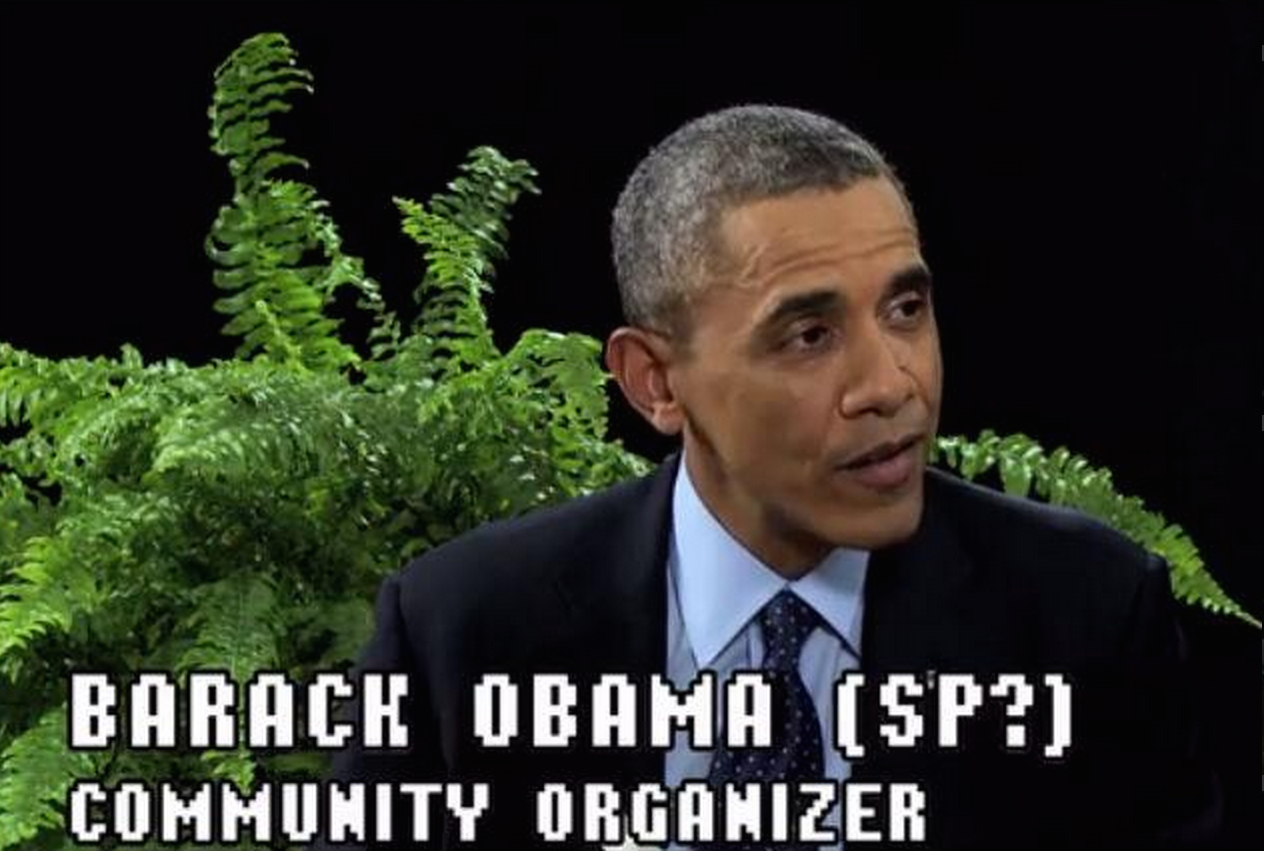
Peter Beinart praises Obama’s decision to appear on Between Two Ferns:

By refusing to defer to the office of the presidency, [Zach] Galifianakis allowed Obama to remind his supporters of what they like about him. To Obama’s admirers, he represents American meritocracy at work. Unlike many leading politicians, he was raised with no special advantages. To the contrary, he succeeded—despite an absent father, an exotic name, and black skin—because of his intelligence, eloquence, and ability to adapt to environments as diverse as Chicago housing projects, Harvard Law School, and the presidential-campaign trail. By putting Obama in an unfamiliar and unpredictable environment, where he was forced to rely on his wits alone, Galifianakis helped Obama display his signature talents. It’s no coincidence that Galifianakis ended the interview with a dig at George W. Bush, whose advisers would never have risked such an unscripted exchange. (Here’s Jon Stewart begging Bush, unsuccessfully, to come on his show during W.’s post-presidential book tour).

O’Reilly, shockingly, criticized the interview, arguing that “Abe Lincoln would not have done it.” Pareene pushes back:

The problem with the “Lincoln wouldn’t have done this” argument, though, is that Lincoln is just about the worst possible choice of historic presidents to use when you’re trying to attack a president for unseriousness. Abraham Lincoln was a notorious jokester. Books were published, during his presidency, purporting to be made up of his comical anecdotes and stories. (Many of the supposed Lincoln jokes were apocryphal, but, equally important, many of them weren’t.) Here’s one representative Lincoln joke. Here are eight more, including this honest-to-god fart joke:

1. The Farting Carver. (via William Herndon): “Well there was a party once, not far from here, which was composed of ladies and gentlemen. A fine table was set and the people were greatly enjoying themselves. Among the crowd was one of those men who had audacity — was quick-witted, cheeky and self-possessed — never off his guard on any occasion. After the men and women had enjoyed themselves by dancing, promenading, flirting, etc., they were told that the table was set. The man of audacity — quick-witted, self-possessed and equal to all occasions — was put at the head of the table to carve the turkeys, chickens and pigs. The men and women surrounded the table, and the audacious man being chosen carver whetted his great carving knife with the steel and got down to business & commenced carving the turkey, but he expended too much force & let a fart — a loud fart so that all the people heard it distinctly. As a matter of course it shocked all terribly. A deep silence reigned. However the audacious man was cool and entirely self-possessed; he was curiously and keenly watched by those who knew him well, they suspecting that he would recover in the end and acquit himself with glory. The man, with a kind of sublime audacity, pulled off his coat, rolled up his sleeves, put his coat deliberately on a chair, spat on his hands, took his position at the head of the table, picked up the carving knife and whetted it again, never cracking a smile nor moving a muscle of his face. It now became a wonder in the minds of all the men and women how the fellow was to get out of his dilemma. He squared himself and said loudly & distinctly: “Now, by God, I’ll see if I can’t cut up this turkey without farting.”

Weigel interviewed the Two Ferns director, Scott Aukerman:

Slate: How scripted was the president’s part of this? In some of the other videos with big stars—the Justin Bieber episode, the Oscar preview—they seem more flustered and less in on the joke. The president was ready with zingers. How much of that was really him?

Aukerman: The president knew what to expect, but at the same time he came up with a lot of improv stuff. He surprised us. The back and forth between Zach and the president, where they’re kind of verbally assaulting each other—that went very well. Everyone had a general idea of where the conversation was going to go. We knew what Zach wanted to do. We were pleasantly surprised by where the president took it. Honestly, it felt like a real episode of the show. There’s something about the nonscripted sense of surprise. We were ready to pull the plug if it wasn’t going to be a normal Between Two Ferns video.

Update from a reader:

I wonder if Bill O’Reilly remembers that time Ronald Reagan used humor to “defeat the Soviet Union?”

You think the GOP would lambast Reagan for making jokes on such a sober, serious, and existentially threatening issue? I mean, Yakov Smirnoff was basically an in-house joke writer feeding one-liners to Reagan.

First Sniff

A parody:

Amanda Hess pans the original:

[I]t’s an advertisement for clothes, and most of these strangers are professional performers who are experienced in acting out love, sex, and intimacy for crowds.

The cast includes models Natalia BonifacciIngrid Schram, and Langley Fox (daughter of actress Mariel Hemingway and sister of model Dree); musicians Z Berg of The Like, Damian Kulash of OK Go, Justin Kennedy of Army Navy, singer Nicole Simone, and singer-actress Soko (who also performed the melancholy indie music that accompanies the short); and actors Karim SalehMatthew CareyJill LarsonCorby Griesenbeck, Elisabetta TedlaLuke Cook, and Marianna Palka. Is it really unexpectedly touching that when gorgeous and charismatic Italian models, French actors, indie band leaders, and Hollywood royalty get together to kiss one another—under a soundtrack that prompts, “If you’re not ready for love, how can you be ready for life?”—the results are “beautiful”?

I’m betting that if Pilieva had filmed the video with a more diverse cast of all the people in the world who constitute “strangers,” the result would have been more unsettlingly comedic than searchingly romantic. It would also have been more interesting, if infinitely less sharable. The video peddles the fantasy that beauty can spring from an unexpected connection between two random people, but what it’s really showing us is the beauty of models making out.

Way to overthink a brilliant viral ad. More of this and less sponsored content, please.

Stop Fixating On The Pope?

Paul Baumann challenges the relentless focus on Francis and other Popes:

The truth is that the more the world flatters the Catholic Church by fixating on the papacy—and the more the internal Catholic conversation is monopolized by speculation about the intentions of one man—the less likely it is that the church will succeed in moving beyond the confusions and conflicts that have preoccupied it since the Second Vatican Council (1962-65). The church desperately needs to reclaim its cultural and spiritual equilibrium; it must find a density and richness of worship and mission and a renewed public presence, which far transcend mere loyalty to the pope. Lacking such equilibrium and self-possession, the church cannot find its true voice. But to find this voice, Catholics will have to turn not to Rome but toward one another, which is where both the problems and the solutions lie.

The fixation on the papacy trivializes the faith of Catholics, the vast majority of whom throughout history have had little knowledge of, and no contact with, any pope. Traditionally, the papacy was the court of last resort in adjudicating disagreements among the faithful. But in the last century or so it has increasingly become the avenue of first resort, determined to meddle in every theological or ecclesiological dispute.

I couldn’t agree more. And, of course, the paradox of this Pope is that, even though his personal, charismatic authority has soared, perhaps the key feature of his pontificate has been an attempt to demystify the Papacy, to remake the role as the Bishop of Rome, rather than the Supreme Pontiff. I laid out the evidence for this at some length in my profile of last December. In other words, one way to undermine this Pope’s actual agenda is to elevate him into a rock-star. Perhaps the secular world cannot resist. But Catholics should.

Can The IMF Save Ukraine?

Daniel Runde urges Congress to approve IMF quota reform, which would open up more money to stabilize Ukraine:

The United States needs to lead the response to the Ukraine crisis because Europe is divided over Ukraine. For the United States to lead, we need IMF quota reform to have the credibility to ride herd on the IMF package. The quota reform will double the “quick money” that is available to Ukraine to $1 billion and double the IMF’s stockpile of money for crises to over $700 billion.

As of today, Ukraine has limited hard currency reserves, and they are shrinking. It has a banking crisis and has limited the amounts of money that depositors can withdraw. The country is on the brink of financial collapse and a financial collapse will open it up to further radicalization and instability — and a weaker Ukraine is an even easier victim for Russia.

Peter Boone and Simon Johnson throw cold water on the idea that financial aid can solve the country’s problems:

This fight over Ukraine between Russia and the West has been going on since the 1990s. Each time the Ukrainian government changes, one side rushes to the fore, offering funds and support. The great problem for Ukraine, and those civil society-oriented individuals that fought for the overthrow of Viktor Yanukovych, is that too much foreign support is forthcoming, making it too tempting for governments to switch allegiances, and extort funds from each side.

Any I.M.F. program will undoubtedly fail again unless this chronic struggle between Russia and the West over Ukraine is stopped. … The I.M.F.’s own analysis implies that large amounts of foreign funds, public or private, are not any kind of solution in this situation. But for political reasons the I.M.F. is likely to ignore the sensible conclusions drawn from its own experience.

Veronique de Rugy, no fan of the IMF to begin with, opposes quota reform:

[I]t would double the funds that the IMF is allowed to loan to any country it wishes, without much limit. For the United States, it means a 100 percent increase in its contribution to the IMF from its current level, $63 billion. According to the Congressional Research Service, “this would be the largest proportional quota increase in the history of the IMF.”

Is Obama A Phony On Torture?

US-POLITICS-OBAMA-WOMEN

I’m dismayed – and somewhat sickened – by the continuing passivity of the president on one of the most important issues the country faces: accountability for the gravest crimes under international law in the first decade of the 21st Century. This is a president who was propelled to two victories in part by those of us who saw the Cheney torture program as an indelible stain on this country that had to be exposed and expunged. And many of us were sympathetic to the difficulty a newly-elected president would be in – if he truly attempted to do right by history. To launch a gut-wrenching investigation into a government agency that remains responsible for our collective security is not something a president should do lightly when assuming the office. As so many presidents have noted over the years, the CIA is powerful enough to wreck a presidency if it tries hard enough – and the rancor may have consumed an administration as it was confronting the worst economic crisis in almost a century. And Obama desperately needed good intelligence to prevent another terror attack, which would have given the pro-torture right yet one more rhetorical point in favor of their disgusting and useless form of prisoner abuse.

But it’s now 2014. The one sliver of hope we have that the war crimes of the past can be accounted for and recovered from is the Senate Intelligence Committee’s thorough investigation of the matter. And yet the very possibility of the report being made public is now in jeopardy, as a result of the CIA’s stonewalling, harassment and obstruction of the Senate’s vital work. And yet the president still sits there, like a potted plant, refusing to put any serious pressure on the CIA to stop its stonewalling and get the report out. Yesterday, he gave the same spiel about his revulsion at torture and his desire to get the report declassified:

He said he was “absolutely committed” to the Senate investigation of the Bush-era practices, and planed to declassify the report as soon as it was finished. “In fact, I would urge them to go ahead and complete the report and send it to us and we will declassify those findings so that the American people can understand what happened in the past and that can help guide us as we move forward,” Obama said.

Wha-wha-wha-what? The Senate Committee completed the report fifteen fricking months ago! The only reason it has not been declassified and published is because the CIA has been engaged in aggressive stonewalling and obstruction – to the point at which Diane Feinstein was forced to denounce her beloved spies on the Senate floor this week. The president should not be telling the Senate Committee to finish their report (which they did over a year ago), but the CIA to quit the harassment of a committee’s vital work.

Then we discover that the White House has not actually fully cooperated with the Senate Committee:

The White House has been withholding for five years more than 9,000 top-secret documents sought by the Senate Select Committee on Intelligence for its investigation into the now-defunct CIA detention and interrogation program, even though President Barack Obama hasn’t exercised a claim of executive privilege. In contrast to public assertions that it supports the committee’s work, the White House has ignored or rejected offers in multiple meetings and in letters to find ways for the committee to review the records, a McClatchy investigation has found.

We’re told this has to do with sorting out executive branch privileges. Please. No executive branch privileges should be used to conceal the truth of what happened in such a grave matter. Obama has already refused to hold anyone accountable for the torture of the past – violating what’s left of the Geneva Conventions which he is constitutionally required to enforce. Now he’s so milque-toast about even accountability he’s withheld over 9,000 documents from the committee whose work he allegedly supports.

For a long time, I’ve given Obama the benefit of the doubt on this issue. It seems to me that that now has to end.

Because of his passivity and unseriousness with respect to the committee’s vital work, because of his elevation of John Brennan to the head of CIA (a man far more concerned with the agency’s reputation than with accounting for the torture he never protested or opposed at the time), and because of his continuing bullshit about what is truly delaying the report – he must now be considered an objective accomplice to the cover-up.

If his pusillanimity continues until the GOP captures the Senate and bottles up this report for ever, he will have failed one of the most important tests of his presidency. He will have lost the one key moment the United States has in confronting and dealing with some of the most serious crimes its highest officials have ever committed. He will be telling the world that, when push comes to shove, the United States cares more about keeping up appearances than with doing the hard work of truth, accountability and reconciliation. He will be ensuring that the one clear chance we had of finally accounting for these horrors was bungled or deliberately crippled by the government itself, in order to protect its own posterior. He will make it almost certain that torture will return.

That’s not just objectionable. It’s unforgivable.

(Photo: US President Barack Obama speaks during a meeting with women members of the US Congress in the Roosevelt Room of the White House in Washington, DC, March 12, 2014. By Saul Loeb/AFP/Getty Images.)

The Marijuana Money Begins To Trickle In

Jeffrey Miron examines early data on marijuana taxes in Colorado:

In my 2010 Cato White Paper, I predicted that full legalization (federal and state) would generate roughly $55-60 million per year for Colorado.

Now just released data from Colorado for January, the first month of fully legal marijuana sales, show about $2 million from recreational marijuana and about $3.5 million for medical-plus-recreational marijuana.  The latter figure implies annual revenues of about $42 million.

This January figure may turn out to be misleading.  On one hand, the industry could grow over time, boosting revenues. On the other hand, initial hoopla over legalization may have inflated January sales.  And, longer term, sales in Colorado could decline if other states legalize or medicalize.

Sullum expects the tax revenue to grow for several reasons:

1. A relative handful of recreational pot stores opened for business in January.

2. Thanks to various artificial restrictions on supply, shortages were common.

3. After the first harvests of marijuana from plants grown especially for the recreational market, legal cannabis will be more plentiful.

4. Current cannabis consumers who were repelled by lines, shortages, and high prices will start switching from black-market dealers to legal outlets as the supply expands and prices fall.

5. After the initial adjustment period, new consumers will start venturing into the state-licensed pot shops.

Kyle Chayka looks at where the tax money will go:

Under the new recreational cannabis law, the first $40 million earned through the excise tax will go toward building new schools in the state. With the governor’s proposal, the remainder of the revenue will be funneled into educational programs around marijuana, “creating an environment where negative impacts on children from marijuana legalization are avoided completely,” Hickenlooper wrote in a letter to the budget committee.