Russia And Ukraine, Marching As To War?

Maria Snegovaya believes Russia’s incursion into Crimea is the beginning of war:

Conflict escalation is likely to continue due to regime’s own logic and ideology, and the Kremlin’s latest actions also point in that direction. As southeastern Ukraine is destabilized by randomly emerging pro-Russia activists and mobs, the Kremlin continues concentrating large amounts of armored vehicles near Russian-Ukrainian borders, Russian authorities are preparing to seize the property of foreign citizens and institutions, and the country is threatening not to repay banking loans in economic sanctions are imposed.

Such escalation is unlikely to be peaceful. Putin lives in another world and fails to realize that Russia is far less welcome on the Ukrainian mainland than in Crimea. Southeastern Ukraine is split in between pro-Russia and pro-West Ukrainians, surveys show, and if Kremlin aggression continues into the mainland, the anti-Russian Ukrainians are likely to counteract. In other words: war.

Steven Pifer also doubts Crimea is the end of the story:

Some suggest the Ukrainian government should accept the loss of Crimea as a fact beyond its ability to reverse. It could then focus on the rest of the country, which poses plenty of political and economic challenges. Having taken Crimea, or at least pried it away from Ukraine, Russia perhaps would be content.

Moscow, however, likely will not be content as long as Ukraine desires to draw closer to the European Union—and Russia’s seizure of Crimea will only fan that desire. Kyiv will not accept the referendum or, should it come to that, Russia’s annexation of the peninsula. Doing so would not end the broader dispute with Moscow but would set a dangerous precedent that the Russians might be tempted to apply elsewhere, such as in eastern Ukraine, where ethnic Russians constitute a significant share of the population—though not a majority—and where there have been some pro-Russia demonstrations.

Andrew Kuchins calls this Putin’s “Brezhnev moment”:

No analogy is perfect, but my gut tells me that historians will regard Putin’s reckless decision to invade Crimea much like Brezhnev’s mistake in Afghanistan—as the beginning of the end. The Soviet system in 1979 had a much stronger foundation than Putin’s. The Communist Party was a very strong institution, and the leadership could trot out any number of achievements, from defeating Nazi Germany to achieving nuclear and military parity with the United States, to justify the system’s legitimacy. Most important, the communists’ tools of repression were far more powerful than those at Putin’s disposal today. Putin has failed to build any powerful institution in his 14 years in power. His principal claim to legitimacy and popular support has been the impressive economic growth Russia has enjoyed during his tenure.

 

A Very Special Election

Republican candidate David Jolly won yesterday’s special election in Florida’s 13th Congressional district, defeating Democrat Alex Sink in a cash-flush race that had been characterized as a referendum on Obamacare and a bellwether for November:

Sink was a test case for the Democrats’ 2014 women’s economic platform as the party seeks to turn out more women voters who trend Democratic. She also road tested their Obamacare messaging—Sink’s line at its core was “I support the Affordable Care Act but I also support major fixes.” …

After Jolly’s victory, Democrats need to win 17 seats in November to take back the House. Jolly will have to run again this fall to win a full term. No word yet on if Sink will seek a rematch.

Weigel advises against extracting any overarching narrative:

Honestly, having seen both Sink and Jolly in action, [t]hey were both lousy.

Sink wasn’t from the district, which hurt her on the margins. Jolly was slicker than Sink, but ran a pretty transactional campaign about knowing how to pick up Bill Young’s portfolio and start sprinting. It was reminiscent of the campaign Democrat Mark Critz ran to hold the late Rep. John Murtha’s seat, in 2010 — a staffer promising to keep the wheels turning. Some of the outside ads focused not on Obamacare, but on Sink’s record as CFO. And even the Obamacare-centric ads warned voters that the problem with the law was that it would cut Medicare. Not exactly a “repeal Obamacare” campaign there — the US Chamber’s ads, interestingly, didn’t even suggest that the law needed to be repealed. They referred to the “Obamacare mess.”

Kilgore also yawns:

[S]pecial elections rarely have any clear predictive value. All we really know now is that about 180,000 voters (as compared to 329,000 in the district in 2012, and 266,000 in 2010) in a district with a Cook PVI of R+1 gave a Republican a victory by a margin of 1.9% (about 3500 votes), with a Libertarian winning 4%. If you want to try to claim that represents some sort of history-bending or prophetic result, go right ahead, but it’s a bit absurd.

I’m guessing (and we can only guess) that the electorate that showed up was crazy old and mighty pale, but then again, if old white folks are voting Republican at the same levels as they did in 2010, that’s not a good sign for Democrats. Come to think of it, “Midterms Ahead!” is not a good sign for Democrats. But nothing that happened in Florida last night changed the odds in any significant way.

Cillizza reads the result as mildly bad news for Democrats:

This was a race that most political observers expected Sink to win. Jolly was a lobbyist — not exactly the best profession in this political environment — who was decidedly unproven as a candidate. He had to beat back a sitting state representative in a primary that drained his resources to the point where Sink was able to drastically outspend him. And, he did spend the entirety of the race bashing Obamacare, the issue that Republicans insist will be their silver bullet issue in the fall.

Tomasky wonders if Sink didn’t fight hard enough for Obamacare:

Let’s watch how this result affects the Florida gubernatorial race for starters. Democrat Charlie Crist has been defending Obamacare—in terms of accepting the Medicaid money—far more aggressively than Sink did. Crist leads Republican Rick Scott in recent polls, by about seven points. Watch how hard Scott—who actually supported taking the Obamacare-Medicaid money for a short time—hits Crist on this point, and how Crist responds, and how the polls change, if they do. Rather than just getting the vapors from Sink’s loss, this is what Democrats nationally ought to be watching. If Crist’s lead shrinks, then Democrats really will run for the hills.

To Byron York, Sink’s lackluster defense of the ACA illustrates a bigger challenge for Democrats:

Sink’s campaign showed the difficulties of the Democrats’ defense of Obamacare. They have to say they want to fix the program because almost nobody (a bare eight percent in the latest Kaiser Foundation survey) wants to keep the law as is. But to fix the aspects of Obamacare that are imposing new burdens on millions of Americans — higher premiums, higher deductibles, a hugely unpopular mandate, and narrower choices of doctors, hospitals, and prescription drugs — Democrats would have to advocate fundamental changes in the law that they have so far steadfastly refused to accept. Get rid of the individual mandate? To do so would rip the heart out of Obamacare, tantamount to repealing it altogether. Many Democrats would rather lose than do that.

Obituary Of The Day

From the Delaware Cape Gazette:

Walter George Bruhl Jr. of Newark and Dewey Beach is a dead person; he is no more; he is bereft of life; he is deceased; he has rung down the curtain and gone to join the choir invisible; he has expired and gone to meet his maker. He drifted off this mortal coil Sunday, March 9, 2014, in Punta Gorda, Fla. His spirit was released from his worn-out shell of a body and is now exploring the universe.

He was surrounded by his loving wife of 57 years, Helene Sellers Bruhl, who will now be able to purchase the mink coat which he had always refused her because he believed only minks should wear mink.

Continued here.

Ask Shane Bauer Anything

Shane Bauer is an investigative journalist and photographer who was one of the three American hikers imprisoned in Iran after being captured on the Iraqi border in 2009. He spent 26 months in Tehran’s notorious Evin Prison, four of them in solitary confinement. Following his release, he wrote a special report for Mother Jones about solitary confinement in America’s prison system, which the Dish featured here. (Our ongoing coverage of the trauma of solitary can be found here.) Shane and his fellow former hostages, Sarah Shourd (now his wife) and Josh Fattal, have co-written a memoir, A Sliver of Light, which comes out next week.

Let us know what you think we should ask Shane via the survey below (if you are reading on a mobile device, click here):


This embed is invalid

Obamacare’s Monthly Check-Up

The latest ACA numbers, in a nutshell:

About 4.2 million people have signed up for health plans on Obamacare exchanges through the end of February, making it unlikely that the Obama administration will hit the estimate of 6 million enrollees by a key deadline at the end of March. Whatever momentum appeared to be building in January dropped off in February, as the number of sign ups fell below the administration’s expectations.

Which is a big reason why Obama took to the ferns. Philip Klein thinks it’s “worrisome for backers of the law is that young people still aren’t signing up in the numbers the administration once deemed necessary for the program’s viability”:

The White House had originally said nearly 40 percent of the 7 million Americans initially projected to enroll would have to be young and healthy to offset the cost of covering older and sicker Americans. When initial signs pointed to low youth enrollment, many supporters of the law argued that younger individuals would enroll later in the process.

But in February, individuals between 18 and 34 years old made up just 27 percent of those signing up — the same as January. Cumulatively, just 25 percent of signups have come from that age demographic.

McArdle is on the same page:

Unless we get a huge rush of young people signing up at the last moment — which is entirely possible — the insurance pool is going to be much older than expected, and that probably means it will be much more expensive than projected. In that event, either the federal government will have to make big payments to insurers through its risk-adjustment programs, or the price of policies will probably rise significantly next year.

More cold water from Suderman:

The administration is still counting sign-ups, not completed enrollments—so the real number of paid enrollments is substantially lower. The monthly “enrollment” reports released by the administration don’t actually count enrollments. Instead, they count people who have “picked a plan” within the exchange system. But multiple reports from insurers suggest that about 20 percent of people who sign up aren’t paying their first month’s premium, and thus aren’t enrolled. Other reports suggest a further attrition through non-payment of around 2 to 5 percent in the second month. What this means is that whatever the final number of sign ups is, the true number of enrollments will be significantly smaller.

Christopher Flavelle argues that the “worst-case scenario for Obamacare enrollment isn’t that premiums go up because the risk pool was worse than expected”:

Rather, it’s that Democrats overestimated the demand among Americans, and particularly young Americans, for insurance coverage that’s both less generous than employer-based plans and more expensive than the plans prohibited by the law.

There’s no reason yet to think that’s happening. It’s possible that the number of young people who’ve signed up for so far — a little over 1 million — will double, or more, by the end of open enrollment. If not, it’s possible the tax penalty will persuade more of them to sign up next year.

But after five months of open enrollment, the level of demand among young Americans to buy subsidized health insurance remains unclear. The answer to that question matters a lot more than what happened last month.

Finally, via Cohn, here’s a reaction from Kaiser VP Larry Levitt:

This enrollment report is somewhat ho hum, which in some sense is good news for those running the program. It means that things are basically on track. Most of the uninsured were never expected to sign up in year one, and because of the early technical problems, actually enrollment will probably fall short of expectations.  At this point, though, the program is pretty much functioning as anticipated.

In terms of what this all means for the number of Americans uninsured or how people feel about the coverage their getting, we’re unfortunately going to have to be patient until reliable numbers are available.

Dissents Of The Day

CIA

A reader writes:

Oh, give it a rest. This is no constitutional crises here; far from it. The oversight the Congress and Senate are supposed to engage in has long been revealed as toothless, thanks to their own actions post-9/11. Feinstein’s histrionics after this latest incident? You reap what you sow, motherfuckers. There isn’t enough schadenfreude to go around after this incident. And Obama won’t do a thing. Don’t believe me? Watch. Oh he may spin a good yarn, but his lack of actions is the tell.

This response to Feinstein’s stand seems to me to be a telling aspect of the far left. They’re so alienated from our entire polity they cynically see no difference between the CIA and Feinstein, because Feinstein for so long has been such a stalwart defender of the CIA. Which means to say they have given up trying to reform the system and are now interested solely in undermining it by leaks and exposure. I would much prefer the system to be fixed by appropriate constitutional channels, precisely because it will be much more durable if it is. To have Feinstein now in that camp is a huge victory for those seeking accountability from the CIA. But the Snowden-style cynics huff and walk off the battle field.

Another reader:

I think your criticisms of the CIA are sort of toothless because you don’t bring President Obama into it.

We’re seeing bad problems with both NSA and CIA, as well as DoJ policies that attack journalists who report on what’s going on.  So I don’t think it’s fair to say this is a Brennan thing, despite the fact that he’s obviously responsible for his own role and for CIA’s actions.

Every now and then you write a post about how you can’t understand why the president doesn’t do something about these crazy guys who work for him, or why he doesn’t do anything about the torturers, etc.  Those posts are hard to read, because they assume that the president is a right-thinking guy who sees these issues as we do, and who inexplicably refrains from taking appropriate action anyway. I don’t know why you’d believe that the president is on the right side of these issues. I think you’re on the side of the angels, so to speak.  But your analysis is wrong.

I even think President Obama is on the side of the angels.  They’re all trying to protect the country.  But the president’s judgment is way off base on this.

Another speculates:

I have always felt that when Obama became president in 2009, that he was made aware of Bush-era offenses so horrific that revealing them was seen by his people as being more damaging than concealing them would be. Real hardcore torture stuff with a paper trail that wrapped around the whole lot of them of a level that the US would lose ALL world credibility for a generation, even if Obama rounded up people and turned them over to the ICC. Doesn’t make it right, but I wouldn’t be surprised if this is how it played out.

I sure hope that’s not the case. But I have a sinking feeling it is.

The CIA Forces A Constitutional Crisis, Ctd

Sen. Feinstein Accuses CIA Of Ease-Dropping On Senate Panel Computers

After watching DiFi’s speech, the course of action Milibank recommends:

If the White House wishes to repair the damage, it would declassify without further delay the report done by Feinstein’s committee — along with the Panetta Review. If the White House won’t, Feinstein’s panel and others would be justified in holding up CIA funding and nominations and conducting public hearings.

Agreed. But here is Rubio, equating the Senate investigation staffers with CIA lawyers, as if there was some kind of equivalence:

Well, again, because I’m a member of that committee, I’m — others may choose to be more forthcoming about — but I try to protect the nature of the work we do in that committee.  Let me just say that I think that story has two sides; I think it’s a bit more complicated than what’s being put out there by Senator Feinstein or others. I think at the end of the day there should be an impartial investigation as to what happened. And you may end up finding out that both sides are to blame, that both sides committed mistakes … But there should be an impartial investigation of it, and I think until that point people should reserve judgment. But I would just caution that I don’t think anyone has a clean hand and I think it’s important for the full truth to come out. I think people may be surprised to learn that, in this case, there were no good guys and maybe two or three bad ones.

Notice the attempt to claim that “both sides” have “unclean hands” – as if perpetrating torture is somehow equivalent to a vital oversight function of the Congress. Then there’s a veiled threat – gleefully touted by Eli Lake – that the CIA could retaliate against a sitting president by leaking information to try and damage him:

“Any agency can undermine just about anyone,” said Pete Hoekstra, who served as chairman of the House Permanent Select Committee on Intelligence during the first two years of Bush’s second term. “We saw that under the Bush administration, there were leaks coming out all over the place. You never knew where they were coming from and some of them were coming from the intelligence community and the objective was to embarrass President Bush.”

If the CIA and the broader intelligence community come to feel the same way about Obama, the White House could find itself as under siege as Bush was in his second term. Then Obama would not only have to face opposition to his foreign policy from Republicans in Congress, but also the bureaucracy of spies that know many of his darkest secrets.

Just take a moment to ponder that empirical prediction. It assumes that the CIA is an entity independent of the president, who is the head of the executive branch. It assumes that the CIA will act against the president if it feels exposed or slighted. Nothing could more baldy illustrate the desperate need to cut this anti-democratic and anti-constitutional power-center down to size. When an agency lies to the White House over torture, when it spies on the Senate investigating its torture program, it has become a rogue threat to our political system. I fear that Obama’s pusillanimity on accountability for war crimes has merely emboldened them to further illegality.

Dickerson weighs in:

We are no longer in a predictable fight between two branches of government anticipated by the framers.

These are public accusations of criminal activity and a cover-up. It’s a class of warfare that people have been craving since Snowden started leaking secrets about the U.S. surveillance state. Whether you think the intelligence agencies have gone too far or not, it’s important to have the people’s representatives battling for their right to do the job the Constitution puts before them. Otherwise the system gets out of whack. That was one of the lessons of Snowden’s revelations and it’s also the point of the story Feinstein took to the Senate floor to tell.

Drum adds:

[I]f there’s one thing an intelligence agency shouldn’t do, it’s get caught monitoring the Senate committee that oversees it. The intelligence community can spy on millions of Americans and Dianne Feinstein yawns. But spy on Dianne Feinstein and you’re in trouble.

And that tells you one more important thing. If the CIA has finally forced one of its most tenacious defenders over the years to the kind of speech she gave yesterday, it is clearly out of bounds and our of control. Only the president can rein it in. The question is: will he? And does the CIA have the potential to humiliate or undermine him if he does?

(Photo of DiFi from yesterday via Getty)

Who Is Robert Eatinger?

I may sound like a bit of a Straussian here, but the absence of a name in this particularly pointed part of Senator Feinstein’s epic speech yesterday drew enormous attention to it. Money quote from DiFi:

There is no legitimate reason to allege to the Justice Department that Senate staff may have committed a crime. I view the acting abughraib.jpggeneral counsel’s referral as a potential effort to intimidate this staff—and I am not taking it lightly.

I should note that for most, if not all, of the CIA’s Detention and Interrogation Program, the now acting general counsel was a lawyer in the CIA’s Counterterrorism Center—the unit within which the CIA managed and carried out this program.

From mid-2004 until the official termination of the detention and interrogation program in January 2009, he was the unit’s chief lawyer. He is mentioned by name more than 1,600 times in our study.

The general counsel’s name is Robert Eatinger, a key figure in the authorization of torture in the US. As I noted yesterday, it’s a testament to how devoted the CIA is to its torture program that, long after it was disbanded, it promoted the lawyer who defended it and was an integral part of it to be the acting chief counsel for the entire agency (while Obama’s nominee for the job remains bottled up in the Senate). So who is this guy? Here’s one key fact:

Eatinger was one of two CIA lawyers who reportedly told the director of the CIA’s clandestine service in 2005 there were no legal Abu_Ghraib_56requirements for the agency to hold onto 92 videotapes that showed the abusive tactics used by its interrogators against Al-Qaeda prisoners. Although Eatinger and the other lawyer did not specifically sanction it, the CIA official, Jose Rodriguez, later ordered the tapes destroyed.

Rodriguez’s destruction of the tapes in late 2005 in an industrial-strength shredder came despite objections by the Bush administration’s White House counsel and the director of national intelligence. The CIA director at the time, Michael Hayden, assured senators that Rodriguez hadn’t destroyed evidence because there were still written cables describing what the videotapes showed, but Feinstein said Tuesday the cables downplayed the brutality of the program.

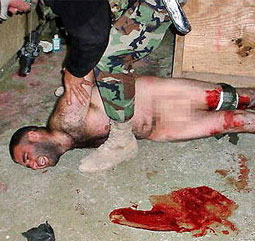
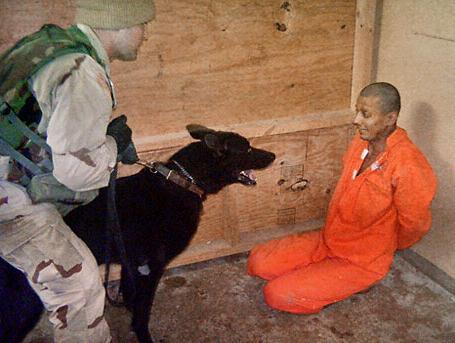
There was absolutely no rationale for the destruction of visual evidence apart from protecting the image of the CIA and the US in the world. What Rodriguez was terrified of was the images of obviously authorized and brutal torture being seen around the world like the torture and abuse sanctioned at Abu Ghraib prison. After all, it would have proven that what happened at Abu Ghraib was a picnic compared with what the higher-ups were doing in their black sites across the globe. So Eatinger gave Rodriguez the go-ahead. A man who helped the CIA conceal evidence of torture is not a man who should play any role in pushing back against a Senate investigation into it – let alone attempt to counter-sue the Senate as a way to intimidate them. Then this:

Eatinger has been a lawyer with the CIA since at least 1994, when he played a tangential role in the aftermath of the Iran-Contra affair, the political scandal involving the Reagan administration’s secret sale of arms to Iran to fund rebels fighting the leftist Nicaraguan government. …

Eatinger was among several CIA lawyers and officers chastised by a senior federal judge in 2009 for withholding critical information in court proceedings about the status of an agency operative who was accused of bugging a former federal narcotics agent’s home. Judge Royce C. Lamberth said that Eatinger, former CIA Director George Tenet and four other agency officials had provided him with erroneous information that led him to dismiss charges against the CIA operative. Lamberth said the officials had committed fraud in not providing him with proper information about the operative’s clandestine status.

In 2007, Eatinger’s name surfaced as part of the House Intelligence Committee’s probe of the destroyed videotapes. An independent prosecutor appointed by Attorney General Eric Holder also reviewed the case but decided in November 2010 not to file charges against any CIA officials.

A lawyer dogged by scandal, already deemed by a federal judge to have withheld evidence in order to protect a CIA agent from scrutiny, and deeply embedded in the torture program itself, should never in a million years have risen to the top legal post at the CIA. 128 pages of the Senate report are reportedly concerned with false CIA representations to the Office of Legal Counsel. I wonder how many times Eatinger appears in them. Yesterday, DiFi said it was 1600 times in the full report.

The conflict of interest is so massive and obvious here that one has to wonder if anyone at the White House knew what Eatinger’s past was, when he ascended to the job. But it sure seems obvious Brennan did. Which is why, yesterday, he seemed so unsettled. The gig may soon be up – unless the CIA manages to suppress the Senate report past the coming elections. Haste, Mr President. Haste.

(Photos from Abu Ghraib prison, documenting torture techniques authorized by George W. Bush and Dick Cheney, as a mild and distant adjunct to the torture program legally defended by Robert Eatinger.)