The Daily Grind

Melissa Gira Grant, author of the forthcoming book Playing the Whore, describes the work environment at a suburban sex dungeon:

In a dungeon, a client can expect that several workers will be available on each shift, and some of these workers will want to do what he wants to and some won’t. A receptionist will take his call, or answer his e-mail and assign him to a worker based on what he’d like, the worker’s preferences and mutual availability. Some dungeons might post their workers’ specialties on a website. They might also keep them listed in a binder next to the phone, the workers each taking turns playing receptionist, matching clients to workers over their shift. After each appointment the worker would write up a short memo and file it for future reference should the client call again, so that others would know more about him. … There are shift meetings, schedules and a commission split based on seniority. Utility bills arrive, and are paid. Property taxes, too. In some cases the manager would give discreet employment references. And sometimes people were fired.

There was one group of people who did perform unwaged work in the dungeon: the many male “houseboys” who would telephone, at least once each day, to ask to come and clean. The women who worked in the dungeon knew that managing these men’s slave fantasies was itself a form of work, but when they could just turn them loose on the dishes, the worst they would have to do is check later to see if anything untoward had happened to a glass or fork. It was never meant as a commentary on the years of feminists’ arguing over the value of housework, but it still could feel deeply gratifying that the houseboys were made to understand their only reward would be the empty sink.

Ancient Ales

Dr. Pat McGovern, author of Uncorking the Past, is “a notable pioneer in the fascinating field of experimental fermented beverage archaeology“:

Most recently, his team worked on artifacts found in various sites in Denmark and Sweden that once held ancient Nordic grog, a term loosely used to define beverages containing multiple fermentable sugar sources. With the help of this chem-lab technology they were able to detect the presence of tartaric acid, which hints at the presence of grapes, dish_dogfish a group of plant compounds associated with lingonberry and cranberry, and traces of other compounds related to juniper berry, bog myrtle, and yarrow.

But rather than stop at a list of ingredients and a journal publication, Dr. McGovern has been taking his work one step further. Using these results and other evidence from Nordic dig sites, Dr. McGovern and Dogfish Head’s Sam Calagione teamed up to bring this ancient grog, along with several other brews, back to life. Named Kvasir after a Nordic deity born from the spit of other gods, this orange-hued brew is made with wheat, cranberry, lingonberry, bog myrtle, yarrow, honey and birch syrup. The result is a tart and complex beer that is packed with spice and floral notes. Instead of coming off as a gimmick, Kvasir feels and tastes more like a refined museum artifact that should studied and pondered. Instilling this millennia-old historical accuracy into a large-scale production beer is certainly no easy feat. It’s a tricky task that calls for innovation and compromise.

A prime example of this is Dr. McGovern and Dogfish Head’s most ancient of ales, the 9000-year-old Chinese elixir known as Chateau Jiahu. … Chateau Jiahu is a brew that must be experienced with an open mind. Beer certainly isn’t the first word that comes to mind when taking the initial sips. Sweet and complex, with subtle grape and white flower nuances, this ancient concoction drinks much more like a dessert wine. I’d suggest slowly enjoying this contemplative brew while relishing in the thought of consuming something that hasn’t been tasted for 9000 years.

Previous Dish on ancient alcohol here.

(Image of Chateau Jiahu by Flickr user edwin)

When “Weed” Became Cool

dish_weedngram

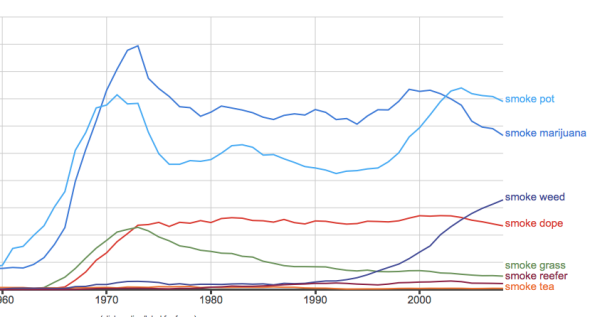
According to Google’s Ngram Viewer, “weed” didn’t take off as a slang term for marijuana until the early 1990s:

Ngram Viewer includes data only through 2008, but it appears the trend has continued and weed is now on top. In Google Books searches confined to 2013 publications, smoke marijuana pops up 69 times, smoke pot 94 times, and smoke weed 149 times. That is also the sense one gets from Urban Dictionary, whose users have been inspired to contribute 225 separate definitions for weed. The most popular one, with more than 39,000 “up” votes, was posted by “AYB” and is short and sweet: “God’s gift to the world. Brings peace when used wisely.” …

Why the recent weed dominance? It seems clear to me that it’s a generational thing. In the 1990s, a new generation of users wanted to distance themselves from their parents’ dope or pot (the latter dates from the 1930s and apparently originated in African-American slang). Weed was already in the lexicon, and provided a nice implicit variation on the hippie-ish grass.

Dare To Be Boring

Hermione Hoby, considering why Karl Ove Knausgaard’s sprawling six-volume autobiography has captivated so many Anglophone writers, concludes that the maximalist approach “gives a reader the irresistible sensation of reading a life as it’s lived – reality, in real time”:

Real life, of course, is mostly boring, and in book one, the longueurs are almost comic in their banality. A teenage mission to procure beer for a New Year’s Eve party, for example, occupies about 70 pages. Throughout, innumerable quotidian tasks are rendered as meticulously and exhaustively as autopsies. Here, for example, is the making of a cup of tea: “After a while I picked up the teapot and poured. Dark brown, almost like wood, the tea rose inside the white cup. A few leaves swirled and floated up, the others lay like a black mat at the bottom. I added milk, three teaspoons of sugar, stirred, waited until the leaves had settled on the bottom, and drank. Mmm.”

Yet, as the New Yorker‘s book critic James Wood put it, “even when I was bored, I was interested.” There is something so compelling and addictive about being immersed in a life like this that it is, as one novelist put it recently, “like reading a vampire novel.” Zadie Smith is among the many writers to declare their fandom, writing at the end of last year: “A life filled with practically nothing, if you are fully present in and mindful of it, can be a beautiful struggle.”

Hoby detects a touch of envy amid the accolades – not because Knausgaard is such a talented writer, “but because he has a knack for defying every piece of received wisdom about how to write well”:

As he declared in one interview: “The critical reading of the texts always resulted in parts being deleted. So that was what I did. My writing became more and more minimalist. In the end, I couldn’t write at all. For seven or eight years, I hardly wrote. But then I had a revelation. What if I did the opposite? What if, when a sentence or a scene was bad, I expanded it, and poured in more and more? After I started to do that, I became free in my writing. Fuck quality, fuck perfection, fuck minimalism. My world isn’t minimalist; my world isn’t perfect, so why on earth should my writing be?”

Previous Dish on Knausgaard here, here, and here.

The Ethics Of Inspiration

Do authors betray their loved ones with fictionalized accounts of their lives – and does the answer matter for the reader? Tim Parks explores the morally murky territory between fiction and memoir:

The question is: Can a novel that will affect the author’s closest relationships be written without any concern for the consequences? Will the story perhaps be “edited” to avoid the worst? Or is awareness of the possible reaction part of the energy feeding the book?

Italo Svevo’s Coscienza di Zeno begins with a hilarious account of Zeno’s attempts to stop smoking, always stymied by his decision to treat himself to l’ultima sigaretta, the last cigarette, usually one of the highest quality. Friends were aware this was largely autobiographical.

The novel continues with Zeno’s courting of three sisters; eventually rejected by the two prettiest, he marries the plain one. Again his wife would have been aware of elements from his own life. And now we have the story of a love affair, its various stages recounted in the most meticulous and again hilarious, all-too-convincing psychological detail. Finally, we proceed to chapters on Zeno’s business life, which much resembles Svevo’s own running of a paint company. Nevertheless the author’s wife always stated with great serenity that she was sure her husband had never betrayed her, nor was she shaken in this belief by the fact that his last words, when pulled out of a car accident were, reputedly, “Give me l’ultima sigaretta.”

So, was the introduction of the affair into the novel a kind of trial for her? She had to believe it was just made up. Or was there an agreement between them, explicit or otherwise, that whatever they knew would be kept to themselves, any truth in the matter forever denied? Did Svevo have to introduce the mistress because the shape of the novel required it? If so, wouldn’t there be a certain anxiety that his wife wouldn’t see it that way, and wouldn’t that affect the way he wrote these chapters? What I am suggesting is that in the genesis of a novel, or any work of literature, there will often be private tensions that the general reader will not be aware of playing a part in the creative decisions made. If, then, a reader becomes aware of these tensions, that awareness will inevitably alter the way the book is read.

James Baldwin, Poet

You know him for his classic novels and searching essays, but Nikky Finney argues that poetry – which Baldwin wrote “throughout his life” – was at the heart of his self-understanding:

Baldwin wrote poetry because he felt close to this particular form and this particular way of James Baldwin, Distinguished Visiting Professorsaying. Poetry helped thread his ideas from the essays, to the novels, to the love letters, to the book reviews, stitching images and feeling into music, back to his imagination. From the beginning of his life to the very end, I believe Baldwin saw himself more poet than anything else: The way he cared about language. The way he believed language should work. The way he understood what his friend and mentor, the great American painter Beauford Delaney, had taught him — to look close, not just at the water but at the oil sitting there on top of the water. This reliable witnessing eye was the true value of seeing the world for what it really was and not for what someone reported, from afar, that it was.

When Baldwin took off for Switzerland in 1951, he carried recordings by Bessie Smith, and he would often fall asleep listening to them, taking her in like the sweet black poetry she sang. It must have been her Baby don’t worry, I got you voice and their shared blues that pushed him through to finish Go Tell It on the Mountain in three months, after struggling with the story for ten years. Whenever Baldwin abandoned the music of who he was and how that sound was made, he momentarily lost his way. When he lost his way, I believe it was poetry that often brought him back. I believe he wrote poetry throughout his life because poetry brought him back to the music, back to the rain. The looking close. The understanding and presence of the oil on top of the water. Compression. Precision. The metaphor. The riff and shout. The figurative. The high notes. The blues. The reds. The whites. This soaking up. That treble clef. Bass. Baldwin could access it all — and did — with poetry.

Check out Baldwin’s poetry in the volume Jimmy’s Blues and Other Poems. Recent Dish on Baldwin here, here, and here.

(Photo of Baldwin in 1971 via Wikimedia Commons)

The World Of Wells

Popova captions the above short film:

From my friends at PBS Digital Studios and filmmaker James W. Griffiths comes A Solitary World — a breathtaking homage to H.G. Wells, with text adapted from five of his most celebrated works: The Time Machine (1895), The Island of Dr. Moreau (1896), The First Men in the Moon (1901), In The Days of the Comet (1906), The World Set Free (1914). Read by Terry Burns and featuring an appropriately haunting score from the young British composer Lennert Busch, the film belongs to — pioneers, perhaps — an emerging creative genre: the cinematic poem.

A Short Story For Saturday

Neil Gaiman’s 1200 word short story, “Down to a Sunless Sea,” makes for a perfect quick dive into fiction. It begins:

The Thames is a filthy beast: it winds through London like a snake, or a sea serpent. All the rivers flow into it, the Fleet and the Tyburn and the Neckinger, carrying all the filth and scum and waste, the bodies of cats and dogs and the bones of sheep and pigs down into the brown water of the Thames, which carries them east into the estuary and from there into the North Sea and oblivion.

It is raining in London. The rain washes the dirt into the gutters, and it swells streams into rivers, rivers into powerful things. The rain is a noisy thing, splashing and pattering and rattling the rooftops. If it is clean water as it falls from the skies it only needs to touch London to become dirt, to stir dust and make it mud.

Read the rest here. For more, check out Gaiman’s most recent novel, The Ocean at the End of the Lane. Previous SSFSs here.