Sister Lives

Casey N. Cep reviews Abbie Reese’s book Dedicated to God: An Oral History of Cloistered Nuns, which documents the lives of the Poor Clare Colettine nuns of Rockford, Illinois:

What does it mean to be called to the religious life? Even the most articulate of these women cannot find the precise words to explain how she came to understand her vocation. The youngest nun says, “I’m sure anyone who falls in love, they look back and say, ‘Oh, remember how we met? Or he showed his love?’ It’s the same, how God has shown his personal love.”

But how does one fall in love? These women are no more capable of explaining their love of the holy than we are of understanding the reasons two human beings are attracted to each other, and yet they try. One sister compares it to God “playing hide-and-seek,” drawing her to the religious life, but leaving her unsure of where to go. Like any love, there is struggle, not only with which of the various religious orders to join but how to live once there; it is not desperation which brings these women to the cloister but desire.

Nic Grosso reviewed the book in January:

While I had hoped to find greater insight into this order of cloistered nuns’ monastic practices, ceremonies, and sources of personal inspiration as they have so much to overcome …, Reese does do an excellent job of presenting the nuns as individuals. They are not fetishized or turned into fringe caricatures with clichéd beliefs. Even when she has a chance to poke a hole in their convictions with contradicting opinions held by fellow nuns, she does not dispel their faith. Instead she withholds judgment, allowing room for the flexibility of their personal beliefs. Each nun gets the chance to express herself as she continues to explore and understand herself in her journey inwards and towards God. “Several nuns volunteered, in the course of the oral history interviews, that outsiders label their life as a form of escapism. They took pains to point out that religious life is not a rejection of the world or its inhabitants; the enclosure is, in a sense, a form of embracing humanity, a calling to, not a running from.”

“Better Sung Than Said”

Giles Fraser thinks “the best theologians are musicians”:

Christianity is always better sung than said. To the extent that all religion exists to make raids into what is unsayable, the musicians penetrate further than most. When Mendelssohn takes the words of Psalm 55 and transforms them into the almost unbearably moving Hear My Prayer [above], he is not offering up some theological argument that can be batted about, agreed with, disagreed with. It’s not propositional. It’s a cry from the depths of his being. Longing, joy, hope, hopelessness, the call for justice – all these get expressed by religious music in ways that religious words can only partially capture.

As the voices of the choir bounce around the pillars of the cathedral, they carry with them the various petitions and often inchoate yearnings of those gathered in the pews: a death, a broken love affair, a new child, a desire for the world to be a different place. Tallis, Bach, Handel, Mozart, even contemporary musicians like the recently deceased John Tavener, they have the capacity take our patchy, confused and half-worked-through feelings and translate them aesthetically into something approaching coherence and worthy of wonder.

The Joy Of Lent

Will Willimon riffs on a conversation he once had with a woman who told him, “I’m so glad next week is Ash Wednesday”:

Glad for Ash Wednesday? I pressed for more. She responded, “You don’t know me that well, but I was the victim of sexual abuse by a relative when I was a young teenager. Spent years in therapy trying to get over it. Pop-spirituality and feel-good religion were just no help to me. That’s why I’m glad that we are coming to that time of the year when the church makes us put all the injustice, sin, blood and guilt on the altar and forces us to look at it and let God deal with it.”

Rejoice. It’s Lent. This is when the poor, old, bumbling church courageously reminds us of the joy of letting go of our illusions about ourselves. We offer our lives not to a God with high standards of conduct, but to a God who loves us as we are and forgives the worst in us.

My favorite theologian, Karl Barth, said that “only Christians sin.” He meant that only Christians know the joy of a God who forgives and thus can be frank about their sin. There is a sense in which awareness of God’s grace comes before, and not after, true and honest repentance. The person who doesn’t know a gracious God can never be truly honest about sin.

On Ash Wednesday this past week, Nadia Bolz Weber argued that people who find the first day of Lent depressing “totally don’t get it”:

[I]t’s a refreshing thing we and Christians all over the world do [on Ash Wednesday]. We gather to remind each other of the truth. To remind each other of our mortality.  We tell each other the inescapable truth that we are dust and to dust we shall return.  It’s downright audacious that amidst our societal anxiety about impermanence we just blurt out the truth as if it’s not offensive.  But the thing about blurting out this kind of truth about ourselves … is that after you do it … you can finally exhale.  It’s like the moment when you stop having to spiritually hold your stomach in.

Calling himself “a bastard” and “complete shit,” Giles Fraser admits he takes comfort in reckoning with himself during Lent:

[T]he language of sin and death – both, in Christian theology, the gift of Adam and thus a constituent part of the human condition – are, I think, much more compassionate ways of looking at human beings than the alternative doctrines of continual self-improvement.

This is counter-intuitive, I know. To use the language of sin sounds all terribly judgmental. But as the wonderful novelist Marilynne Robinson puts it in The Death of Adam: Essays on Modern Thought: “The belief that we are all sinners gives us excellent grounds for forgiveness and self-forgiveness, and is kindlier than any expectation that we might be saints, even while it affirms that standards all of us fail to attain.”

Meanwhile, Alice Robb recommends that observers resist broadcasting their abstention intentions:

What are the effects of sharing your goals on Twitter? It’s often assumed that the social pressure of announcing your intentions will compel to you follow through, but recent research suggests that it might actually backfire—and not just by irritating your friends and followers.

For a 2010 paper in the journal Psychological Science, a team of psychologists led by New York University’s Peter Gollwitzer looked at how students’ behavior changed when they shared their goals with the psychologists or with their peers. For the first experiment, Gollwitzer and his team recruited 49 students training to be psychologists. They were told they were participating in a study on the motivation of first-year psychology students, and were asked to write down two goals relating to their coursework. Some expressed an intention to take reading assignments more seriously, for instance, or to get to grips with statistics. For half the students—those assigned to the “social reality” condition—the psychologist conducting the experiment read the students’ intentions back to them. Members grouped into the “no-social reality condition,” on the other hand, were told that the page on which they recorded their intentions was included by mistake and would be thrown away. One week later, the students were brought back to the lab and asked to list the days on which they’d acted in accordance with their stated goals. On average, the “no-social reality” group kept their resolutions on more days than the “social-reality” group.

A Poem For Sunday

“i thank You God for most this amazing” by e.e. cummings:

I thank You God for most this amazing
day:for the leaping greenly spirits of trees
and a blue true dream of sky;and for everything
which is natural which is infinite which is yes

(i who have died am alive again today,
and this is the sun’s birthday;this is the birth
day of life and of love and wings:and of the gay
great happening illimitably earth)

how should tasting touching hearing seeing
breathing any—lifted from the no
of all nothing—human merely being
doubt unimaginable You?

(now the ears of my ears awake and
now the eyes of my eyes are opened)

(From Complete Poems: 1904-1962 by E.E.Cummings, edited by George J. Firmage © 1950,1952, 1956, 1978, 1980, 1984, 1991 by the Trustees for the E.E.Cummings Trust. © 1979 by George James Firmage. Used by permission of  Liveright Publishing Corporation. Video is of Cummings reading the above poem.)

Who’s The Greatest Revolutionary In History?

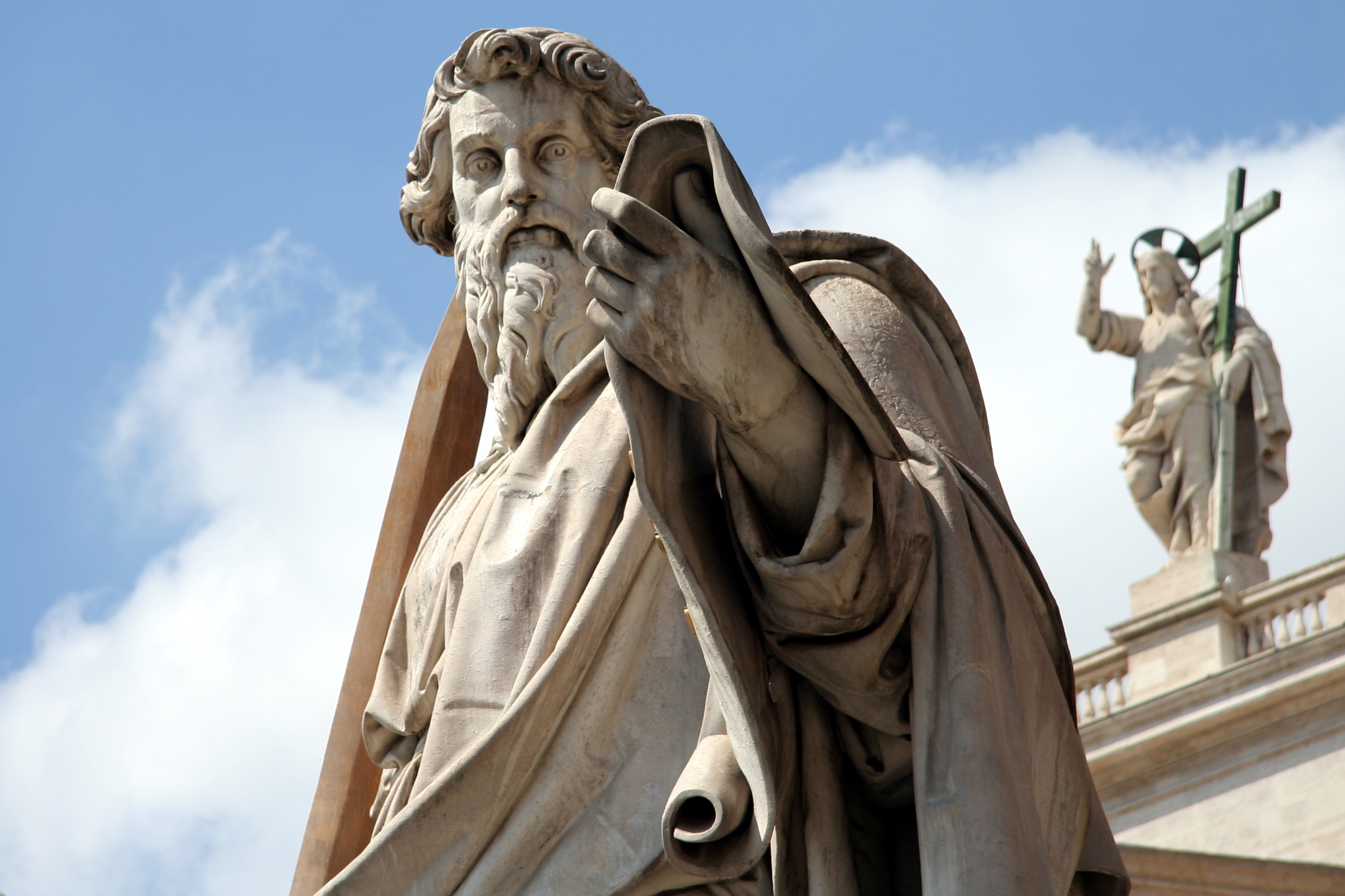
Vatican_StPaul_Statue

Larry Siedentop nominates St. Paul in his new book, Inventing the Individual. In a review, Jeremy Jennings unpacks the reasons why:

[A]t the core of both ancient thinking and ancient society was the assumption of natural inequality. Different levels of social status, Siedentop argues, reflected what were taken to be inherent differences of being. Crucially, it was this assumption of natural inequality that was to be overturned by the Pauline interpretation of the significance of the life of Christ. As Siedentop expresses it, Paul wagered on human equality and in doing so he set out a Christian understanding of community as “the free association of the wills of morally equal agents”. In essence … Siedentop’s Inventing the Individual seeks to show how this new assumption of the moral equality of humans came, over a thousand years and more, to transform the way in which we conceived of both society and government.

At its heart is the claim that the Christian assumption of moral equality in turn gave rise to a commitment to the equal liberty of all individuals. If this is true, it follows, as Siedentop states, that it was the canon lawyers and philosophers of medieval Europe and not, as has usually been assumed, the writers of the Renaissance and their rediscovery of ancient humanism who are largely responsible for our modern conception of liberty and who therefore can lay claim to having established the fundamentals of modern liberalism.

In an earlier review, Kenan Malik wasn’t quite convinced:

Siedentop usefully challenges the conventional narrative about the development of the Western intellectual tradition. But the story he tells in reframing that narrative is itself deeply problematic. Consider the issue around which Siedentop builds his whole account: the tension between the Ancient belief in natural inequality and the Christian idea of moral equality. Christianity certainly played a major role in developing notions of equality and universal visions of humanity. Yet, ideas of hierarchy and inequality remained central to the Christian tradition. “It is in the natural order of things”, Augustine preached, “that women should serve men, and children their parents, because this is just in itself, that the weaker reason should serve the stronger.” It was given by nature for the lower orders to serve the upper orders. …

Siedentop disregards, too, the distinctiveness of modern notions of equality. Christian equality was tied to religious belief; hence the long and fractious debates about whether non-Christians were equal, or even possessed souls. The crumbling of belief in a God-ordained order helped, in the sixteenth and seventeeth centuries, to develop a new, radical, inclusive form of egalitarianism. Having dispensed with God, there was, as the historian Jonathan Israel has put it, no “meaningful alternative” to grounding morality in a “generalised radical egalitarianism extending across all frontiers, class barriers and horizons.” The new egalitarians drew upon radical strands of Christian thought. But they transformed the very meaning of equality.

(Image of statue of St. Paul in front of St. Peters Basilica, the Vatican, via Wikimedia Commons)

Is Religious Experience Irrational?

Last year, David Sessions wrote an essay about his “deconversion” from Christianity, drawing on some of the ideas we aired last week about religious experience in a secular age. In particular, he noted that “something else besides just theories and arguments was driving the shift” and that, in addition to reading and thinking, he “was pulled along by massive changes in experience.” Dreher compares this to the story of Rosaria Champagne Butterfield, a lesbian academic who became an evangelical Christian (eventually marrying a man), and who admits to praying “that God would give me the willingness to obey before I understood.” Rod considers what this says about the limits of reason in our lives, especially with regard to religion:

The willingness to obey before I understood. Yes, this. Reading that line reminded me of my own slow, keep-calm-and-obey-god-10winding, herky-jerky path to conversion, and how I kept hitting a dead end because I wanted to understand it all before I obeyed. This doesn’t work.

I was thinking about Rosaria Champagne Butterfield’s point this morning, listening to our priest’s sermon about fasting …, and about how, when I first became Orthodox, I didn’t understand why we fasted, and fasted so strictly. But I did it because that’s what one does as an Orthodox Christian, and everybody in my church was doing it. Now I deeply get it, and as hard as it is, I’m grateful for it, because it’s exactly the medicine I need for my soul. But it took the experience of doing it for years before I really understood it.

What’s interesting about the Butterfield story of conversion in light of Sessions’s story of de-conversion is the role experience plays in both. It is epistemologically humbling, no matter what side of the belief/unbelief divide you are on.

Sessions argues that Rod takes the comparison too far:

There is a superficial similarity in the sense that Butterfield and I both had experiences that changed us before we had a full explanation or argument for what happened. What Butterfield describes … is essentially her embrace of obscurantism, a “truth” that either defies or ignores well-established scholarship—and even her own previous experience—on human sexual orientation. But the fact that experience drives intellectual transformation is not a license to abandon intellectual rigor.

For example, how does she know God has a point of view about homosexuality, or that it’s negative?

Why does she think Christianity requires her to obey it before she understands? What if Christians disagree about what that view is, or think that view is something that’s obviously misinformed? Does it make sense that a Christian God would want a convert to break up a happy family? For a former scholar, Butterfield shows remarkably little philosophical skepticism; she also seems to cast aside her training in how to review and evaluate the available evidence to determine if these views she’s been introduced to are reasonable or even widely considered to be Christian.

Millman make a distinction between Butterfield’s religious experience and the kind Sessions describes having, calling the former “the experience of divine command,” believing you won’t get very far in understanding religion “if you start from the proposition that God’s commands ought to be reasonable.” He defends this approach with an analogy:

the experience of falling in love.

Can we trust it? How should we understand it? How should we respond to it? These are not easy questions to answer. Should you marry the person for whom you experience that feeling? What if the feeling doesn’t last? What if you’re already married – should you leave your spouse for this new love? What if you never experienced that feeling with your spouse – now should you consider leaving them for this other person? Should you shun this person you’ve fallen in love with, lest the experience cause you to do something irrational or morally wrong? Or should you cultivate that feeling of blind devotion while, simultaneously, abjuring any socially or morally forbidden expression of affection? …

These aren’t easy questions to answer – unless you answer that the experience of falling in love is a bad one, to be shunned, categorically, which, it seems to me, devolves into answering that experience as such should have no bearing on our actions. Which, to my mind, is an untenable approach to life.

Dreher agrees with Millman:

This is a fundamental point. Millman explains well why you cannot understand Biblical religion if you expect everything to make perfect sense, especially (he might have added) to a 21st century Westerner. What is reasonable about God commanding Abraham to sacrifice Isaac? What is reasonable about God incarnating as a Palestinian Jew and willingly suffering torture and dying, humiliated? God cannot be contained by human reason. This is not to deny the power (and the importance) of reason, only to put it in its proper place.

Marathoners Anonymous? Ctd

Gracy Olmstead takes the debate over addiction to running another mile, giving it a theological gloss:

McWilliam’s runner is no stranger to us, whether we be runners or no. Most modern Americans feel compelled to develop an expertise—be it a career, hobby, or sport. The “specialist” or “expert” always receives greatest respect, while those who “dabble” in various trades or interests are less likely to garner acclaim. Indeed, in education, fields that teach breadth over depth are seeing less students and less interest. Take the humanities, or philosophy: as philosopher professor Rebecca Newberger Goldstein told the Atlantic, interest in philosophy has declined as students “want to get good jobs and get rich fast.” Money and renown goes to the specialists, not to the holistic scholars.

This isn’t meant to denigrate experts, professional athletes, and the like—most careers require a good depth of knowledge in a given subject. But it is important to consider whether we are practicing virtue in our trade, and whether we ought to “branch out” in order to become more healthy and well-rounded human beings. Perhaps the politician should pick up art (like Winston Churchill), the “foodie” should study literature, the economist should take dancing lessons. It isn’t that specialization is bad, so much as that specialization can often lead to obsession—and obsession leads to personal and societal disorder.

St. Augustine called such obsession a “disordered love.” The concept springs from his beautiful Confessions: disordered love seeks ultimate happiness in temporal, earthly objects or pursuits, “an action which engenders all kinds of pathologies in human behavior,” writes David K. Naugle.

Is Watching Porn Wrong?

A startling percentage of Americans say yes to that question:

According to data from the Public Religion Research Institute, only 29 percent of Americans think watching porn is morally acceptable. Somewhat predictably, men and women have very different opinions on the issue: Only 23 percent of women approve, while 35 percent of men think it’s okay. … White evangelicals and people over 68 are the least likely to approve of watching smut: 10 percent and 9 percent, respectively. On the opposite side of the spectrum, Millennials and people who consider themselves religiously unaffiliated approve of porn the most: 45 percent and 53 percent, respectively.

But some trends are more surprising. White Catholics are twice as likely as Hispanic Catholics to find watching porn morally acceptable—28 versus 14 percent. People with an advanced degree are somewhat less likely than college graduates to think it’s morally acceptable to watch (34 versus 40 percent). But both of those groups are significantly more likely than high-school grads to approve—only 23 percent of that group told PRRI it was okay.

For those who like your porn, a new site called SkweezMe wants to “make accessing the content that people want so easy, seamless and stress-free that pirating porn starts to look like too much work”:

The site is structured around tokens — which users buy with money or bitcoin — each of which provides 24 hours of access to anything that’s on the site, period. Unlike a lot of sites that seem to penalize people who only want to take a dip by charging significantly less for monthly subscriptions than a day pass, users can get started on SkweezMe for as little as $2.97 for three tokens — which never expire. … “If I can take 0.01 percent of people watching porn on [piracy-prone] tube sites and get them to pay a dollar a day on Skweez, then we’ve done something that’s good for everyone,” [SkweezMe co-founder Mike] Kulich said.

The industry side of this is just as straight-forward: at the end of each month, 25 percent of SkweezMe’s total generated proceeds go into a revenue sharing pool. Then, the total number of minutes viewed is divided into the rev-share’s pool figure. This determines what a Skweez minute is worth during a particular month. Producers and studios are then paid per minute, all at the same rate, for the total number of minutes their content was viewed. To illustrate, say a minute ends up being worth $1 this month. Now say that Producer A’s content was viewed for 100 total minutes, while Producers B’s was viewed for 1,642. Upon payout, Producer A will get a check for $100 and Producer B will get one for $1,642.

Basically, consumer demand drives compensation in this model, not some predetermined percentage established on the back end. This, hopes Kulich, will encourage studios to pay attention to content quality and put more power in the hands of consumers.

The above tweet is from the young woman at the center of the Duke porn outing:

Knox is a College Republican[8] and considers herself a sex-positive feminist and libertarian. She believes her experiences are a testament to the rising costs of higher education in the United States.[7][19]

Email Of The Day

And fitting for NSFW Saturday night:

As I was renewing my subscription just now, I realized my motivation for doing so was one of the only ones that hadn’t been mentioned, perhaps with reason: being a Dish subscriber gets me laid.

The mechanism is fairly simple: most people only discuss the topics that show up on their Facebook news feed, and they have self-sorted so that the viewpoints are ones they agree with. Being a Dishhead gives me access to a wide variety of different viewpoints and lesser-known facts about all things non-Kardashian, allowing me to contribute to a conversation with nearly anyone worth talking to.

Thanks dude!