Propping Up Mitch McConnell

https://twitter.com/AlexKoppelman/status/441604933444304897

John Cassidy watched McConnell’s performance yesterday:

[W]hen you want to boost your bona fides with conservatives, many of whom regard you as a hopelessly compromised establishment figure, there’s still nothing like putting on your hunting jacket, grabbing your rifle, and paying homage to the N.R.A.

This being the Gaylord Convention Center rather than a rifle range or a field in Kentucky, McConnell went without the hunting jacket. His official purpose was to present a “lifetime achievement award”—that would be the rifle—from the National Rifle Association to Senator Tom Coburn, the Oklahoma senator who is retiring this year with a hundred-per-cent approval rating from the gun-rights lobby. McConnell handed Coburn the gun, they both admired it, and then McConnell delivered a lengthy attack on President Obama and the Democrats.

Paul Waldman is jealous that conservatives get all the cool props:

[C]onservatives have lots of these kinds of identity markers that can easily and quickly communicate a whole set of beliefs to an audience when they’re mentioned, like the Bible or Ayn Rand or country music.

The fact that Democrats don’t have these things is probably because their coalition is more diverse, made up of people with a variety of cultural backgrounds and life experiences. The markers that may unite certain portions of the Democratic coalition—like, say, the music of the recently departed Pete Seeger—are not anything close to universal within that coalition, so politicians can’t use them so easily.

Drum joins the conversation:

Conservatives have guns, pocket copies of the Constitution, and the Bible to use as really handy props that instantly demonstrate their tribal affiliation. So why don’t liberals have similar, universally-recognized totems? Waldman may be right that it’s because our coalition is more culturally diverse, but I’d toss out one other possibility: almost by definition, conservatives are in favor of tradition and liberals are in favor of change. So it’s easy to find simple conservative props because every culture has lots of recognizable traditional icons that it’s developed over the centuries. It’s a lot less easy to find liberal props because icons of progress change every decade or two.

Should Congress Stem “Big Weed”?

Mark Kleiman, fast becoming the biggest buzz-harsher on the planet, worries that our state-by-state approach to legalization will end badly unless the federal government steps in to regulate the pot market:

The systems being put into place in Washington and Colorado roughly resemble those imposed on alcohol after Prohibition ended in 1933. A set of competitive commercial enterprises produce the pot, Kush_closeand a set of competitive commercial enterprises sell it, under modest regulations: a limited number of licenses, no direct sales to minors, no marketing obviously directed at minors, purity/potency testing and labeling, security rules. The post-Prohibition restrictions on alcohol worked reasonably well for a while,but have been substantially undermined over the years as the beer and liquor industries consolidated and used their economies of scale to lower production costs and their lobbying muscle to loosen regulations and keep taxes low (see Tim Heffernan, “Last Call”).

The same will likely happen with cannabis. As more and more states begin to legalize marijuana over the next few years, the cannabis industry will begin to get richer—and that means it will start to wield considerably more political power, not only over the states but over national policy, too. That’s how we could get locked into a bad system in which the primary downside of legalizing pot—increased drug abuse, especially by minors—will be greater than it needs to be, and the benefits, including tax revenues, smaller than they could be. It’s easy to imagine the cannabis equivalent of an Anheuser-Busch InBev peddling low-cost, high-octane cannabis in Super Bowl commercials. We can do better than that, but only if Congress takes action—and soon.

Kleiman makes some good points about the radical insecurity of the legal regimes in Colorado and Washington, but I have to say I find his worst case scenarios a stretch. This, for example, is Kleiman’s understanding of federalism:

Justice Louis Brandeis’s praise for states as the “laboratories of democracy” has been widely quoted … Dr. Frankenstein also had a laboratory.

Oy. Pete Guither offers a must-read and detailed rebuttal. On the federalism point, is Kleiman honestly saying that the federal government is to be trusted in this area? The entire reason the states have taken the lead is that the feds still can’t change its absurd classification of the drug. Then Kleiman has a bugaboo about marketing, as if nurturing and cultivating a customer base for marijuana is some kind of a crime, or inherently damaging. Guither responds:

Sure, if marketing causes an increase in the overall number of users, and you assume that the same percentage of those new users will become dependent as in the original class, then marketing could lead to dependency indirectly. But that assumption is flat-out contradicted by evidence and common sense, since prohibition laws, to the extent that they deter at all, are more likely to deter casual non-problematic use than problematic use.

I know that it’s popular to claim that marketing is used to cause dependency, but there’s really very little evidence to support that claim.

But Reihan agrees with Kleiman that federal oversight is needed:

It’s easy to see why Congress doesn’t want to touch cannabis legalization. Though support for legalization has increased, the issue remains contentious, and it raises difficult questions regarding U.S. treaty obligations. But the federal government needs to step in to see to it that the emerging cannabis markets don’t spiral out of control. One of the central purposes of our federal republic is to regulate interstate commerce, and it would be foolish to deny that legalization in some states will have spillover effects in others.

By “spiral out of control” he means that lots of people may buy the product. It’s so weird to read a conservative making a case for socialized non-profits. Jon Rauch compares legalization to Obamacare, noting that much depends on the implementation:

[E]arly indications are that Colorado and Washington are faring reasonably well. If they pass the implementation test, marijuana legalization could prove that obituaries for effective, adaptive government—some of them written by me—are premature. But if they yield chaos or crisis, they would discredit the policy they seek to promote.

As of now, I’m cautiously optimistic that the states’ experiments will be made to work, not perfectly but well enough. But liberaltarians and drug reformers need to get it through their heads that just passing legalization initiatives is not enough. They need to stick around once the vote is over and commit to the hard slog of making the policy succeed.

Agreed. But I see no reason why reforming, adjusting and monitoring the impact of legalization isn’t best done by the states that have had the cojones, unlike the frozen-in-aspic feds, to actually deal with the issue in a way that isn’t transparently self-defeating.

Shining A Light On Development

africa-lights

Keating relays a study that uses nighttime satellite photography to illustrate economic changes over time:

In a recent NBER working paper (summary here), Maxim Pinkovskiy of the Federal Reserve Bank of New York and Xavier Sal-i-Martin of Columbia University used luminosity as measured by NOAA weather sattelites as an “independent measurement of true income.”

The comparison above shows a decade of change in sub-Saharan Africa. Angola (the third country from the bottom on the west coast) has many more lights in 2009 than in 2000, as you might expect from a country whose GDP per capita has nearly doubled. Zimbabwe, on the other hand, “has fewer lights, because of its economic collapse under the disastrous hyperinflationary policies of Robert Mugabe.”

What Class War?

John Dickerson tells the One Percent to stop worrying about Democrats trying to seize their hard-earned millions (except perhaps in the form of campaign donations):

It’s not just the president who has removed hints of class warfare from his language. Democratic candidates are being coached to do this, too. Polls consistently show that Americans of both parties believe that income inequality exists and that it is a problem, but as Democratic pollster Mark Mellman explains, when you ask voters to rank “income inequality” among other issues, only 1 percent say it is a priority. “The polling imperative is to make sure you’re attacking opportunity inequality, not income inequality,” says one veteran Democratic strategist. “Obviously, one creates the other. But the public sees a distinction. One seems American. The other, Communist.”

Voters are more likely to back specific items that address inequality, like raising the minimum wage, extending unemployment insurance, or ensuring equal pay for women. These are the kinds of policies the president and Democrats are pushing, but none of those items actually represent a broad attack on the wealthy. The limits of this agenda are why Jason Furman, chairman of the White House Council of Economic Advisers, recently said that the 1 percent’s fears that they are under assault were “just hyperventilation around not paying attention to specific facts and data.”

The Triumph Of The Western Diet

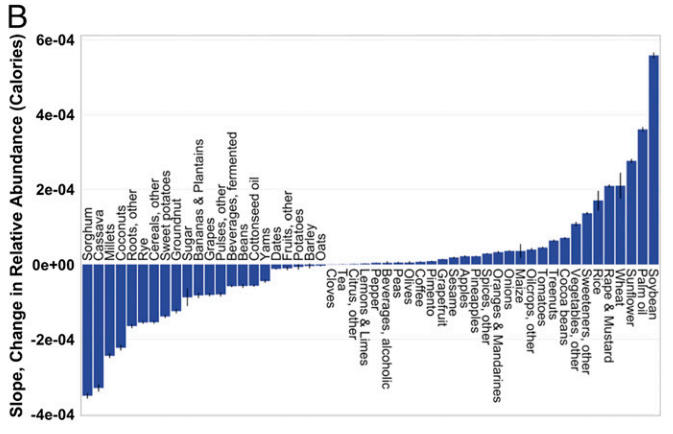
Western-diet

More and more, a new study finds, people around the world are eating like we do:

Between 1961 and 2009, the global consumption of soybeans, sunflower, and palm oil-based products—”staples” of a classic Western diet—grew several orders of magnitude, while traditional diets based on crops such as sorghum, millets, sweet potatoes, and cassava declined, according to researchers at the International Center for Tropical Agriculture. The data, gleaned from the Food and Agriculture Organization of the United Nations, backs up the idea that the world is increasingly relying on processed and other “Western” foods. Lead researcher Colin Khoury calls it “Western plus,” because foods like potatoes, rice, and wheat are still eaten worldwide. But, more than ever, humans are now using those big three: soybeans, sunflowers, and palm oil, to create processed foods for people around the world.

Dan Charles discusses the problems of over-reliance on mega-crops:

The trend toward greater dependence on fewer crops continues, Khoury says. And so do the risks. It’s dangerous to depend on just a few crops because any one of them could be hit by some disaster, such as disease. But governments and international organizations can still help to safeguard diversity in our food sources. They can act to preserve the many genetic varieties of mega-crops that still exist, and also preserve and encourage cultivation of minor crops, he says.

Update from a reader:

Soybeans, sunflower and safflower oil are “‘staples’ of the classic American diet”? What are those guys talking about?

Soybeans are from East Asia. They weren’t planted in the US until the latter part of the 19th century, and even then were used almost entirely as feed for livestock. (Supposedly George Washington Carver discovered they could be used for oil.) Not until after the Second World War did they become a part of the US diet, mostly in the form of additives. Even today, relatively few Americans eat soybeans directly, whether it’s in the form of beans or soy products like tofu. The exception, of course, is soy sauce, but soy sauce is a symbol of Asian food, not American.

Palm oil is from Africa. Hardly any is produced in this country; the world’s biggest palm-oil producer is Indonesia. In this country, it is used mainly as an additive to processed foods. As with industrial soy, nobody but people who study food labels knows they are eating it. How is an increase in its consumption to be considered a sign of Americanization?

Safflower oil is grown in the US, but it, too, is of African origin. As a food, it is mostly used in salad dressing and margarine (although this is declining). Margarine is a minor product outside the English-speaking world – try buying it in Japan! It’s sufficiently uncommon in India that the last time I was there I came across an article in the Times of India explaining to its readers what margarine is (the government periodically goes into anti-butter campaigns, and the newspaper was examining whether this strange foreign stuff could be substituted for it). Again, how is this evidence of “Americanization”?

Nutrtionally speaking, much more important are the rise in the big staple cereals – wheat, rice, and corn (maize). Consumption of the first two is driven by increasing affluence in East and South Asia, where both wheat and rice have been grown for thousands of years. Again, no evidence of Americanization. Corn actually is American – I guess you have to give them that one. But overall the graph they produce shows the opposite of what they allege.

Materialistic For Mother Earth

Nick Thorpe urges environmentalists to reconsider their approach to things:

The ‘new materialism,’ as it was dubbed in a report by the New Economics Foundation in 2012, challenges us to love our possessions not less but more – to cherish them enough to care about where they came from, who made them, what will happen to them in the future. Environmental campaigners are, in a similar spirit, slowly redefining themselves less by what they’re against (global warming, fossil-fuel extraction, runaway consumerism) than what they’re for: a healthy and balanced relationship with the material world that sustains us in all its delicate, interconnected beauty. But it’s a philosophical, even spiritual position, too. If we could truly cherish the things in our lives, ‘retain the pulse of their making,’ as the British ceramicist Edmund de Waal puts it, wouldn’t we be the opposite of consumers?

Building A Bigger House?

Geoffrey Skelley looks at how congressional representation has changed between 1960 and 2010:

Congressional Seats

Trende wants more congressmen:

Today a representative answers to over 700,000 constituents, well over 10 times the number of constituents deemed appropriate by the First Congress. While it seems unwise to adhere to the strict letter of Article the First, the time has likely come to abide by its spirit and increase the size the House.

The United States is supposed to be the world’s premier representative democracy, yet India’s Lok Sabha is the only lower chamber on the globe where representatives have more constituents. Indeed, Pakistan’s National Assembly and Indonesia’s People’s Representative Council are the only other lower chambers with a population-per-seat ratio exceeding even 400,000.

Among his reasons for increasing the size of the House:

[It] could help mend some of the detachment that is felt between Washington and the states. Campaigns would be less expensive, so politicians would have to spend less time fundraising, and representatives would have fewer constituents to answer to, allowing for more personalized representation. It may even be that smaller constituencies allow for the election of more ideologically diverse members. Indeed, there is some correlation between the size of state legislative chambers and the number of third-party/independent candidates elected.

Bernstein is against the idea:

For elections, it would probably mean fewer voters in competitive districts, and less media attention to each individual election. Given the way redistricting works in most states, competitive districts are what’s left after both parties have grabbed the solidly partisan areas. That means there are often are as few competitive districts in California and Texas as there are in states with only a handful of seats. So a bigger House would likely leave us with about the same number of competitive districts as we have now, but with fewer people in each. And with more races to cover and each one a little less important, the resources devoted by the media to individual elections probably would decrease. That’s good news for incumbents, but bad news for competition and democracy.

Success Is Not For The Sensible

In Scott Adams’ How to Fail at Almost Everything and Still Win Big, the Dilbert creator talks about his doomed ventures, including two shuttered restaurants and an attempt to market “a rosin bag used by tennis players to keep their hands dry.” Reviewing the book, Vikram Bath entertains the possibility that a touch of overconfidence is a prerequisite for success:

Adams has an irrational optimism that nevertheless makes him better off. … Yes, a strict rationalist might start 10 companies each with only a 20-percent probability of success but promising a 10x return on investment. But most of us can’t put our hearts into something day after day if we think it only has a 20-percent chance of success. Even criminals seem to behave according to how likely they think it is that they will get caught rather than how severe the consequences would be to getting caught [pdf].

If this is the case, maybe irrational optimism is the only way to success. Maybe you have to rely on your brain twisting that 20 percent into a 70 percent so that you can get to work in the morning and give it your full effort. How else can you put your heart into a velcro bag that might someday be something bigger?

Previous Dish on rationality and cognitive bias here.

“Who Needs World War I?”

Tom Streithorst poses the question:

Few events are more central to the history of the 20th century than the First World War.  Without Sarajevo, Tannenberg and the Somme, we have no Hitler, no Lenin, dish_wwibookcover no Hemingway.  The history of the past hundred years flows directly from the happenstance series of events that led to Europe destroying itself for little reason between 1914 and 1918.

And yet, if we imagine a German diplomat or general falling asleep in February 1914 and waking up today to see a prosperous Germany dominating a peaceful Europe, he would be pleased but not be surprised. The fall of the multiethnic Austrian Hungarian and Ottoman empires and their replacement by nation states was also predictable. No one in 1914 would have been astonished to learn that 100 years later Russia would remain an exporter of raw materials and its politics would be authoritarian, oligarchic, and corrupt. Britain’s half-hearted relationship towards the rest of Europe would startle no one.  What would shock our German general is the realization that it took two brutal world wars and the rise and fall of communism to achieve this outcome. Disastrous defeat twice over did not impede Germany’s rise.

So we have a conundrum.

On the one hand, even deeply important historical events can be seen as accidents or flukes.  On the other, over the longer term history seems tied to the profound processes of demographics, technology, culture and institutions that have little to do with the actions of mere men.  To put it another way, even if Christopher Columbus had never gone to sea, cassava would nonetheless be a staple crop in Africa today and a Nahuatl speaking emperor would not be ruling Mexico.  If we explore the counterfactual and assume that World War I had not broken out in 1914 and so the Russian Revolution not occurred in 1917 and Hitler not come to power in 1933, we might still end up with a world pretty close to what we have today.  I’m not sure what that tells us about the value of the study of history.

Update from a reader:

Well what a provocation to a historian! Let’s focus on Germany. So if we had a liberal German emperor in the lead up to World War I – say the emperor Friederich III had lived – his challenges in creating a liberal, parliamentary and peaceful Germany in a peaceful Europe would have been enormous.

It is difficult to exaggerate the degree to which Germany and German-Austrians (among others) were saturated with Darwinist racial politics before and after the Great War. This was accompanied by an understandable awe at German economic and technological progress since 1871, an over-optimistic confidence in the army as a decisive and speedy instrument of policy, and vociferous popular demand in Germany for colonial expansion, either in the tropics, or to the east, coupled with fear of a growing Russia.

Friederich would have had to swim against all these currents. He would have had to face down his own ruling class to liberalise German politics and constitutional structures and progressively reduce himself to a constitutional monarch in the style of the Scandinavians, Low Countries, or British. He would have had to help Austria-Hungary, racked by ethnic conflict, through to some new, better state, and successfully manage rivalries in the Balkans. He would have had to counter-intuitively tamp down the enormous temptation to view the army as an instrument capable of producing easy triumphs over other great powers à la 1866 and 1870. He would have had to promote some kind of de-escalation of the arms race through CFE or START-style reductions and confidence building measures. He would have to face down strong popular and aristocratic urges in Germany for territorial expansion. He, or his new liberal or social-democrat chancellor, would have had to somehow, single-handedly, reform the international trade environment from imperial protection to free trade, through some sort of pan-European zollverein, so that German and Austro-Hungarian industry could access the raw materials they needed.

Needless to say, such an agenda seems far beyond the capabilities of Friederich and the pre-war European ruling class.

Conversely, how would racism have been so thoroughly discredited if not for the horrors of Nazism? How could Europeans nations put aside imperial rivalry and world dominance and settle for a brotherly confederation, if not in recoiling from the utter destruction of the world wars? How could democracy have spread so widely?

In short, we have the world we have, in some ways much better than it might otherwise be, because of the great struggle between democracy and its enemies in the twentieth century. How much worse would it be if all that sacrifice had been in vain.

(Image of cover of book for WWI veterans by William Brown Meloney, 1919, via Wikipedia)

Can You Copyright Coffee Pods?

Cory Doctorow explains why Keurig is planning to fight off-brand coffee pods:

The reason they’re adding “DRM” to their coffee pods is that they don’t think that they make the obviously best product at the best price, but want to be able to force their  customers to buy from them anyway. So when, inevitably, their system is cracked by a competitor who puts better coffee at a K-Cups & Podslower price into the pods, Keurig strikes me as the kind of company that might just sue. And not only sue, but keep on suing, even after they get their asseshanded to them by successive courts. With any luck, they’ll make some new appellate-level caselaw in a circuit where there’s a lot of startups — maybe by bringing a case against some spunky Research Triangle types in the Fourth Circuit.

Now, this is risky. Hard cases made bad law. A judge in a circuit where copyright claims are rarely heard might just buy the idea of copyright covering pods of coffee. The rebel forces that Keurig sues might be idiots (remember Aimster?). But of all the DRM Death Stars to be unveiled, Keurig’s is a pretty good candidate for Battle Station Most Likely to Have a Convenient Thermal Exhaust Port.

McArdle compares Keurig’s move to that of printer companies:

That’s why printer manufacturers have been waging a long war against knockoff toner cartridges. Most people think that this is a case of companies trying to “gouge” you on the ink, but from the firms’ point of view, if they can’t make it on the consumables, they have to charge more for the printer, which consumers hate. However, the reason that printer manufacturers have been waging such a long war against knockoffs is that it’s hard to win. “Educate” the consumer all you want about the benefits of genuine Hewlett-Packard Co. ink; a lot of them still want to save a few bucks.

Olivia Solon notes that coffee makers are “quite the litigious bunch”:

This may be because the global coffee capsule market is estimated to be worth $6.6 billion (£3.9 billion). In April 2013, Nespresso (well, parent company Nestec) took Dualit to court in the UK for infringing a European Patent for supplying coffee capsules that worked with the former’s machines. In August 2012, Nestec took the Ethical Coffee Company to court in Germany for making coffee capsules under the brands “Espresso” and “Esprimo” that could fit into Nespresso machines. In both cases, judges ruled that there had been no infringement.

In October 2013, Nestec took its case to the European Patent Office, taking on several companies making pods for Nespresso machines. These included DEMB Holding, Distribution Casino France, the Ethical Coffee Company and Casa del Caffe Vergano. While the case in the US is an antitrust one, the European cases all focus on patent law, particularly on whether if you make replaceable coffee capsules you are “making” the patented technology as a whole or not. The courts seem to think not.