The Best Of The Dish Today

Dogs And Owners Gather For 2014 Crufts Dog Show

The latest twist in the CIA’s campaign to be above the law emerged this afternoon:

The Justice Department has been asked to investigate whether Senate staffers improperly obtained and removed documents from a CIA computer system at a joint facility created by the CIA and the Senate Select Committee on Intelligence (SSCI), TIME has learned.

The DOJ has already launched a criminal inquiry into whether the CIA was actively spying on the Senate staffers investigating the agency’s torture program, so one should count this as an attempted counter-strike. But you still have to sit back and marvel. The CIA is answerable to the Congress in a democratic country. But the CIA, in its current unaccountable form, actually thinks it has the standing to launch an investigation into the Congress! If that doesn’t suggest the CIA answers to no one, what would? Drunk on their own power, the agency is not acting the way a spy agency should in a constitutional republic. They’re acting like they are the government. Time reports, by the way, that “none of the documents allegedly removed were classified.”

I’m dumbstruck by the president’s decision to let this unseemly spectacle continue. In a democracy, we have an absolute right to see what was done in secret in our name – especially when it amounted to war crimes, and when the CIA actually destroyed large swathes of the incriminating evidence. The Senate Committee completed its exhaustive report a long, long time ago. Since then the CIA has done all it can to suppress it, amend it, censor it, and trash it. Enough. The president needs to get tough, fire Brennan for this outrageous stonewalling, and insist on the publication of the full report, in its original form, unredacted and transparent.

Some other posts worth revisiting: how the blind dream; how Americans keep over-estimating their own homophobia; the spirituality of Harriet Beecher Stowe; the English tweet cheekily back at David Cameron; Clinton triangulates herself; my take on Pope Francis’ stance on civil unions; and how the least popular Senator in America – John McCain – is somehow the most popular in Washington.

If you’re a subscriber, check out my intense conversation with Richard Rodriguez, another gay Catholic, on Islam, terror, faith and women. If you need a reminder to subscribe, you just got one. Subscribe!

The most popular post of the day was Yes, The CIA Spied On Congress; followed by the remarkably popular Beard of the Week.

See you in the morning.

(Photo: A Boxer dog looks out from its kennel on first day of Crufts dog show at the NEC on March 6, 2014 in Birmingham, England. Said to be the largest show of its kind in the world, the annual four-day event, features thousands of dogs, with competitors traveling from countries across the globe to take part. Crufts, which was first held in 1891 and sees thousands of dogs vie for the coveted title of ‘Best in Show’. By Matt Cardy/Getty Images.)

Tribes Facing The End

fotdafrica

Photographer Dori Caspi spent time with one:

For this particular series, Caspi traveled to Namibia 15 times and formed a close relationship with the people of the Himba village. This village has been encountering a progressive amount of challenges, including the intrusion of roads upon their land, and the increasingly severe threat of the AIDS epidemic which has the potential to eradicate the village entirely. “My camera was never used as a tool of anthropological or research-like documentation of the tribes’ way of life, but always as an instrument with which I could express my love for its wonderful people, and my admiration of their inner and physical beauty.”

Caspi explains the significance of the series:

I have no doubt that on historical time dimension, the Himba, like the Omo Valley tribes, are in the last minute of their existence as traditional tribal societies. The changes which these tribes are going through, those enforced and those at will, are powerful and swift more than ever before. Roads are being broken into the tribes isolated regions, their lands are being given to huge corporates, and cellular communication is arriving at their huts. These days, almost all tribesmen walk around with cellular hanging on their chests. This is not the beginning of the end. This is end itself, and in some sad way – my art documents its last moments.

See more photos from Caspi’s series here.

The Real Split In Ukraine

Tensions Grow In Crimea As Diplomatic Talks Continue

Generational, according to Ioffe:

The younger a citizen of Donetsk, the more likely she is to view herself as Ukrainian. The older she is, the more likely she is to identify as Russian. And this is the crux of it all: What we are seeing today is the reverberation of what happened more than 20 years ago. This is still the long post-Soviet transition. And this is what it’s like to wander in the desert, waiting for the old generation to die off.

(Photo: A child cries as a Russian Cossack places a traditional Cossack hat on her outside of the Simferopol parliament building in Simferopol, Ukraine on March 6, 2014. The Russian Cossacks surrounded the building in a show of support for Russia. By Spencer Platt/Getty Images)

Closing The Book

Novelist Ann Bauer ponders the challenge of writing endings:

“We want a novel to swell with a sense of limitless possibility at the start and in the middle,” wrote the book critic Laura Miller in a 2011 article on Salon. “But we also want it to zero in to a point of inevitability as it ends. For this reason, last lines, like first ones, often suffer from a bad case of Trying Too Hard.”

The key is that inevitability Miller talks about, but mixed with a bit of freshness or surprise.

Readers who have stuck with a novel for many hundreds of pages deserve an ending that makes them think and question, but also one that “fits” with the story they’ve just read. The goal is to be inventive but in such way that the closing section feel seamless and organic, as if it’s the only way this particular tale could possibly end.

Bauer highlights a favorite closing sentence, from The Catcher in the Rye:

Don’t ever tell anybody anything. If you do, you start missing everybody.

(J.D. Salinger, 1951)

This is one of my favorites because it captures perfectly the sweet, lonesome, almost unearthly quality of Holden Caulfield’s thoughts. And it both contradicts and bears out the theme of the novel, which he has just told to everyone.

For previous Dish on opening lines, head here.

(Hat tip: Thomas Beckwith)

What’s Wrong With Ukraine’s Economy?

ukraine economy

A lot:

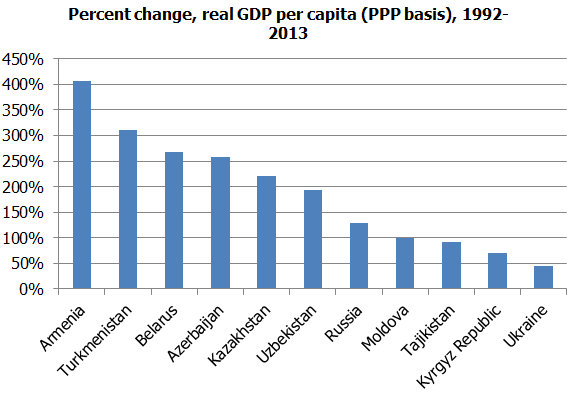
Ukraine was badly hit by the financial crisis and plummeting steel prices. GDP fell by 15% in 2009. That made it a prime candidate for economic streamlining. In 2010 the IMF agreed to loan Ukraine $15 billion—with conditions attached. A major target for reform were Ukraine’s cushy energy subsidies. The state gas company, Naftogaz, only charges consumers a quarter of the cost of importing the gas. Cheap gas discourages investment: Ukraine is one of the most energy-intensive economies in the world and domestic production has slumped by two-thirds since the 1970s. The IMF ended up freezing the deal in 2011 after Kiev failed to touch the costly subsidies.

Daniel Berman’s explains the EU’s new $15 billion aid offer:

This is not quite as generous as it seems – the aid is tied to the implementation of an IMF restructuring campaign that is sure to be almost as destabilizing in the short-run as the aid is intended to be stabilizing. If the goal was simply to strengthen the Ukrainian state in the near future, the aid should have been offered with fewer if any strings.

Nonetheless a major aid package is an excellent idea, and is precisely what should have been [done] 20 years ago. The 15 Billion Dollar package would have done infinitely more to strengthen Ukraine and to guarantee the nation’s territorial integrity than the near-worthless promises entailed within the Budapest Memorandum, or a decision to risk both American and Russian ostracism by retaining control of Nuclear weapons Kiev could not fire. Kiev’s greatest weakness through the last two decades and even today has been less its lack of military force, and more its lack of political unity. History teaches us that money does not solve those divisions on its own, but it sure damn helps. In times of crisis economic weakness is, as was demonstrated in 1930s France and Germany, a political, not an economic problem.

But he also wonders if it’s just a payoff:

The package can be just as easily seen as a bribe to console Ukraine for the loss of the Crimea as it can be as an effort to retake it. With Crimea seemingly preparing to increase the tension by petitioning to join Russia, that is suddenly a more important issue than anything else. Right now the package represents the overlap between the German and American positions because it can either console Ukraine for accepting Russia’s terms, or strengthen the Ukrainian state in its resistance, the respective goals of those two countries.

Silence Is Golden

Because we’re willing to pay for it:

Noise ranks as the number one gripe of restaurant-goers nationally according to a Zagat survey, and it is the complaint submitted to New York City’s 311 hotline with the greatest frequency. (From 2012 to 2013, noise-related calls to 311 increased 16 percent according to noise activist Arlene Bronzaft.) Even if these complaints are just cyclical resurgences of an age-old problem—the ancient Greek colony Sybaris mandated that certain noisy tradesmen (potters, tinsmiths) had to live outside the city walls; Elizabethan men couldn’t beat their wives past 10 p.m.—we seem to be dealing with it differently. From noise-canceling headphones to the popularity of silent retreats, there has never been quite so great a premium placed on silence. And not only do we value it in a general sense, we’re willing to pay for it. Silence has become the ultimate luxury.

Giving The SAT A Low Score, Ctd

Yesterday the College Board introduced an overhaul of the SAT, with a return to the 1,600-point scoring system, a revamped and now-optional- essay section, and a new emphasis on American “founding documents” as source material. Todd Balf offers a “simplistic example” of a new SAT prompt:

Students would read an excerpt from a 1974 speech by Representative Barbara Jordan of Texas, in which she said the impeachment of Nixon would divide people into two parties. Students would then answer a question like: “What does Jordan mean by the word ‘party’?” and would select from several possible choices. This sort of vocabulary question would replace the more esoteric version on the current SAT. The idea is that the test will emphasize words students should be encountering, like “synthesis,” which can have several meanings depending on their context. Instead of encouraging students to memorize flashcards, the test should promote the idea that they must read widely throughout their high-school years.

Elizabeth Kolbert, who last week panned the current version of the exam, thinks the timing is interesting:

The Board’s announcement was months – perhaps years – in the making. Suggestively, though, it came just two weeks after the release of a new study that questioned the SAT’s utility. Commissioned by the National Association for College Admissions Counseling, the study analyzed the college experiences of students at so-called test-optional schools. It found only “trivial” differences in grades and graduation rates between the students who had presented SAT scores and those who had not.

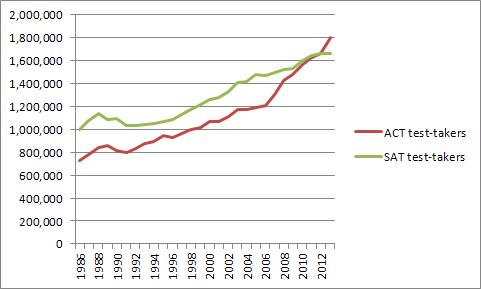
Jia Lynn Yang suggests that competition from the ACT is behind the redesign:

testtakers

According to these numbers, the ACT passed the SAT in 2012. But by some measures, the lead may have changed earlier in 2010. That year, when it became clear that the ACT was gaining on the iconic SAT, FairTest says the College Board revised its number upward to include more exam administrations. “This is Coke versus Pepsi trying to hold onto, or in this case try to regain, market share,” said Bob Schaeffer, director of public education at FairTest. Schaeffer says the new SAT in 2005 was like “the New Coke of tests; a total failure in the marketplace. “

Meanwhile, it appears college administrators are cautiously optimistic about the redesign:

Michael Sexton, vice president for enrollment management at Santa Clara University, said that his institution has never looked at scores on the existing essay on the SAT, “so we won’t miss it.” He said that, generally, the changes announced Wednesday made sense. And he said he values the SAT as helping admissions officers make decisions, especially in science fields.

A number of other admissions leaders agreed, although frequently with caveats about one or more changes. Seth Allen, vice president and dean of admissions and financial aid at Pomona College, said via email that “there appears to be more of an emphasis on measuring critical thinking skills in this new version of the test. There also appears to be more emphasis on connecting the material to actual learning rather than memorization and test preparation. Both are steps in the right direction.” But Allen said he was “less keen on the idea of including American-centric passages in every exam. This creates a potential issue for non-US applicants.”

Readers recently debated the merits of the SAT here.

The Texas GOP Has Two Right Feet

Abby Rapoport thinks political reporters are inventing a GOP establishment-Tea Party divide after Texas’s Tuesday primaries, in which Senator John Cornyn and other establishment figures fought off challenges from the right:

Texas is complicated because there’s no binary opposition between “establishment” candidates and those affiliated with the Tea Party. Should we define “establishment” as Speaker of the House Joe Straus, who has himself a relatively moderate record but has presided over one of the state’s most conservative legislatures? Outside Tea Party groups have tried to topple Straus, yet he also commands support from Tea Party-backed state representatives. Or is the “establishment” closer to Governor Rick Perry, the state’s longest-serving governor, who gave one of the first major speeches at a Tea Party rally in 2009? Or is it David Dewhurst, who hung tight to Perry’s message, passed extreme measures, but then watched his political dreams crumble as Cruz rose to power by accusing Dewhurst of being a moderate?

Benen agrees that the primaries are a contest between the far right and the farther right:

If the top-line takeaway is that the GOP Establishment won and the Tea Party faltered, some might get the impression that more moderate conservatives prevailed over voices of extremism. That impression would be mistaken. Federal lawmakers like Cornyn and [Rep. Pete] Sessions became some of the most conservative members of Congress in recent years as Republican politics in Texas became more radicalized.

Cillizza points out that the Tea Party didn’t much care for Cornyn’s challenger:

Yes, [Steve] Stockman ran as the conservative alternative to Cornyn who he attacked as part of the problem due, at least in part, to the fact that the incumbent is the second ranking Republican in the Senate. And, yes, some of Stockman’s views on the problems with the Republican party in Washington align with the tea party. But, the idea that Stockman was a tea party darling is simply not true. In fact, it’s hard to find a single major tea party group that endorsed Stockman’s campaign. Several leaders of the tea party even denounced it.

John Fund looks at the down-ballot races in which Tea Partiers fared much better. Sean Sullivan provides highlights from the other primaries, which included a familiar name:

George P. Bush easily won the GOP primary for land commissioner, a powerful post in Texas. He has the inside track in the November general election given the state’s conservative tilt. Bush is the nephew of former president George W. Bush and the son of former Florida governor Jeb Bush. While the former president has largely avoided the spotlight since leaving office, the Bush name is bound to get more attention in the coming months with George P. Bush’s campaign and speculation over whether Jeb Bush will run for president ramps up as 2016 draws near.