The Village Media And John McCain

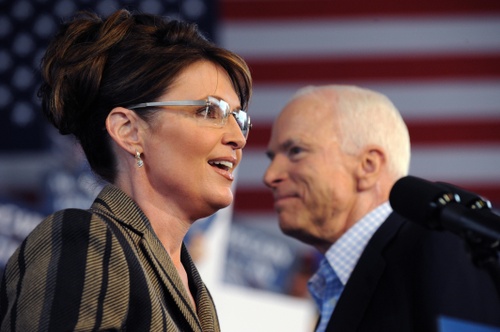
The buffoon from Arizona is one of the most frequent guests on cable news and on the Sunday morning talk shows. He was dead wrong about Iraq, Afghanistan and has never copped to it, clinging to his fantasy that his beloved “surge” made it all worthwhile. It didn’t, as the resilient sectarian warfare in that benighted country demonstrates day after day. He caved to Karl Rove on the torture question in 2006, leaving the CIA program in place. He picked a delusional maniac to be a vice-presidential candidate after close to no vetting whatsoever. He was jumping up and down trying to foment a war with Russia over Georgia in 2008. This week, he was dyspeptically assaulting the president of the United States at a time when, one might imagine, wise souls in Washington might see the benefit in a temporary united front vis-a-vis Putin. He is determined to sabotage any deal with Iran, which would necessitate another war in the Middle East, a war for which there is close to no public support, and which could have incalculable consequences in the region and the world.

A simple question: why does anyone still take him even faintly seriously? Why does David Gregory defer to him? Why does CNN have him on to discuss foreign affairs when he has demonstrated catastrophic judgment time and time again? McCain was on the Sunday morning shows 24 times in 2013 – far more than countless other Washington figures with far better records. The year before, he was invited on 21 times.

In stark contrast, the latest PPP poll in Arizona finds the following results for McCain:

John McCain is unpopular with Republicans, Democrats, and independents alike and has now become the least popular Senator in the country. Only 30% of Arizonans approve of the job McCain is doing to 54% who disapprove. There isn’t much variability in his numbers by party – he’s at 35/55 with Republicans, 29/53 with Democrats, and 25/55 with independents, suggesting he could be vulnerable to challenges in both the primary and general elections the next time he’s up.

He is the least popular Senator in the country and the most popular among Beltway hacks and TV producers. That tells you something that … well, you already knew.

(Photo from Getty)

Apathetic Atheism vs New Atheism, Ctd

Readers continue the thread with many wonderful emails:

I also relate to the brother-in-law who wanted to support his wife but did not stand in church because he doesn’t believe in God. I also attend church with my family during holidays, or Mass when I’m visiting my boyfriend’s family. But I don’t take communion or say anything that indicates I am a believer. Why? It’s not to be contrary; it’s out of respect. These are very real beliefs for these people, and participating to the point of lying is disrespectful to their traditions and faith (not to mention confusing for my family, who have been told and must continue to be told that I do not share their beliefs). Isn’t Revelations 3:15-16 applicable here? “‘I know your deeds, that you are neither cold nor hot; I wish that you were cold or hot. So because you are lukewarm, and neither hot nor cold, I will spit you out of My mouth.”

Another broadens the discussion:

I think there’s something missing in these posts: an accurate label. Personal atheism is an apathetic stance, since it only describes one’s absence of beliefs compared to others’. But what is always referred to as New Atheism can better be described as anti-theism. It’s not just a statement of personal beliefs, but a political stance against religion as the basis for legal or political policy. Of course, being “anti” something carries a stigma (so that anti-abortion becomes pro-life, or anti-gay becomes pro-“religious freedom”). So perhaps New Atheists – or in my term, anti-theists – can call ourselves pro-secular. But somehow, that doesn’t have the same ring. My main point is that it’s a branding issue. How do you oppose conflating religion and politics without denigrating others’ beliefs?

Another notes, “Regarding Thomas Wells’ article, there’s already this term: Apatheism.” Another reader, less concerned about labeling, sees the value in being a gadfly:

I’m probably one of the “New Atheists” Thomas Wells dislikes or one of the dickheads your reader described. The reason why I’m a dickhead atheist relates to when I realized I was an atheist.

Recently my brother entered into the seminary to become a Catholic priest. After a year, he decided he wanted to have a family and kids, quit the seminary, and got a degree in theology. After he graduated, we began to have discussions about religion and politics. We would get into heated debates while discussing topics like gay marriage and the contraception mandate (I support both; he is against). Every one of his arguments boiled down to “because the Bible says so.” As the arguments continued, I would attempt to use logic, facts, and scientific studies to argue my point. He just became condescending and argued I couldn’t understand his argument because I never studied religion and philosophy. To counter that “argument”, I began to study religion from both points of view (from Aquinas to Dawkins). After doing so, I realized two things:

1) I don’t buy into religion at all
2) I’ll never convince my brother his views are wrong.

I realize I’ll never be able to convince people like my brother there is no God, but I might be able to convince people who were like me. I think it’s important to express my point of view to make others think about their beliefs. Hopefully this can stem the tide of religion forcing its way into public policy.

Another:

When I was a New Atheist I was so angry at believers for needing God to explain the Universe and say what is right. And it’s easy to see the worst in religious people to confirm my views (See Westboro Baptist). Then one day, and I don’t exactly know why, I realized a lot of very good people found meaning in life from the Bible, the Torah, and the Koran. They pray to God and find warmth in their hearts. Who am I to tell them that is wrong? From then on it was just as easy to find the good believers as the bad ones. It only depended on what I was looking for. This Onion article is probably the best way to explain it: “Local Church Full Of Brainwashed Idiots Feeds Town’s Poor Every Week“.

Now, I think it’s best to be a silent voice in support of atheism. The believers that made me feel OK with other believers just did small, good, kind acts each and every day. So I can only do the same. The best way to convert a mad believer into an accepting one is to show that an atheist’s moral code is no different for how we open doors, care for the sick, or extend a hand to those in need. Maybe this is what Francis was talking about for how the believers and atheists can meet on common ground.

On that note, another reader:

Recently a young fellow who openly identified as atheist began attending the same church I do, and by attending I mean fully participating: small group meetings, community service projects, Sunday School – the whole nine yards. It turns out, he is there for much the same reason I am, because he needs friends and community and a church can be a good place to find it.  He is welcomed with open arms and loved by everyone.

Fast forward to a recent Sunday meal with a young couple who also turned up at our church.  When the question was asked how they found out about our church, the answer was through our young atheist friend.  “We thought if you accepted him, then we’d have a place too.” As it turns out, our atheist has been the best recruiter our little church has ever had.  I count at least eight regular attendees he brought with him. Some of them were already people of faith, some were searching, and others were just lonely.

I love that kid and the way he has opened up space in our midst. The church should be a place of refuge for everyone and when it truly is people just might start coming.
Anchor Away!

Liz Wahl, the RT America host who resigned on air yesterday in protest against the network’s biased coverage of Ukraine, gives Jamie Kirchick an inside look at the network’s editorial agenda:

Wahl, for her part, says that while the Kremlin influence over RT isn’t always overt, that journalists there understand what they have to do to succeed and fall into line accordingly. “I think management is able to manipulate the very young and naïve employees,” she says. “They will find ways to punish you covertly and reward those that do go along with their narrative.” …

Wahl recalls a story she attempted to report about last year’s French intervention in Mali, aimed at repelling an al-Qaeda takeover of the country.

She interviewed a Malian man who “talked about what it was like to live under sharia law, people getting limbs amputated…And I thought it was probably one of the best interviews that I’ve ever done. I was touched by what he said as a first hand source, but he also talked about how the French were well-received there and how they were waving French flags and how they should have come sooner, how grateful a large part of the population was, having seen people being literally tortured and having their limbs cut off.”

That story, however, didn’t fit the RT narrative, which portrays every Western military intervention as an act of imperialism while depicting Russian ones as mere humanitarian attempts at “protecting” local populations, as the network constantly describes Moscow’s role in Crimea. Needless to say, Wahl’s interview with the thankful Malian never aired. “I was told after that it was a ‘weak’ interview,” Wahl said.

Allahpundit asks the obvious question:

Good for her, although I wonder what she expected when she went to work for RT. Her boss invaded Georgia a few years ago; his feelings about Ukraine being a de facto Russian province aren’t a secret. What did she think was going to happen? If he had laid off on invading but sought to crush Ukraine economically and politically to stop the phantom Nazi menace in Kiev, would that have been more acceptable?

Dan Wright is even less understanding:

After one of her colleagues Abby Martin got great press when she condemned the Russian invasion of Ukraine, Wahl decided she had had enough (of not being famous). So she went into a monologue about how her family had some mixed background where parts were from Hungary and other parts were not and that one her parents was a veteran and her partner works for the US military (it was less than perfectly coherent) then finished with an on air resignation.

Wahl was shocked (shocked!) to be working for a media organization that promoted a pro-Russian perspective despite it being owned and operated by the Russian government to provide a pro-Russian perspective.

Meanwhile, Ravi Somaiya notes that Wahl was not the first RT-er to quit over Russian whitewashing:

William Dunbar, a British journalist … started working for RT in 2008, when he was 23. He knew he would struggle to overcome the channel’s editorial line, he said, but “I was confident at the time that I would be able to fight my corner.”

That moment arrived, he said, when he was in Georgia as Russian bombs began to fall in the summer of 2008. He mentioned reports of the bombs in a phone interview with the studio, he said, and was quietly told that those mentions were responsible for his being kept off the air. He had previously seen reporting critical of Russia held off the air, and studio commentary that ran counter to his reporting. He recalls that Georgian staff members, who were likely to find such edicts hard to stick by, were given paid leave.

After seeing footage of destroyed apartment blocks in Georgia and photos of the dead, Mr. Dunbar said, he found he “was not allowed to report it,” but was instead asked to divert to stories that served Moscow. He resigned.

If You Like Your Can, You Can Kick It

Cohn translates the latest Obamacare tweak, which allows people to keep insurance plans that don’t meet the law’s minimum coverage standards through the end of 2016:

Administration officials argue that this announcement merely changes the duration of the transitionary period, without altering the end result. They make a good case. From the get-go, the law had a “grandfather clause,” allowing people with insurance as of March, 2010, when the Affordable Care Act became law, to hold onto their policies. This decision is similar to expanding that protection—and not to a very large group of people. One estimate, from the Rand Corporation, suggests only a half million people still have the old plans. And as Greg Sargent pointed out on Wednesday, that number will dwindle over time, because the non-group market is so volatile, with people moving in and out as they obtain or drop coverage from employers.

Allahpundit calls the delay nakedly political:

Quite simply, Obama was forced to choose between doing something that would help his party at the ballot box but hurt his signature health-care law and doing something that would help stabilize the law financially at the risk of generating a nasty backlash to his party from consumers with cancellations. He made the political choice. Which is exactly what O’s critics feared would happen as government insinuated itself further into the health-care industry via O-Care. Decisions on health-care policy are now a species of politics. You’re welcome, America.

Drum concedes that point:

It would hardly be the first time that a particular provision of a complex law got delayed a bit, after all. On the other hand, most delays are due to agencies flatly being unable to meet statutory deadlines, something that’s just part of the real world. The Obamacare delays, conversely, are pretty clearly being announced for calculated political purposes. What’s more, to the best of my knowledge the administration has never provided a definitive legal justification for these actions, which suggests that they don’t really have one they aren’t embarrassed to defend.

Bob Laszewski warns that this endangers the law’s long-term sustainability:

As a person whose policy is scheduled to be cancelled at year-end, I am happy to be able to keep my policy with a better network, lower deductibles, and at a rate 66% less than the best Obamacare compliant policy I could get. But for the sake of Obamacare’s long-term sustainability, this is not a good decision. The fundamental problem here is that the administration is just not signing up enough people to make anyone confident this program is sustainable. Yes, the law’s $20 billion “3Rs” health insurance company reinsurance program will prop up the program through 2016––and even be enhanced because of these changes. But then the “training wheels” come off and the program has to stand on its own. As I have said on this blog before, I don’t expect the insurance industry to be patient past 2015 before it has to begin charging the real cost of the program to consumers.

But Adrianna McIntyre doubts the delay will have a major impact:

There’s a fear that individuals who cling to old, less generous plans are healthier than those who already jumped to the exchanges. That might be true, but it also probably doesn’t matter much. CBO estimates that the exchange population will swell to 22 million by 2016 as people become more aware of coverage options and the penalty becomes more severe. The specter of adverse selection fades pretty fast when you set 1.5 million—a number that will erode over the life of the administrative fix—in that context.

“Looking at the issue more broadly,” Philip Klein argues, “the change undermines a central rationale for Obama’s health care law”:

Obama and his allies long-defended the outlawing of certain health care plans, arguing that they were substandard. And they argued that depriving people of the ability to purchase such plans was essential to making the health care law work. If young and healthy people can purchase cheap health insurance with fewer benefits, they argue, it would make coverage more expensive for older and sicker Americans.

Now, not only is Obama saying that these legacy plans can remain, but he’s saying they can stay alive for three years longer than intended. If they can be extended for three years, the new rules may never fully go into effect (unless Obama will allow a wave of cancellations in October 2016, just before the presidential election). And maintaining these plans will further drive up the cost of insurance on the exchanges.

Ask Jennifer Michael Hecht Anything

From her bio:

Jennifer Michael Hecht is a poet, philosopher, historian and commentator. She is the author of the bestseller Doubt: A History, a history of religious and philosophical doubt all over the world, throughout history. Her new book is Stay: A History of Suicide and the Philosophies Against It, out from Yale University Press. Her The Happiness Myth brings a historical eye to modern wisdom about how to lead a good life.  Hecht’s The End of the Soul: Scientific Modernity, Atheism, and Anthropology won Phi Beta Kappa’s 2004 Ralph Waldo Emerson Award “For scholarly studies that contribute significantly to interpretations of the intellectual and cultural condition of humanity.”

Popova loved Stay, insisting that the book is “more than a must-read — it’s a cultural necessity”:

Hecht argues that, historically, our ideologies around suicide have set us up for “an unwinnable battle”: First, the moralistic doctrines of the major Western religions, Judaism, Christianity, and Islam condemned suicide as a sin that “God” forbids, one more offensive than even murder because you were stealing directly from divinity with no time left for repentance — a strategy based on negative reinforcement, which modern psychology has demonstrated time and again is largely ineffective. Then came The Enlightenment, whose secular philosophy championed individual agency and, in rebelling against the blind religiosity of the past, framed suicide as some sort of moral freedom — a toxic proposition Hecht decries as a cultural wrong turn. Reflecting on such attitudes — take, for instance, Patti Smith’s beautiful yet heartbreaking tribute to Virginia Woolf’s suicide — Hecht makes the case, instead, for two of history’s relatively unknown but potent arguments against suicide: That we owe it to society and to our personal communities to stay alive, and that we owe it to our future selves …

The Dish featured the arguments of Stay here and Hecht’s ideas about atheism here and here, part of a thread asking, “Where are all the female atheists?” Let us know what you think we should ask Jennifer via the survey below (if you are reading on a mobile device, click here):


[SURVEY NOW CLOSED]

Central Interference Agency

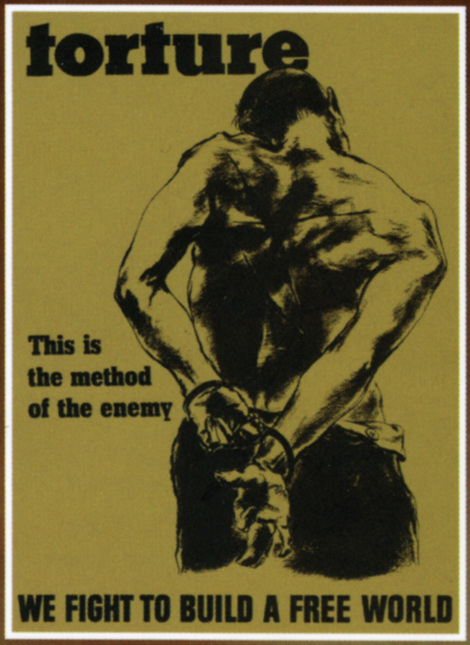
oldantitortureposter.jpg

Yesterday, we learned that the CIA spied on Congress’ investigation of the agency’s torture program. Dan Froomkin puts the revelation in context:

The resistance to oversight about torture mirrors similar problems legislators have experienced when it comes to trying to monitor surveillance programs and other secret activities, with one huge exception: The torture report was championed and endorsed by Senate intelligence committee Chairman Dianne Feinstein (D-Calif.) and other senior members of that committee. By contrast, Feinstein and House Intelligence Committee Chairman Mike Rogers (R-Mich.) have emerged as the strongest defenders of surveillance activity, leaving the so-far-losing battle for disclosure to be fought by more rebellious legislators.

Alex Ruthrauff makes the obvious point that the agency must have something to hide:

Agencies that operate in good faith and within the law have no need to obstruct investigations. If you’re doing that, you’re admitting guilt.

That might actually be the worst part of all of this — beyond the torture and the law breaking, the CIA is actually incompetent enough 1) to let Congress discover the CIA was spying on them, and 2) not to realize that their best chance of making this go away is to cooperate, say “sorry,” re-arrange the deck chairs, and move on. A lawless CIA is one thing, but a lawless CIA run by people who apparently can’t even manage a simple PR crisis is pretty fucking scary.

Drum quotes yours truly saying the same:

It’s enough to make you think that the CIA committed crimes so damning and lied so aggressively during the torture regime that it is now doing what all criminals do when confronted with the evidence: stonewall, attack the prosecution, try to remove or suppress evidence, police its employees’ testimony, and generally throw up as much dust as possible.

Actually, the funny thing is that this might not be true. It’s possible that spying is simply so ingrained in the CIA’s culture that they do it anytime they can, even if there’s no good reason for it. Alternatively it’s possible that the CIA committed crimes so damning and lied so aggressively during the torture regime that it’s now terrified of a full accounting of what it did. I could believe either possibility.

I fear the second. The zeal and passion with which the CIA has tried to justify the unjustifiable strongly suggests to me that the Senate Report, along with the CIA’s internal report, is correct: the US practised horrifying torture on a large scale and did so under cover of darkness, lying to the Congress, lying to itself, destroying tapes of its own atrocities and covering up all the way. They must be exposed and returned to democratic civilian control.

(Illustration: an anti-torture poster, from the days when the US opposed the use of torture in warfare.)

Where Interns Make Bank

The tech sector:

In contrast to the media and arts industries, where interns are notoriously underpaid or just go without compensation altogether, those at tech, finance, and consulting companies can get a hefty sum for their summer or semester of work. According to a survey by Glassdoor, Twitter (No. 3 on the list) pays $6,791 per month, Facebook (No. 4) pays $6,213 per month, and Google (No. 9) pays $5,969 per month. …

Perhaps companies feel it’s worth it to pay interns at this level so candidates will compete heavily for the jobs, do real work once they’re at the internship, and potentially be hireable at the end of their stint. But it’s worth noting that the U.S. Census Bureau is currently reporting median U.S. household income at $53,046.

The Dish approach to our own internship program is here.

A Conversation With Richard Rodriguez: Will The World End With A Prayer?

rodriguez-post-img

The most striking aspect of Richard Rodriguez’s latest book, Darling: A Spiritual Autobiography, was its attempt to understand 9/11 in an empathetic way. His response to that atrocity was to draw closer to Islam, not to push it as far away as possible. He saw Islam as a desert religion like Christianity and tried to see what had happened to create a monstrous fanaticism of the Taliban and al Qaeda variety, and to look into his own Catholic faith for reasons as well. I was challenged by this, and wanted to talk about it. So here we have the podcast. Richard insists on the connection between Islam and Christianity, perhaps most vividly in the Arabic-rooted Spanish words of his own Catholic grandmother, and the intimacy of inter-religious conflict:


We went on to talk about martyrdom in both Islam and Christianity, and the distinction, important to me, between fundamentalism and faith:


For the full conversation on Deep Dish, click here. If you aren’t a subscriber, click here to sign up for complete access to all things Dish.