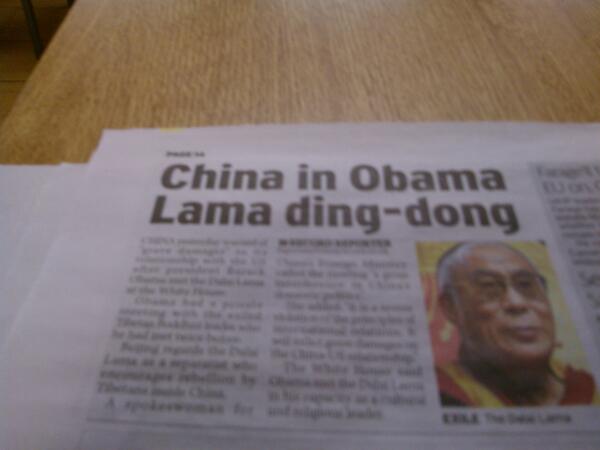
Sometimes you have to just sit back and marvel at British punnery. From today’s Scottish Daily Record (via a reader):
Update from a reader:
“Obama Lama Ding Dong” is hardly original.
Sometimes you have to just sit back and marvel at British punnery. From today’s Scottish Daily Record (via a reader):
Update from a reader:
“Obama Lama Ding Dong” is hardly original.
Moynihan considers the odd politics of Western progressives who support Venezuela’s “Bolivarian revolution”:
A pro-Chavez academic writing in The Nation argued that the massive street demonstrations across the country “have far more to do with returning economic and political elites to power than with their downfall.” The Guardian headlined a news story: “Venezuela’s hardliner reappears as Nicolas Maduro expels US officials.” That hardliner wasn’t Maduro, whose government is arresting regime opponents and strangling the free press, but Leopoldo Lopez, the opposition leader currently languishing in jail. Flip over to the Guardian’s editorial for the bizarre excoriation of President Obama for his supposed “support for regime change in Venezuela.”
It’s a thought experiment I often present to the Western Chavista, one that usually ends up demonstrating that sympathizers of the regime, both in this country and in Europe, have something of a colonialist attitude towards Venezuela. Because one wonders the reaction of these faux progressives if Prime Minister David Cameron, President Barack Obama, Chancellor Angela Merkel–pick your the imperialist lackey!–arrested an opposition leader who had organized peaceful street protests? Or if the CIA shut off the internet in politically restive cities like Berkeley and Brooklyn; blocked Twitter traffic it found politically suspect; and took over PBS, forcing it to broadcast only pro-administration agitprop, never allowing the opposition party to traduce the government across public airwaves?
Update from a reader:
I think you should ask yourself a very basic question: do you really think that every regime that you don’t like is necessarily illegitimate?
Has it crossed your mind that there are countries with populations that support leaders who don’t cater to American interests, or have the same values as your bourgie free-market readership? Do you think it’s a coincidence that you see as inherently undemocratic any country that does not act in a way that you approve of? This is what democracy actually is: people deciding to do things that you don’t like. If your support for elections is only as strong as their capacity to deliver results that you like, then you have no actual commitment to democracy at all.
During the Iranian protests, the Dish was draped with green ribbons for months, and yet there was barely any notice of why the current regime survives: because it is in fact very popular with a significant majority of Iran’s citizens. It’s just not popular with the English-speaking, Westernized Iranians who write blogs and are on Twitter. I don’t like that regime anymore than you do, but I don’t pretend that my disapproval amounts to proof positive that the regime is illegitimate or not supported by a majority of its people.
I think you and the whole crew over there should ask yourself whether the events of the last ten years suggest you should adjust your understanding of how the world works, or what progress means. Because from the Iraqi civil war to the election of Hamas to, yes, the repeated re-election of the Chavez government, what the world has shown is that it will pursue its own interests against the narrow paternalism of Western progressives. You’ve got to decide if you actually support real, messy, ugly democracy, or if you support the rosy lies of the Bush-era embrace of “democracy.”

There was something rather delightful in the way that Ukraine’s refusal to be forced into a Euro-Asian Community of Putin-favored despots ruined the new Tsar’s Olympics. The revolt of the Ukrainians – even some supporters of Yanukovych – exposes the stark limits of Putin’s approach to politics: always zero-sum, contemptuous of the West, posturing across the globe, acting the way dumb tyrants always act. The Kremlin is now touting the Friday “truce” agreement that its representative refused to sign. And so it is unsurprising that the Kremlin has gone completely over-the-top in reacting to the weekend’s epic events:
“If you consider Kalashnikov-toting people in black masks who are roaming Kiev to be the government, then it will be hard for us to work with that government,” prime minister Medvedev said. “Some of our foreign, western partners think otherwise, considering them to be legitimate authorities. I do not know which constitution, which laws they were reading, but it seems to me it is an aberration … Something that is essentially the result of a mutiny is called legitimate.” …
The Russian foreign ministry statement pressed all the buttons that will have the west and Kiev alarmed about ethnic and religious strife fracturing the country in two. It complained that ethnic Russian rights were already being violated after the parliament rescinded the status of Russian as a second language. “Referring merely to revolutionary expediency, [the parliament] is imposing decisions and laws aimed at repressing the human rights of Russian and other national minorities. There are even calls for a complete ban of the Russian language,” it said.
Now we’ll see how mature the opposition is, and whether it can control its more radical elements, which would only goad Russia to more brinksmanship. Fisher says it’s a positive sign that the parliament took the lead in pushing out Yanukovych on Friday:
What makes this an even bigger deal is that, while foreign countries have played a role, it’s ultimately Ukrainians pushing through a resolution, and doing it democratically. Most of the time, these sorts of crises end when one side is simply defeated outright, or cuts a middle-of-the-night deal brokered by foreign powers. But what’s happening right now in Kiev is being driven by procedural, by-the-letter votes in the country’s own parliament. In many ways, it’s a victory not just for but by democracy and the rule of law.
And that’s maybe the most amazing thing about Parliament so aggressively undermining Yanukovych — that they’re doing it democratically, within the rule of law, following all the rules of procedure and form. That’s just extremely rare in “transitional” states in the long process of developing from an authoritarian to democratic system, particularly post-Soviet states.
It is. But now the president is being charged with mass murder:
The Kyiv Post reports that acting Interior Minister Arsen Avakov announced on his Facebook page this morning that Mr. Yanukovych and “other [former] government officials” are wanted for “mass killings of civilians.” Though the charges do not name the alleged victims, the Post writes that it is “presumed that the investigation centers on whether Yanukovych hired snipers or ordered riot police to shoot EuroMaidan [Independence Square] demonstrators in January and February.” At least 100 people have been killed in Ukraine‘s political turmoil, including at least 75 in the past week.
Ioffe worries that demobilizing the protesters’ armed contingent might be a challenge:
The so-called self-defense groups patrolling and ruling the Maidan these last few months are now highly organized groups of men who have tasted victory—and their own power. What do you do after you take up a baseball bat and topple a president? Go back to your day job? The new interim Interior Ministry head said he promised the groups posts inside the Ministry, but the devil will absolutely be in the details: there are a lot of these guys, and some of them really are extremists. Will there be room for all of them? If not, what will happen to the rest?
Uri Friedman says to watch the power struggle:
It’s also worth keeping an eye on what happens among Ukraine’s opposition leaders. The triumvirate —Oleh Tyahnybok of the Svoboda (Freedom) party, Vitali Klitschko’s of the Udar (Punch) party, and Arseniy Yatsenyuk of the Batkivshchina (Fatherland) party—may have united against Yanukovych, but their uneasy alliance is beset by power struggles and ideological divides, particularly between the mainstream opposition parties and the far-right Svoboda party (what U.S. Ambassador Geoffrey Pyatt, in his leaked “Fuck the EU” call with U.S. diplomat Victoria Nuland, referred to as “troubles in the marriage”). Now the powerful Tymoshenko, who some activists support and others view as part of the corrupt political elite, has entered the mix. And the extent to which these leaders can win over the diverse mix of protesters in the street remains an open question.
Max Boot predicts shenanigans from the Kremlin:
We can expect a riposte from Putin before long, and from his allies in Ukraine who are down but not defeated. How the revolution will unfold no one knows, but Ukraine has had plenty of experience of thwarted upheavals. This is, after all, the second popular uprising against Yanukovych, the first being the Orange Revolution of 2004-2005. Although thwarted in his attempt to steal that election, Yanukovych returned to power in 2010, managing to win a fair election after his political adversaries failed to show results while in office.
Bershidsky points out that revolution or no revolution, Ukraine is still broke:
Sweet as revenge may be, what Ukraine needs now isn’t a Yanukovych trial or tourist destinations such as Mezhihirya (pictures of gold-laden interiors of the former prosecutor general’s home are also popular on the social networks). Right now, the country needs $35 billion to avoid default, according to acting Finance Minister Yuri Kolobov, until recently a Yanukovych loyalist. If Ukraine is to get that money from the International Monetary Fund, the European Union the U.S. and, possibly, Russia, it needs to concentrate on finding ways to go forward, not look back at its ugly past. Otherwise, there will be plenty of politicians and bureaucrats hungry for a bite of the aid package, and their gnawing will go unheard in the revolutionary din.
And lastly, Brian Merchant implores us not to stop watching now that that the “excitement” appears to be over:
It’s certainly an overused technique, but framing stories as “apocalyptic” or “dystopian” gives audiences an easy window for empathy. We’re all afraid that our world will fall apart, after all, and seeing it happen anywhere gives us a paroxysm of worry, fear, and guilt. The bombs and clubs are coming down on our fellow humans, and we imagine their specter looming over us too—it’s healthy, I think, to stare, engrossed, with trepidation and sympathy.
But in order for the experience to amount to much more than looking at porn, we have to keep watching. The livestream is still rolling, you know. After the fire-licked glow and apocalyptic combat comes real, 3D-life: the scenes now filling the stream reveal the tumult of compromise, the measuring of loss, and a mass of people groping for the next step.
(Photo: A wanted poster showing a portrait of ousted Ukrainian president Victor Yanukovych on February 24, 2014 in Kiev, Ukraine. Ukrainian interim interior minister has today announced that an arrest warrant has been issued for the ousted president. By Rob Stothard/Getty Images.)
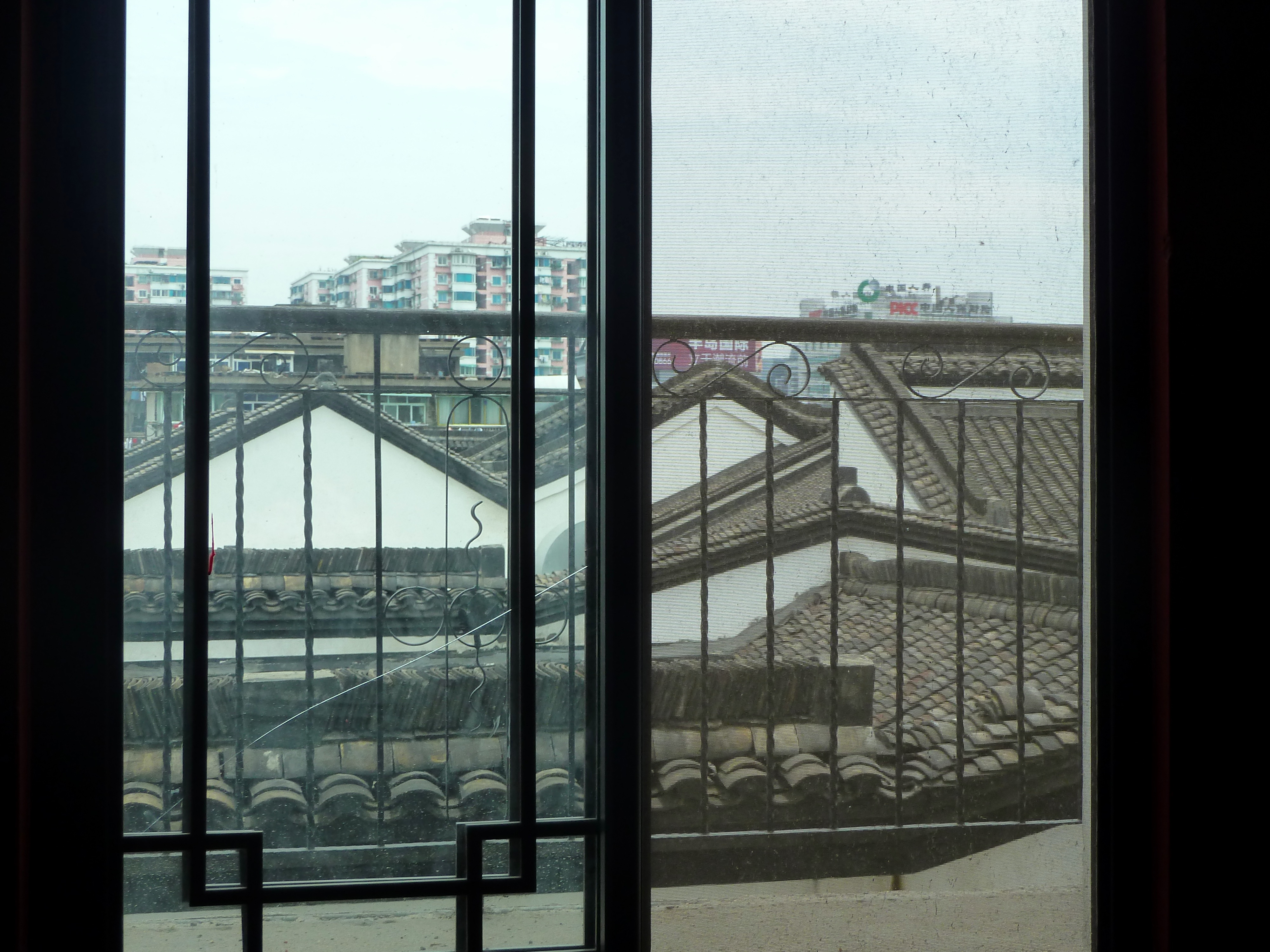
Hangzhou, China, 12 pm
The country’s anti-gay bill has been signed into law:
Under the new law, the penalty for same-sex conduct is now life imprisonment. The “attempt to commit homosexuality” incurs a penalty of seven years as does “aiding and abetting” homosexuality. A person who “keeps a house, room, set of rooms, or place of any kind for purposes of homosexuality” also faces seven years’ imprisonment. Because the law also criminalizes the “promotion” of homosexuality, there are far-reaching implications beyond the increase in punishments for same-sex sexual conduct. A person could go to prison simply for expressing a peaceful opinion. Local and international nongovernmental organizations doing advocacy work on human rights issues could now be at risk of criminal sentencing of up to seven years.Public health promotion and prevention efforts targeting “at risk” groups might have to be curtailed, and health educators and healthcare providers could also face criminal sanction under the same provision.
Zack Ford notes the role played by American Christianists:
It was five years ago today that U.S. evangelicals announced they would be traveling to Uganda to promote their anti-gay views. Among those who participated in the conference were two ex-gay therapists and Scott Lively, who has argued that gay people were responsible for the Holocaust (despite being victims thereof). A suit against Lively filed by Ugandan LGBT activists for crimes against humanity is proceeding in U.S. courts.
The full text of the bill is here.
“Old hands in the television news business suggest that there are two things a presenter cannot have: an accent or a beard,” – David Carr. Oh well.
Ed Krayewski sees the protests in Ukraine, Venezuela, and Thailand as part of a global backlash against irresponsible “democratic” governments:
To varying extents, Ukraine, Venezuela, and Thailand have democratically-elected governments. And in each case, those governments, rather than working to do their best to represent all people, have demonized and alienated the opposition, claiming their slim margins of victories as mandates to act in any way they please.
The root problem in each country is unaccountable government. That unaccountability, in each case, is an outgrowth of the attitude that a mere democratic majority (of the actually-voting voting population) suffices to permit the government to do anything it wants under the guise of having a popular mandate for it.
Dalibor Rohac and Juan Carlos Hidalgo note several “striking parallels” between Ukraine and Venezuela. On the two countries’ economies:
In 1990, Ukraine’s GDP per capita was $8,200, which was roughly identical to Poland’s.Today, Poland’s GDP is $18,300 and Ukraine’s has gone down to $6,400. Unlike its post-communist neighbors to the West, Ukraine did not pursue deep institutional reforms and its economy was seized by a narrow group of oligarchs, with close connections to political power and to the Kremlin. The son of the President Viktor Yanukovych, Oleksandr, has become one of the richest men in the country during his father’s time in the office, while incomes of most Ukrainians stagnated.
In Venezuela the economic situation has deteriorated sharply since the death of Hugo Chávez last year. The country has the highest inflation rate in the world (officially 56 percent in 2013, although according to Steve Hanke’s Trouble Currency Project, the implied annual inflation rate is actually 305 percent). After years of nationalizations, expropriations, and currency and price controls—all under the name of “21st Century Socialism”—the private sector has been decimated. Hour-long lines in supermarkets are a daily occurrence and shortages of basic food staples and medicines are widespread. And just like in Ukraine, corruption is rampant as the ruling elite rake in the profits from oil revenues. This has resulted in the rise of a new privileged class called the “Boligarchs.” so-named because they’ve prospered tremendously under the so-called Bolivarian revolution.
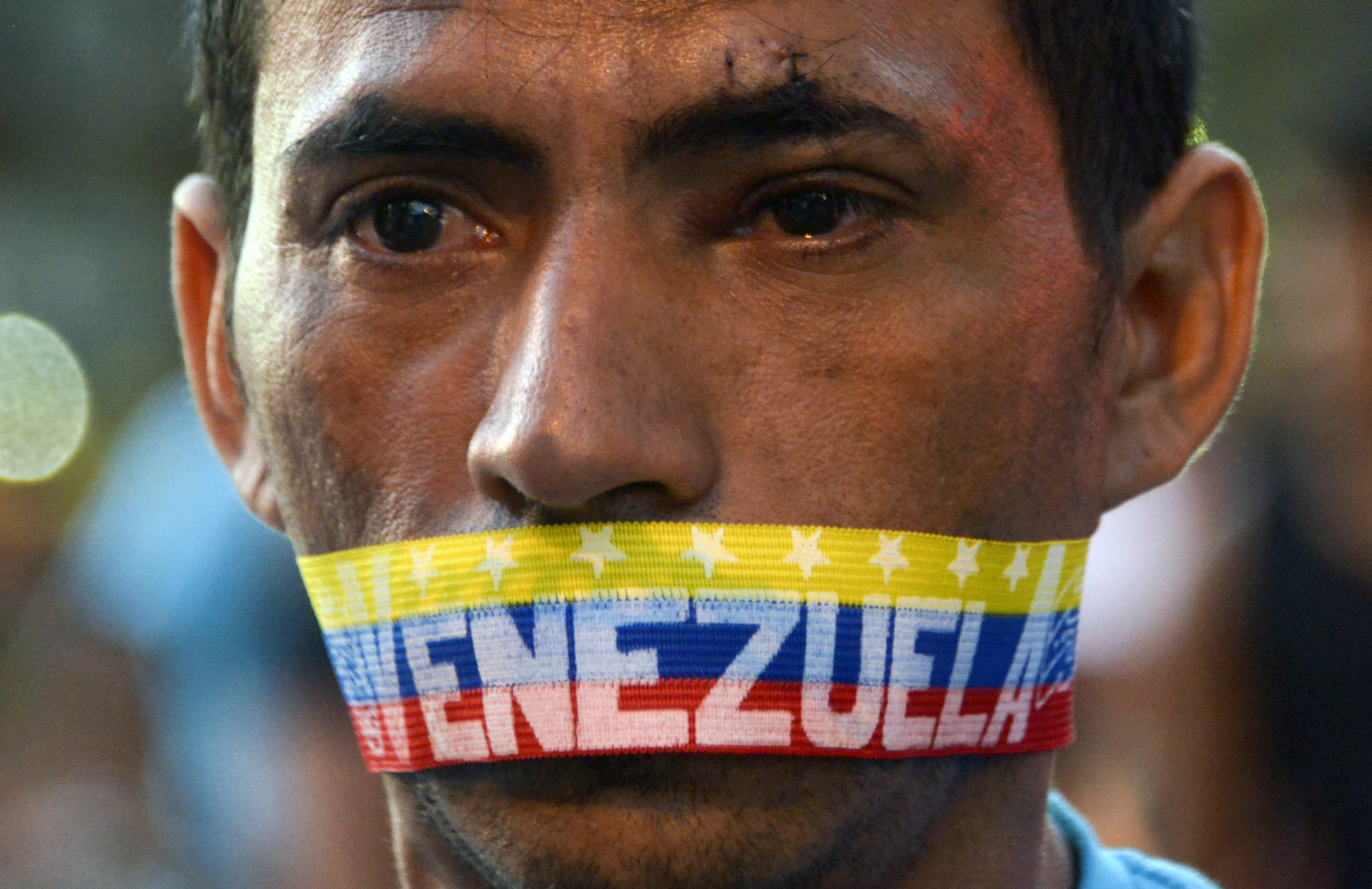
(Photo: A man attends a protest against the government of Venezuelan President Nicolas Maduro in Caracas on February 23, 2014. By Raul Arboleda/AFP/Getty Images)
Briefed by my old @WhiteHouse colleagues yesterday on the new wildlife trafficking report. Good progress being made. http://t.co/N5IOpQY1SA
— Hillary Clinton (@HillaryClinton) February 12, 2014
John Dickerson fears that 2016 presidential hopefuls will be overly cautious:
The candidate reaction to increased scrutiny is timidity and increased calculation. The level of attention and constant pressure is likely to squeeze out the innovation, risk-taking, and spark that we want in our presidential candidates. If they can somehow retain these qualities, they don’t dare show them, for the searchlights will be on them immediately. There was once a period in which two years before the primaries presidential candidates could roam around Iowa and New Hampshire without these constraints. That gave us a better chance to see them before they were encased like Robocop in armor and artifice. It wasn’t a genuine view, but it was less rigid than the full battle-readiness now required. Christie’s office used to promote YouTube videos of the governor in heated conversations with constituents. No more of that now—the governor doesn’t want to reanimate the image of him as a bully. So after his latest town hall, the governor’s office released a picture of him giving a little girl a high-five. Next week: puppies.
Jack Hamilton marks Jason Collins’ momentary return to the NBA:
Years from now memories and box scores will attest that Collins entered that game and was the best thing anyone could hope for:
He was himself. He was himself without any hint of incident, turmoil, or gawky spectacle. In the aftermath of his coming out last spring, the vast majority of NBA players voiced strong support for their friend and co-worker, but that landmark Sports Illustrated cover also provoked its share of ugliness. Certain members of the media howled about how they could care less about Collins’ sexuality, and shame on all of us for turning Collins into a “hero” since sexual preference (suddenly) mattered so little to them (that is, straight dudes). As we’ve seen repeated in the wake of Michael Sam’s announcement, there were passive-aggressive grumblings about “distraction”: Hey, I’m not saying it’d bother me, just the guys who work with me, even though they’re saying the opposite. There were no “distractions” last night—Brooklyn came away with a victory—and no one was unduly concerned with sexuality, outside of the energized anticipation of seeing a brave and important person make history.
Update from a reader:
Taking nothing away from Jason Collins, but he wasn’t the first active player of a major American sport to come out; Glenn Burke was (Los Angeles Dodgers and Oakland As from 1976 to 1979 ). He was out to his team, family and the front office of the Dodgers. He even talked to reporters about it. But they wouldn’t print it.
Rosie Gray has a must-read on how the Ukraine government tried to get pro-Yanukovych op-eds into the US journalist mainstream. The usual suspects pop up. Money quote:
Huston didn’t directly deny being paid by Scoville. “I would not be open to say who pays me and who doesn’t,” he said.
Other writers who were producing incongruous pro-Party of Regions stories at the time include Ben Shapiro of Breitbart and Seton Motley, a conservative blogger. One of Shapiro’s Ukraine posts, “Hillary Sides With Anti-Semitic Ukrainian Opposition,” is nearly identical to a post that appeared four days later in a different publication under Huston’s byline: “Clinton Dept. of State Backing the Anti-Semitism Party in Ukraine?”
Shapiro said he hadn’t been paid by anyone other than his employers to do the posts.
 The Dish